



Welcome to the first instalment of The Dirt Tracker, a series of review articles I’m going to do during the Lions tour to cover the goings on outside the Tests against Australia. I’ll be doing full Wally Ratings articles for those, but I still felt that the tour games and warm-ups deserved coverage, so here we are, hauling cheeks with the bin juicers.
***
Andy Farrell does not do losing very well. You never want a head coach to be too comfortable with losing, but they all have their quirks when they do. Joe Schmidt, for example, would get incredibly peevish. Johann Van Graan would take on the aspect of a parish priest who’s just realised his car’s been clamped. Andy Farrell starts waffling and asking rhetorical questions at the end of every sentence, like he’s just been caught smoking a fag in an airplane toilet.
He was at it again last night after the Lions lost to Argentina and a little more decisively than the final scoreline suggests. I won’t say he looked rattled, but I’m sure he was aware of the precedent; the Lions have only ever lost their first game on a tour once, back in 1971.
Even then, the chicken bones don’t scatter well when it comes to the historical parallels associated with underwhelming “home” performances against Argentina either; just ask Clive Woodward.

But that was a different time, a different squad and a different context.
The Lions losing this game to, if not a weakened Argentina side, then certainly one that would be strengthened by the likes of the absent Petti, Kremer, Gallo, Juan Cruz Mallia, and Chocobares, isn’t that much of a shock? While the Lions might have had more star power, Los Pumas are a more cohesive unit in a general sense, and that matters at this level, as we know.
That’s why I was so surprised to see the Lions try to play pretty much how Ireland did in 2024 for large stretches of this game. If cohesion is important and we accept that the Lions can’t have it after two weeks in camp, then my logic was that the only sensible way to give everyone in this selection the best possible chance was to start with a simple, kick-first off-ball strategy that prioritised using Alex Mitchell, Fin Smith and Marcus Smith to kick contestably, with two 6’4″ wingers chasing, and with the small forward build backrow and midfield filling the field on defensive transition.
That’s the baseline. Keep ruck numbers under 75 if you can, keep the pass per carry ratio down, play direct and let the set piece kick into gear.
Maybe it would have worked, maybe it wouldn’t, but I think it might have avoided the all too familiar jankiness that any Irish fan will recognise as a scratch side trying to work a Farrell attack.
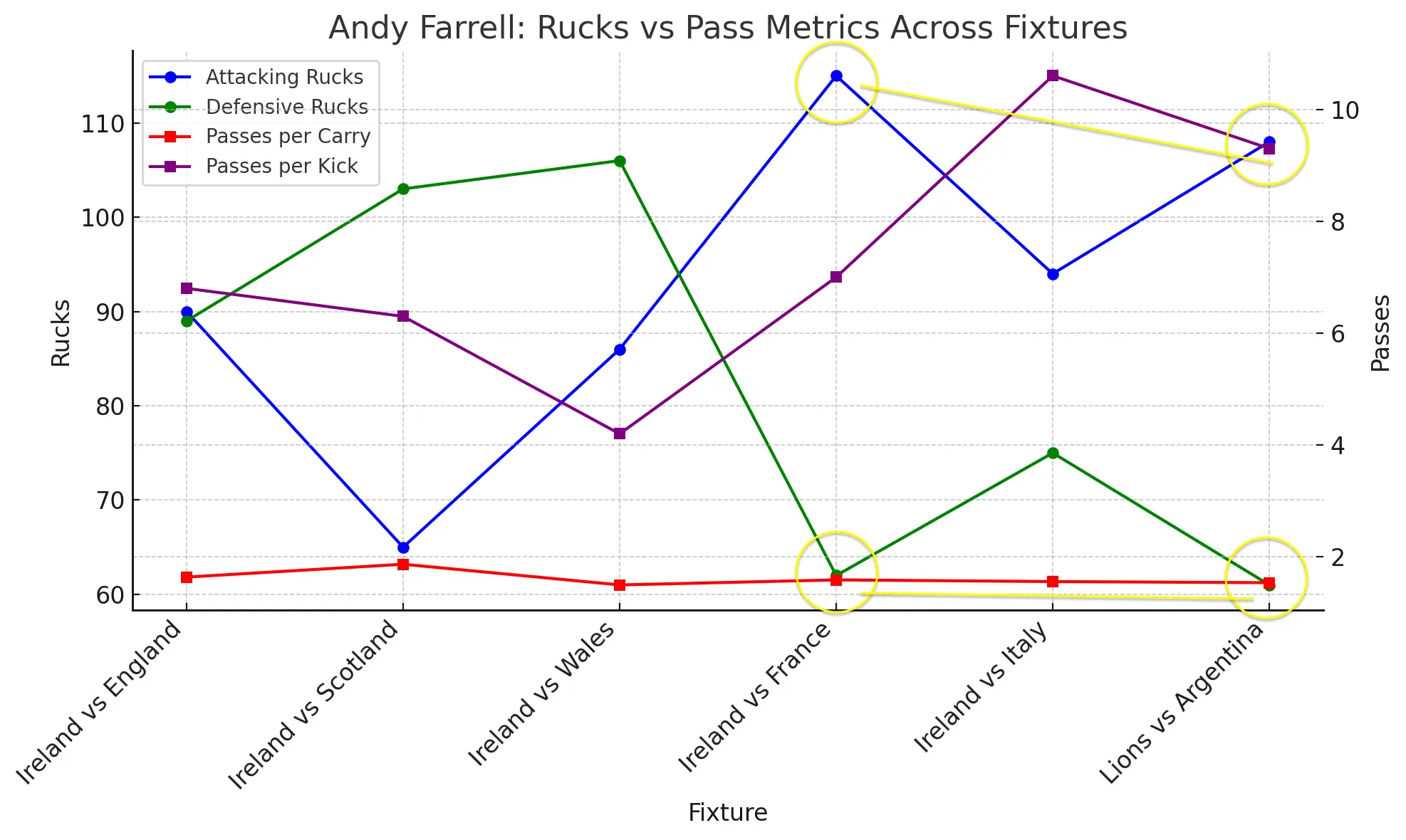
When we examine some of the raw numbers from this game, we see some core similarities between some of the main identifying factors in Andy Farrell’s Ireland and this Lions performance.
| Fixture | PPC | Attacking Rucks | Defensive Rucks | PPK | Result | Quality of Play |
|---|---|---|---|---|---|---|
| Ireland vs England | 1.64 | 90 | 89 | 6.8 | Won narrowly | Played poorly |
| Ireland vs Scotland | 1.87 | 65 | 103 | 6.3 | Won comfortably | Good |
| Ireland vs Wales | 1.50 | 86 | 106 | 4.2 | Won narrowly | Played very poorly |
| Ireland vs France | 1.59 | 115 | 62 | 7.0 | Lost badly | Played poorly |
| Ireland vs Italy | 1.56 | 94 | 75 | 10.6 | Won comfortably | Didn’t play well |
| Lions vs Argentina | 1.54 | 108 | 61 | 9.3 | Lost narrowly | Poor |
What jumps out?
- The Lions’ numbers almost perfectly mirror Ireland vs France – the one game where Ireland played poorly and were also beaten.
- Attacking Rucks: Ireland v France 115 → Lions v Argentina 108
- Defensive Rucks: Ireland v France 62 → Lions v Argentina 61
- PPC: Ireland v France 1.59 → Lions v Argentina 1.54
- PPK: Ireland v France 7.0 → Lions v Argentina 9.3
- In Ireland’s other wins – even the ones where they played badly – either defensive rucks stayed high (75+ in the Italy game), attacking rucks were more moderate (<100), or passes-per-kick stayed lower (<7).
Whenever Farrell’s teams piled into an ultra-high attacking-ruck count (≈110+) and conceded very few defensive-rucks (< 65), mostly due to the opposition’s kicking volume, they ended up on the wrong end of the result.
The Lions replicated that exact profile and, likewise, went down to defeat.
Andy Farrell’s core game-plan (heavy ruck focus, measured passing and kicking) is evident in both teams. However, when his teams push ruck-count to extremes, performance dips and results follow suit. The Lions’ first outing looked very much like Ireland’s loss to France, and predictably, they suffered a similar fate even when playing a “weaker” but more cohesive opponent.
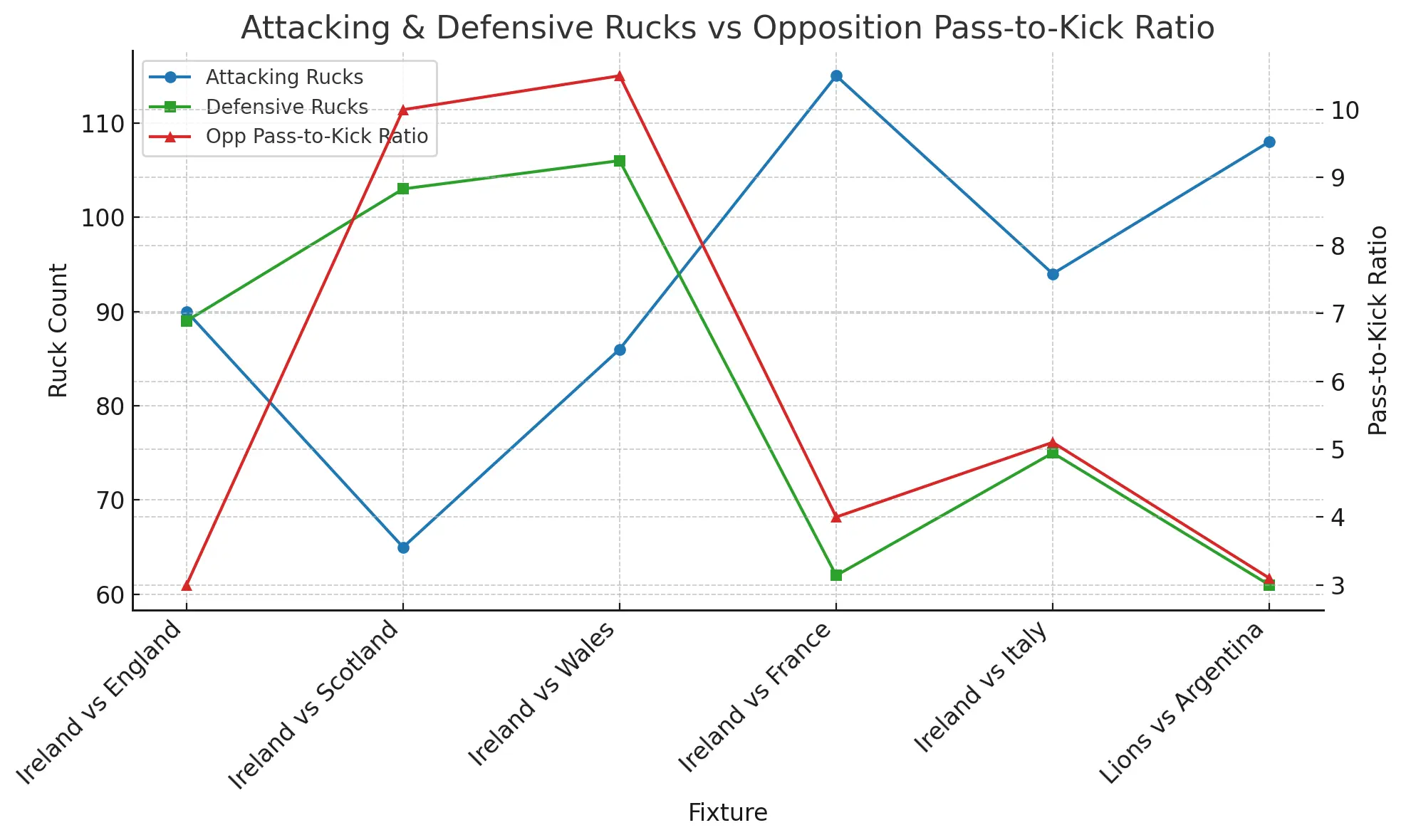
But it gets even more interesting when we factor in the opposition’s Pass to Kick Ratio against Farrell’s teams this year, and we start to see a clear trend when we remember how difficult England and Italy made life for Ireland before ultimately succumbing to defeat, and then France’s ultra-dominant victory.
Key Takeaways
Low pass-to-kick opponents (≈3–4 passes per kick) tend to win
England (3.0), France (4.0) and Argentina (3.1) all kicked strongly and posted high attacking-ruck counts against Farrell’s sides, pinning them in their own half and winning the ruck battle.
High Pass-to-Kick Ratios Invite Defensive Rucks
Scotland (10.0) and Wales (10.5) attacked at pace, leading Ireland to defend heavily (100+ defensive rucks), but the territorial giveaway was limited, so Ireland could nullify the threat and win.
Balance Matters
Italy (5.1) sat in the middle, and Ireland’s control of both rucks (94 vs 75) plus a strong kicking game tilted the contest in their favour.
Overall, when opponents kick more (low pass:kick), they force Farrell’s teams into an attritional ruck contest on their own ball, which is one of the clearest signatures of a side that can cause Ireland and the Lions real trouble.
So, how does this affect selection?
Teams who kick at a high volume draw three immediate challenges: the lineout, the scrum and Ireland/The Lions transition work. This is also directly tied into the tweak in the kick escorting law since the turn of the year, which creates more transitions and more scrums.
For this article, I want to focus on transition because it is directly relevant to selection dilemmas for Ireland in the past 12 months, which might also cause an issue for the Lions.
I think most of the Crowley vs Prendergast debate that ate the heart out of Ireland’s test season in 2024/25 is a core misread by Andy Farrell and his coaching staff on why Ireland’s system hasn’t been working as consistently since the 2023 World Cup. His usage of Marcus Smith at fullback – and Smith’s subsequent underperformance – is set to give Farrell another bad system read, in my opinion where he confuses an individual performances in isolation with wider systemic issues.
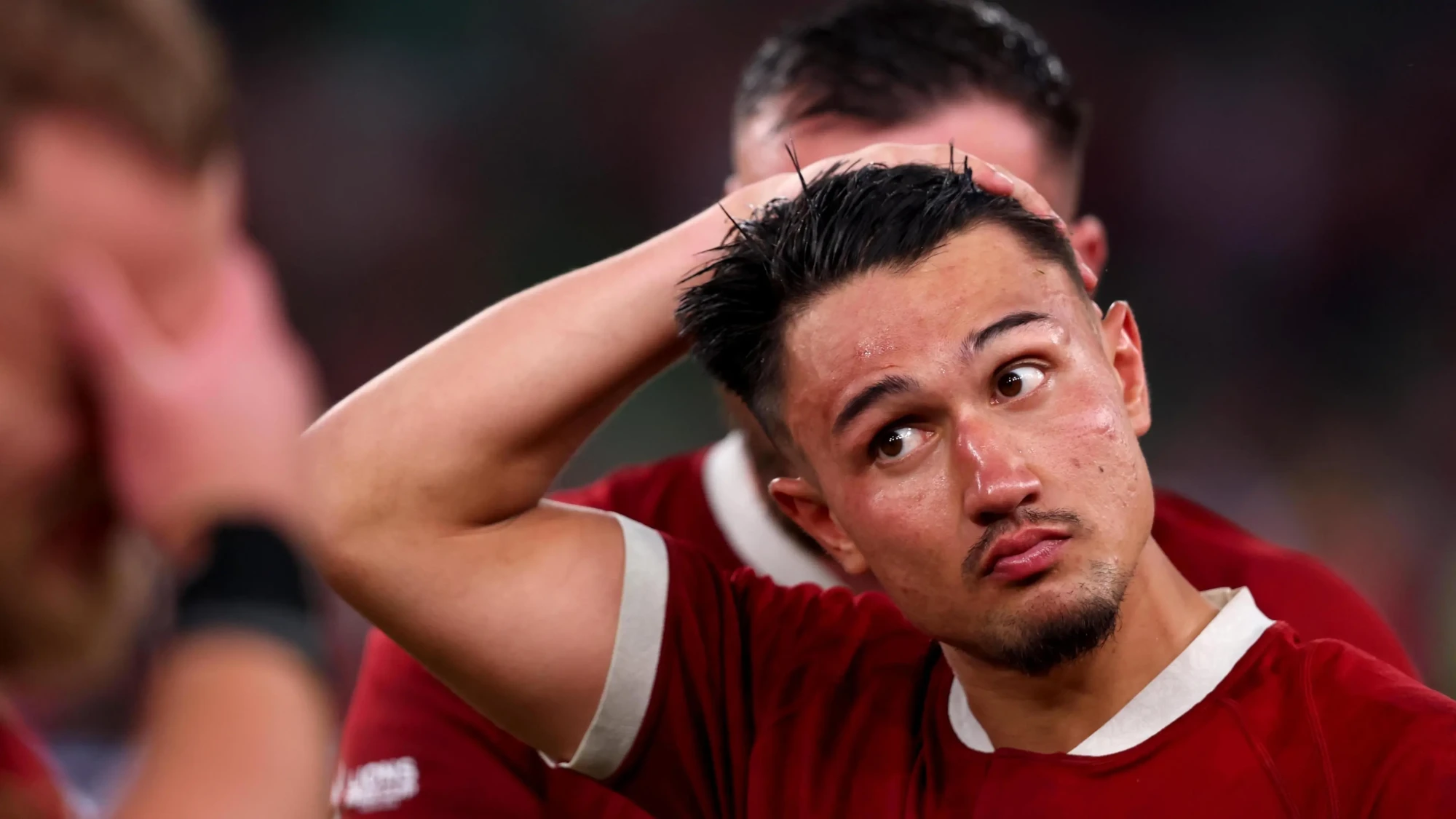
I contend that Ireland – and, as a result, Farrell’s Lions – suffer from the same fundamental issues. It isn’t based on players, it’s based on systems. Andy Farrell’s attacking system and overall game concepts are vulnerable to being “brute forced” by higher volume kicking games in the post-escort law tweak.
As a result, I think Farrell needs multiple central playmakers, which isn’t currently possible in the Irish system, but is possible for the Lions. I think Prendergast’s passing and kicking range intrigued Farrell because it would allow him to keep his midfield the same and centrally contracted Hugo Keenan at fullback because, on paper at least, Prendergast could unlock teams who were kicking to Ireland at volume in transition.
You could do this by moving Frawley to #12 or to fullback but that came with defensive liabilities that Farrell couldn’t balance out with yet to be proven offensive benefits. I think Hansen and Lowe are key parts of that equation, but Prendergast’s lack of a carry game meant fewer involvements for Hansen as a first receiver, and a stodgier attack overall.
Even then, a centrally lying second player is a better system fit for this concept than a looping playmaker. Look at how Marcus Smith was able to unlock the edge spaces as the central second receiver in these clips.
Pretty good, right? Now that was mixed with a few errors and a few bad decisions, but Smith made 16 passes, which is up there with the handling volume that Hansen was taking at the peak of Ireland’s system in 2023.
Did Marcus Smith do enough to stay on? Did he do enough to overcome the Keenan safety blanket? Can Farrell afford to take on Joe Schmidt’s Wallabies with their transition game so vulnerable to getting stuffed?
We’ll find out over the next few weeks.
