



Ireland’s win over Scotland in the Aviva Stadium to secure the Six Nations looked different to what many people expected.
Not just because Ireland were held to a nervy lead for most of the game despite a mountain of possession, but because everything looked so difficult.
There are many reasons for this but, for me, Scotland’s defensive breakdown performance is chief among them. The Scottish pack constantly drew Irish forwards into the ruck at a rate we hadn’t seen in the tournament to that point.
In round 1, we made 230 ruck entries against France. Round 2 saw Ireland make 271 ruck entries against Italy, before backing that up with 287 ruck entries against Wales. We had a big drop-off against England, with just 186 ruck entries before the fifth-round game in the Aviva which saw us rack up 315 ruck entries. The last time Ireland had more ruck entries than this was against France in the 2023 Six Nations, where we made 329 ruck entries in what was largely agreed to be one of the most intense games of recent history.
But this game felt wildly different – why is that?
It comes down to efficiency.
Against France in that game in 2023, for example, we scored an average of 1.9 ORW points per entry.
Against Scotland two weeks ago? 1.5 ORW points per entry (ORWpe). That would rank this game in the middle of the pack for this Six Nations if we strip away the context of just how much possession and red zone territory we had 70 minutes of this game.
The England (1.17 ORWpe), Wales (1.79 ORWpe), Italy (1.26 ORWpe) and France (1.63 ORWpe) games give us more context for the “feeling” of how these games progressed.
The England game was a poor performance – in a game we lost, it should be added – and the ORWpe ratio shows that clearly. The Wales and France 2024 games were the closest to that peak of the win over France in 2023, which feels mostly right when you consider both were bonus point wins.
That leaves the Italy game – the worst ORWpe ratio score of the tournament – with that Scotland game right above it.
What does ORWpe show? It illustrates the quality of our ruck entries relative to the opposition’s contesting rate and the quality of those contests*.
What does that 1.5 ORWpe against Scotland show? We had high-quality ruck work in the face of high-quality contesting, but nothing in this game is without cost. The number of ruck entries we were forced into drew forward numbers out of the line, which limited our short-passing options and drained our ball-carrying energy.
*As an aside, our loss to New Zealand in the World Cup scored 1.66 ORWpe with the win over South Africa producing 1.53 ORWpe.
Let’s look at the individual ORW scoring.
IRELAND’S OFFENSIVE RUCK WORK SCORE VS SCOTLAND
- A Dominant Clean is an action that decisively secures possession when the ball carrier takes contact. A Dominant Clean does not have to be the first arrival at the breakdown but it is rewarded in the context of effectiveness. We will assign this action 3 points.
- A Guard Action is where a player plays a role in helping to retain possession after we have “re-won” the ball on the floor. Sometimes this can happen on a carry/ruck point where there is no active contention by the opposition. Let’s assign this action 2 points.
- An Attendance can be anything from standing as a “kick shield” on a ruck to adding a bit of bulk to ward against a counter-ruck to extending your leg to make space for a box kick. I’m marking this down as being worth 1 point.
- An Ineffective Action is a blown cleanout, a lean, a breakdown penalty or an action that I couldn’t see any direct benefit for. This will be worth -2 points.
| Player | Dominant Clean | Guard Action | Attendance | Ineffective | Ruck Work Score |
|---|---|---|---|---|---|
| Porter | 17 | 7 | 3 | 35 | |
| Sheehan | 2 | 14 | 2 | 36 | |
| Furlong | 3 | 14 | 3 | 2 | 36 |
| McCarthy | 1 | 14 | 5 | 9 | 18 |
| Beirne | 3 | 16 | 4 | 2 | 41 |
| O'Mahony | 4 | 21 | 1 | 55 | |
| Van Der Flier | 3 | 40 | 3 | 1 | 90 |
| Doris | 1 | 24 | 4 | 3 | 49 |
| Gibson Park | 1 | -2 | |||
| Crowley | 10 | 1 | 18 | ||
| Lowe | 2 | 4 | |||
| Aki | 1 | 8 | 1 | 17 | |
| Henshaw | 14 | 1 | 29 | ||
| Nash | 1 | 6 | 15 | ||
| Larmour | 1 | 8 | 1 | 3 | 14 |
| Kelleher | 9 | 1 | 1 | 17 | |
| Healy | 2 | 4 | |||
| Bealham | 7 | 14 | |||
| Baird | 1 | 4 | 1 | 9 | |
| Conan | 2 | 1 | 5 | ||
| Murray | 1 | -2 | |||
| Byrne | 0 | ||||
| Ringrose | 0 |
Top ORW Scorers
- Josh Van Der Flier – 90 points
- Peter O’Mahony – 55 points
- Caelan Doris – 49 points
- Tadhg Beirne – 41 points
- Dan Sheehan / Tadhg Furlong – 36 points
Notes
• Josh Van Der Flier produced the highest ORW score I’ve recorded. His previous high of 82 – scored against Japan a few years ago – was impressive but that was in a November test with nothing on the line. This was a near-flawless performance with involvements on 37% of Ireland’s rucks in this game.
O’Mahony’s performance in what was speculated to be his last in an Ireland jersey in Dublin was emblematic of the man. He was a constant offensive menace at the breakdown, especially in his new, tighter role in this Ireland squad. We don’t really use “edge forwards” in Farrell’s changing system anymore, so O’Mahony’s involvements when Ireland have a decent amount of possession are quite a bit higher than the same possession would in a Munster jersey if he was deployed in the same jersey (but not the same role).
• Jack Crowley’s ruck entries were elevated in this game to the joint highest levels since the Wales game where he played as an auxiliary fullback with Frawley. I don’t think it has to do with Larmour’s ORW performance at fullback, which was credible given how far outside of his roleset it is. Crowley’s ruck entries at Munster seem to fluctuate with the ruck performance of the fullback but I don’t think there are any systemic issues at play. I do think the defensive performance by Scotland drew extra ruck entries from Crowley when we moved the ball to the edges, in line with a slightly lower ORW performance from Aki.
Combined ORW Scoring in 10-Minute Blocks
Our ORW output right after half-time is the highest-scoring 10-minute block of the Six Nations so far. As per usual, when Ireland gets that 75-80 point ORW start in the first 10 minutes it seems to correlate with a win.
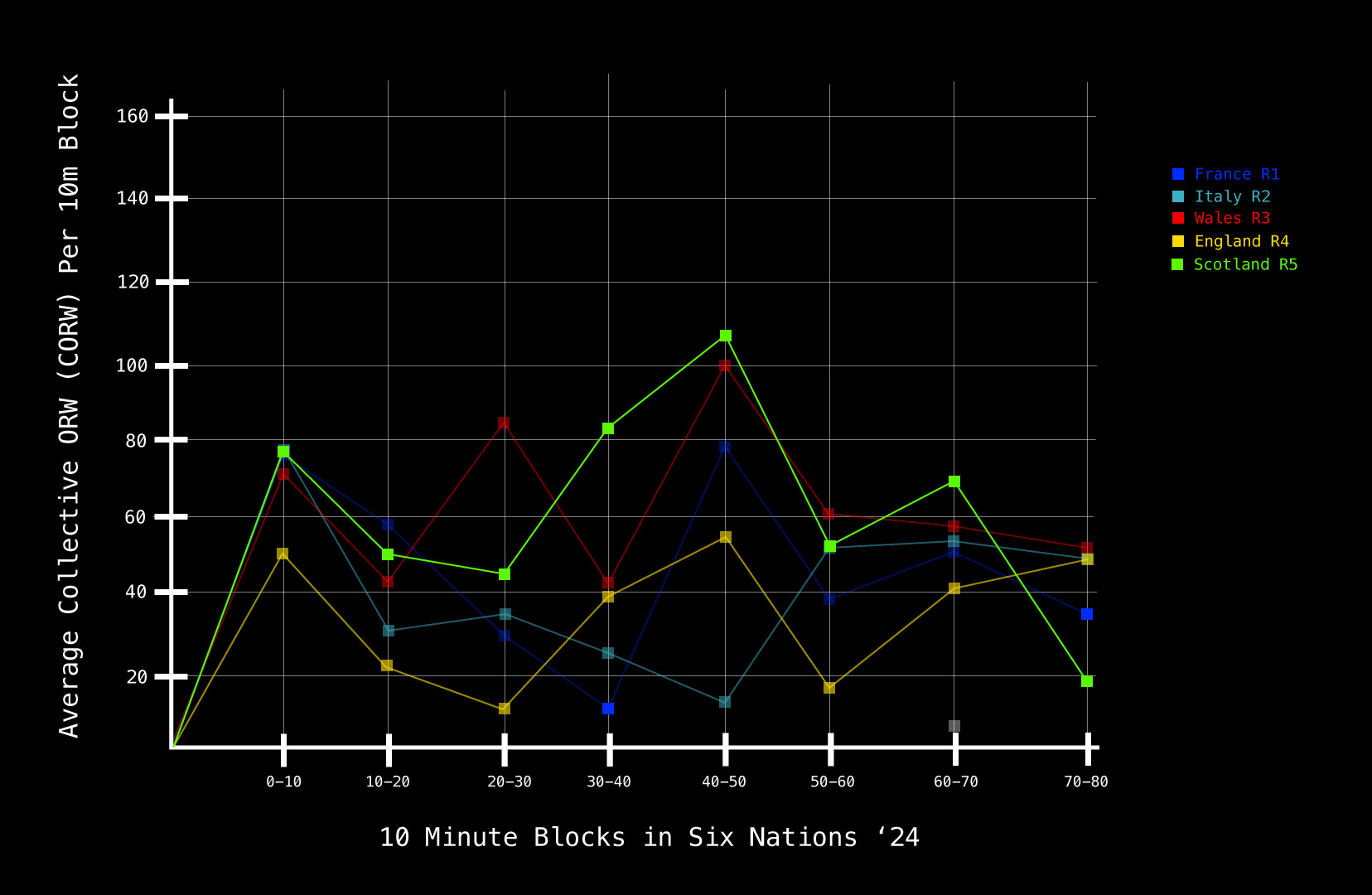
One of the most interesting things about these metrics is how close to a loss the Italian game was purely from an ORW perspective, and it was also instructive in what build works for Ireland at the moment. That Beirne, O’Mahony, Van Der Flier and Doris unit looks very hard to displace but the big question mark is how quickly McCarthy can get up to their level. For me, Ireland’s effectiveness (and our ORWpe) fluctuated with the quality of McCarthy’s carrying. His ruck entries are something of a write-off at this stage of his career, something we hope will improve as he gets more seasoned. His ORW numbers aren’t important to his game at the moment and I just wish he’d make fewer ruck entries and concentrate more on getting on-ball offensively. He made more carry attempts in this game than his last few outings, to be fair, but Scotland – like England the week before – seemed to have his number with low, two-man tackles killing any momentum he might have brought.
We had huge ORW output but very few holes punched in the middle of the field from that output. That has to change if Farrell doesn’t want to break up his usual four stalwarts, especially against South Africa this summer.
ORW Player of the Tournament
When it comes to consistency at the offensive breakdown across the entire championship, one guy stands out; Caelan Doris.

He averaged 43.4 ORW points per game but did it while playing the #8 and #7 role in multiple different games. His effectiveness as a set carrier might be questionable at this point but he’s as effective as ever on transition starter plays. The England game was his worst performance in green for several years but it was reflective of a wider malaise in the squad. From a consistency perspective – which is what I judged it on – Doris was the clear winner.
