


South African teams provide the biggest scrummaging challenge in world rugby.
That statement is almost always true, despite various pretenders to the throne popping into view now and then. Many people talk about the Georgian scrum but, for me, that’s been overrated for a decade or more. You hear about the Italian scrum too but that hasn’t been at an elite level nationally since the late 2000s, and everything since then is probably still mentally picturing Martin Castrogiovanni. I’d put Los Pumas in the same bracket.
For me there is South Africa, then there is a gap, then you have France and England. South Africa is #1 for me because not only are the Springboks the best scrummaging test side, but all of their URC teams have a claim to have the best scrum in the tournament or have the best scrummagers in the game at any given time in their teams.
There is no scrummaging examination like touring in South Africa.
When we look at the four South African URC teams, we see three of them are in the top five for scrummaging metrics; scrum win percentage, the number of scrums engaged with and scrum penalties won.
The Stormers, who rank 13th overall on those metrics, only do so because they’ve had a relatively low number of scrums but they have the most scrum penalties won per scrum and the highest number of scrum penalties overall. That’s without Steven Kitshoff for the entire season and Frans Malherbe for most of it.
Long story short, if you fly to South Africa and want to win, you must have a strong scrum. Without one, you concede territory, momentum and points anytime the ball skitters forward against some of the biggest, most aggressive scrums in the game. That is doubly true at altitude.
So, if Munster were going to tour at altitude for two weeks against two of the biggest and best scrums in South African rugby, we would have to be doubly strong and doubly solid to make it out with what we wanted; 10 points.
***
One thing about scrummaging South African sides is that you’re not just dealing with physically large men, you’re also dealing with teams who have a mindset focused on using the scrum to win penalties, rather than use it as something that compresses defenders so you can launch attacks into the space they aren’t in and must run to.
When you know that, you know that you’ll be scrummaging longer than normal on every given scrum. That means holding pressure for longer and holding your bind until the last possible minute.
Here’s a good example from the first scrum against the Bulls, where they would have been fresh, focused and looking to set the template for the rest of the game. If the Bulls could win a penalty here, it tells the officials that “these guys can’t live with us” and every scrum after this will be a danger point.
The Bulls go full 8 on 8 here looking for the penalty.
We’re actively engaged in full-pressure scrummaging for nine seconds here, which is longer than what we would usually engage with. That is typical when playing the South African teams. The average against Cardiff in the rounds before this tour, for example, was around five seconds of active pressure per scrum.
You’ll also notice straight away that both sides kept all eight players engaged for the vast majority of the scrummage. O’Mahony and O’Donoghue only popped up after the referee shouted “use it” which coincided with Steenekamp getting a drive up on Archer.
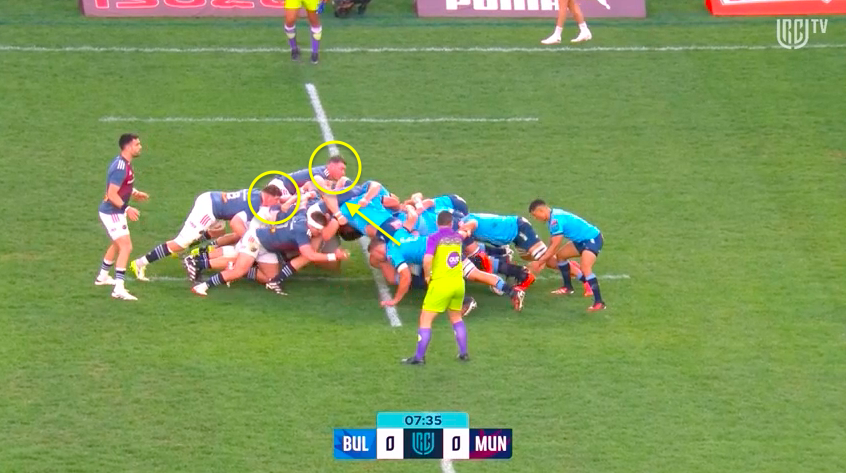
O’Donoghue and O’Mahony aren’t directly bound onto Archer’s side but you can see the pressure shifting from our loosehead side across as the scrum breaks. The flankers produce the least amount of force in the scrum but that doesn’t mean they aren’t important. A paper on the forces exerted in the scrum done in 2020 showed the force breaks down as follows;
[The study] found that in both machine and live scrummaging, the front rows produced 40–51% of the average or maximum sustained pack force, locks produced 31–33% of these forces, and back rows contributed 18–27%
So they aren’t the main players in a big scrum but they can be the grains of sand that make the difference when you’re under pressure. At the max end, over half of your scrummaging force is generated by the front row and, of that force, most of it is effectively transferred at 40% of your body height.
What does this mean? It means that your props scrummage more powerfully when they can engage with the opposition at a shoulder level that is 40% of their height. When you hear about being able to scrummage “high”, this is what they’re talking about. To scrummage high, you’ve got to be supported by your second-row pairing and Munster used RG Snyman incredibly well in this aspect of the performance.
Our second scrum in that game, with our put-in, was their first chance to really go after us without having to worry about striking the ball and Archer held Steenekamp out well with a high entry and bind.
We don’t move an inch even though the Bulls have a full eight-man shove for six full seconds after the set. We strike the ball well and get out of there but O’Donoghue can only break here with a stable platform in front of him. That isn’t to say that we were flawless though. Heading into the last 10-minute block we got a little lucky on this scrum when Archer got taken a bit by surprise by Steenekamp’s early push, and got too long and low as he adjusted.
His knee hit the deck here – which is a penalty for me – but I think the early shove from the Bulls balanced it out. Either way, not going backwards was the key thing. Munster did this in both games by accepting from the start that we would not give them easy angles to work with by being overly aggressive in the early to mid-game.
You can see what that looks like in this scrum on 64 minutes in Loftus Versfeld.
The Bulls have the put-in and go for another massive shove – a full 10 seconds of pressure after the put-in – but we hold them out by committing to stability and not chasing after a big penalty. Look at Josh Wycherley’s foot positioning as the Bulls sink the pressure in. He starts inside Jack O’Donoghue’s brace arm and then splays his base wider to just outside O’Donoghue’s arm.
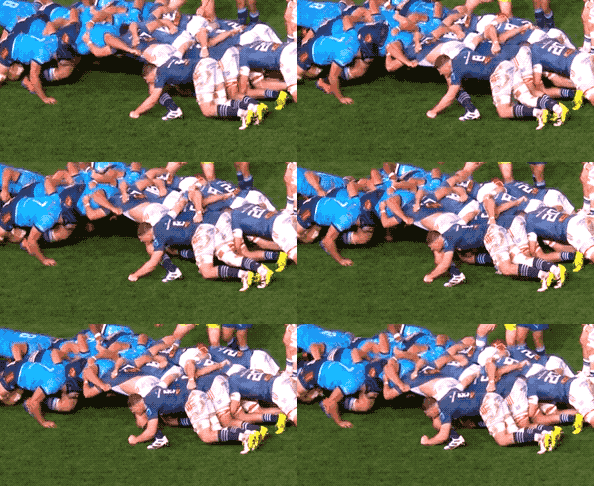
What does this do? A wider base stance – and the slight swing out to effect a bore angle – means stronger resistance to forward pressure but it ensures that there will be no forward movement. We’re OK with that, though. Our scrummaging against the Bulls was based on defending that invisible line up the middle of the scrum. We weren’t going to risk getting “invaded” on our side by being overambitious. If Josh Wycherley decided he wanted to have a cut off Wilco Louw in this scrum, he’d leave himself exposed to getting caught on the angle three seconds into the drive and get driven back off his feet.
By sitting back and committing to holding the Bulls, I think we felt we’d have a big chance to outlast them. You can see that principle again here a few minutes later. Louw is absolutely gunning for Wycherley on this one and, for me, Louw should have been penalised.
If you switch to the Lions game, you’ll see a similar approach, albeit with a tweak to respect the extra power they were due to bring off the bench – the inverse of the Bulls game.
In the second half, we knew we’d have to deal with the 145kg Asenathi Ntlabakanye and the 125kg JP Smith off the bench, so we tailored our approach to maximise the respect for them. We held on when they were fresh, and attacked when they weren’t. This scrum on 53 minutes is a great example; look at the power coming through on their tighthead side onto Loughman!
But going backwards isn’t a penalty and the Munster front row kept their bind the entire way back. Our starting front row was flagging at that point – we’d make a change pretty soon afterwards – but it showed how comfortable we were scrummaging high too.
In the first half, you can see Loughman being much more aggressive with Ruan Dreyer, the Lions starting tighthead. Dreyer is very light for a South African tighthead and Loughman bullied him physically in this exchange.
This is the approach we took in the first half – aggression – before letting the replacement Lions front row blow themselves out in the sixth and seventh ten-minute block.
Look at how Jager keeps a lid on JP Smith on this scrum – strong body shape, perfect control with the bind and making him feel every one of those 130kgs.
Ten minutes later, Jager can flat-out attack Smith on our put-in and drive him, with Loughman popping and splitting a gassed Ntlabakanye who had carried the ball 17 times since coming on the field 20 minutes earlier.
Aggression when it was on, conservatism when we felt the pressure – Munster’s scrummaging was exactly what it needed to be when it needed to be in South Africa. If these trends hold up, our scrum can be a real weapon off the back of the perception bonus we banked on this tour while keeping cheap penalties out of our game.
