


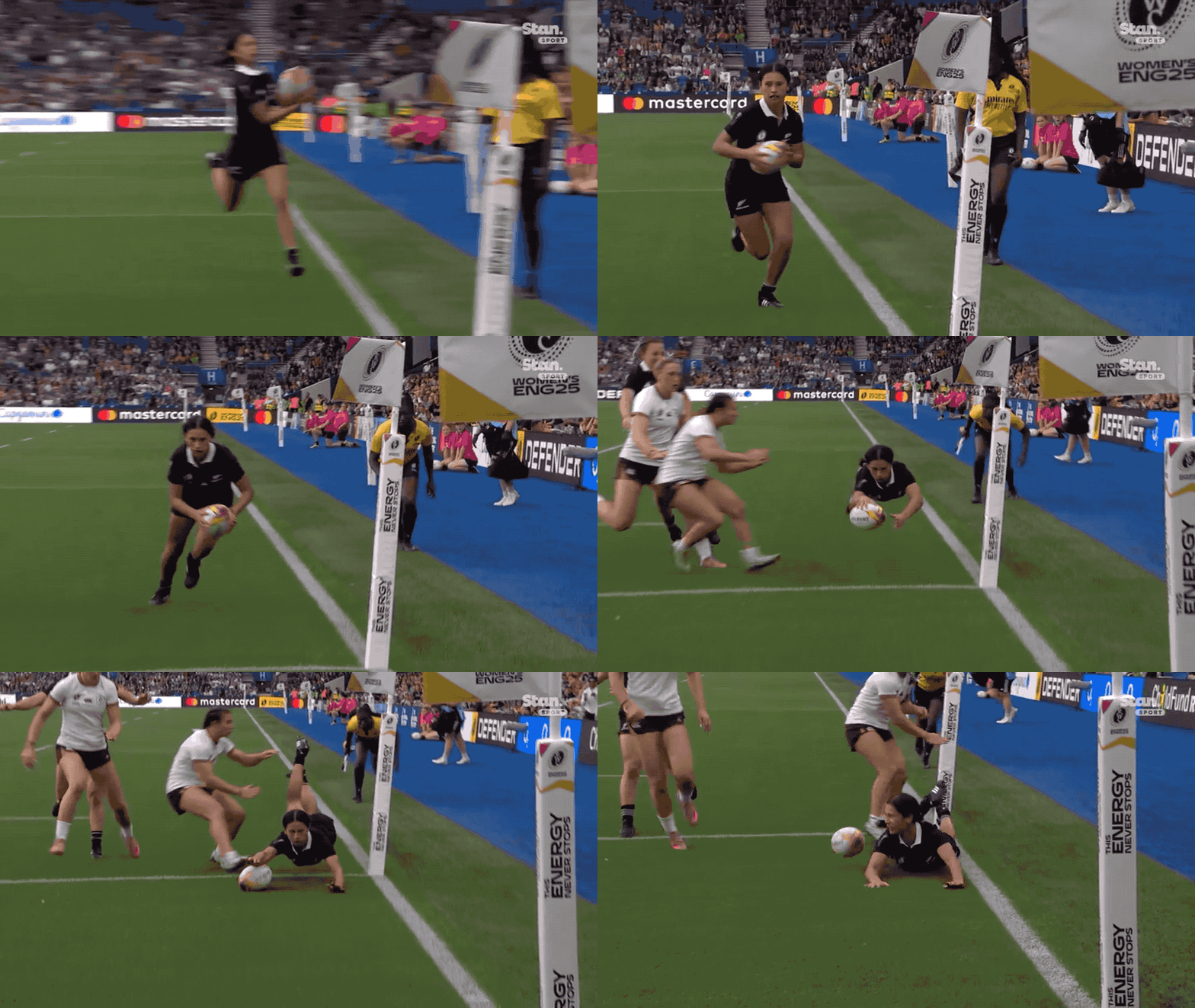
There’s nowhere to hide for Ireland this week.
Losing 40-0 in a big pool decider is about as decisive as it gets. It’s not fatal to our World Cup progression by any means — a loss in this weekend’s quarter-final against France would be — but it does risk a severe knock to the group’s confidence. Getting back Aoife Wafer, as well as some of the other players from the infirmary, will certainly help that confidence grow, but it’ll take more than that.
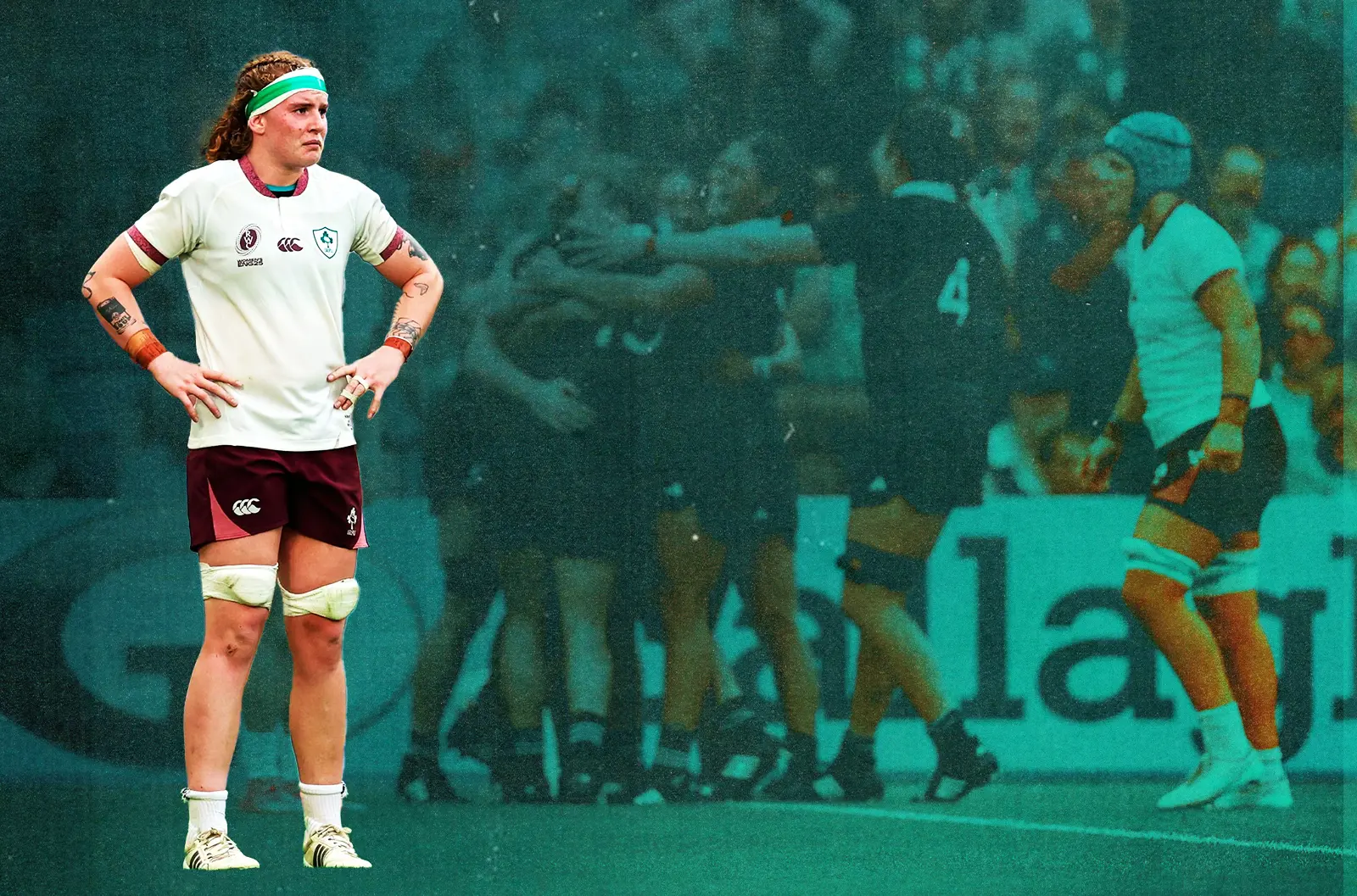
The most effective way to rebuild this group’s confidence is through accuracy.
Against New Zealand, we had multiple chances to take an early lead when the game was in balance or start the road to a comeback when the score was surmountable, but inaccuracy bedevilled us, time and time again; both out of the hand, structurally and tactically.
First, an obvious one. Three metres out, five minutes on the clock, numbers on the outside; there’s no way this chance should be getting botched as badly as this.
Eve Higgins hits the ball up really well and while the Black Ferns do well to slow that recycle a touch, this was the picture we were looking at when the ball left Reilly’s hands. Simple hands put Ireland five and very likely seven points up.
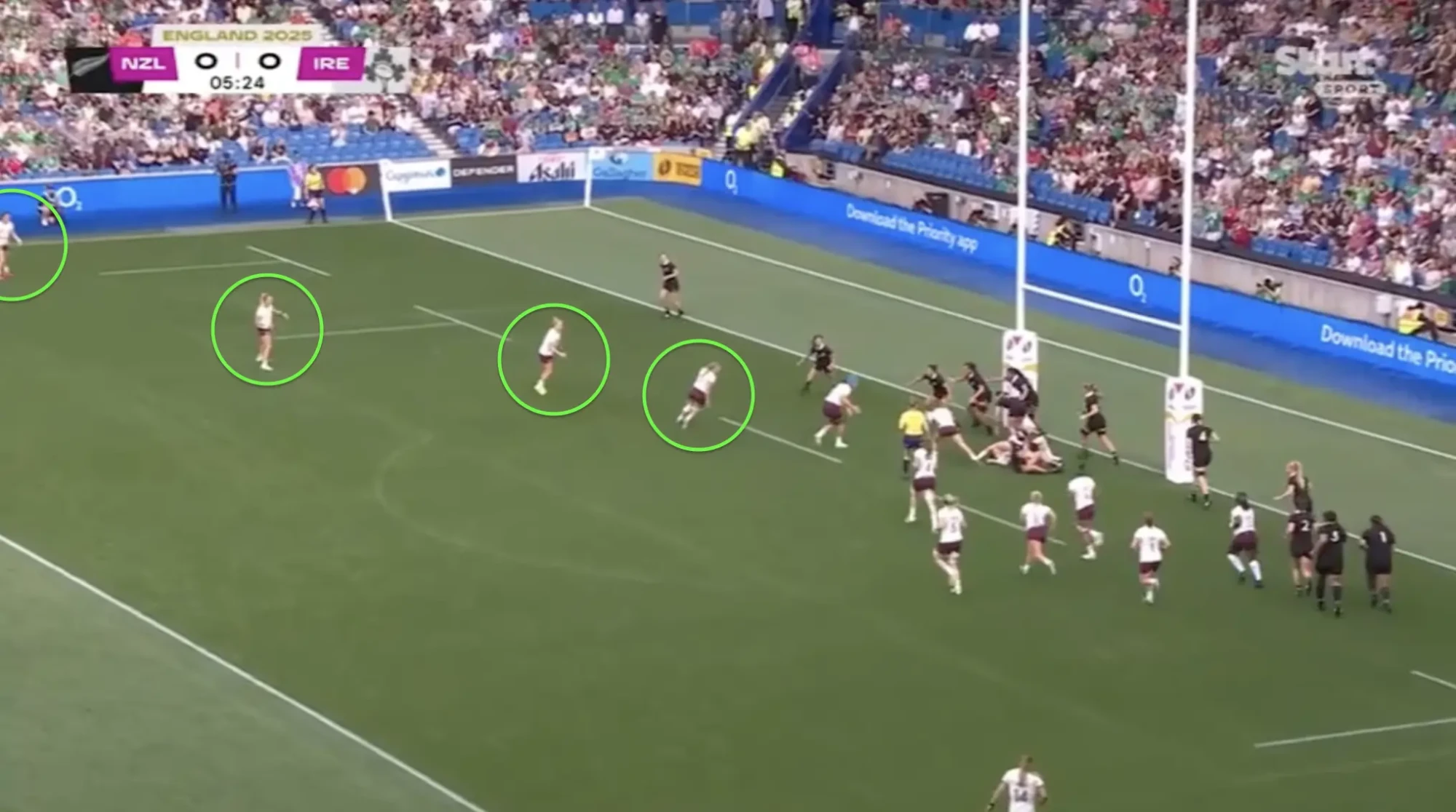
We can look at Hogan running that pinch line a little too late with a scrumhalf who’s already shown in this tournament that pass quality isn’t amongst her strengths; that turns an easy pass to Dannah O’Brien into an incredibly difficult one.
Reilly plainly isn’t expecting that late pinch line either, as her last look before release is at O’Brien standing outside the second last Black Fern defender.
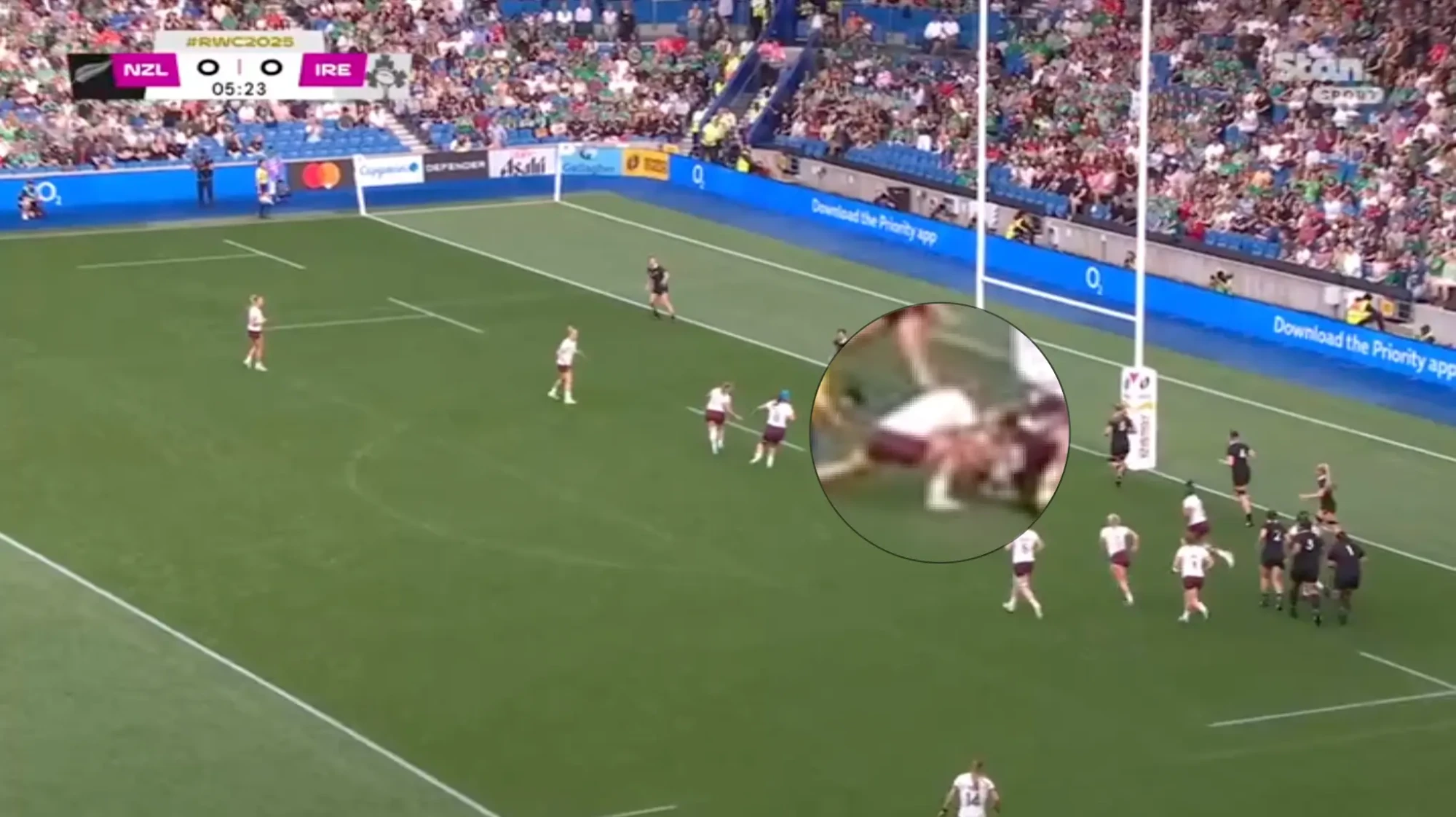
This is a group lack of composure, where our own runners put pressure on our possession, as opposed to the defending side. At the same time, Reilly should still be executing this pass, even if the pinch runners are incrementally off.
But pass quality is only one part of it — the main issue was predictability, especially against a Black Ferns side who were applying real linespeed pressure to our defensive structure.
To get around that, I think we wanted to attack off central ruck positions to shorten the Black Ferns defensive press. So, in practice, this meant that we were attacking from a central ruck position to pick at the edge of New Zealand’s defensive line. We did this directly off #10 or bounced through a screen when we wanted to use the shape on openside plays.
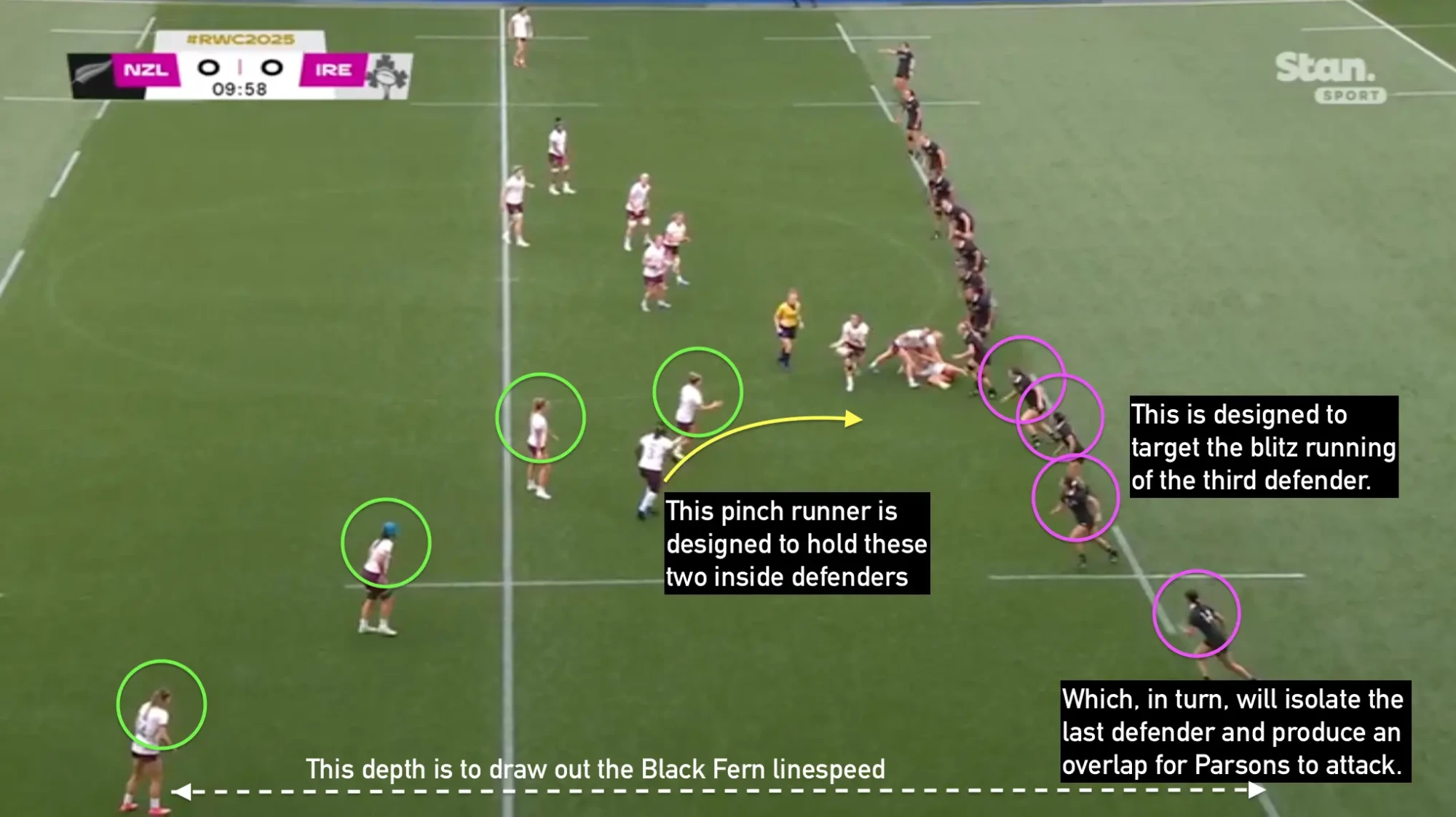
The Irish pod on the openside of the structure is there to hold the Black Ferns openside defence, which allows our shortside structure to get to work. As the graphic shows, it’s a simple process. The pinch runner has to sell the inside defenders on a short ball crash, with the outside structure stepping wide and deep to attack the blitz of the third defender outside the pillar to, in turn, isolate and freeze the edge defender.
You see it twice on this structure; first to produce the shortside, then to attack it.
Look for the first pinch runner on the short ball, and then the same structure on the next phase.
At a base level, this is what we were trying to engineer. The ball in Stacey Flood’s hands, Brittany Hogan to hold and isolate the third defender and Sorensen-McGee left flapping at the pass. If it works, it’s almost certainly an Irish try.
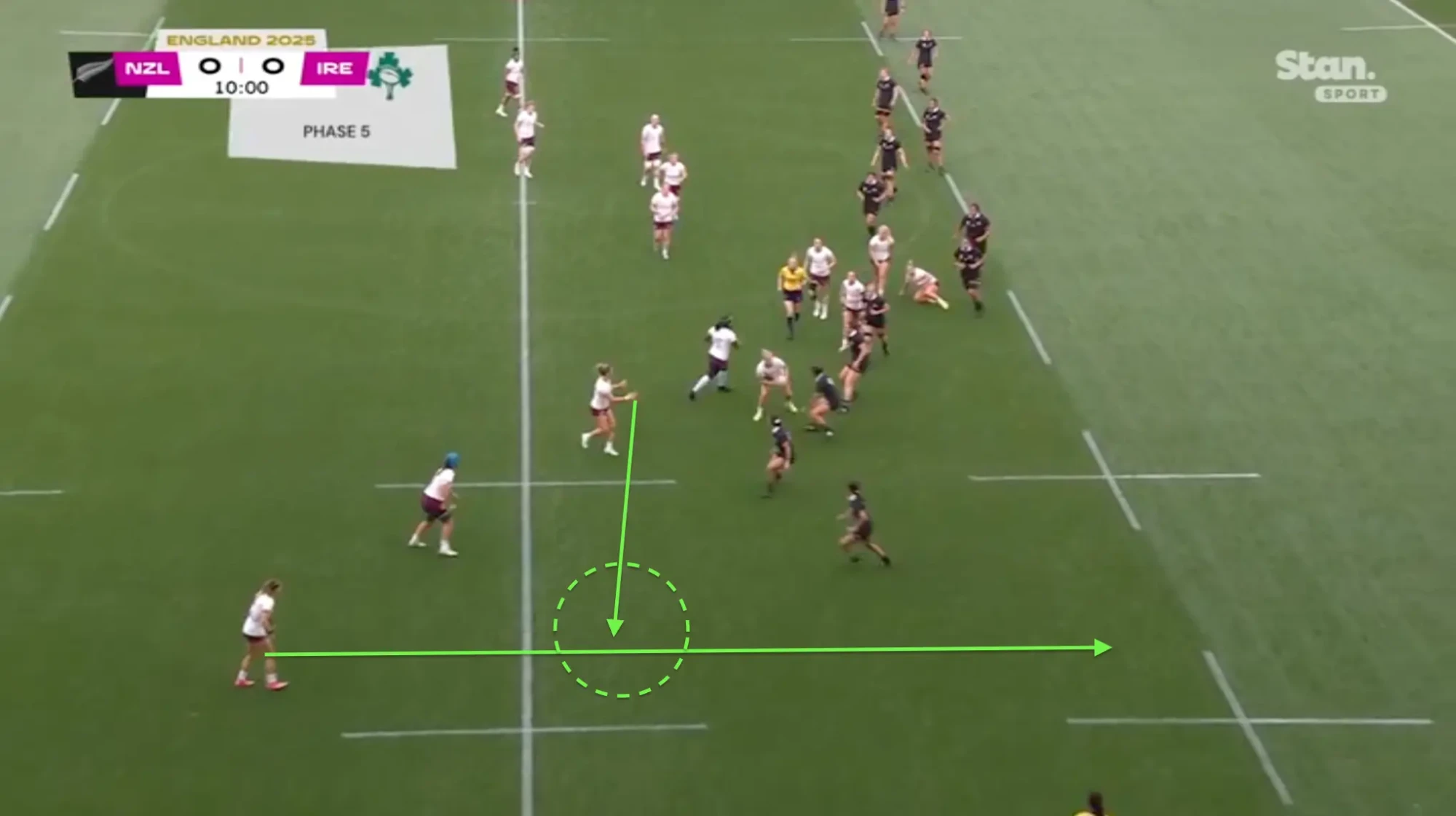
But we can see the issues with it too.
Djougang’s weave line inside doesn’t hold the inside defenders at all — why is it there? It’s a holdover from rugby league but makes no sense in this context as no defenders are ever held by the weave inside and all it really does is take away a potential cleaner from Flood if she carries, or O’Brien if she does.
With the inside defenders free to transit across, the Black Ferns can swarm O’Brien and spook her into passing to Flood, as she’s doing so on the back foot.
This is our core attacking shape but, at it’s core, is real risk because that combination of deep lying attacking layers and width combined with a pinch runner to hold defenders means that any passing inaccuracy kills the move stone dead and, in a worst case scenario, leads to an easier poaching opporunity for the defence as the main “triggers” of the shape after the pass from #10 are isolated, almost by design.
And the Black Ferns had it perfectly scouted, down to the last detail.
Whenever the ball left O’Brien’s hands, the second last defender presser hard on whoever was in the second last layer of Ireland’s attacking structure.
If there were four layers, the pass target was the inside runner on the third layer. If there were three layers, it was the inside runner on the second layer.
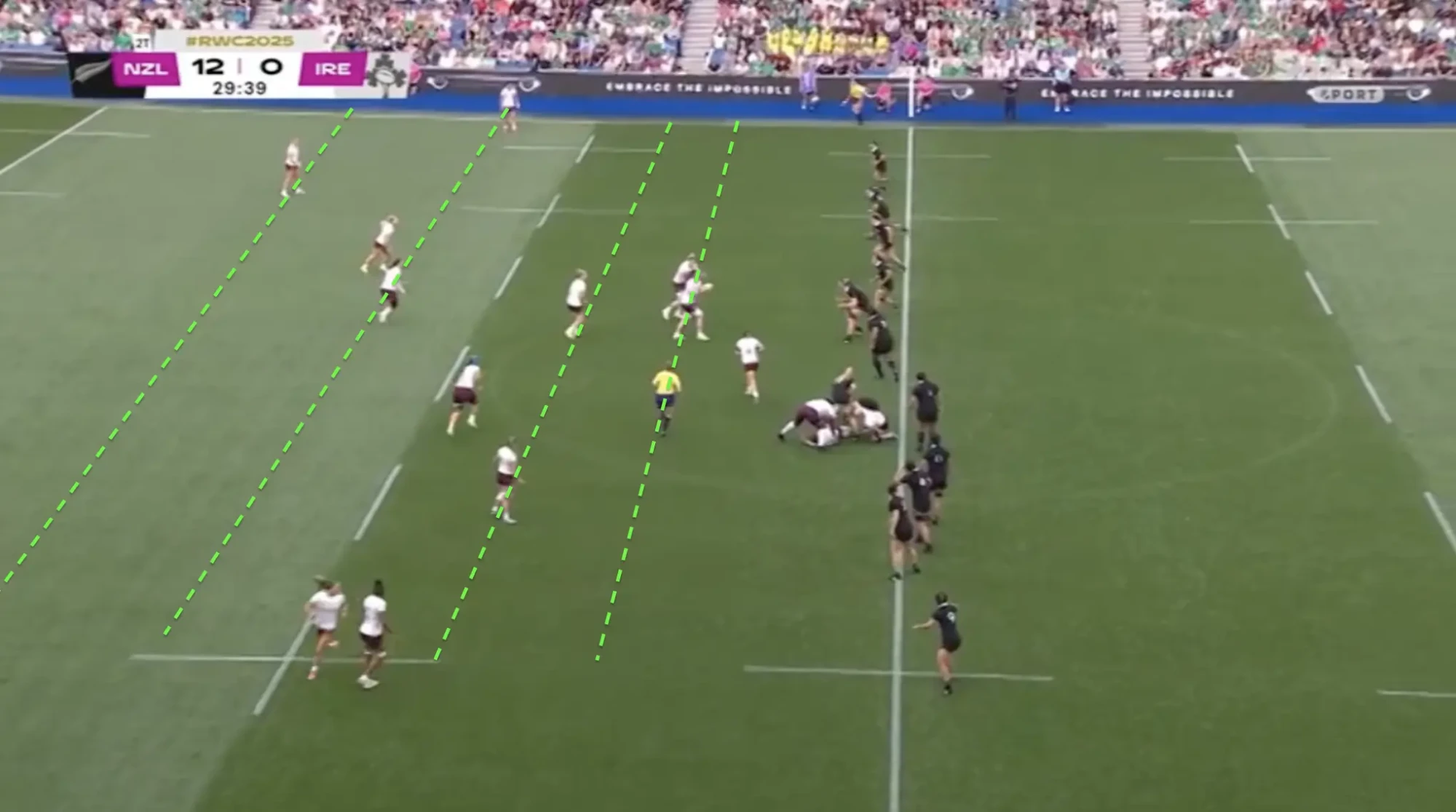
Ireland so rarely used the inside pinch option — because it was a fundamentally bad pass option with guaranteed contact and no on-site ruck support — that the Black Ferns could easily shoot up on O’Brien’s outside regardless of what might be lurking outside.
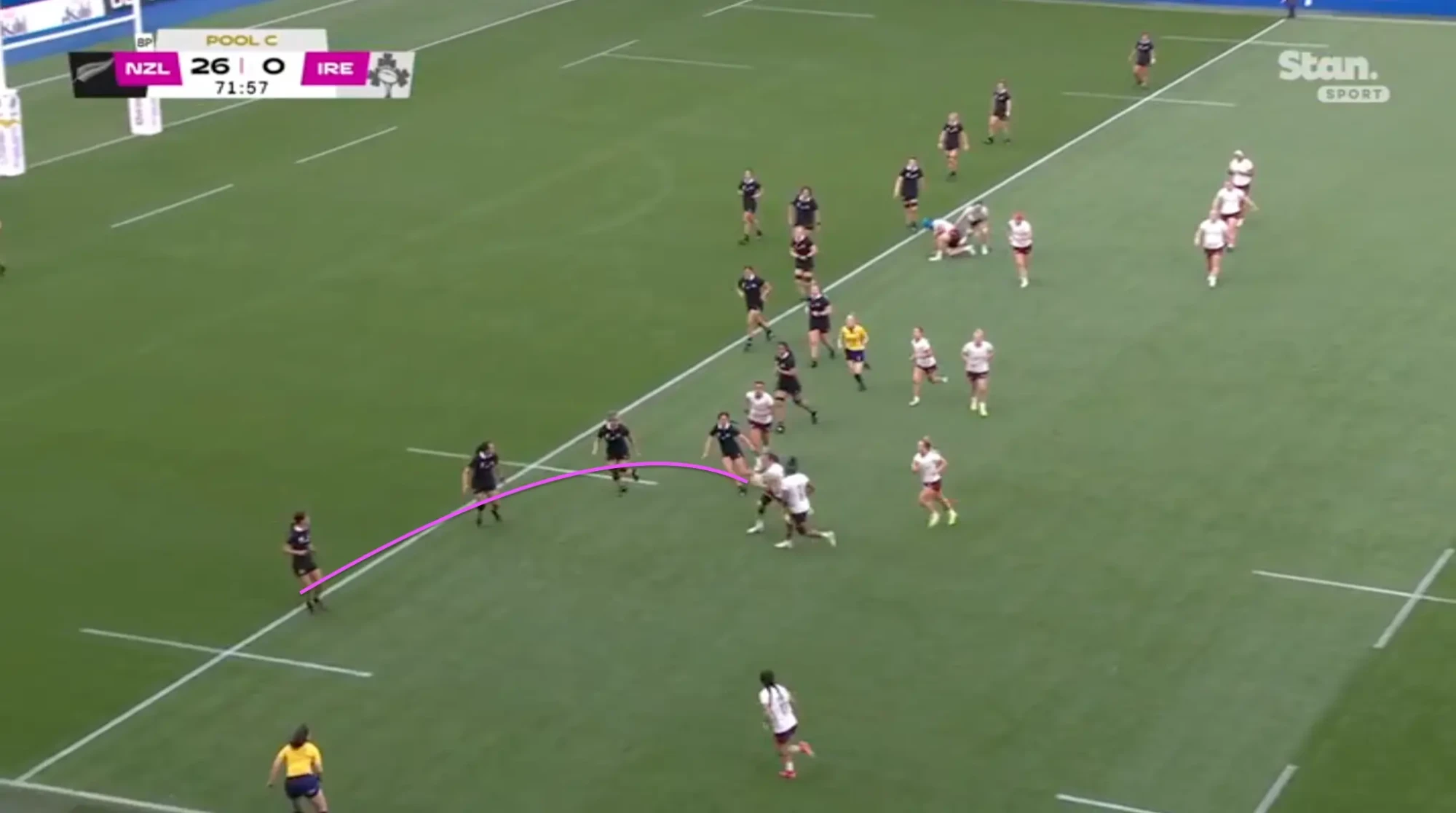
The only time the third defender didn’t swarm the layer on this shape was around 70 minutes in when we were so deep that our pinch runner had no impact on the defensive transit at all, and the Black Ferns could easily swarm our runners.
Higgins had nowhere to run, and was completely outnumbered by the New Zealand defensive press.
Is it possible to play around this press trigger with sharper, quicker passing? Absolutely, but do we have that in our locker? I don’t know. You could compensate by narrowing this shape and having the release as a pass to an outside arc run (a “Y” line) by Parsons, but if that’s not in this scheme, it’s too late to add it now.
The concerning element of all of this is that this shape was present all the way through the game and it didn’t work once. France will have seen this too and, if they know the triggers, they will kick to us from deep all day long because there’s nothing to fear from this shape, or our post-transition work.
Lots to work on, or a quarter-final exit is inevitable.
