


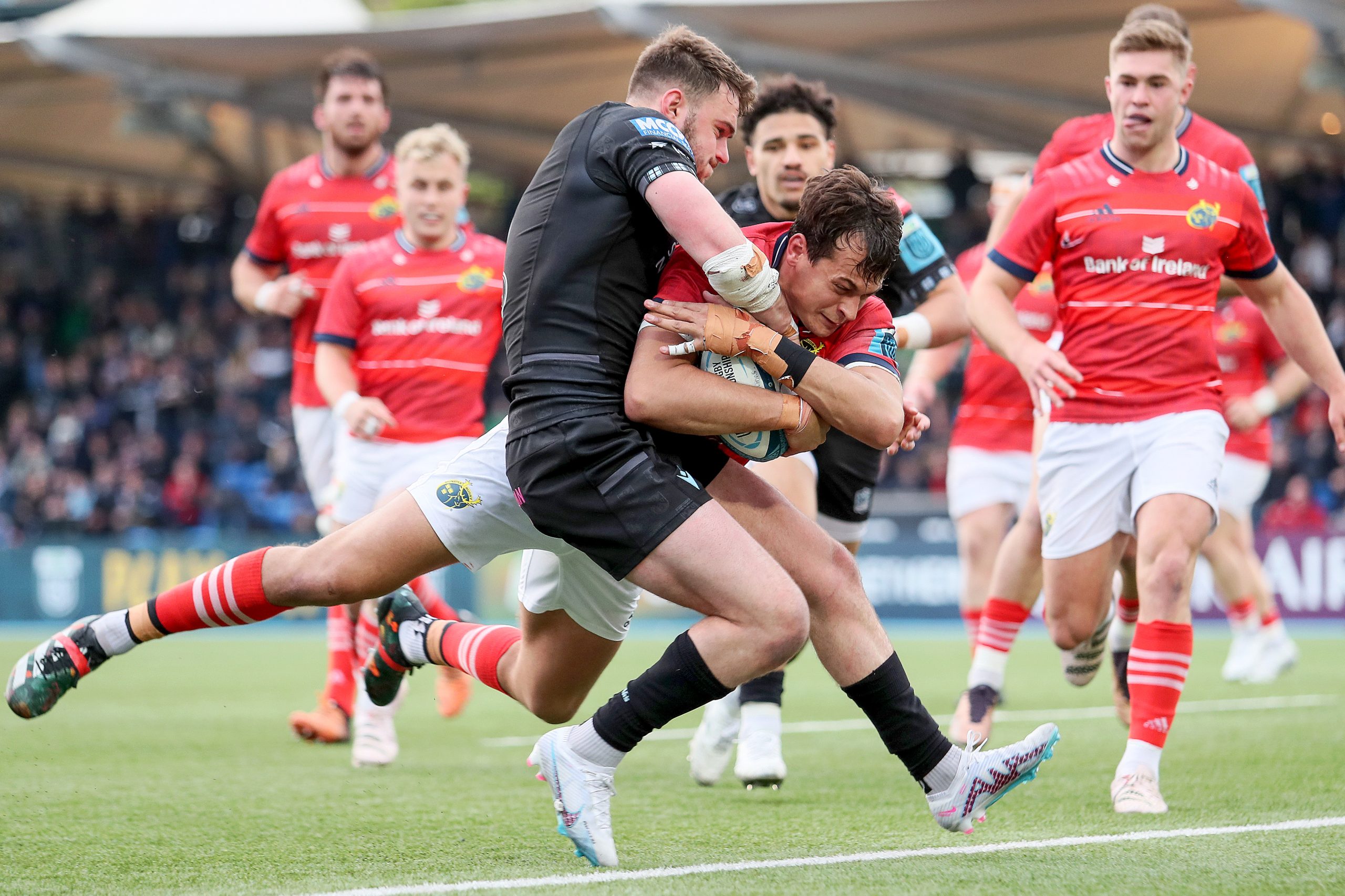
Munster didn’t play all that well here, to be honest.
I watched this game back a few times now – the usual – and this Munster side is capable of far, far better than what we saw here from an offensive perspective. Our scrum didn’t really fire at all, our lineout was a lottery and we didn’t have enough possession to build pressure on Glasgow, even when they went down to 14.
Much of what we produced with the ball in hand in this game won’t make it onto an end-of-season highlight reel but that, in some ways, is an aberration on the season at large. Since we got our offensive game into gear consistently in mid-November, we’ve been able to score tries and build phase pressure that leads to further scoring opportunities on penalty advantage.
This game wasn’t about the attack, though.
It was about guts, bollocks and being willing to dig deep to pull out a win on the road when the pressure is on. This was about Munster relishing every step of the Hard Way and remembering this club’s fundamental tenets: being hard to beat and even harder to kill.
That comes from our defence, which is the best in the league when it comes to the core fundamentals – fewest points conceded, fewest tries conceded. Our improving attack combined with that best-in-the-league defence powered us from fourteenth in the league to fifth in just eleven regular season games.
But then that defensive solidity all fell apart at halftime against the Scarlets in Cork and seemed to stick around like a bad cough for the next few weeks.
In three games, we conceded 115 points. To illustrate how off-kilter those few games were, the points we conceded against Scarlets and Glasgow in the URC – just two games – made up 22% of our total points conceded in the regular season and 23% of our total tries conceded. The bones of a quarter of our total points conceded in 120 minutes of rugby! It was a remarkable collapse by any metric and it continued into the European Cup against the Sharks.
The two weeks off after that collapse have seen some turnaround when it comes to the defensive side of the ball. You heard all the rumours about hard truths and tough sessions but the proof would only be in the pudding itself. The improvement we saw against the Sharks and the Stormers was really good but this game in Scotstoun epitomised what this team has become.
Before the game, I wrote the following;
The Warriors don’t win a whole lot of collisions (they only make the gainline 50% of the time) but they don’t need to. They aren’t going for depth, they’re going for a quick ruck point that they can run shape off to force wide number overloads. That is especially true in the direct aftermath of a maul feint or a gimmick play off the front. Look at the first ruck here;

Lightning quick ball despite the lack of gainline. Connacht opted to no-compete here to keep players on the feet but Glasgow are so good at running blocking lines you’re nearly better off contesting these wide rucks when they are stacking numbers in their big openside framework. They aren’t after gainline – they want space. Deny them the quick recycle and you can slow down the Warriors, bring them back into settled phase play and you take them off-scheme.
Right from the first whistle, we seemed keen to impart what we had learned about Glasgow back in March. Their killer game state is lightning-quick ruck ball. They average 2.8 seconds per attacking ruck so if you can slow down that collision and rest, you can stack your defensive line and slide outside their blocking runners.
Look at Snyman’s slowdown on this ruck with Glasgow stacking numbers outside;

Snyman’s slowdown here – 3.57 seconds – meant that Munster could fold and identify defensive targets while the ball was still in the ruck.
So instead of Munster players filing out and then up, we could move in straight lines into Glasgow’s layers with underlapping cover once the ball moved wide.
Kleyn avoids the blocker – literally swerves to move past him – while the outside blitz forces Glasgow back inside where Archer can close the door on the runner.
Watch Coombes add another slowdown after the contact.

He puts 4.81 seconds onto this ruck, which is exactly what Glasgow don’t want in this area of the field. When the ball comes out, we’re numbered up and settled again, which forces Glasgow back inside for another collision to try to generate a compression.
Look at it though – we only lose two defenders to the collision, Glasgow have to send in ruck support players and when the ball comes to the edge of the play, we can just step up at the edge to cut off the pass and force them back inside again, right into the waiting arms of Tadhg Beirne, who’s in the perfect edge space to draw numbers from Glasgow.
 Watch how active our fold behind the ruck is – constant movement into the open side of each ruck to stack numbers. Glasgow have already lost meters on this sequence – a by-product of deep layers is that the worst possible ruck position is always further back than a flatter play – and they haven’t managed to get one good blocking phase into the game. They would kick a few phases later.
An early defensive win for Munster.
Our intent early on seemed to be limiting the lineouts we gave them when we kicked the ball unless absolutely necessary. The typical profile of these kicks was a mid-range box kick outside of contestable range but in “hit on landing” range to advance into Glasgow’s half of the field and piece up their attacking structures.

This particular movement up the field didn’t work as our Floating Tackle missed his shot on the link player when he broke back inside. You can see Kleyn trusting that the inside man – O’Mahony – covers the runner to make sure that we’ve always got numbers pushing outside to be replaced and covered by the players coming from the previous ruck.
It breaks down here because O’Mahony got injured in the act of making the tackle and gave up a critical linebreak – look, it happens.

You can see our structure in this moment though. Barron tracks across as a potential Jackal/Slowdown threat if O’Mahony makes the tackle and he’ll pillar up if he can’t get at it, which is the role O’Mahony will take if the play moves to Kleyn’s lane.
If the play moves beyond that, the midfielders and winger will cover the action with O’Mahony and Kleyn pushing the physicality at the tackle/ruck.
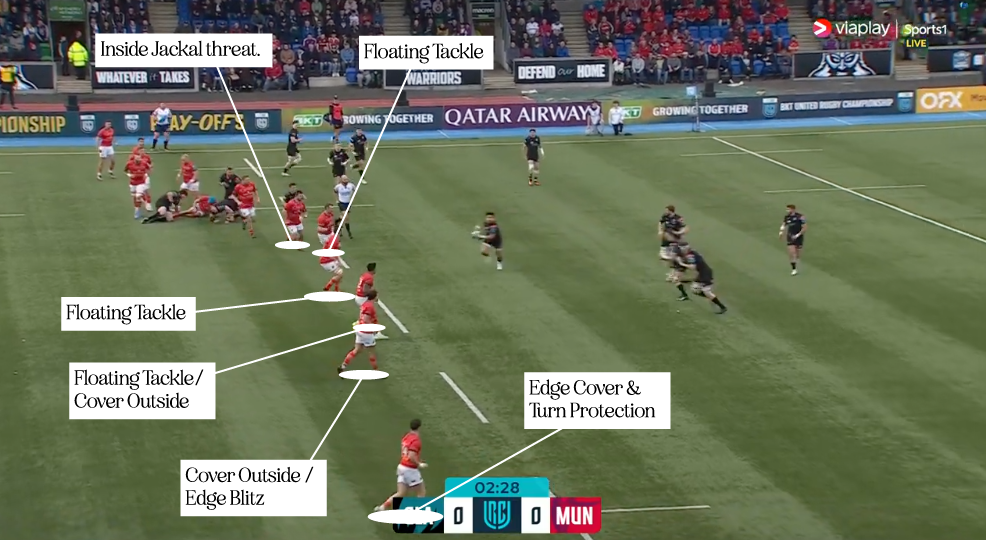
We don’t need our midfield to stick the tackle – ideally, they would – but we’re more than happy to funnel them back into our overlapping cover smashing into the space from a lateral angle.
The natural reaction to a ruck slowdown and an edge blitz, if you’re a Franco Smith team, is to go deeper to get around the blitz.
His teams have been doing this for years. This is from a 2018 Red Eye on his Cheetahs’ side.
This quality is a key part of the Cheetahs’ attacking strategy and it’s why you’ll see them stand quite deep to the gainline on some of their attacking plays. They look to draw the opposition midfield and loose forwards into deep water so they can then play around them

But the downside to that depth, if the breakdown is slow, is that every single dip in pass quality isolates your handlers and creates a static target for a moving defender.
Around 15 minutes in, Glasgow were already going to deeper plays to try and get outside our blitz defence and inside cover but all it was doing was isolating their runners.
Remember the structure from above when you look at Hodnett and Barron.

Barron gets a great slowdown on the ruck which allows us to punish them again on the next phase. A few minutes later, Glasgow’s depth would send one of their outside backs to the dark place – lined up from a distance by Malakai Fekitoa while they’re adjusting after a poor pass.
Slow down > depth to get outside blitz > poor pass > NUKE.

That isn’t to say that Glasgow never got outside us – they did, and we scrambled well to snuff it out – but this was a classic defensive performance that showcased just how deeply we understood how Glasgow beat teams. They try to run the opposition off their feet with constant phase play and kicking every single penalty they get down the line to keep up the physical pressure.
Essentially we said to them – you like playing? Play. And then we beat them up phase for phase on the whole. And endless wave of Glasgow faces running into Munster haymakers. How else do you keep a team like that scoreless for 67 minutes when they had well over 60% possession at times, especially after their red card? Bone on bone, trench warfare stuff at times.
With their #10 off the field and a 6/2 split with no #10 cover on it, Glasgow essentially turned their entire game into “keep-ball” and all but refused to kick because, if they did, their backfield would be critically exposed. With our lineout and scrum struggling – scrum in particular in the third quarter – we kept giving Glasgow opportunities to kick deep into our territory but we kept turning them back with big play after big play.

We had a few opportunities to kill this game off but we blew them – not clinical enough. There were a few moments right before half-time where we overthought our plays from close range against a Glasgow team on red alert not to concede a game-killing third try.
Some of it was good defence, and some of it was cluttered thinking and execution.
That will have to improve this coming week against Leinster but if we bring the defensive zeal and physicality we brought here, we’ll be some of the way there. Not all of the way – not even close – but it would be a start.
The injury toll from this game will really hurt us going into the Aviva next week but we’re bringing in real momentum and genuine belief, the kind you only get with a seven-point tour of South Africa and by beating Glasgow at home for the first time in over a year.
Just like that, we’re back in a semi-final against the team who have turned beating us into a yearly routine. You could say that we’re ahead of schedule but that means nothing this week.
No one is going to give us a shot here because we haven’t beaten Leinster in a serious game since 2011.
Leinster are the heroes of Irish rugby. World #1. They are the consensus favourites for the double.
Yet, I’m reminded of a quote that I’ve been fixated on for the last few weeks from Buffy the Vampire Slayer where one of the – then – chief antagonists, Spike, is talking to the titular Vampire Slayer.
“We just keep coming. But you can kill a hundred, a thousand, a thousand thousand and the armies of Hell besides, and all we need… is for one of us, just one, sooner or later, to have the thing we’re all hoping for.”
“And that would be what?” says Buffy.
“One good day.”
Notable Players
| Names | Rating |
|---|---|
| Jeremy Loughman | ★★★★ |
| Diarmuid Barron | ★★★ |
| Stephen Archer | ★★★★ |
| Jean Kleyn | ★★★★★ |
| RG Snyman | N/A |
| Tadhg Beirne | ★★★★★ |
| Peter O'Mahony | N/A |
| Gavin Coombes | ★★★★★ |
| Conor Murray | ★★★ |
| Jack Crowley | ★★★★ |
| Shane Daly | ★★★ |
| Malakai Fekitoa | ★★★★ |
| Antoine Frisch | ★★★★ |
| Calvin Nash | ★★★★ |
| Mike Haley | ★★★★★ |
| Niall Scannell | ★★★ |
| Josh Wycherley | ★★★★ |
| Roman Salanoa | ★★★★ |
| Fineen Wycherley | ★★★★★ |
| John Hodnett | ★★★★★ |
| Craig Casey | ★★★★ |
| Ben Healy | ★★★ |
| Alex Kendellen | ★★★ |
