




We were absolutely pumped here.
Forget about the 15-minute purple patch in the second half when France, after making six changes at once, lost focus to almost marvel at how comfortable they were. We scored two, might have had a third, but that was Ireland fighting for their lives as France dithered, for a spell. You expect that. This Irish team will fight. Irish teams always have, even during the dog days of the 90s, when we regularly got hammered in Paris.
But something is wrong.
You feel it. You’ve seen it over the last 12 months. And you saw it in stark relief last night. Last night, there was no hiding place.
Against New Zealand and South Africa in November, you could point to the lineout, or the scrum, or a red card to explain why games spun out of control. Inaccuracies. Refereeing interpretations stinging us “out of nowhere”. An out that many gladly swallowed.
Here, Ireland only conceded six penalties and had a rock-solid scrum and lineout. It wasn’t a factor. Instead, we got destroyed by the pace, athleticism, power and flair of a French side who seemed like they could score whenever they wanted, however they wanted.
After the game, French head coach Fabien Galthie laid it out in stark terms that only your opponent can do after a game like this.
But the reality is that the world ranking position is fake. Like the discourse around this team, it gives too much credence to what has come before. Ireland are third, in large part because of what happened in 2023 and 2024.
That past is a foreign country in 2026.
As it stands, I don’t see how this team can compete with New Zealand, South Africa, England and France on like-for-like terms over the next two seasons. For now, and for the foreseeable future, without radical change, we are and will be a middle-of-the-road test side sitting on an island of test irrelevancy.
The bill of the last three years has come due.
And we look out of energy, out of luck and out of ideas.
***
France didn’t just beat Ireland on the scoreboard (36–14), they beat us on the tempo-to-damage axis, and LBR is the cleanest way to show it.
LBR: the game in one number
Linebreaks per ruck (LBR) = Linebreaks ÷ Rucks
- France: 13 linebreaks / 94 rucks = 0.1383 LBR (13.83 per 100 rucks)
→ one linebreak every 7.23 rucks - Ireland: 5 linebreaks / 87 rucks = 0.0575 LBR (5.75 per 100 rucks)
→ one linebreak every 17.40 rucks
That’s a 2.41x gap in linebreak generation per ruck. In plain terms: France were turning the transitions that Ireland gave them on a near constant basis into defensive ruptures; Ireland were turning phases into… more phases.
Why Ireland’s LBR was so low (despite decent ruck speed)
We were fast… but not dangerous
Ireland actually had the better ruck-speed profile:
- 0–3 sec rucks: Ireland 63% vs France 52%
- 3–6 sec: Ireland 21% vs France 33%
- 6+ sec: Ireland 16% vs France 15%
So this wasn’t “slow ball killed us”. It’s just that our quick ball didn’t matter. Ireland had plenty of quick ruck ball, but quick ball without front-foot or defensive dislocation just means you’re attacking an organised line faster. That’s when collision winning comes into play, and we were rejected on the gainline over and over again.
France won the collision, which multiplies LBR
France posted:
- 392m post-contact metres vs Ireland 265m
- 139 carries vs 116
That post-contact gap is important. It’s the difference between rucks that reset the defence and rucks that stress it. France’s carries were consistently bending the line, which is exactly how you raise LBR over 80 minutes.
Ireland’s attack had too few “break moments”
Even before you bring rucks into it, the output gap is stark:
- Linebreaks: France 13 vs Ireland 5
Ireland simply didn’t create enough moments where France’s line had to scramble. And when you’re not breaking the line, your entries and points tend to come the hard way; either through grinding from close range, or looking for the referee to move you up the field.
Territory and entries: France lived in the right areas, and LBR followed
The general possession map shows France spent far more ball-time upfield:
- France: 49% in opposition half, 22% in opposition 22
- Ireland: 29% in opposition half, 22% in opposition 22
Ireland matched the 22% share in the opposition 22, but the big difference is how often France were operating in that “gold zone” where linebreaks and entries spike.
It also shows up in entries and conversion:
- 22 entries: France 13 vs Ireland 8
- Avg points per entry: France 2.7 vs Ireland 1.7
- Tries: France 5 vs Ireland 2
France weren’t just creating more access; they were converting that access more efficiently.
The other side of LBR: what Ireland conceded
If Ireland’s attacking LBR was low, France’s was high — and the defensive indicators explain why.
- Tackles missed: Ireland 35 vs France 21
- That’s a tackle success of roughly 80.6% for Ireland vs 87.6% for France
High missed-tackle volume tends to express itself as… linebreaks. And France’s 13 linebreaks are consistent with Ireland defending without the kind of consistent first-hit accuracy that keeps LBR down. Fundamentally, France looked at the ruck as a staging point that they would avoid if possible, and that completely hijacked our defensive system and pulled defenders all over the place in the first half an hour, and beyond. Without 100+ defensive rucks, and in an environment where France’s offloads were extending phase sequences well beyond the ruck, players like Doris, Van Der Flier, Beirne and McCarthy were left on an island where they had no plausible way to impact the game.
Set piece and kicking weren’t the “root” of the problem
The set piece was broadly functional:
- Scrums: 100% both sides
- Lineout: Ireland 94% vs France 100%
Kicking volume was identical (39 each). France kicked longer per kick; we kicked shorter, but France passed more (191 vs 154) and caused more damage. That, again, points back to collisions + tackle accuracy + blown transitions as the underlying LBR drivers.
What this tells us
When Ireland are at their best, we don’t just play quickly, we force defenders to fold, over-chase, and break shape.
In this match:
- Ireland had speed, but not deformation → low LBR. All of our attacking phase play was inside France’s defensive envelope.
- France had deformation, even without elite ruck speed → high LBR.
- Once France were ahead (70 minutes in the lead), Ireland were chasing the game in organised-field conditions, which typically suppresses LBR further.
***
Beating France in Paris is never easy.
So I won’t treat it like a formality, or something that Ireland — even in our peak — should just rock up to and expect to win. What bothers me is that we looked like a lower-level team for most of this game, a side that France could toy with as we bumbled around trying to get our contestable game into action.
Our plan here was to kick early and contestably to win scraps on the drop, so we could play off that defensive “deformation”. Essentially, we’ll hang up four second box kicks or garryowen’s off #10, chase to swarm the landing point, and either play off a return to width, or force scrum or a bad exit from France, which we would then use to go into our post-set piece game around their 10m/22.
This is a good example.
But the x-factor here is that once that ball is in the air, you’ve still got to retain it or at least get a favourable outcome. This is, fundamentally, a lottery.
Stockdale doesn’t do a lot wrong here, to be honest. Chases well, gets a favourable matchup with Jalibert, and the kick from Gibson Park is a good one — 4.2 seconds of hangtime.
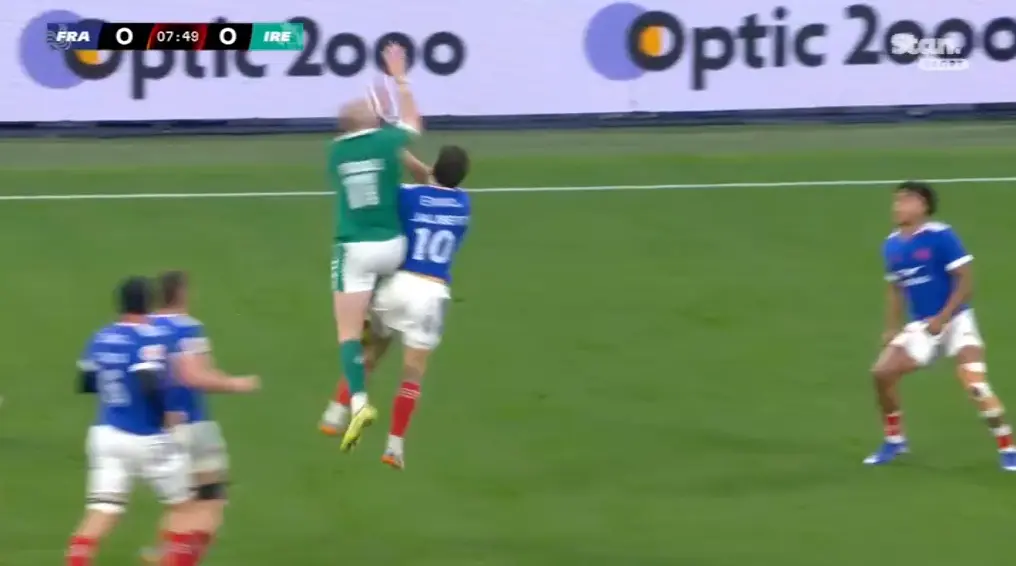
But it’s still an incredibly difficult take.
We used the same approach against Australia back in November, in similar greasy conditions, and we seemed to think that the same thing would work here. I would say that this French kick receipt unit, from a kick receipt perspective, is night and day better than Australia in almost every facet you could care to look at.
Stockdale didn’t take the kick because it was contested incredibly hard. It’s a genuine 50/50. But look at how many resources we’re pouring into the drop. There are eight Irish players in the chase box here. One recovering after the previous ruck, which means we have only five players guarding the transition space.
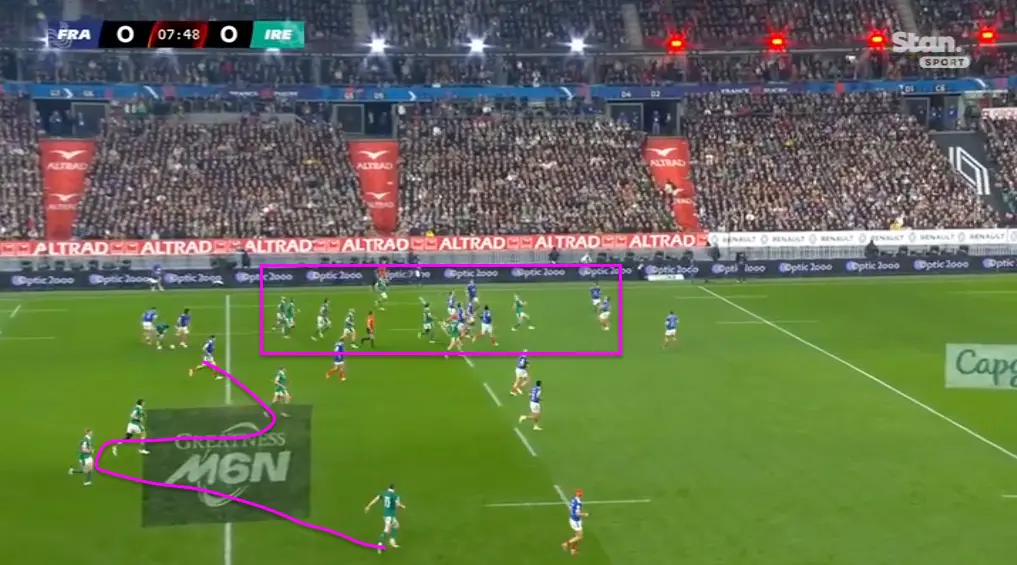
Against France.
In this instance, France kicked long to clear — as they often do — and we almost got away on the second kick transition. We like this outcome too — Prendergast is good at these crossfield kicks.
O’Brien is, unfortunately, outpaced on the chase by Thomas Ramos, so the opportunity comes to nothing, but those are the metrics we’re going for. Either a swamped, heavily contested drop — win or lose the kick — with wide separation on the long return.
Jamie Osbourne kicked a lovely 50/22 off a similar concept, but the point is that we need to give up the ball to generate these outcomes, because we are fundamentally unable to create opportunities further out, or directly on post-transition. I would argue that we have the slowest outside backline in the Six Nations.
So we can’t get separation without a kicking action, or win collisions in those first three phases post-transition. Worse again, we commit so much to swarming the drop that we leave ourselves consistently exposed to transition teams because we leave so much space outside.
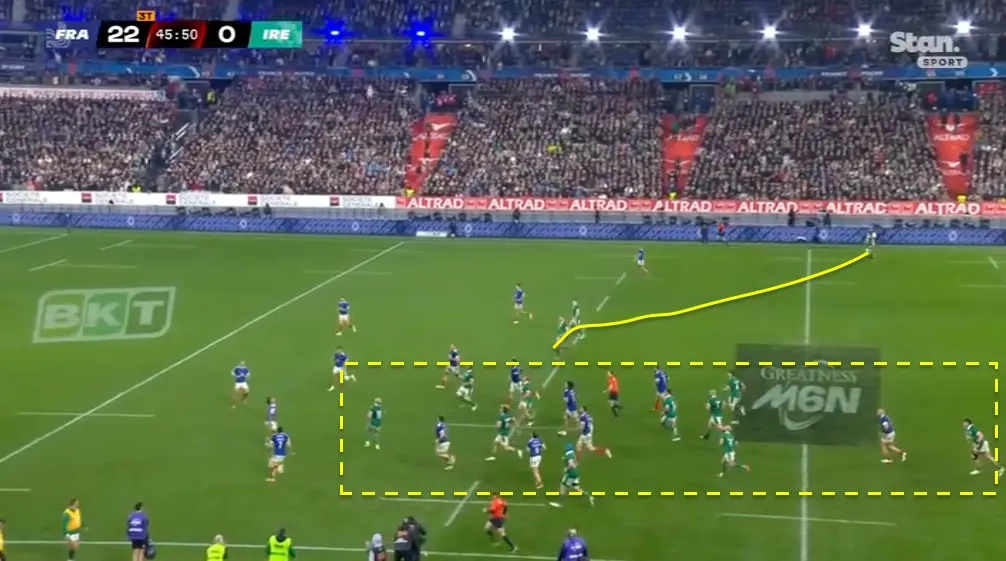
This is a box kick in the second half before France’s fourth try. There are ten Irish players in the “drop chase” with just three in the coverage zone outside.
When Dupont returns the kick, France don’t commit as much space to the drop. There are nine French players in this drop zone, but they have coverage outside.
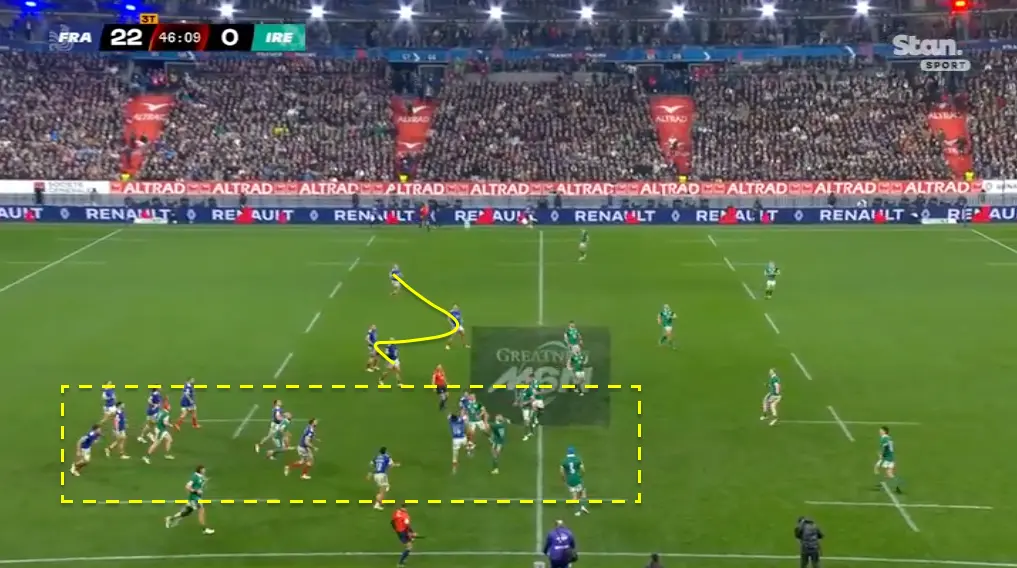
When they win the ball back, they have numbers immediately.
It’s not as simple as “win your aerial duels”, but you could apply that here and have it make sense. Fundamentally, we seem to be aware of our lack of pace — we wouldn’t be swarming the drop zone if we thought that we could cover the openside — because we intend to stop up the ball narrow, and then break narrow.
When France got separation on those duels, they were set up to kill us in the next phase, to pull us out of that narrow shape and buy overfolds, scrambled defence and then play off the back of that.
Look at the full clip, and you’ll see it.
France won the duel, but it’s a scrappy ball. It shouldn’t be lethal, but they have numbers to move the ball directly through the hands. One pass has Ringrose shooting diagonally inward from 20m away to cut off a pass to Bielle-Biarrey that would have ended in a try nineteen times out of twenty, but we swarm the next ruck — again, narrow — and it costs us on the next phase.
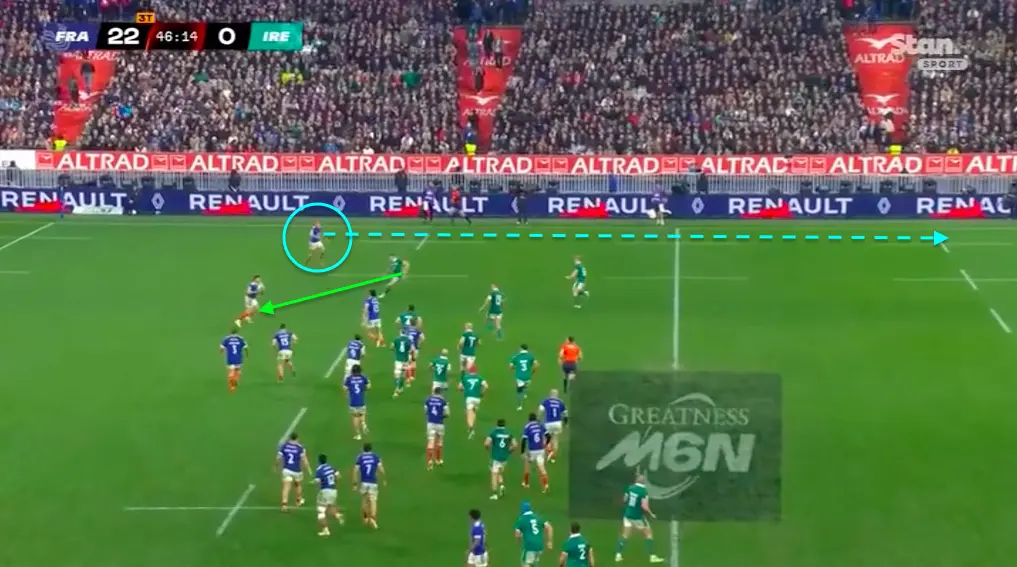
This is a good kick from Dupont, into a space that our forwards are too wrecked to cover — Joe McCarthy is, in theory, the last forward covering a possible pass to Bielle-Biarrey — but O’Brien and Osbourne have to close down the ball and Ramos sooner than they did.
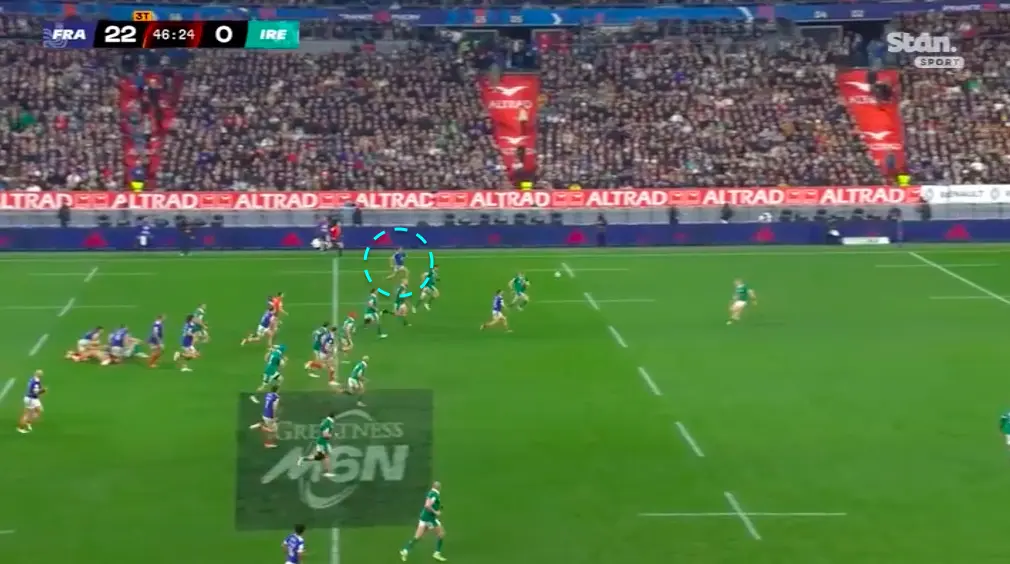
He gets a little flick through, and Bielle-Biarrey has the freedom of Paris to finish anyway he wants.
Too narrow, too slow, too predictable — and all too willing to engage France in their transition superstrength either through an inability to manage the game appropriately, or through blind panic.
This is a good example from the first half, and I want to show you the full 60 seconds to get the full context.
Ireland kick long to exit, but look at how many Irish players are in the narrow picture after Ramos’ run back. There are twelve.
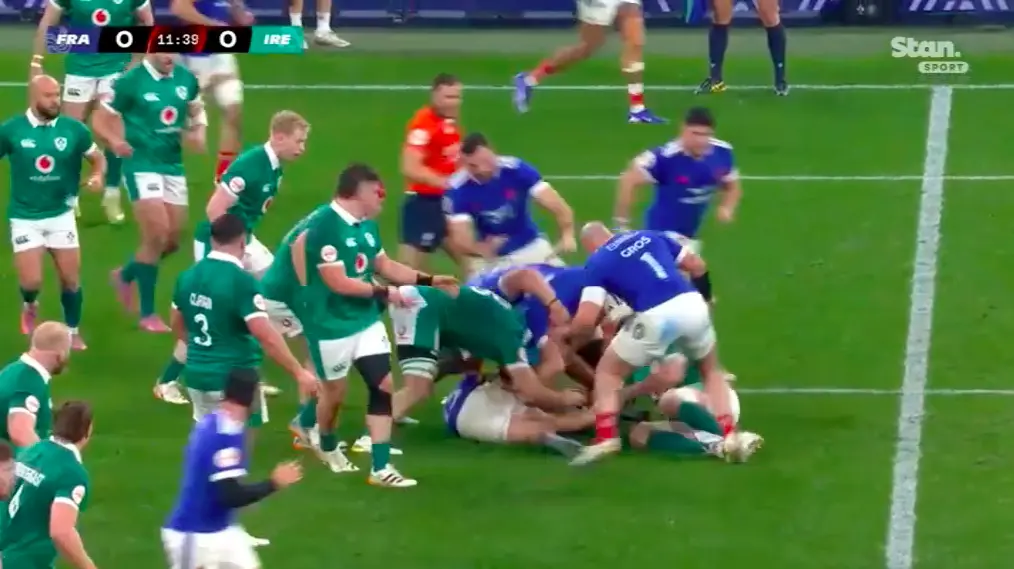
France went through some positive post-transition carries, but we lost four defenders on the last one.
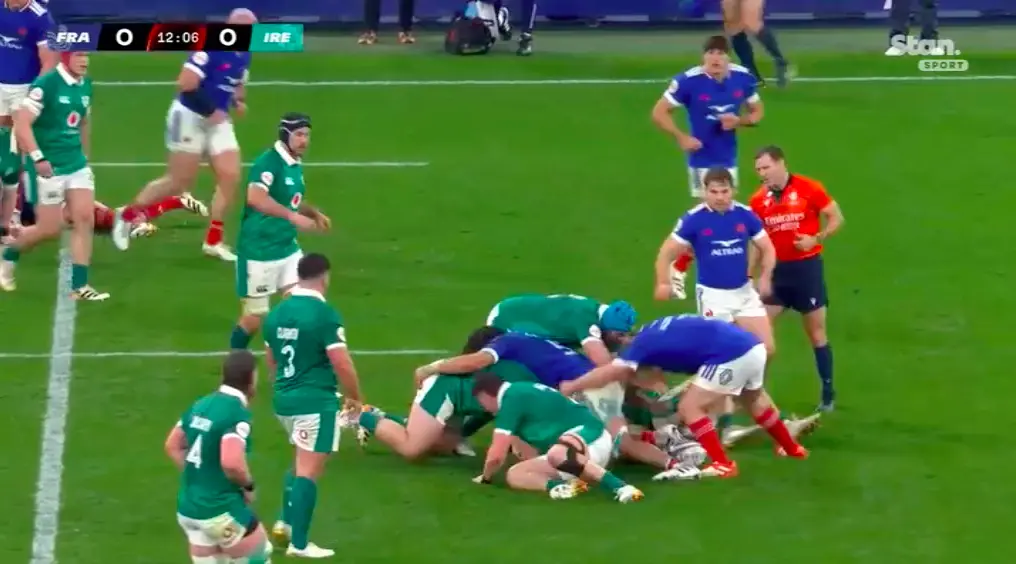
They end up with a big lateral space to work with, but Jalibert chooses to kick because he sees Prendergast is covering centre-pin and has to hustle to cover the back left-pin as Jalibert sees it.
Trouble.
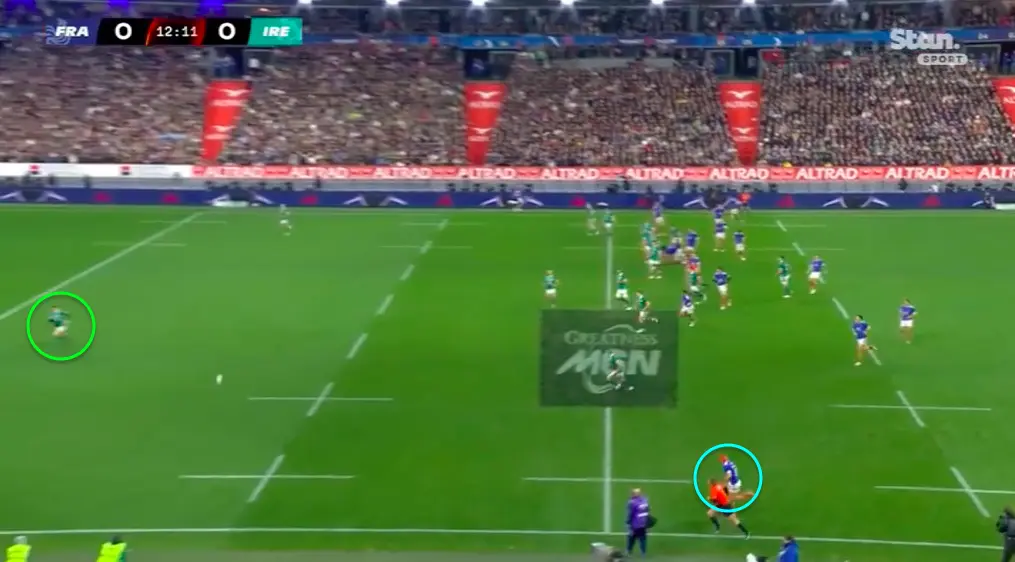
Prendergast has to make a decision here, and the only one for a player of his supposed game IQ is to run this into touch. Hold onto the ball, let the forwards recover and take the lineout, even if it means scrapping with Bielle-Biarrey.
What he absolutely cannot do in this instance is try to volley the ball.
All of these players are now offside, so they have to retreat.
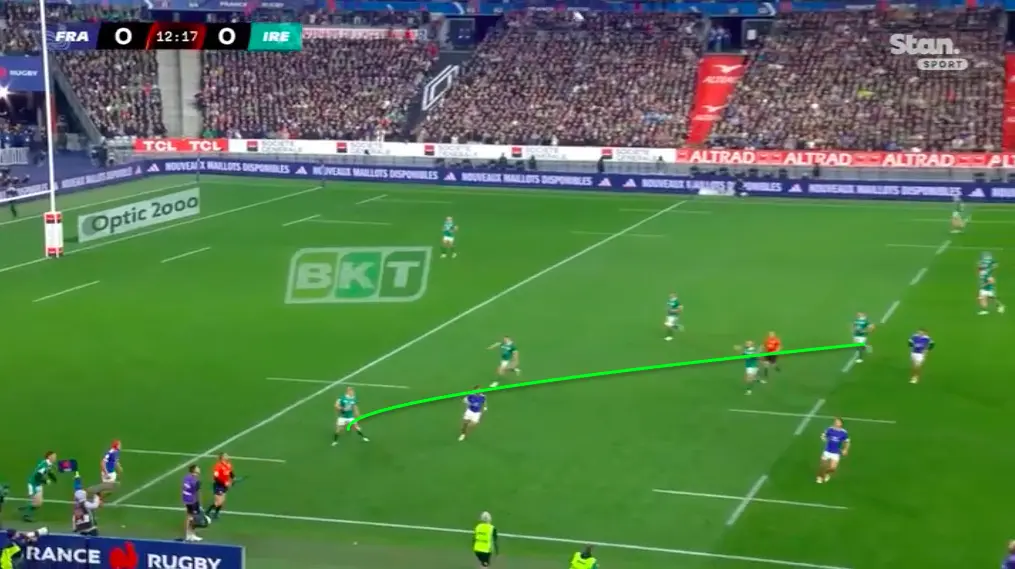
The ball doesn’t go to touch either, so now France have an open transition on the 5m tramline, with retreating Irish defenders. What happens is what was always likely to.
Give them an open transition like this, with built-in space to work, and they’ll find a way. I’d take a scrap for the ball, maybe a scuffle and a lineout any day of the week instead of this, against France.
And that’s before you factor in how we consistently bail out of heavy collisions in favour of “footwork” that leads to lost collisions and lost rucks. Doris has a 5m run-up here. Put your head down and fucking crash into them.
He staggers himself to a standing start and gets smashed. Earlier in the game, McCarthy had an opportunity post-transition to get us a bit of go-forward possession, plenty of ruck support, but he goes for a tip on pass to fake space, where Loughman gets smashed up in contact.
I want my power forward lock to smash into contact here, set the tone and try to get us some momentum back. Instead, it’s this soft-shoe shuffle, like we’re too clever for the fundamentals of a collision sport.
What are Ireland in 2026?
A team that wants to pressure teams in the air, without either the pace or the aerial threat to do it consistently post-transition.
A team that wants to play in post-transition, but without dynamic collision winners or actual x-factor in the squad. Andy Farrell fundamentally does not trust players like that. We like to try and talk our players into being x-factor players when most of them in the side are functional, hard-working, max effort guys. There’s nothing wrong with that, of course, but no amount of podcast megabytes, column inches or Instagram reels will make guys like Tommy O’Brien, Garry Ringrose or Sam Prendergast into more than what they are: honest, hard-working, but ultimately limited system players.
Our system tries to synthesise the effects of genuine attacking intent through a mix of effort and trying to put players like Gibson Park, Lowe, or Aki, into positions where they might create something, but when that doesn’t work, all we get is sweat and labour. We rely on guys like Beirne, McCarthy or Doris to produce something in defence, but if they can’t, what do we have?
Ultimately, what we actually are is what we were last year: a team that needs opposition errors or repeated penalty access to score, because our ability to create beyond that is functionally non-existent against the very best sides in the game.
We are vulnerable.
If the loss to South Africa was the concept, this game was the proof. We look like a deeply limited side in an improving Championship, and France and England are looking like top sides at the same time, which is normally a red alert status for Irish Rugby anyway, but when we’re not playing well, it’s Defcon One.
The pressure now falls on the head coach to find something different, either in style, system or personnel. Maybe all three. If he can’t, there’s no telling where this team could end up.
| Players | Rating |
|---|---|
| 1. Jeremy Loughman | ★★★ |
| 2. Dan Sheehan | ★★ |
| 3. Tom Clarkson | ★★ |
| 4. Joe McCarthy | ★ |
| 5. Tadhg Beirne | ★★ |
| 6. Cian Prendergast | ★★★ |
| 7. Josh Van Der Flier | ★★ |
| 8. Caelan Doris | ★★ |
| 9. Jamison Gibson Park | ★ |
| 10. Sam Prendergast | ★ |
| 11. Jacob Stockdale | ★ |
| 12. Stuart McCloskey | ★★★ |
| 13. Garry Ringrose | ★★ |
| 14. Tommy O'Brien | ★★ |
| 15. Jamie Osbourne | ★★★ |
| 16. Ronan Kelleher | ★★★ |
| 17. Michael Milne | ★★★ |
| 18. Finlay Bealham | ★★ |
| 19. James Ryan | ★★★ |
| 20. Jack Conan | ★★★ |
| 21. Nick Timoney | ★★★ |
| 22. Craig Casey | N/A |
| 23. Jack Crowley | ★★ |
