


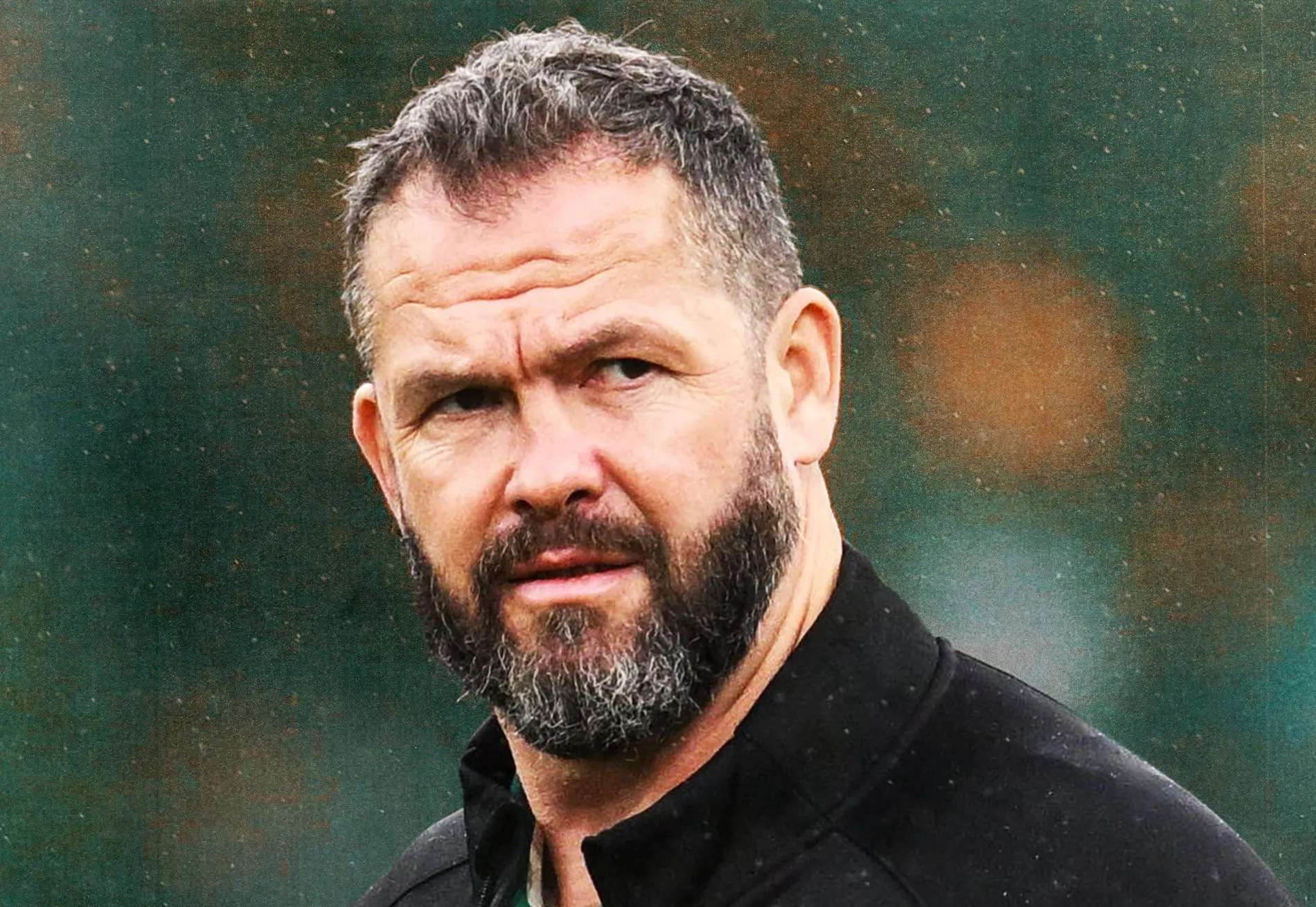
So, it’s another four years of Andy Farrell as Irish head coach.
On the face of it, for most people, it’s a positive. For me, it’s… OK. I’ll explain why.
First, I think it’s a mistake to extend a head coach for four years this far out from a World Cup. It was a strategic error when Eddie O’Sullivan got a similar extension in 2007, a month before the 2007 World Cup, and I think this is similar. Sure, Andy Farrell has had more success during his tenure and is absolutely more popular with the fans and media — media in particular — but booking out your coaching for the next cycle before the current one has completed is setting yourself up for a fall, in my opinion. Two years is a long time in test rugby. Four years is an eternity, especially when the last two seasons have been iffy, to say the least.
Ireland are falling behind the top three teams in the world as it stands — South Africa, France and New Zealand — and are a side on the cusp of settling into a “best of the rest” role that doesn’t really fit what we’ve had for the last ten years, more or less. There will be discomfort in that, unless we can change it, and I don’t think we have the groundswell of players for that. Farrell has to own his own role in that, too.
If Farrell sees out his term, he will have had the second-longest tenure in the history of test rugby in the professional era, just one year less than Warren Gatland’s first spell at Wales between 2007 and 2019. If you include Farrell’s time under Schmidt, it’ll take his time at the top of Irish rugby to fifteen years.
This isn’t a huge surprise, though. The IRFU loves stability. Every union does, but the IRFU does in particular. They will take stability every single time, even at the risk of staleness, with a few caveats. If Farrell can produce another one or two Six Nations titles, compete for second or third in the others, while staying competitive in test matches against the Big Two southern hemisphere teams and make a decent fist of the next two World Cups, the IRFU will view that as a success.
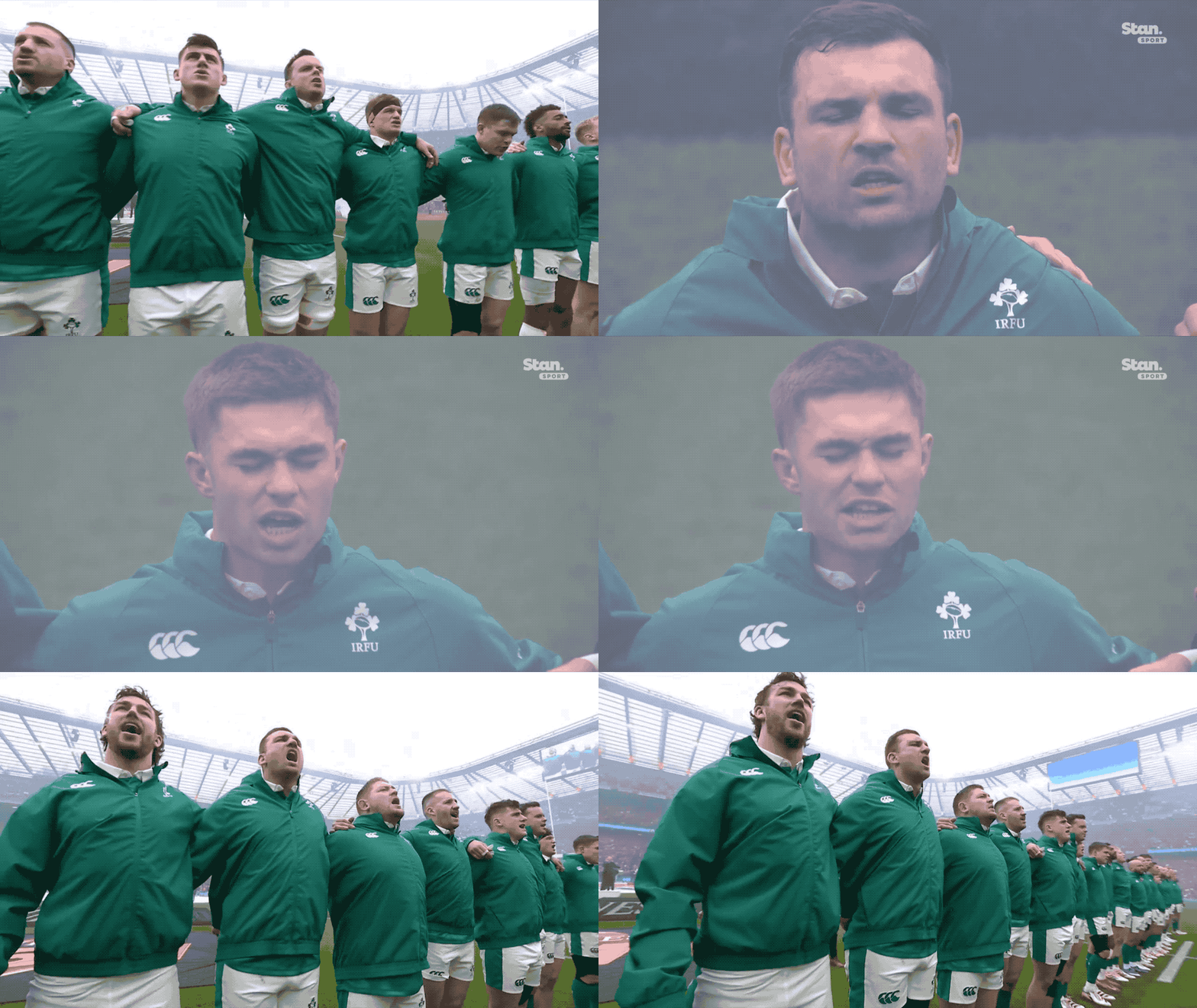
If Ireland goes through a bad run post 2027, when a large section of Farrell’s most trusted players are either retired outright or further along the downslope of the back end of their careers, a few bad test results in the summer or November, along with two bad Six Nations back to back could change things, but they’ll take the risk that, if or when that happens, they’ll be able to move on if needs be.
The reality is that, if you suggest that Farrell should move on after the 2027 World Cup, there is currently nobody that I would rate as a slam-dunk successor to him.
No internal candidate — that is to say, Farrell’s coaching group — looks capable of making the permanent step up. Easterby had something of an audition in 2023 during the Lions cycle, but that was broadly seen as a failure, despite Farrell being in the HPU as often as he ever was.
Inside the Irish system, I could only point to Stuart Lancaster as a possible successor as it stands today, but that would come with more risk than most people think. Lancaster is best suited to day-to-day, incremental, layered coaching — club rugby, essentially — and his impact decreases the less time he spends between the cones.
Leo Cullen is not that guy. Neither is Richie Murphy. Clayton McMillan could be, potentially, but after the season just gone with Munster, we just don’t know enough about what he’s capable of building.
Externally, it’s arguably even leaner still.
Ronan O’Gara is probably the highest-profile Irish coach in the game at the moment — and would be the obvious choice alongside Lancaster, if Farrell were to depart between now and 2031 — but he would be something of a divisive hire for an organisation that loathes rocking the boat. Ronan O’Gara will always be a Munster guy first, as far as the immediate surroundings of the IRFU’s home address are concerned, and a La Rochelle guy second; one who took immense pleasure in beating Leinster in European Cup finals. It would be box office, but it would also be a powder keg.
Who else is there that’s realistically available? Scott Robertson? Johann Van Graan?? Eddie Jones??
The market for proven test head coaches who could keep the Irish squad between the ditches during a period of immense financial insecurity is basically… Andy Farrell himself.
So in that light, another four years makes sense. I don’t see anyone who wouldn’t come without immediate baked-in risk, especially for a team that is clearly on the slide from their peak. Results against the current best teams in the game show that slide pretty clearly, despite a concerted effort to pretend that it isn’t amongst the Irish media, for whom Andy Farrell can still do no wrong.
One thing Farrell can and should do to help the coming refresh cycle post-2027 is to freshen up his coaching box. He’s been reluctant to add a strong outside coaching voice during his time as head coach — he’s preferred to stick with inexperienced coaches whom he has either worked with before or over whom he has a semblance of control.
Rassie Erasmus, his great rival in the test world, has shown the way by hiring Tony Brown into a massive position of influence within the Springbok environment. The IRFU and Farrell himself can begin to look at what’s next by adding a coach of similar stature to the test environment, either before the 2027 World Cup or immediately after.
That he hasn’t done so already — and that there’s been little real pressure on him to — tells you plenty about where Irish rugby’s collective comfort level sits right now. We are, as a rugby public, very good at confusing continuity with progress. The two are not the same thing, and the next four years will be the test of whether the IRFU has bet on the former while quietly telling itself it’s buying the latter.
Because that’s ultimately what this is: a bet. A reasonable one, given the barren state of the alternatives, but a bet all the same. It’s a wager that Farrell can arrest the slide rather than just manage the descent with a bit of dignity; that he can freshen a squad and a coaching ticket that both badly need it; and that the Ireland we see in 2031 looks closer to the side that topped the world rankings than the one that’s spent two seasons being quietly overtaken by the teams that matter most.
If he gets that right, this’ll look like the easy, obvious, correct call it’s being sold as today, and I’ll happily be wrong about the timing. If he doesn’t, we’ll look back at the summer of 2026 as the moment we had a chance to ask the harder questions and decided, as we so often do, that we’d rather not.
That’s why, for me, it’s just… OK.
