


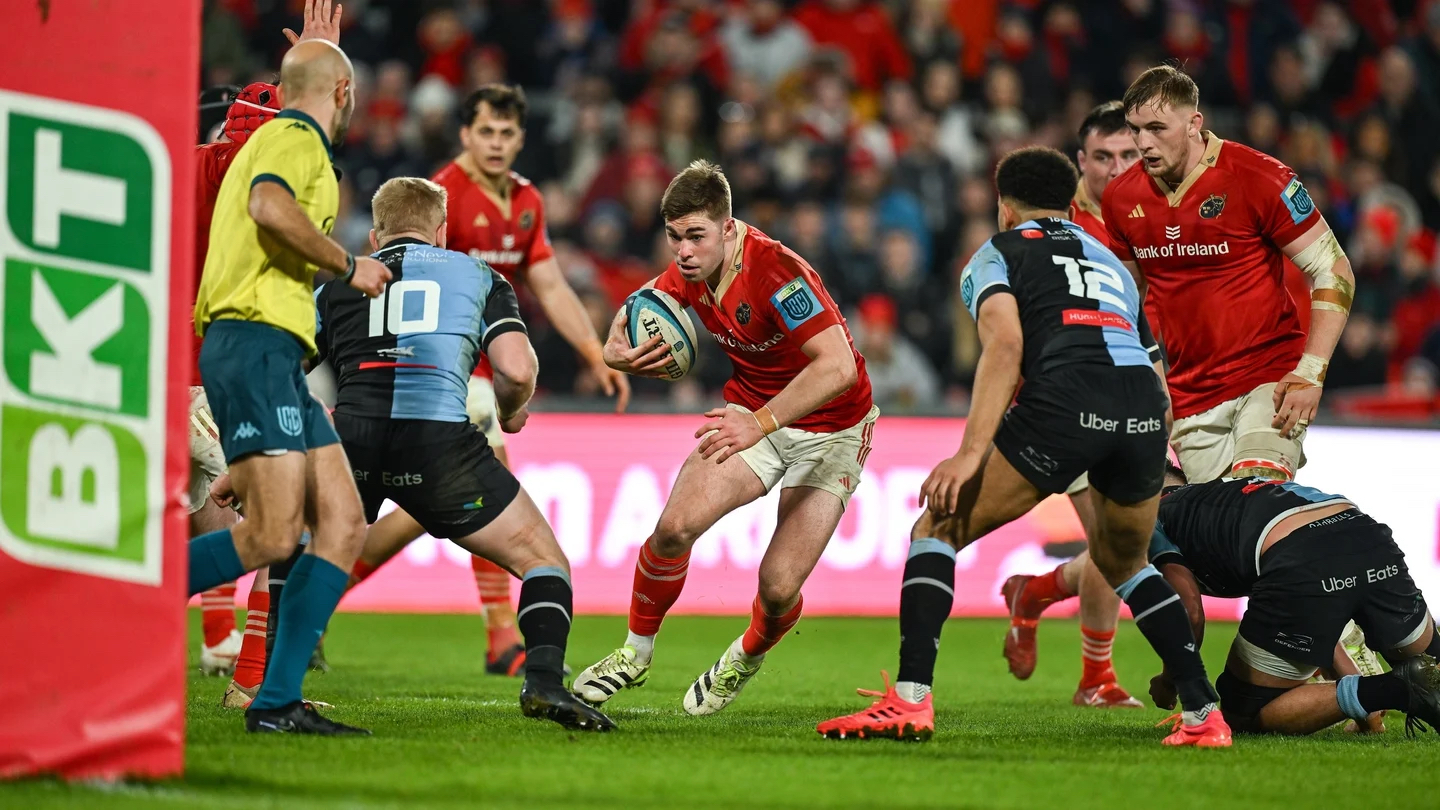
Back in 2020, during the first lockdown of the pandemic, I managed to get my hands on Jack Crowley’s first three games for the Irish u20s before the entire world – and that year’s Six Nations – shut down for the foreseeable future.
I wrote three articles on those three games and Jack’s performance in them.
I think they’re a pretty good read on his game, to be honest, but my conclusion – that he could be a “serious pro” – was off base. Looking at him now, with the benefit of what we’ve seen of him since those articles were written exactly four years ago, I can say that Jack Crowley won’t be a serious pro.
He’ll be a generational talent.
You could just look at his record to see that you’re looking at a talent of that stature. I’ll list it, just for completeness.
He went straight into the Munster academy the summer after his u20 Six Nations breakout campaign and played four games off the bench for Munster in that COVID-19-disrupted season. He signed a two-year senior deal straight out of the first year of the academy which is typically restricted to top tier talents.
The year after he managed to make his way into regular match day 23s under Johann Van Graan. Some of that was due to an injury crisis at 10 – Healy and Carbery were both out for key periods of the season – but Crowley ended up starting an away game in the European Cup against Castres and played incredibly well. He had a poor game away to the Lions on that year’s South African tour and Van Graan seemed to lose confidence in him as a result. Crowley spent the rest of the season as a travelling reserve and watched that quarter-final against Toulouse in the Aviva from the bench.
In the following off-season, Munster were keen to go all in on Crowley under the attacking systems being implemented by the newly hired Mike Prendergast. Crowley was the best suited of all the flyhalves in the squad at the time and he had that x-factor that marked him out as being someone you could trust with the investment you were looking to put in him.
Munster went into that off-season looking to build around Crowley, until Andy Farrell decided that he wanted to turn a provincial A tour to South Africa that failed to materialise into an Emerging Ireland tour, primarily to fast-track Ciaran Frawley. Jack Crowley was named in the group that would be playing three games in South Africa in the middle of the opening rounds of the URC, which meant that he started Munster’s first game of the season on the bench. Munster had to pivot to get Healy into the system as a starter – Crowley was earmarked for all those early season games before he got called up – which some people read as Munster not rating Crowley as a #10. Frawley got injured before the tour, which meant that Crowley ended up getting the lion’s share of the minutes on the tour and he impressed in every single outing.
Andy Farrell ended up getting the credit for “discovering” Crowley on that tour, even though the bould Andy was watching those games on TV like the rest of us before picking Frawley to start the A-game that followed in November ahead of Crowley. Once again, Crowley looked the more natural fit at #10 off the bench in that game even though a scratch Ireland side got walloped by New Zealand XV. Crowley made it onto the bench against Fiji a week later and made his first start against Australia a week later.

This was around the same time that Crowley started to establish himself as a key playmaker for Munster at 10/12. This was, once again, framed as a genius Andy Farrell move to take a guy who had been playing with #12 on his back for Munster and put him in the Irish #10 jersey. Crowley might have been wearing #12 – Fekitoa’s head wasn’t in the game during his first few months here as he agitated for a move – but he was essentially playing like another #10 on the field albeit with the physicality to live with the job in midfield on both sides of the ball.
He finished that season at #10 and produced an outstanding performance in the URC final in Cape Town. He travelled to the World Cup that autumn after eventually shaking off the challenge of Ross Byrne, Harry Byrne and Ciaran Frawley to be the guy who doesn’t come on the field no matter how badly Sexton is shambling around the field.
By the 2024 Six Nations, Crowley had established himself as The Guy for Ireland with some really good performances and will, injury-allowing, do the same in the summer when Ireland tours South Africa.
Every single year, Crowley took a massive step up.
Year One as a pro? Made four appearances at URC level and earned a senior contract.
Year Two? Started an away European Cup game in France.
Year Three? He made his Emerging Ireland, Ireland A and Ireland debut and won a trophy for Munster at #10.
Year Four so far? Became the starting Ireland #10.
That is a trajectory that puts him on the same course as some top-level talents but don’t just rely on what he’s done – look at what he’s doing.
***
Jack Crowley’s performance against the Bulls last weekend was the perfect blend of tactical discipline mixed with his ever-growing influence with the ball in hand. I covered his tactical kicking in the Wally Ratings, but I wanted to focus a little bit on his offensive performance in this piece.
One thing you’ll notice about Crowley’s game on the first look is how comfortable he is running off screens and blocking lines. This is a really good example from the first half against the Bulls.
This was pulled back for a penalty – the Bulls played slapped the ball away – but look at how aggressively Crowley attacks the space after the pass and how late he makes the play action.
A poor playmaker makes the pass here.
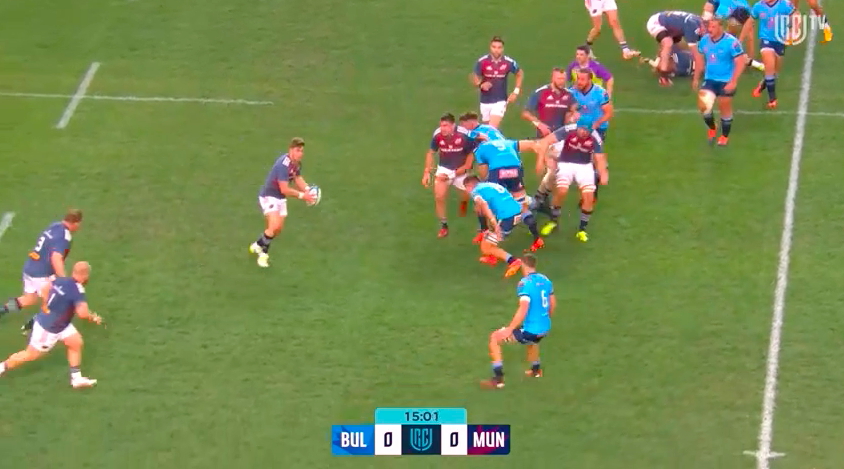
He’d see the space outside Light Blue #6 and look to get the ball there as quickly as possible. He’d snatch at the space and the defender turning in and it might end in a linebreak, but I’d back Light Blue #6 to adapt his shape to make the tackle.
A decent playmaker probably passes here.
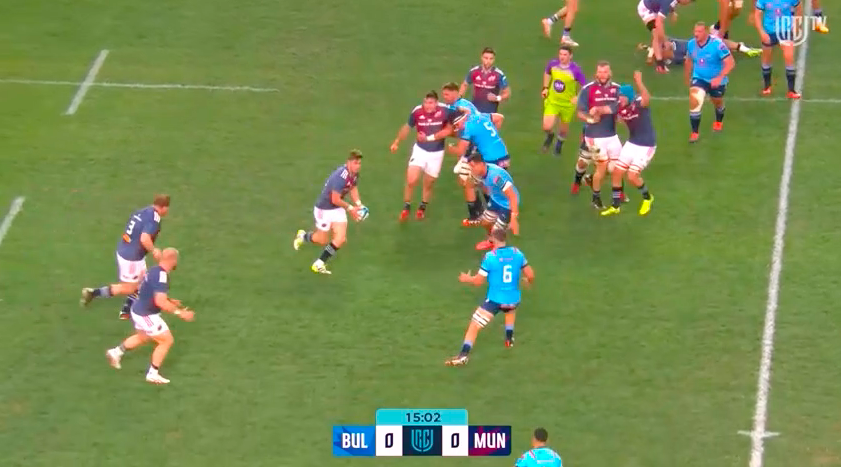
The defender has turned in more and stepped towards the gap, which makes the pass to Loughman more appealing but there’s still time for Light Blue #6 to shift his feet and get a stop. The closer Crowley moves to the line, the more likely it is that he’ll take a massive shot from one of those big defenders.
A top-level playmaker makes the pass here.
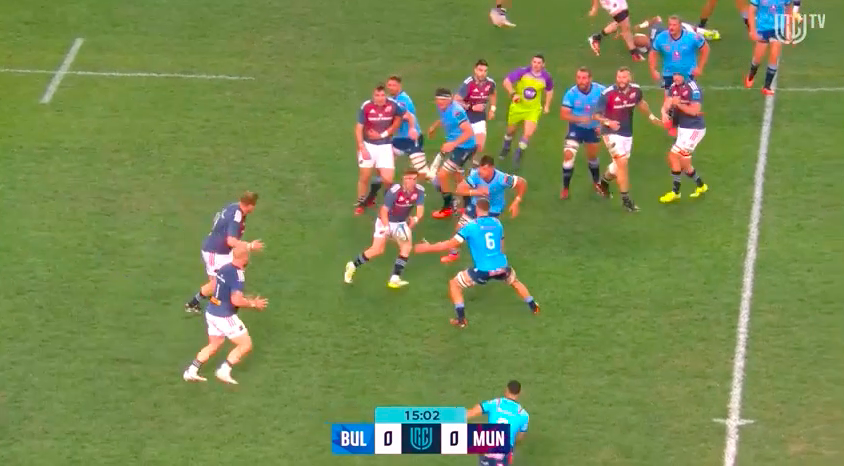
Crowley has shifted to the outside of the inside defender, which fully commits Light Blue #6 and guarantees a linebreak for Loughman with no chance of recovery from either of the defenders in Crowley’s gravity.
The defender has to slap the ball down because if he doesn’t, it’s a critical linebreak for Munster. When you start breaking down Crowley’s work in these moments, you can see how much attention he pays to what defenders see in him.
I’ll show you a clip in a minute but, first, look at these screengrabs of a play with Crowley as the link with a 3+1 screen off him.
What do you see first if you’re a defender?
I’ll tell you what I see – Crowley’s kicking. That’s what it looks like to me.
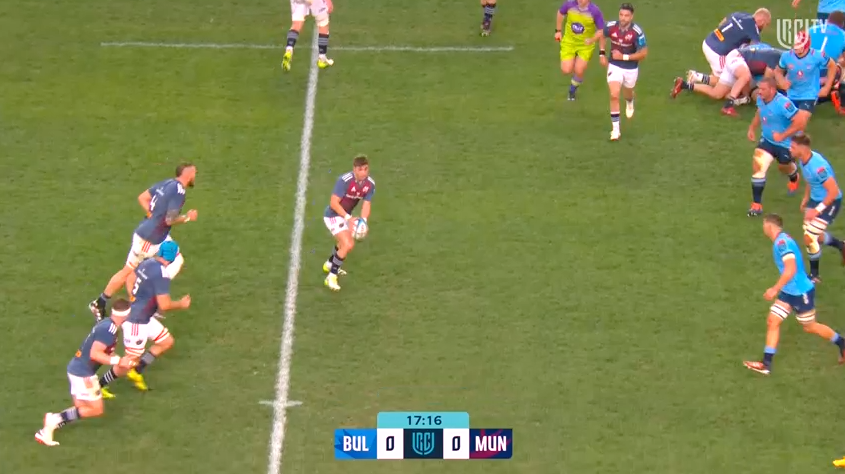
A heart beat later and it looks like he’s getting ready to step in and carry with Snyman as a possible pop option.
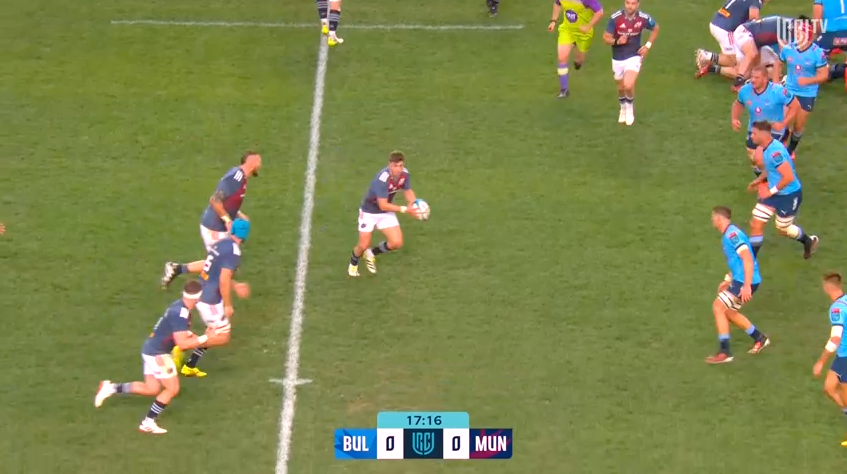
Now it looks like Crowley’s about to hit Beirne to go for that space outside the most advanced defender. This is all happening in under a second, by the way.
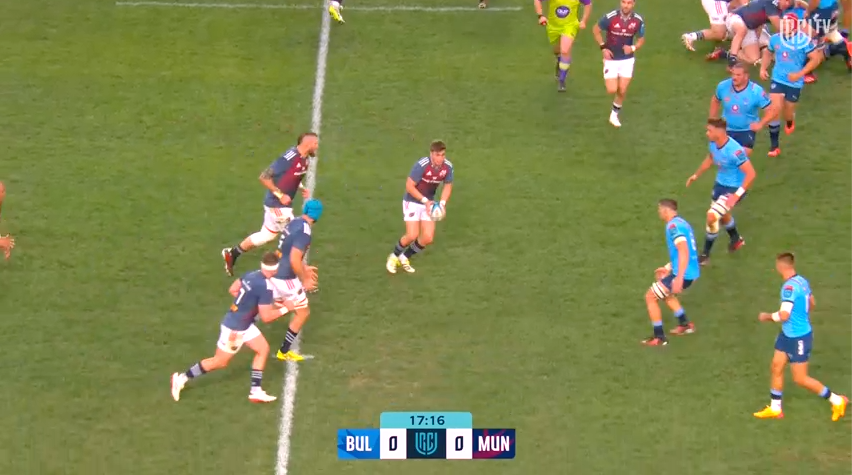
Then, right before the pass Crowley is looking right at Beirne and Kendellen so the defenders reading his body language have to sit down on the pass because it looks for all the world like he’s going to hit the screen runners.
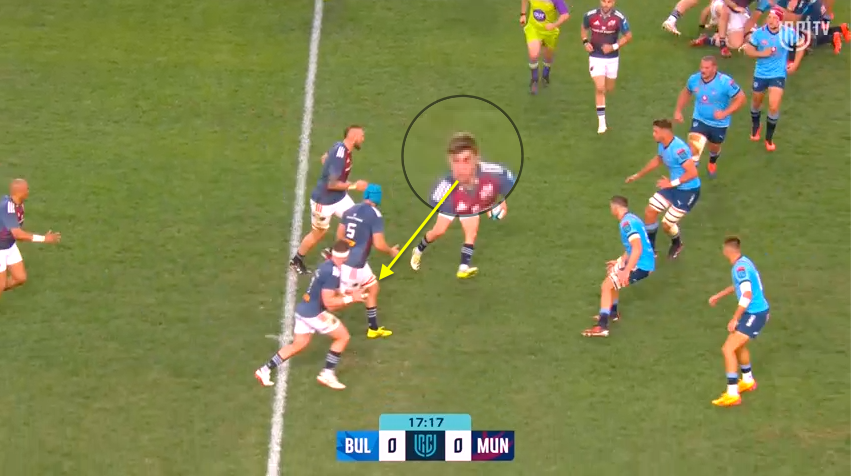
Instead, he throws a no-look pass to Zebo who can play without a blitzing defender in his eye line. Watch that like a defender does – action for action, beat for beat – and there is no easy read on what the final play action is. Every possibility is covered. Look at it in real time.
When the ball comes back to Crowley, he’s got the composure and execution to dab this kick over the top and Munster score on the next sequence.
On that next sequence, you see that late action tendency again – this time with a step block after the pass to make sure the defender he engages can’t swim across easily onto Nash.
That action preserves the space and ensures Le Roux has to come across on Nash, because Ceowley scrags De Klerk with a block action perfectly disguised in his passing action, so there’s no question of obstruction.
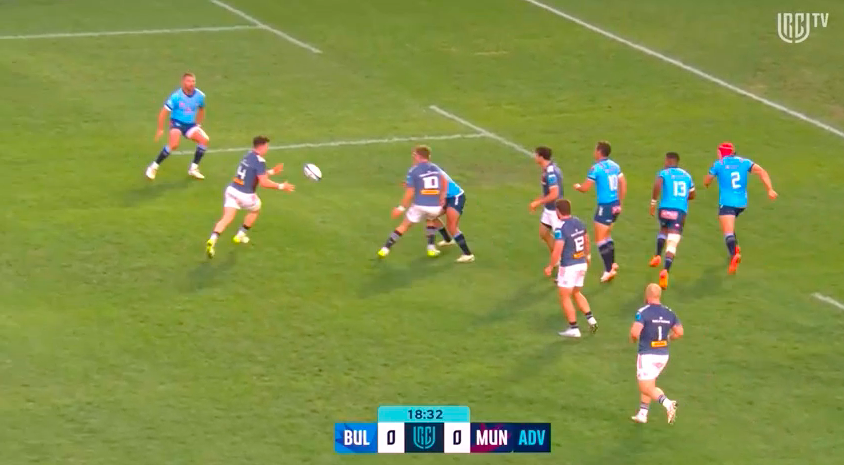
But Crowley’s biggest strength, in my opinion, is that he is committed to playing with variety. This led some outlets to criticise him for “not taking the ball to the gainline” during the Six Nations as they scrambled for something – anything – to criticise him over. As I’ve shown, Crowley does take the ball to the gainline but a good playmaker can’t just do one thing; you have to be able to pick your passes as the picture changes in front of you too.
This example from the Bulls game is pretty much a perfect example;
If you were to just look at this in isolation, you’d see Crowley passing across the face of the defence and not “taking the ball to the line”.
The problem with this logic is that “the line” isn’t here;
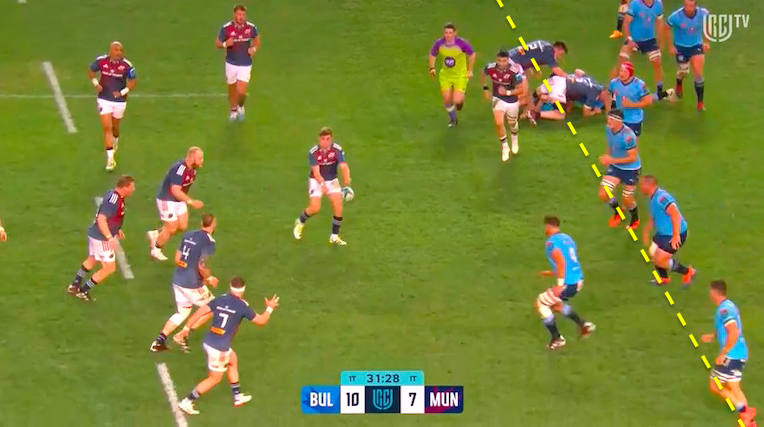
The blitzing defender means that the gainline is actually here, so Crowley’s pass has to beat him to be effective.
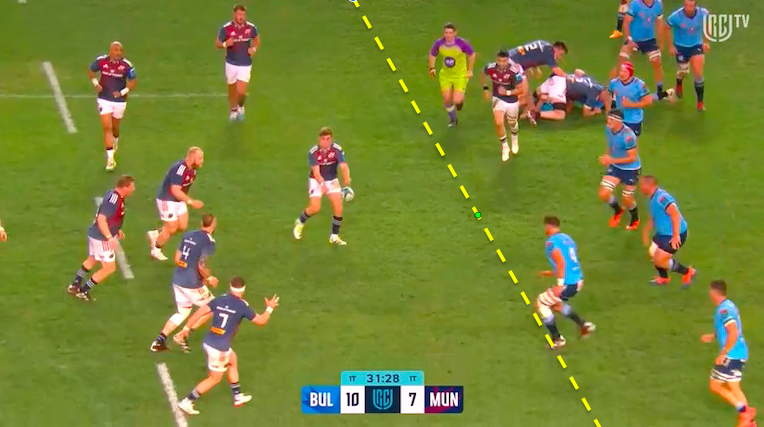
The pass is perfect – zero fat on it, perfect flight – so it beats the blitzing defender and opens up the sweep around the screen for Calvin Nash off the back of Snyman’s pullback.
Best of all, Crowley has shown he can do all of this under pressure. With the game in the balance, Crowley pulled out another spectacular bit of playmaking in the build-up to Conor Murray’s winner at the weekend. Here it is at full speed, with Murray’s finish thrown in because I think it’s cool.
But go back and look at how Crowley turned a pretty poor pass from Murray into a play action that held off Arendse’s killer blitz.
Look at how Crowley’s late pass decision staggers Arendse – because he thinks Crowley is hitting Frisch – and that delay gives Zebo enough time to escape Arendse’s recovery and spin into space.
Without that doubt, Arendese takes Zebo man and ball and makes it count.
It’s actions like these that tell me Jack Crowley isn’t just the real deal, it tells me that he’s the guy Munster have been searching for to take us to the next level. Other positions might be in flux but in Jack Crowley, I truly believe we have a generational talent in the most important position on the pitch.
