


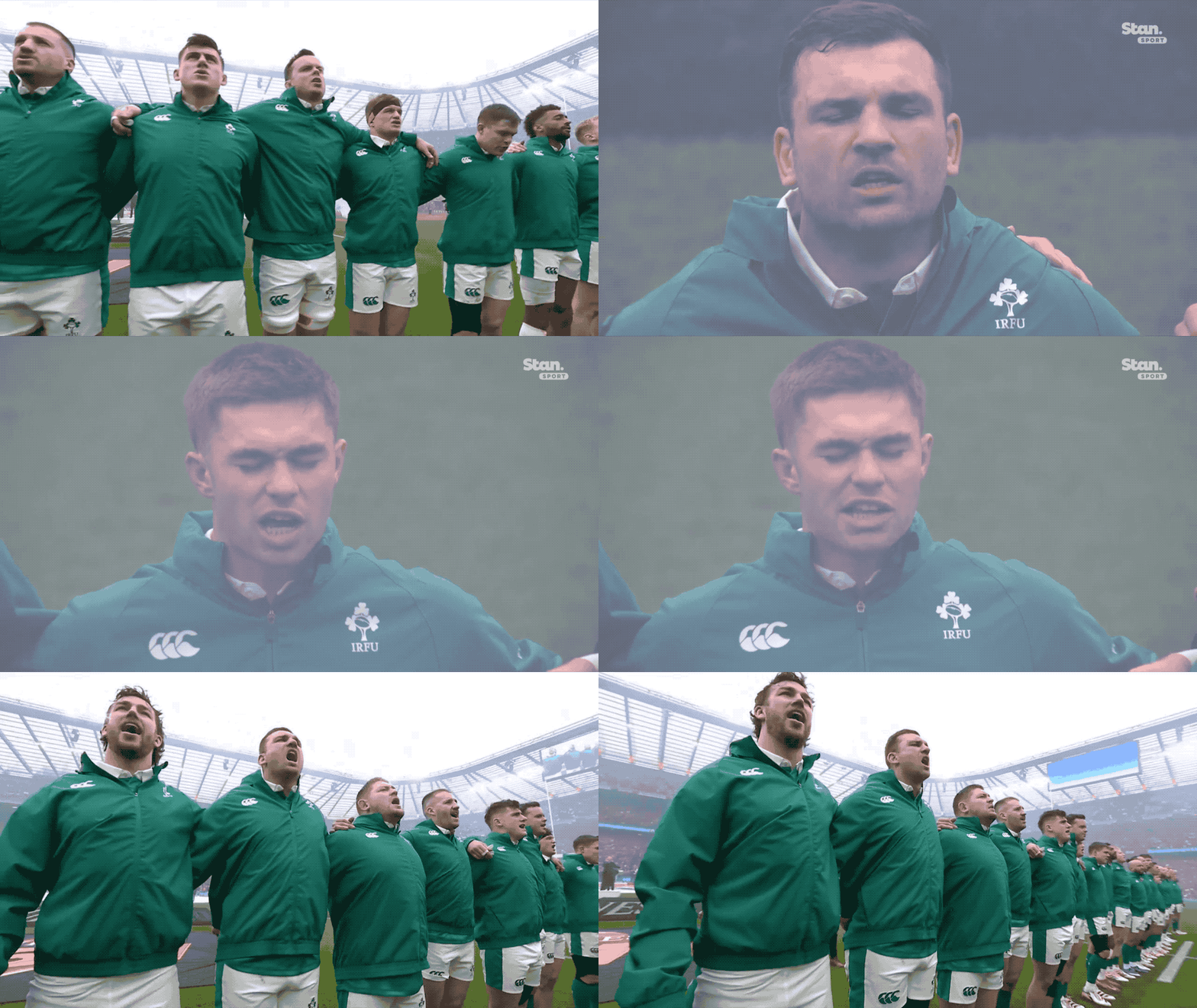

There was a lot on the line for Ireland in Twickenham.
Six Nations points, obviously. A Triple Crown starter? Yes. But, more importantly, we had vibes on the line. Where are we going as a rugby nation? Is the party over?
No. The party’s not over. It’s not a brand new party, though. We’ve found the Bluetooth for the speaker, and we’ve got a blast of the old playlist, so nobody needs to go home yet. The guitar in the corner has yet to be picked up and have Wonderwall played on it, so Party Death has been postponed, for now. It’s still there, though, the guitar, and we just have to hope that it stays in the corner, unstrangled with the first chords and “today is gonna be the day that they’re gonna throw it back to you”.
What this enormously cathartic win over England shows is that if you rock up to play Ireland like it’s 2023, 2023 Ireland will re-emerge and kick the shit out of you.
It’s like saying “Candy Man” into a mirror five times, except if you play Ireland as England did here, the Big Green Machine will appear behind you, and make no mistake about it.
What this game also showed — proved, I would say — is that there is a formula to beat this Irish team, or stymie them, and that what England brought through either coaching error or on-field misread was the exact opposite of that. I’ll show that in a later article, but first, a quick little read* on what I think happened, and why it was so different to the Green Eye.
* I’ve just come back to edit this and realised my quick little read is 2000 words. So there.
What Actually Happened
My central threat model going into Twickenham was built around England’s kicking game — the one they showed for most of the last 12 months. Kick early, kick often, chase aggressively, force us into transition defence, and exploit the scramble vulnerabilities that have been quietly eroding our defensive numbers for two seasons. That’s the version of England that was always going to be dangerous. That’s the version that didn’t show up.
Almost immediately, I got the feeling that England were off-model, for whatever reason.
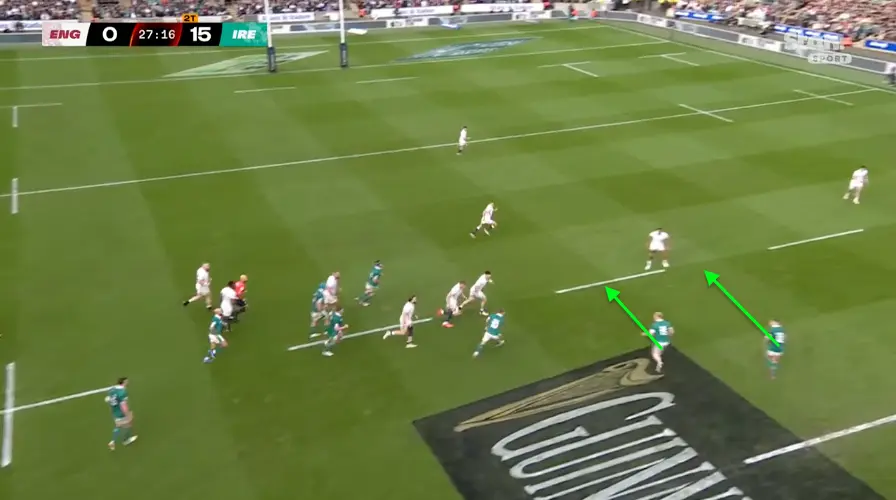
Have a look at this sequence here, and have a think about what looks “off” about it from an English perspective, and why it might suit Ireland.
Steward doesn’t take the lineout — mistake #1 based on recent history — and runs back in transition to a massed Irish defence.
England then ran through a five-phase block before kicking a shallow contestable that didn’t have any functional difference to a long pass over the top, before taking another two phases and eventually turning the ball over.
In the last two weeks, neither France nor Italy went through any sequence of phases in the same zone, especially on transition. They either kicked back immediately or took two or three phases max per possession before kicking deep into Ireland’s backfield.
In practice, what happened here was Ireland kicked the ball from our 22 off the restart and, seven phases of defence later, got the ball back up the field.
Ireland got a free-kick at the scrum, and exited really well through Crowley, even with a scrappy enough screen-ball from McCloskey.
More ground.
England then blew the lineout, and Ireland surged into their 22 before coughing up the ball for a scrum, then a scrum penalty. Ford only got 20ish metres off the kick — that would be meaningful later — and instead of just doing what France and Italy did, which was play it quickly off the lineout and kick to exit, England decided to maul with a drive unit made up exclusively of small forward build players.
Forget, for a minute, that Genge blew the backlift on Itoje to give Ireland a clear drive through on the maul, which allowed Ireland to blow up the infield side of this drive immediately.
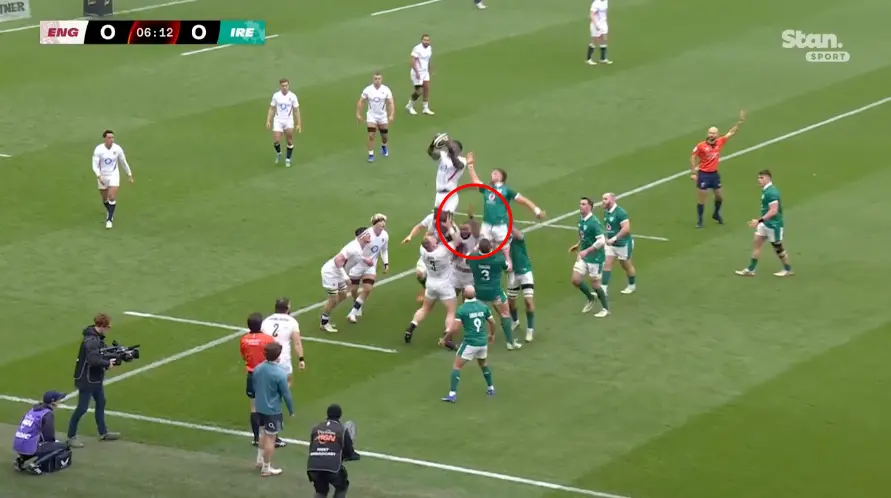
Even the intent to maul here at all, with the pack they selected, seemed completely off-model. Mitchell isn’t in a position to take a drop down of the top here — the plan was always to maul this — so the tactical plan that made sense in this moment (drop to Mitchell, hit Ford for an exit) was never on the cards.
Did they feel Ireland’s maul would be this soft with three locks barely six minutes into the game?
They must have.
Ireland turned the ball over really well through McCarthy and surged into the English 22 again, eventually forcing a penalty for 3-0.
England won a cheap enough penalty after a long kicking battle that they came out on the wrong side of, tactically.
Ford missed the kick to touch, and England started again near half-way with a no-jump maul that made decent ground without compressing Ireland.
When they played off it, they played narrow and soft; look at Van Der Flier hassling England on both of these rucks.
Watching this, I felt England would reset to kick here. It’s a slow ruck, two slow rucks really. They were already getting the edge in the scrum, so it wasn’t really a ball they had to play.
But they did. Pollock got away with a carry that should have been a penalty for not releasing, but even when England got into Ireland’s 22, they were never really playing “outside” Ireland. They were on the 5m line, but never really looked comfortable because they walked Ireland back into that zone.
Baloucoune makes a huge, physical read on the edge off a scrappy, hopeful pass from Mitchell, and Ireland were back up the field.
England were asking Ireland if we could work hard in defence off short-rucks. If that were an exam question for this Irish team, it would be the equivalent of getting points for writing your name at the top of the paper.
When Ireland gave up transition opportunities, you could see England — and George Ford — double-crossing himself in confusion.
The obvious play here was for Ford — who looked at it twice — to find grass behind Lowe. Osbourne was in the previous ruck; Crowley was guarding the blindside back pin.
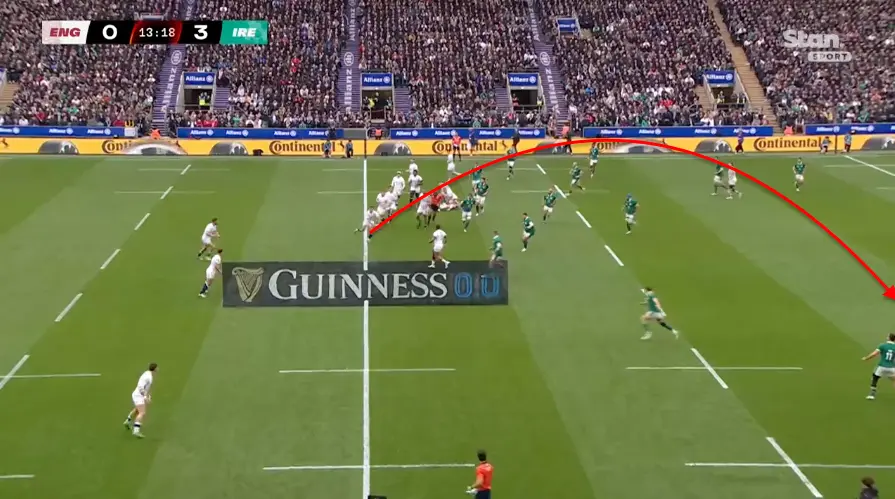
Instead, he goes after the fake transition space through the hands, which Ireland scramble on and shut down, forcing another turnover.
Ireland’s defensive issues in the first two weeks had nothing to do with a lack of hard work or closing down space on transition. England’s approach here almost seemed to bank on the issues we’ve had in transition spaces, without taking the necessary steps to create the same conditions.
When they did, eventually, box kick, Baloucoune in particular bullied Arundell in the air.
That seemed to convince England that kicking contestably at any volume wouldn’t work. Ireland were not giving them the pictures that they, perhaps, had anticipated.
Here is another long, long sequence of phases where England are burning through rucks and Ireland rarely look that uncomfortable.
Fourteen phases in, it’s England who look leggy going from ruck to ruck.
The numbers from the opening 18 minutes tell you everything about why. England burned through 43 rucks in that spell — almost half their total for the game. Seven possessions, 348 seconds of ball-in-hand time across those sequences, for an average of a ruck every eight seconds of attacking possession. They had 101 and 131-second possessions that represented sustained periods of contact that would test any forward pack’s legs, with nothing to show for it.
For the remaining 62 minutes, England managed just 57 rucks — dropping to 0.92 rucks per game minute. That’s a collapse in tempo of roughly 60%, and it wasn’t a tactical adjustment. I think it was exhaustion. England had front-loaded an enormous physical investment into their on-ball sequences against a defence that was making stops and winning turnovers. 18 minutes in, England looked cooked. There were still 62 minutes to play.
Counter Punch
It’s not just defendball, though. You have to be able to counterpunch, and Ireland did just that to take a 10-point lead around 18 minutes.
Everything about this is Classic Ireland.
McCloskey holds three defenders in place, releases a lovely pass to Baloucoune, who torches Arundell up the wing, only to release the ball inside to the hardworking O’Brien.
A 22-entry.
From there, Ireland were playing into a skittering English defence who struggled to get back into position. This was the key bit for me — Ringrose and Crowley tearing up that English edge with a nice Sexton loop. McCarthy made a big carry off the pick and go into space, England gave away a penalty, and Gibson Park made them pay.
10-0.
The next ten minutes, England were well and truly in a washing machine. Blown out. Absolutely fucked.
They started conceding back-to-back errors with lads looking like they had cement blocks on their feet.
They were lethargic, like the air had been blown out of their lungs.
Look at England’s chase back and scramble on this box-kick, won by O’Brien in the air against Freeman, who looked in two minds as to whether Steward was going to come for this or not. Sluggish. Confused.
Van Poortvliet was out of position here — something Earl recognises — and he has to scramble across the field to fill the obvious gap.
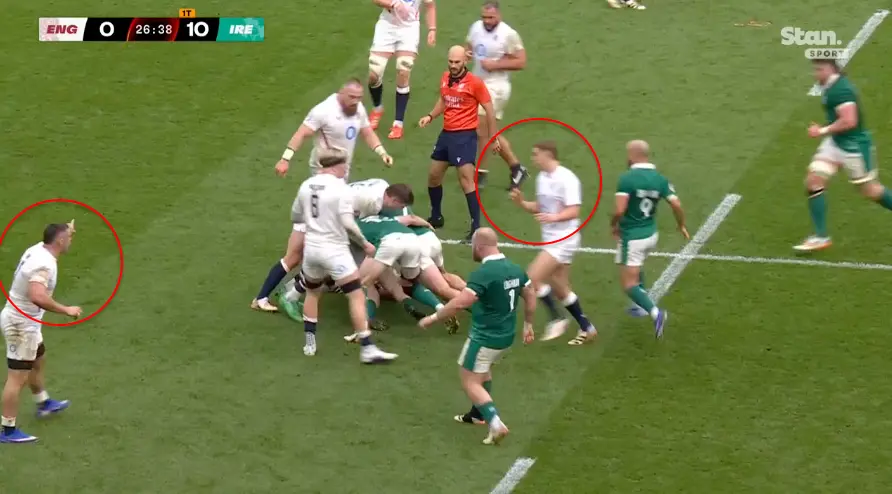
But Ireland get to the gap first.
Crowley finds Osbourne — Crowley drawing some nice compressions on his line because of the quality of Beirne’s screen ball — and McCloskey makes the big breakthrough in midfield off a pop from Osbourne. The hero ball to McCloskey would be the easy, look-at-me play here, but Crowley runs the simple ball to Osbourne, who puts Big Stuart through the gap, with Van Poortvliet in no man’s land.
Gibson Park picked the perfect pass off the break to find Baloucoune in space, England lost Steward to a yellow card, and it was almost game over at that point.
England conceded a 50m linebreak direct from the next restart. A few minutes later, Ireland had a third, and it really was game over.
In the ten minutes directly after England expended a massive, 131-second-long sequence that ended in nothing, off the back of a huge ruck output in the opening quarter, they conceded three tries from range.
England threw their Sunday punch in the first eighteen minutes. Ireland just wasn’t there when it landed. They came out swinging and hit nothing but air, cordite from the fireworks and steam.
They recovered with around five minutes to go in the half, and finally got a score back on 41 minutes. The damage was done.
England lost Henry Pollock to a yellow card inside the first two minutes of the second half after an excellent linebreak on post-transition phase play by Doris, Ireland converted the tap and go. Bonus point.
And that was that.
The whole concern going in was that England would kick us into the transitions we’ve struggled with — instead, they played directly into our hands early, generating phase after phase that our defence could organise against and terrorise, before blowing themselves out.
We didn’t face the aerial contest. We didn’t face the scramble of a bouncing ball and hard running in a broken field. We faced a team trying to carry and ruck us into submission, and that’s a fight we still know how to win, and probably always will.
The turnover count told the same story. England lost 24 turnovers to our 12. In the Green Eye, our 42% missed-tackle-to-linebreak rate was flagged as a critical vulnerability, but England never built the phase quality required to stress-test it. The ball kept getting spilt before the pressure could compound.
England did get into our 22 with reasonable regularity but only managed three tries, most of those when the game was long dead. Our red zone defence, which looked so fragile on paper, held better than the data suggested it should. That’s an area where we outperformed our own expectations, in combination with infinitely better work on transition.
The uncomfortable question is whether we forced England into the daft, pass-and-carry heavy game, or whether England simply made the wrong tactical call — either through hubris, panic, or both — and handed us a game we might have struggled with against a more tactically disciplined opponent.
The scoreline felt comprehensive — was comprehensive — but the underlying picture is more complicated. Any teams that are to hurt us in the remaining rounds, or for the rest of the test season, are the ones who won’t make the same mistake that England made.
But that shouldn’t dampen down the quality of this win either. Ireland were under serious pressure coming into this game, in a place that it’s never easy to win, and they made it look really, actually quite easy to win in that place, as it happens.
Whether England were off-model, or off-structure, or just didn’t fancy kicking the ball here for whatever reason, they still had to be put away, and when Ireland saw a blowing, stunned opponent in front of them, they were as ruthless in that ten-minute block as I’ve seen, even at their peak.
That’s the crux of the question of decline.
I think that Ireland are still on the decline as a top, top team. I think the rest of the 2026 will probably show that, but I hope it doesn’t. I hope Ireland win their next two games and that France slip up.
After yesterday’s game, I threw my little girl up into the air as she shouted “Yaay Ireland!”, admittedly at her mother’s prompting. Ireland had beaten England in Twickenham, and whatever about anything else, that’s always a good thing.
A great thing.
| Players | Rating |
|---|---|
| 1. Jeremy Loughman | ★★★ |
| 2. Dan Sheehan | ★★★ |
| 3. Tadhg Furlong | ★★★★ |
| 4. Joe McCarthy | ★★★★ |
| 5. James Ryan | ★★★★ |
| 6. Tadhg Beirne | ★★★★★ |
| 7. Josh Van Der Flier | ★★★★ |
| 8. Caelan Doris | ★★★★ |
| 9. Jamison Gibson Park | ★★★★★ |
| 10. Jack Crowley | ★★★★★ |
| 11. James Lowe | N/A |
| 12. Stuart McCloskey | ★★★★★ |
| 13. Garry Ringrose | ★★★★ |
| 14. Robert Baloucoune | ★★★★★ |
| 15. Jamie Osbourne | ★★★★ |
| 16. Ronan Kelleher | ★★★ |
| 17. Tom O’Toole | ★★★ |
| 18. Finlay Bealham | ★★ |
| 19. Cian Prendergast | ★★★ |
| 20. Nick Timoney | ★★★ |
| 21. Craig Casey | ★★★ |
| 22. Ciaran Frawley | ★★★ |
| 23. Tommy O’Brien | ★★★★ |
