


Munster’s attack has been good or at least threatening to be very good all season, it just hasn’t always been clearly visible. For me, an attack is measured in tries and points scored, and when you start adding in things like Expected Tries or using linebreaks as a key measurement, I think it’s easy to get lost in the weeds. At the same time, however, if we’re to look at just points scored, there is no difference at all between a 5m driving maul that scores inside four phases and a ten-phase post-transition sequence that shows up on a post-season highlight reel. If anything, the maul try is more efficient. It uses less energy, has less scope for error and can be easily drilled repeatedly.
A ten-phase post-transition scoring sequence uses a tonne of energy, has a tonne of scope for error and is very hard to layer onto the squad to execute it perfectly.
I think most of what we talk about when it comes to Good Attack comes down to efficiency or inefficiency and a lot of that comes down to the choices made by the coach. Under Van Graan and Larkham, for example, Munster were a very efficient team in how we used possession but ultimately not an elite attacking side when it came to breaking teams down during phase play. We are visibly less efficient under Rowntree – we play way more phases, from further out the field and expend more energy in doing so – but, as a result, we’re a far more dangerous side.
A good rule of thumb regarding attack is that if it is very efficient to utilise, it must also be efficient to defend against. If we go back to the idea of the maul try as an example; you can disrupt it in the air, you can sack the maul on the drop and you can muscle up off the try line. These are not easy things to do but they are “simple” and, from an energy-expended perspective, you can defend as efficiently as the attacking team can attack.
“Inefficient” attack works on the same principles. If it’s inefficient for the attacking team it will, when done right, also be inefficient for the opposition to defend. It’s the “when done right” part that’s the most difficult to do at a high level and it’s what Munster have been trying to build over the last two seasons.
Lateral Movement
At this stage, you’ll be familiar with the idea of looping wingers. Last season, you’ll also have been familiar with looping midfielders as Antoine Frisch and Malakai Fekitoa would join in on the players who would start a sequence on one wing and then, a few phases later, show up en-masse on the other wing to overload the opposition defence. As an example, here’s Alex Nankivell hugging the touchline.
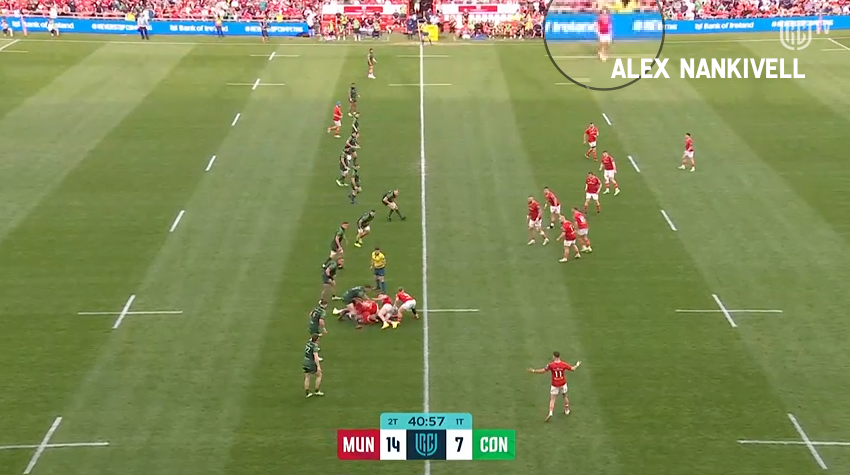
As the play develops, Sean O’Brien (wearing #12) and Shane Daly loop around the play to arrive late onto the pass in the second and third layer respectively.
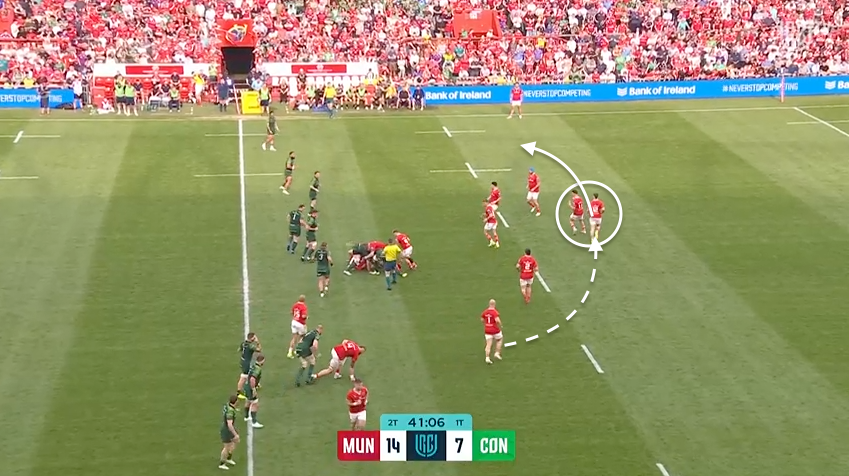
When we look at the whole play, we know it doesn’t work out – Nash grabs at the ball but lets it through, which puts O’Brien off and forces the knock on – but we can see the intent. The two rucks across the field create the time for the loop runs to happen in the first place.
Without those two rucks, O’Brien and Daly don’t have time to arrive late to the line in the second and third layer of Munster’s attack. If Daly’s pass sticks to either Nash or O’Brien, this is a linebreak up the edge of the field at the very least, with more danger in the next phase for the defending team. On this post-transition scheme, Alex Nankivell plays the role of a winger while Daly is, essentially, the “midfielder” giving the pass into the second layer.
Munster’s backline moves the pieces around from the “traditional” positions almost constantly with our #11 acting as a looping playmaker when the ball is coming left to right and as a finisher when the ball comes back right to left.
The #12’s role is pretty much the inverse of this on those post-transition phases with the #13 in this system being a secondary playmaker off Crowley who also has full licence to get into that edge space. This is a variant of the play I showed you above but with Daly and Nash running the loop route and Frisch holding his width.
When done right – and with enough compression making forwards on the two phases prior, this structure of looping and positional distortion creates opportunities for players to get into space and make something happen.
In the last couple of months, however, Munster have started adding looping edge forwards to this overall attacking framework as part of our evolving use of the 3-3 forward shape in the middle of the field.
In the above video clip, you can see our 1-3-3-1 base formation pretty clearly.
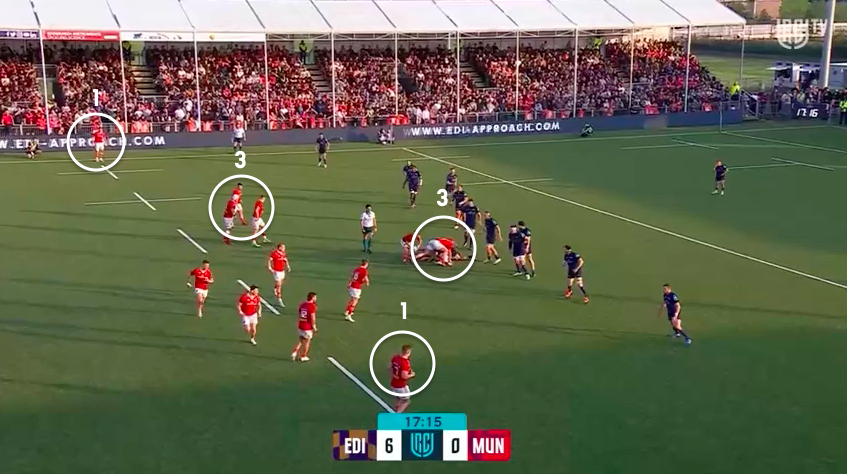
You’ll often see one edge forward hugging the touchline in this formation while the other stays a little closer to the play to act as a blocker or ruck support player in and around that 3/4 space. As a guideline, Nankivell, Nash and Daly are flooding the 3/4 space in this screenshot.
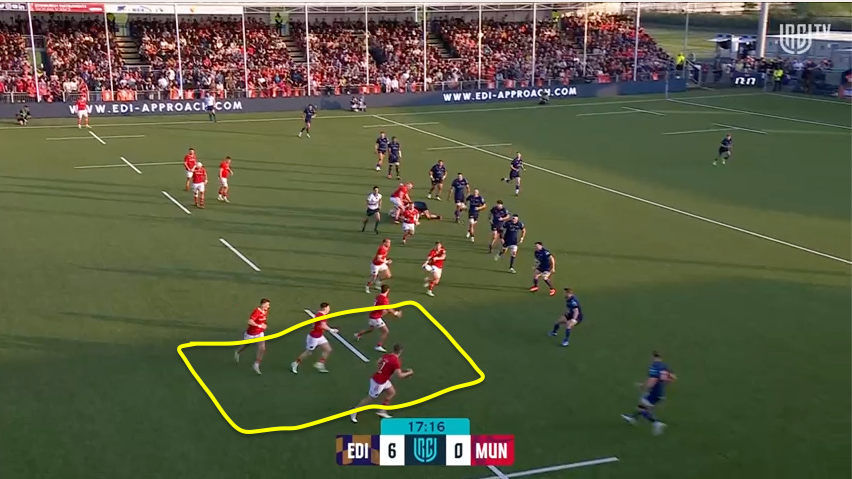
Kendellen holding staying narrower here drags Van Der Merwe away from the tramline and that gives Nankivell the cue to fire a pass over the top to Frisch.
But the formation isn’t rigid.
What we’re also seeing now is Munster rotating and stacking edge forwards by running them in loops on post-transition phase play.
What’s the benefit of this? If you loop your backline to make sure they show up on overloads in those tramlines, why wouldn’t you loop your edge forwards who also occupy the same spaces? In both examples here, Munster moved a forward from one zone where they were clocked and “marked” by the opposition to a position where they were not. When players move so much behind the central play – especially with a primary playmaker like Crowley who can create something out of nothing with his athleticism – it creates unpredictable pictures that change very late for defenders.
And none of it is possible without “inefficient” phase play that allows there morphing formations to build over three, four or five phases.
