


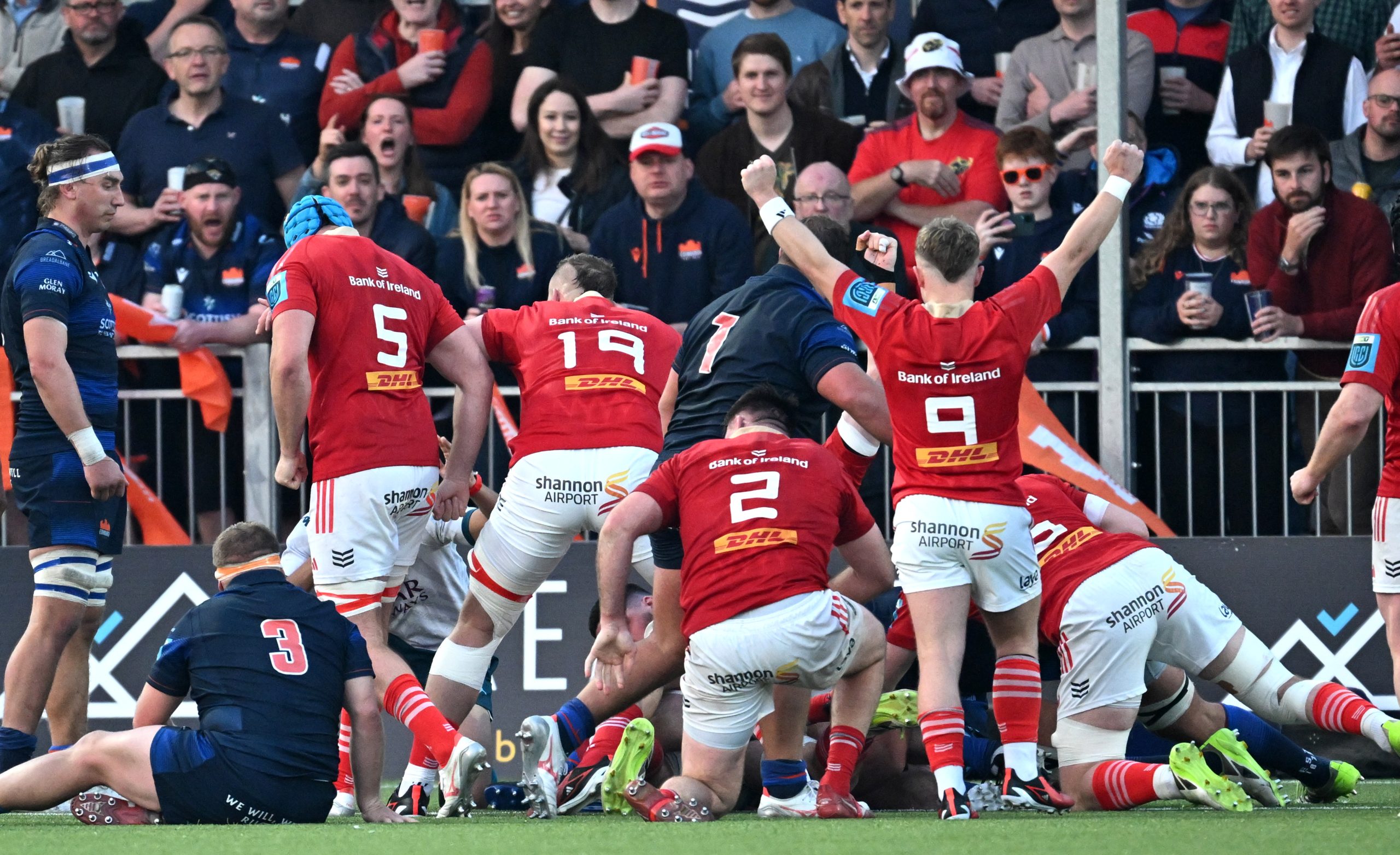
The best thing about this Munster team is that even when it was 26 all with just over 10 minutes left after one of the most ridiculous bits of TMO work I’ve ever seen and with a man in the bin, I never had any doubt that we’d pull this one out of the fire.
We did just that.
I wrote before the game on Friday about how good Edinburgh are and how difficult it would be but here I am on Sunday writing about another bonus point win on the road (for the Bad Guys) with Munster sitting #1 on the log with one regular season game to play.
I specifically – and speculatively – wrote the following in the Red Eye;
Seven games, 34 points, and six bonus point wins put us in a spot where we can realistically say that we can finish this round on top of the log with a home quarter-final, semi-final and final within reach with just one regular season game to play if results go our way this weekend, including our own.
Munster won with a bonus point on Friday, then Glasgow lost with nothing in Johannesburg and then Leinster dropped a late loss to Ulster in the final game of the round; all that combined to leave Munster top of the league, two points ahead of the Bulls and three points ahead of Glasgow and Leinster.
Any kind of win over Ulster in two weeks will guarantee us a home semi-final and final, should we win the home quarter-final we’ve already earned. That’s what it’s come down to; four home wins will retain the URC title in Thomond Park.
It’s one game at a time from now on – quite literally – but one thing will stand to this group above all else as they climb that mountain again; toughness.
It’s that toughness that saw only one of our four league losses this season end without a bonus point when we struggled to field a back five with anyone over 6’4″ between December and January. It’s that toughness that saw us front up two weeks in a row with half the squad sick as dogs before going to South Africa a week later and taking home ten match points, something no other northern club has done in this league. That toughness saw Munster come from behind against a fully loaded Edinburgh and ride out a hostile home crowd in the second half to go top of the league.
You can’t fake it; you either have it or you don’t, and this Munster team have it in spades.
***
Munster are forcing adjustments from opposition teams as we head into the business end of the season.
For me, your chosen game state is almost entirely defined by your kicking tendencies and how many passes you make relative to those kicking tendencies. There are four primary moments in this game during open phase play; settled attack, settled defence, offensive transition, and defensive transition. They are all linked and interdependent. When a team in possession (settled attack) chooses – and it is a choice – to kick, they are accepting that retaining the ball directly from the kick is proportional to how far you kick it. The closer you kick it, the better your chance of retaining the ball directly but even the best teams at retaining their kicks – the Sharks in this year’s URC – only manage to retain 19%. So 81% of the time, the Sharks kick the ball and don’t get it back.
What happens then? The team that was in settled defence transitions into the attacking team, and vice versa. The teams who kick longer generally do so to avoid scrummaging too much and accept they will retain very few of those kicks. They are comfortable defending – settled defence and defensive transition – and their preferred game state is hammering teams with their defence to produce errors and penalties in those game states. These teams will tend to not waste time passing the ball too much relative to these kicks throughout a game so the number of passes per kick will be lower. Leinster in the European Cup and the Vodacom Bulls kick in the lower counter-transition range to put that emphasis on their settled defence, defensive transition and offensive transition at the expense of complexity in their settled phase play.
On-ball teams still kick the ball but put a lot of focus on retaining the ball. They might kick as much as an off-ball team but when they get the ball back they pass at a higher volume as they try to break the opposition down. As a result, on-ball teams have a big focus on their settled attack, settled defence and offensive transition.
Edinburgh were solidly in the on-ball range over the last four games. Munster were just on the lip of Counter-Transition after two kick-heavy game weeks in South Africa, but would usually be up around the 10.0 mark. Our three games before this four-game stretch have an average of 10.8.
In the three games before this one, Edinburgh’s Pass to Kick ratio averaged out at one kick for every 7.9 passes. I’ve mapped some relevant teams’ Game States over the last four URC games but I also included Leinster’s European run to show the difference in game states relative to peak performance. We’re at the time of year when very few teams play pure off-ball rugby over a three-game stretch; hard ground and dry days mean more ball in hand, even for kick-dominant teams, but we can still establish trends.
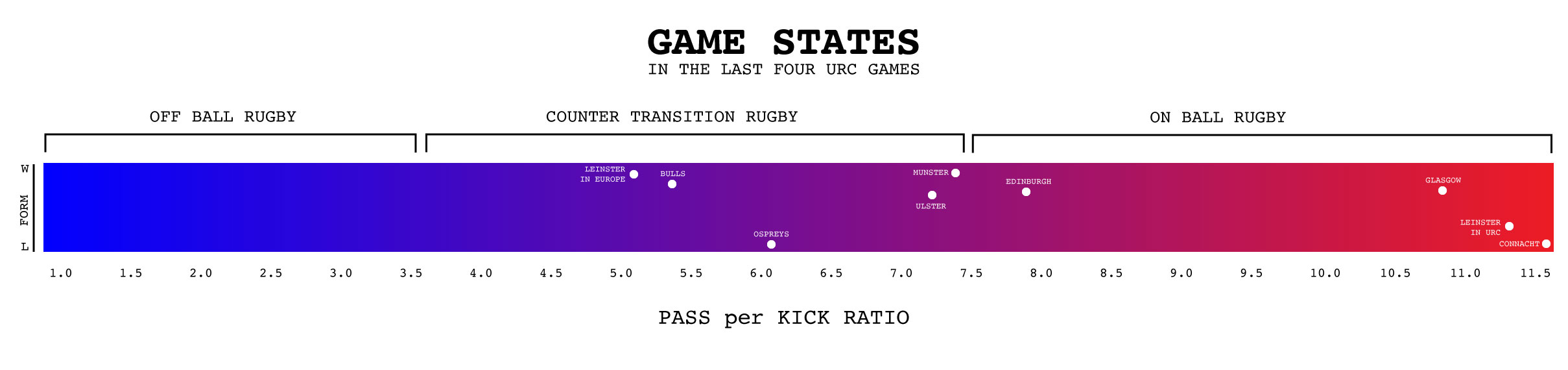
Your preferred game state is where you play your best, most effective rugby. Leinster’s best rugby – illustrated by a three-game winning streak in Europe – is on the lower end of the counter-transition scale, near enough to the Vodacom Bulls from a game-state perspective. In the last four URC games, however, where they’ve lost three of four, their game state has skewed towards heavy on-ball rugby. Connacht have lost three of the last five games and they have the highest Pass-per-Kick ratio in the league. On the other hand, Glasgow have been winning most of their recent games while playing in the heavy on-ball range, right where they are comfortable.
Against Munster on Friday night, Edinburgh had a Pass-per-Kick ratio of 3.9 passes per kick, which would be just outside the off-ball rugby range. What is it about Munster’s game that pulled Edinburgh so off-scheme relative to what we typically see from them?
First thing; environmental factors. In the first half, Edinburgh got a tonne of change from Munster because of the added advantage of a low spring sun dazzling our backfield.
There was some poor fielding too, though, and it gave Edinburgh entry points where we know they’re good; creating penalties through their phase play around the 22 and through their scrum, when they’re fresh. They also got good returns from attacking our offensive breakdown, in between moments when it looked like we were capable of cutting them open over and over again.
They even gave up decent lineout position to have a go at kicking to our backfield which, again, produced the opportunities they would have drawn up before the game.
To understand this we have to understand what teams are seeing in our game state. We are typically an on-ball team so what does that mean from an opposition perspective? It means we won’t kick that much and we go through a lot of rucks, and we will pass the ball a lot to get to those rucks. What does this mean? Attack the breakdown, because if we go through a long sequence of phases we’ll have to under resource one or two rucks to build a number advantage somewhere.
Why kick more? Because we have the second most turnovers in the league while being 8th on tackles made. Cardiff have 134 turnovers won this season so far – the most in the league – but they also have the most amount of completed tackles while kicking the most and longest. So Cardiff’s game is based on kicking the ball long down the field, limiting the amount of time they spend in their half of the field and then maximising their work in settled defence and defensive transition after the kick.
For Munster to be second in the league for turnovers – 116 so far – while kicking the ball way less and making way fewer tackles means that we’re the best team in the league when it comes to defensive efficiency. We’re winning a turnover every 20 tackles this season, which is better than Cardiff who have made 404 more tackles. Ulster, who we play next, are winning a turnover every 31 tackles, to illustrate the difference in approach. This is especially important when you realise that Munster have the most tries scored in the URC this season in the aftermath of a turnover.
What does this mean? It means that Edinburgh were wary of conceding breakdown penalties or losing turnover ball to us so they passed the ball less often, played narrower and kicked more often so they could defend us instead, with a real focus on the defensive breakdown. When you combine those, it causes us problems and we saw that here too.
It’s a strategy not without risk but it’s one they felt would work. For a time, it did. They went to a 16-5 lead at one point but we were able to use their game plan against them.
We don’t really get the credit for being as good on transition as we are right now. To be an on-ball team, you have to be a good offensive transition team otherwise teams will just kick the ball to you, hem you into your half of the field, watch you burn through phases and eventually watch you turn the ball over in your territory.
If you’re a really good transition team, you’ll be able to “close the loop” on teams who try to off-ball you. As the game wore on, we kept finding separation when Edinburgh kicked to us. They stopped getting slowdowns and steals, we started finding the outside edge and getting over the gainline as we came back across.
We’re turning into a very complete team as the season runs to a close. We’re beating opponents in multiple different ways and showing that we can adjust – with the personnel to match now that we have a somewhat improved injury list – to the opposition if we have to. We’re also showing that we find ways to win tough games and, in doing so, rightly top the league right as we hit the final straight.
It won’t be easy from here but we’ve shown the kind of grit and quality that champions have; with any luck, we’ll take some stopping.
| Players | Rating |
|---|---|
| Jeremy Loughman | ★★★★★ |
| Niall Scannell | ★★★★ |
| Oli Jager | ★★★★ |
| Fineen Wycherley | ★★★ |
| Tadhg Beirne | ★★★★ |
| Jack O'Donoghue | ★★★★ |
| Alex Kendellen | ★★★★ |
| Gavin Coombes | ★★★★ |
| Craig Casey | ★★★★★ |
| Jack Crowley | ★★★★★ |
| Shane Daly | ★★★★ |
| Alex Nankivell | ★★★★ |
| Antoine Frisch | ★★★★ |
| Calvin Nash | ★★★★ |
| Mike Haley | N/A |
| Eoghan Clarke | ★★★★ |
| Mark Donnelly | DNP |
| John Ryan | ★★★ |
| RG Snyman | ★★★★★ |
| Tom Ahern | ★★★★ |
| Conor Murray | ★★★ |
| Rory Scannell | ★★★★ |
| Brian Gleeson | ★★★ |
