


I’ve used the rhetorical vehicle of Bo Burnham’s “That Funny Feeling” so many times since the pandemic. Too many times, you might say, and I’d be inclined to agree with you, but I use it so often because it reflects, admittedly at a very surface level reading, that feeling you get when you know something is wrong, but all you have to point to are unconnected signs.
This is my favourite line of that song.
In honour of the revolution, it’s half off at the Gap
It perfectly captures late-stage capitalism’s ability to commodify its own demise, turning the idea of radical upheaval into a seasonal promotion. Burnham’s irony lies in how rebellion is no longer a realistic threat to the system but a theme for retail branding within it. Revolution now comes with a receipt and a 30-day return.
There it is again, that funny feeling.
In a bare-bones rugby content application, I’ve often used it to describe Munster performances where something familiarly depressing has shown itself again, in either a win or a loss, which provokes that funny feeling.
So you can imagine how thrilled I was when Jamison Gibson Park said this after the Lions’ scrappy win over the Brumbies on Wednesday afternoon, Irish time.
“I suppose we are happy with the result in the end, a patchy performance, but we are happy. Hats off to the Brumbies, they came with a plan and they executed it well. There is a little bit of a funny feeling in the camp, but there are things we need to review. We don’t get a lot of time on the training pitch, and a lot of things are done in the meeting room.”
You can imagine how thrilled I was. I get to use it again!
At a basic level, I’m sure Jamison Gibson Park was referring to the fairly unconvincing win he’d just played in, but it also seemed to indicate a general unease with how the Lions have been playing and training. That final sentence in the above quote doesn’t just spring from nowhere, after all.
In a way, it’s entirely understandable. Andy Farrell has made quite a bold choice for this tour in that he’s demanded the squad play his prime Ireland system, almost down to the last metric. As I’ve mentioned in dozens of articles and podcasts since 2022, Farrell’s attacking system is not easily learned, relies on massive levels of in-system cohesion to work well, and is prone to disastrous breakage if internal units aren’t working.

You might say that’s true of all game systems, but some systems have more room for error than others. Farrell’s system, when done badly, has an incredibly low floor, but when it’s done well, very few teams in the game can live with it.
At its core, Farrell’s attacking system is a form of rugby league, using refined principles I laid out in For Every Wall A Hammer in 2019. Farrell, as a former defensive innovator using rugby league defensive principles, revolutionised Ireland’s attacking structure by bringing the depth and short-passing options of league attack. After all, what better way to defeat the blitz defence that came from league in the first place with core principles of attacking rugby from the same code?
At its core, Farrell’s attacking system holds teams in place with high ruck numbers – each ruck is a resetting offside line – and the real danger is almost always lying between 5/10m back from the gainline, which is why Ireland use so many short passes and looped runners to draw out defenders and then cut around them for big linebreaks.
The last time Andy Farrell had Ireland in system for a sustained period was the 2024 Six Nations, and in that time they averaged 107 rucks per game, and the only game they lost – to England – was the only game where they had fewer rucks than their opponent.
On this Lions tour, where the playing principles are broadly the same, the Lions’ worst, scrappiest performances – Argentina, Waratahs and Brumbies – have come when their ruck count has been higher than the opposition’s, and the games where they scored 50+ points came when the ruck count was lower. This makes sense when you think about it because fewer rucks usually mean a positive kicking differential, which suits lower cohesion teams.
In the same span of five games, the Lions have averaged a kick-to-pass ratio of 7.3 passes per kick per game, which is incredibly high for low-cohesion teams. When we assess Kick to Pass Ratios, the lower the pass number relative to kicks, the more pragmatically you’re playing.
The two games in which the Lions scored 50 points were also the only two games in which they had a lower kick-to-pass ratio than their opponents. Again, this makes sense for a low-cohesion team, so why aren’t the Lions doing more of this? It’s easy and also the central conflict of this tour.
This is not how Farrell envisions winning the test series.
At least, I don’t think it is.
For me, the easiest way to build up to the first test would be to layer the game plan on in stages. Start with a very pragmatic, kick-first game plan that leans heavily on the set piece and your chasing game. These are the easiest things to train with a disparate group of players coming in from multiple different playing systems.
You rely a little on your individual quality to produce some magic with this kind of system, but the Lions have more than enough firepower for that.
Instead, Farrell immediately went for the full Ireland 3-2-X shape, with all the complexity and layered running that comes with it. I get the logic, even if I don’t agree with it. To Farrell, his intent is for the Lions to play his style of attacking rugby in the tests, so he had the choice of layering his game plan in stages for the six warm-up games, or going full bore from week one. They went with the latter, and it’s been a real mixed bag, even though the results, on the face of it, have been good.
The real truth of it is that the Lions haven’t played a single credible opponent since the loss to Argentina, so the relatively close games of this past week have felt a lot like losses, right when things should be clicking.
Going back to Jamison Gibson Park’s “funny feeling”, I think the issue the Lions are facing is mainly about time. The first test is in ten days, as of the time of writing. The Lions have had four games in the last eleven days since they landed in Australia. That means at the very most, two days of light training before the game and likely two days of recovery afterwards, with the players involved recovering as the other part of the squad is trying to ramp up for the next game.
That means since they landed in Australia on the 22nd of June, the Lions have had room for just five heavy training days. In this environment, your games become your heavy training with a big focus on the review as a way to cauterise the learning from the game as an exercise, and, as Gibson Park alluded to, that means a lot of time in the meeting room. That means you’re not spending a lot of time training intensely, as Ireland like to do during international windows and that the set-up holds in very high regard when it comes to prepping for test rugby.
It’s far from ideal, and I think it’s a large part of why Andy Farrell has cut such a frustrated figure in the last week is down to this time pressure. But, in addition to this, I think players he wanted to be in key roles aren’t fitting the way he’d like as of yet and, worst of all, I think he knows that the opposition have been so poor in Australia so far that he has no idea of where the Lions are actually at, but his gut feeling is that they’re behind where they need to be.
And worse again, I think he’s seeing this pattern in the 22 Efficiency Delta going game to game;
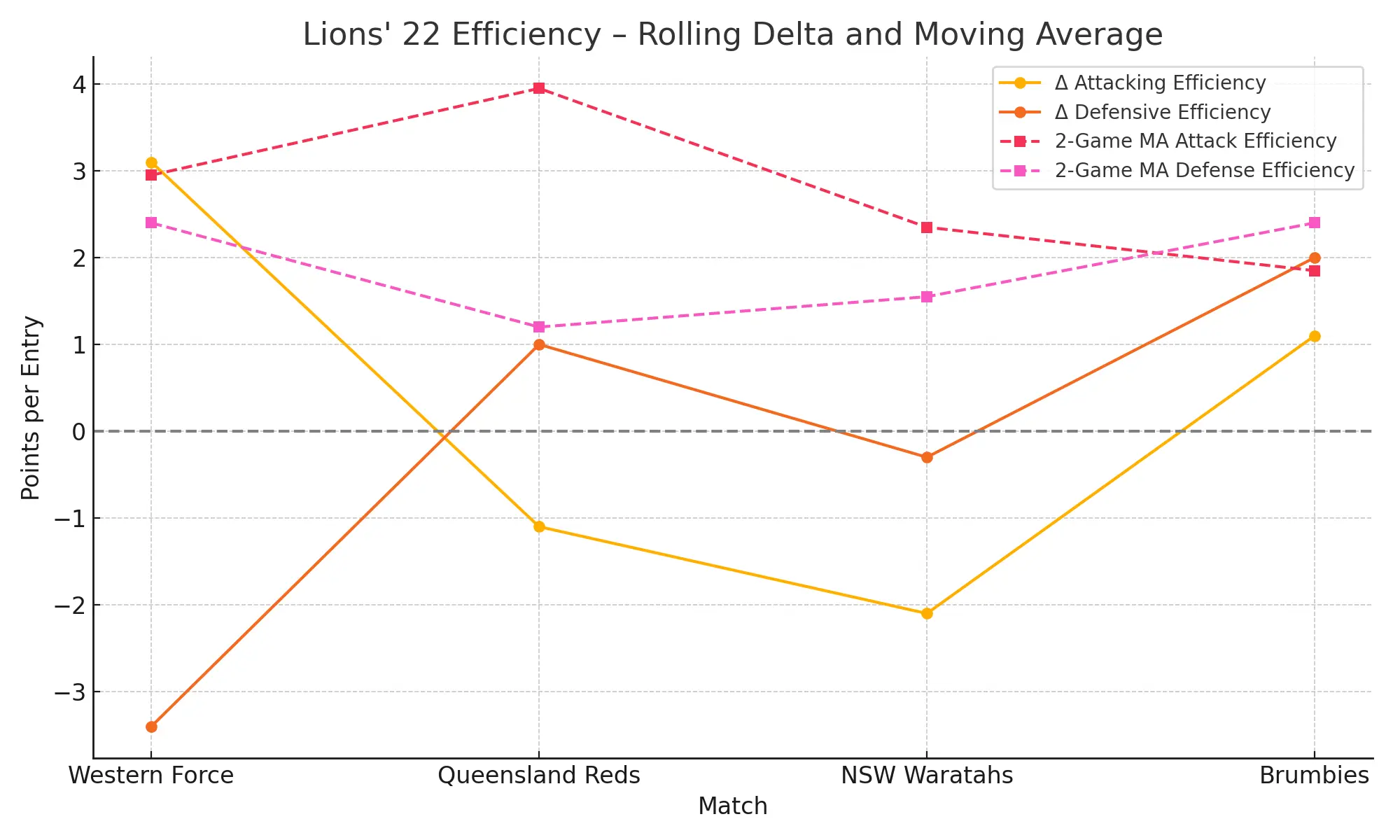
Key Swing Points
Attacking Delta:
- Big jump from Argentina to Western Force (+3.1) – massive improvement.
- Sharp drop after Reds to Waratahs (–2.1) – one of the worst reversals
- Slight rebound vs Brumbies (+1.1).
Defensive Delta:
- Huge improvement from Argentina to Western Force (–3.4).
- Worrying rise again vs Brumbies (+2.0)
The Lions’ rolling efficiency on both sides of the ball is way too close for comfort against these weaker opponents. If that trend holds for the first test against what we assume will be the strongest opponent since Argentina, things could get very nervy for Andy Farrell, and when coaches get nervy, they revert to what makes them most comfortable.
That’s when things could become particularly difficult for this Lions tour.
