

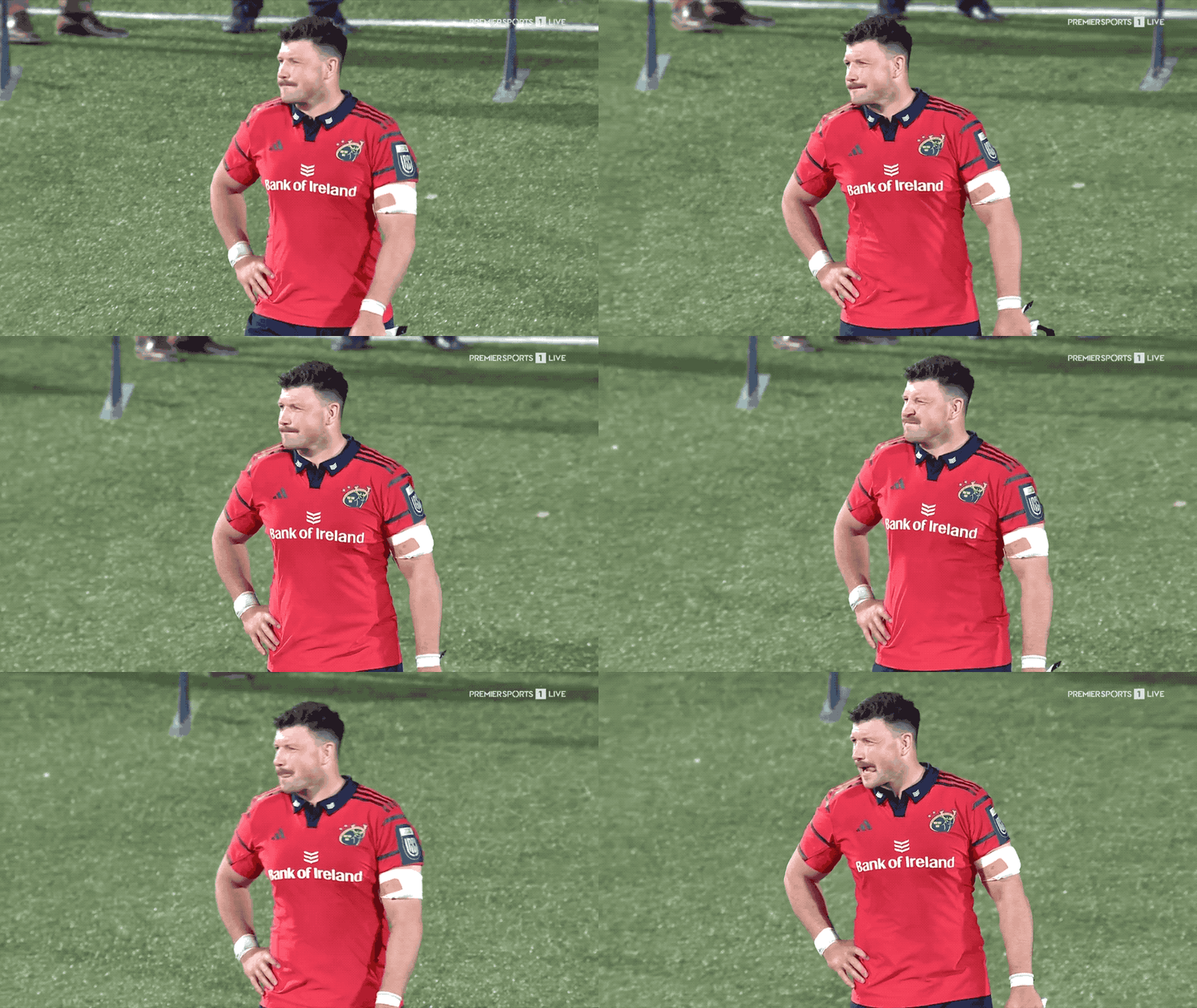

I wrote before the game that, on paper, this game was more important to Connacht than it was for us as far as the table was concerned. Turned out it looked like that on the pitch, too.
This felt very much like a game where Connacht were fighting for their season and, unfortunately, we weren’t able to match that energy. They were fighting for survival — they needed a win to stay alive for the top 8 — and we were playing to secure something. That differential turned out to be quite meaningful.
Before the game, I spoke about what Munster needed to do tactically to get what we needed out of this. We didn’t get that, in part because of how the stiff wind dictated the first half, and because of how we executed that plan. We had the wind to start — as much as any team can have the wind in the Dexcom — but we didn’t use it as well as we’d have liked, and that translated to Connacht being able to play from far further up the pitch than was ideal.
Our first possession of the game tried to get after Connacht’s defensive structure in line with using the wind, but it got charged down. You can see it here. We loaded Smith and Abrahams into a two-man chase unit on the edge. Dan Kelly tried to kick through into the space behind, but the ball hit a tangle of legs.
The play made sense, but Connacht got a decent block in place and instead of hunting down a ball into their 22, we were back on the defensive around the halfway line.
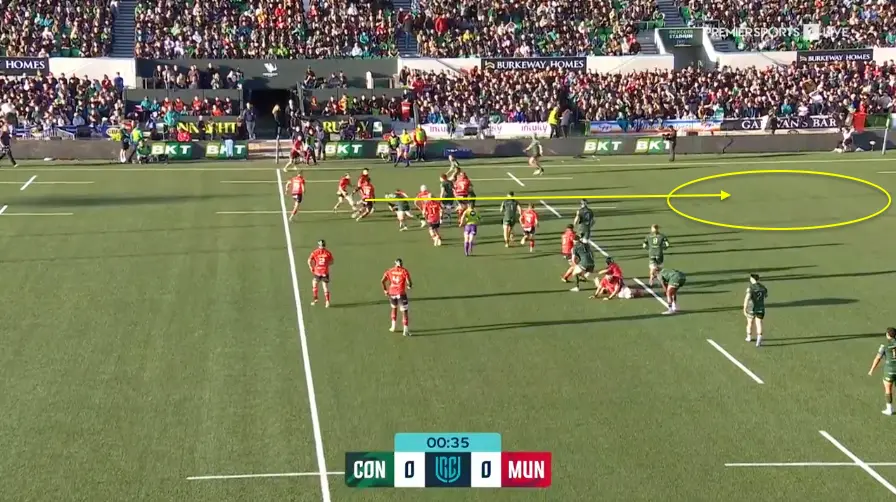
No problem there, you’d think.
Except we gave up a rudimentary linebreak right up the middle of the field off a pretty standard Connacht phase play. A bit of luck involved, yes — the ball skitters off the lead player in the pod right into the only open space on the play, but we’ve been giving up this kind of linebreak a lot this season.
The penalty on Michael Ala’alatoa at the end was harsh — he was somehow judged to be blocking the clearout despite being held on the ground a metre from the ruck — but that mostly set the tone for the first half. We knew coming in that we’d have to be perfect, especially with this particular ref, and the linebreak set the tone for conceding this kind of penalty.
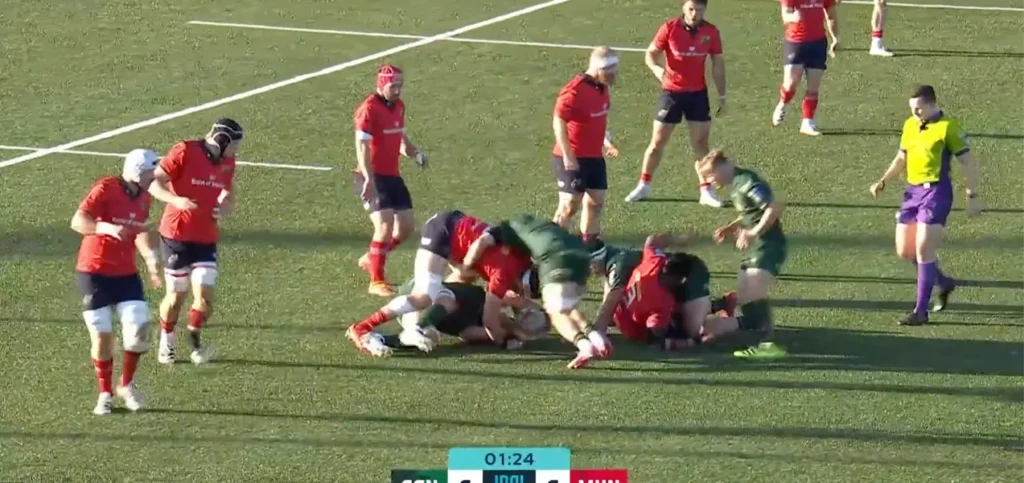
Connacht, like Leinster under Lancaster, have become really good at trapping players into the ruck, and when you give them a chance to do that, Irish referees, in particular, fall for it every time.
We conceded another penalty just like that on the play right after the exit, and the pressure was back on again.
Murphy and Prendergast are clearly holding Ala’alatoa in here, but if it works, it works. It turns bad ball presentation into easy metres. We didn’t catch onto it soon enough.
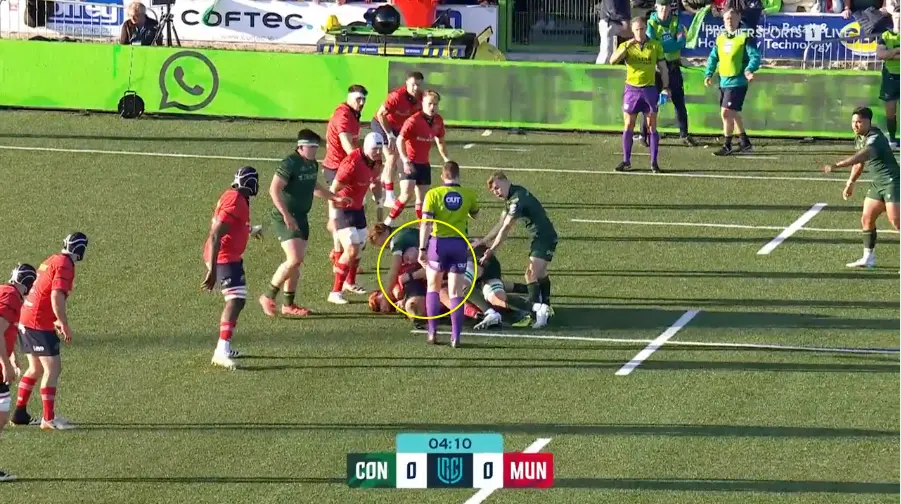
When Connacht didn’t get those easy penalties, we handled them quite well when we were playing with 15.
Their primary carriers were Jansen and Aki, and we did a decent job of stuffing them outside of the 22, but time and again, when it came time to exit and tilt the field — and the wind — in our favour, we consistently failed to do so.
This kick should be landing well inside the Connacht 10m line, for me. Instead, it gave Connacht a decent scrum platform off the knock-on from Haley, and when you combine it with passive defence, it gave Connacht momentum to move back up the field.
They did a really good job of targeting Michael Ala’alatoa in particular on multiple sets. He’s an aggressive, impactful defender, but if he’s blitzing up or half-blitzing, that leaves space elsewhere when everyone else is drifting.
That led to Connacht’s first, when we got our spacing wrong off a ruck. Ala’alatoa was slow getting up off a tackle, sure, but our fold here was all wrong.
Is Wycherley taking the pillar? Or should Loughman have stayed blind rather than folding open?
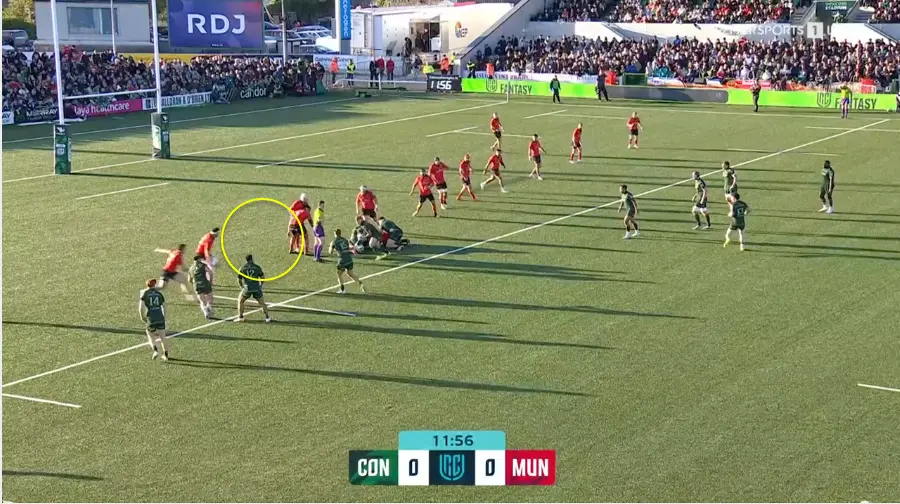
It left an obvious hole.
7-0.
No big deal. But then we conceded one of the strangest yellow (and then red) cards you’ll see all season. You’ll never see one like this again all season. Diarmuid Barron — who was already on the ground with Dylan Tierney Martin — was adjudged to have made a “croc roll” here. He was given a yellow, then a red card, after the bunker review.
This wasn’t a croc roll or anything like it because Tierney-Martin’s leg is never static. He puts his leg underneath Barron in a dynamic situation on the ground. This is a rugby incident for me, a penalty at most, and an incredibly harsh yellow/red card that I’d be stunned to see cop a ban of any kind. There’s no point in wondering about “consistency” either, because you’ll never see a decision like this in a pro game ever again. Call that the URC refereeing effect.
We spent the next few minutes struggling to get a hooker on the field as we won back-to-back penalties and coughed up both lineouts. We would concede another 12 points in the 20-minute sin bin period. 7-0 became 19-0.
Defensively, we seemed to be in constant flux with our edge positioning. On one wing, we seemed terrified to leave Abrahams with any kind of defensive responsibility, while trying to make sure we didn’t leave Hanrahan and Casey exposed on the other. When that was combined with guys crossing defensive lines in the middle of the pitch — one defender jumps across the line, meaning everything is a scrag, or a soak tackle — it left us constantly exposed.
A bad first half. Something we’ve, unfortunately, become accustomed to. Our energy didn’t ever look where it needed to be, and not from a fitness perspective. It felt, to me, especially in the forwards, that we were constantly looking for someone to produce a big moment defensively. They never really did. Not consistently.
We were better in the second half, but were unlucky not to score inside the first five minutes. If Kendellen is judged to have gotten that ball down, maybe it changes the context of the 35-odd minutes to come; maybe it doesn’t, but what it actually led to was a lot of huffing and puffing in the Connacht 22, which was almost an exact duplicate of the Leinster game in Thomond Park.
Connacht stand off our runners, we take contact on negative terms, the latchers arrive late after the collision is already lost, slow ball, rinse and repeat. This was, essentially, a three-on-one collision.
The latchers weren’t driving forward after that; they were trying to hold the ground we have.
It happens way too often, on top of our lineout maul being genuinely well below the level required physically and structurally. Barron really should have let this out to Casey before being bundled into touch, but it was in trouble from the jump.
I could show you multiple examples from this season where the defensive have already braced out our initial drive unit before we’ve gotten our drive unit in place, but this is as good an example as you’ll get.
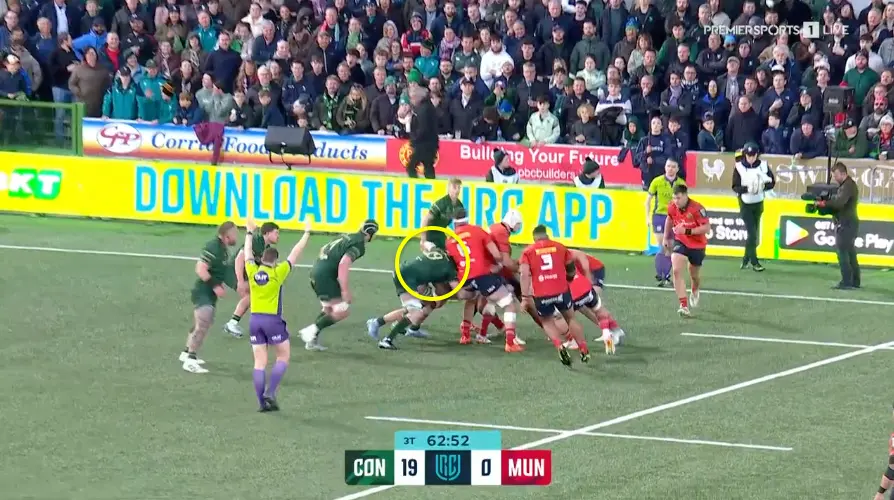
When we’re playing badly, everything seems a hundred times harder, and this is a clear example of that. Working hard, from a structural disadvantage, fighting uphill almost constantly.
That’s a good analogy for this game, and this season, actually. Fighting uphill.
It won’t get much easier this weekend against the Lions in Thomond Park, but we have to get over ourselves. The injuries are what they are, but we’ve got to find a bit of the desperation and energy that we were missing here.
Do we want this?
I know we do, but we have to show it.
| Players | Rating |
|---|---|
| 1. Jeremy Loughman | ★★ |
| 2. Diarmuid Barron | N/A |
| 3. Michael Ala’alatoa | ★★ |
| 4. Edwin Edogbo | ★★ |
| 5. Fineen Wycherley | ★★ |
| 6. Tom Ahern | ★★ |
| 7. John Hodnett | N/A |
| 8. Gavin Coombes | ★★ |
| 9. Craig Casey | ★★★ |
| 10. JJ Hanrahan | ★★ |
| 11. Thaakir Abrahams | ★ |
| 12. Dan Kelly | ★★ |
| 13. Alex Nankivell | ★★ |
| 14. Andrew Smith | ★★ |
| 15. Mike Haley | ★★★ |
| 16. Lee Barron | ★★ |
| 17. Josh Wycherley | ★★ |
| 18. Conor Bartley | ★★★ |
| 19. Jack O’Donoghue | ★★★ |
| 20. Brian Gleeson | ★★★ |
| 21. Ben O’Donovan | ★★★ |
| 22. Sean O’Brien | N/A |
| 23. Alex Kendellen | ★★★★ |
