


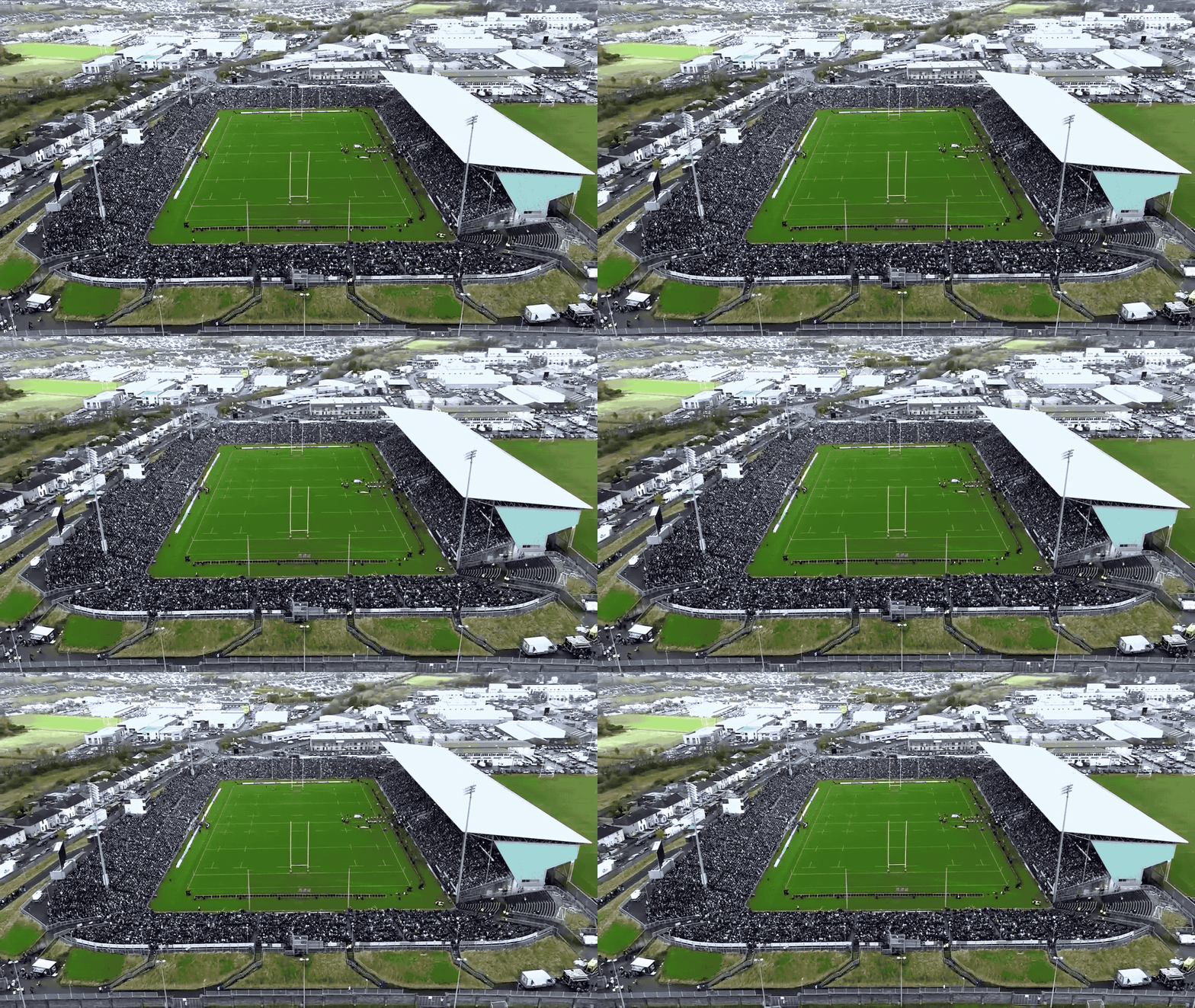
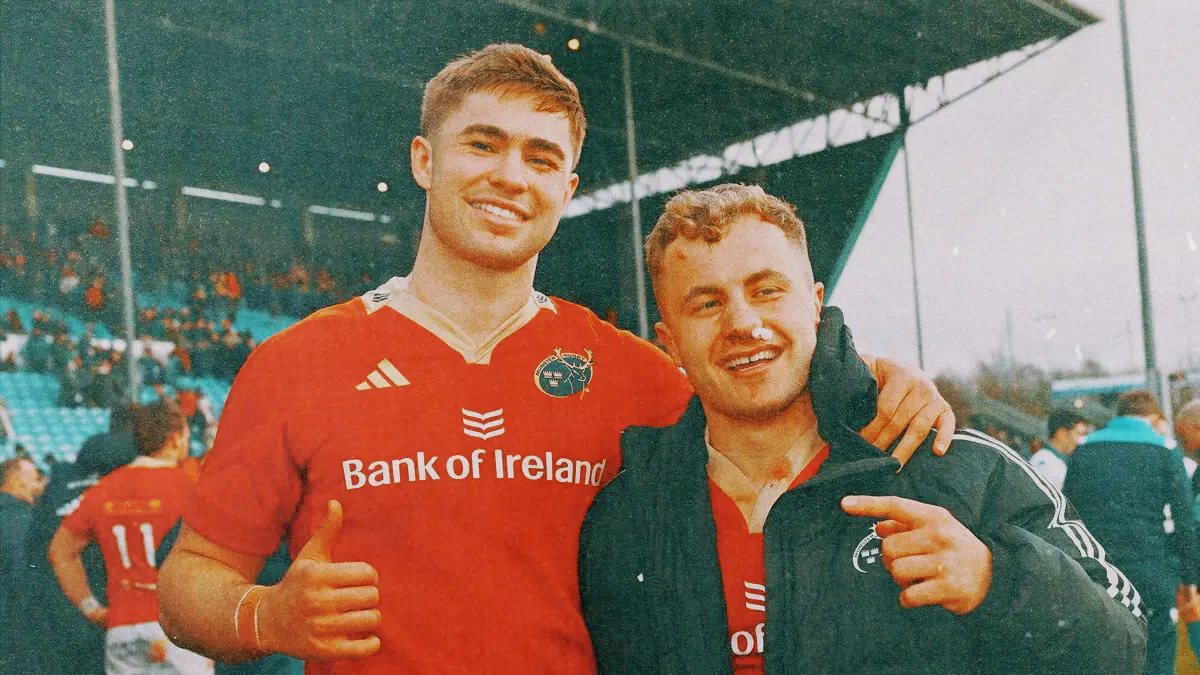
There have been three seasons in this season.
The End of the Rowntree Era, which feels like two seasons ago. The All Blacks (xv) to Northampton feels like last season, and then we have the Six Nations window until now as this season.
Maybe it’s all ⚡️the discourse⚡️ that there’s been every single week that’s forced this time warp effect, or maybe I’m just getting old. Maybe it’s both because I’m definitely getting old. The other day I deliberated for five minutes in a shop about what brand of wheelie bin liner I should buy after cleaning out my wheelie bins with a pressure washer. Maybe it’s the clocks going forward, which I now hate with a burning fury because I’m a parent of a two-year-old.
Whatever it is, I think we owe ourselves a break in dealing with mentally and emotionally exhausting interpros like this one. The one back in September – two seasons ago, remember – was bad enough, and this one was, if anything, worse for the old heart rate.
Why? Because it shouldn’t have been close.
Even with a mixture of 14 and 13 men for the last three quarters of this game, Munster were the better, more efficient, better-coached and more tactically aware team driven by one of the best halfback performances at #9 and #10 you’ll see in 2025.
The cards, coupled with a few bizarre home town calls, pushed Connacht back into this game, but the scrappy end game shouldn’t take away much from what was a very composed and efficient display that showcased our most physically imposing performance of the season.
I wrote before the game about Connacht’s attacking layers and Munster’s performance had its foundation in the theory that we would kick to them a lot and then overload their on-ball game with a defensive performance that attacked key elements of how they play the game.
We showcased that on Connacht’s first attack of the game with heavily contested central ruck positions followed by an understanding of how Connacht like to run their layered attack.
Here are the three Connacht layers.
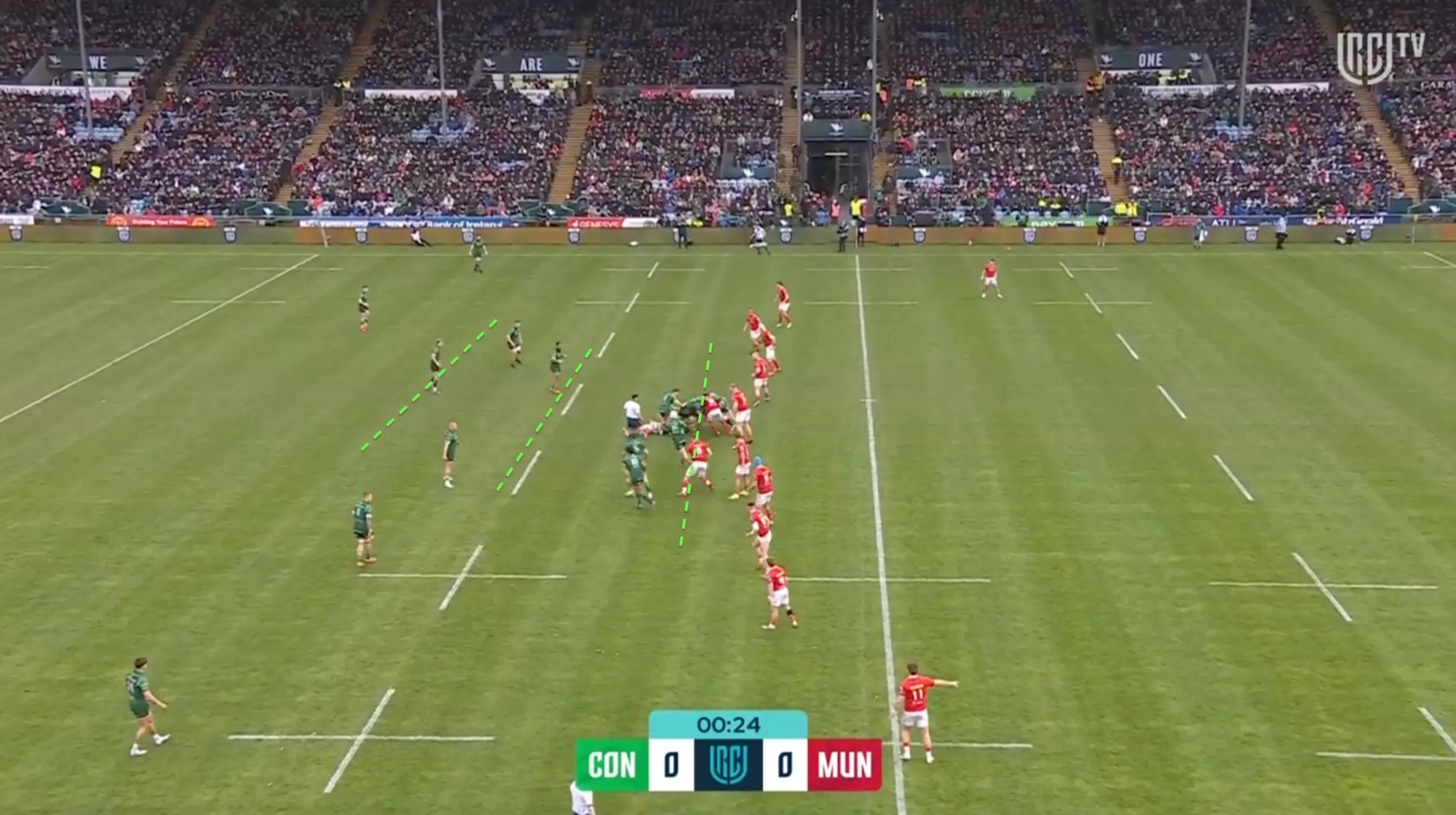
But we knew that without any release options outside, this was almost always going to attack the fringe of the ruck where Munster were going to fold. The scheme runs on Connacht exploiting a ruck transit by hiding Hansen at the previous ruck and then using him as a short loop, late arriving inside pass option with Gavin also acting as an obstructing runner.
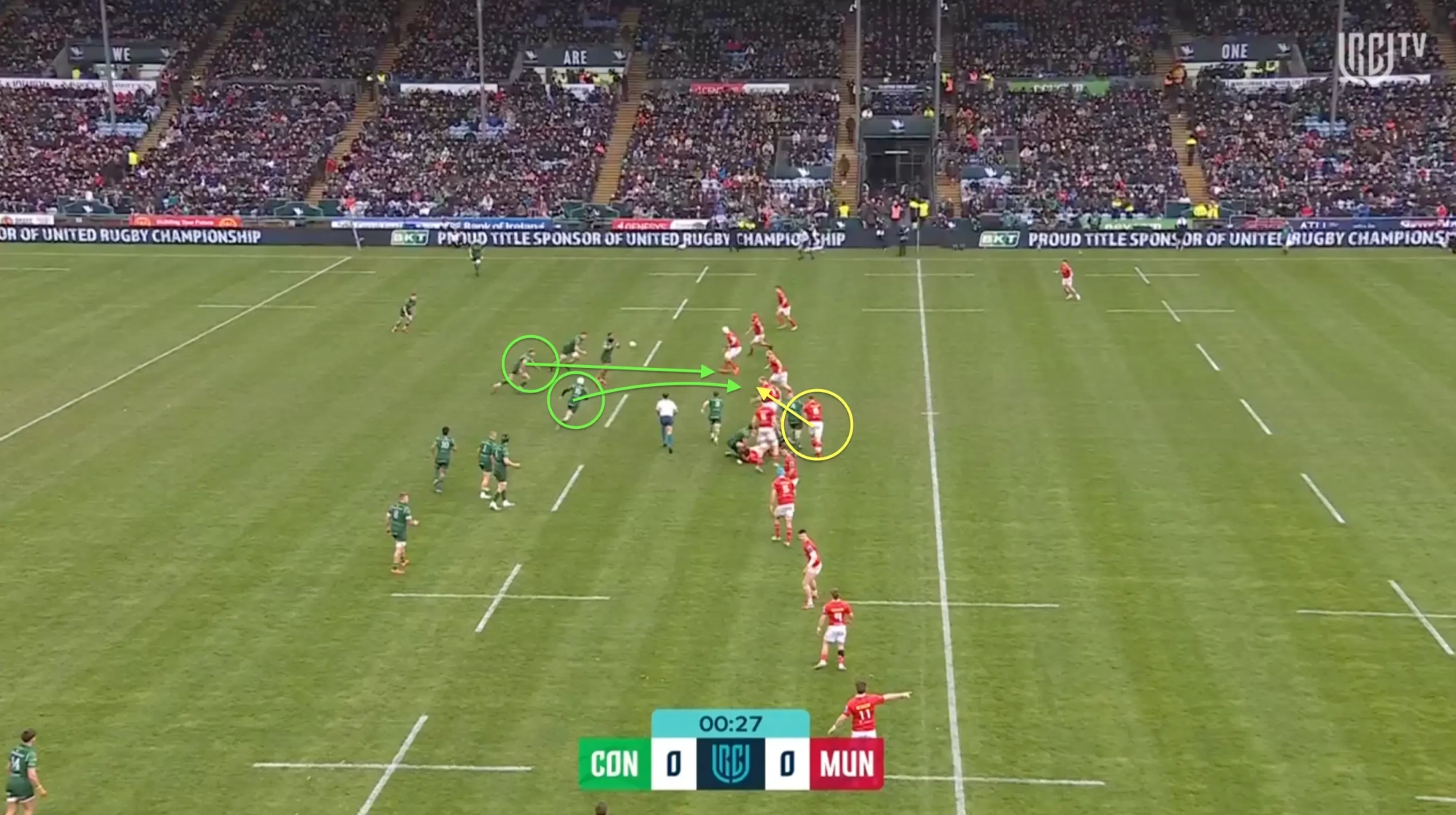
For Munster, the key was to contest the ruck, make it messy, draw numbers out of the layers to resource it but also fold well across the face of that same ruck for moments just like this. Also, watch Wycherley and Hodnett step up to that first layer to cover the outside options, while the inside folds deal with the inside ball option.
Jager gets hands on Hansen, but the offload gets away to Prendergast – who Hodnett has well covered.
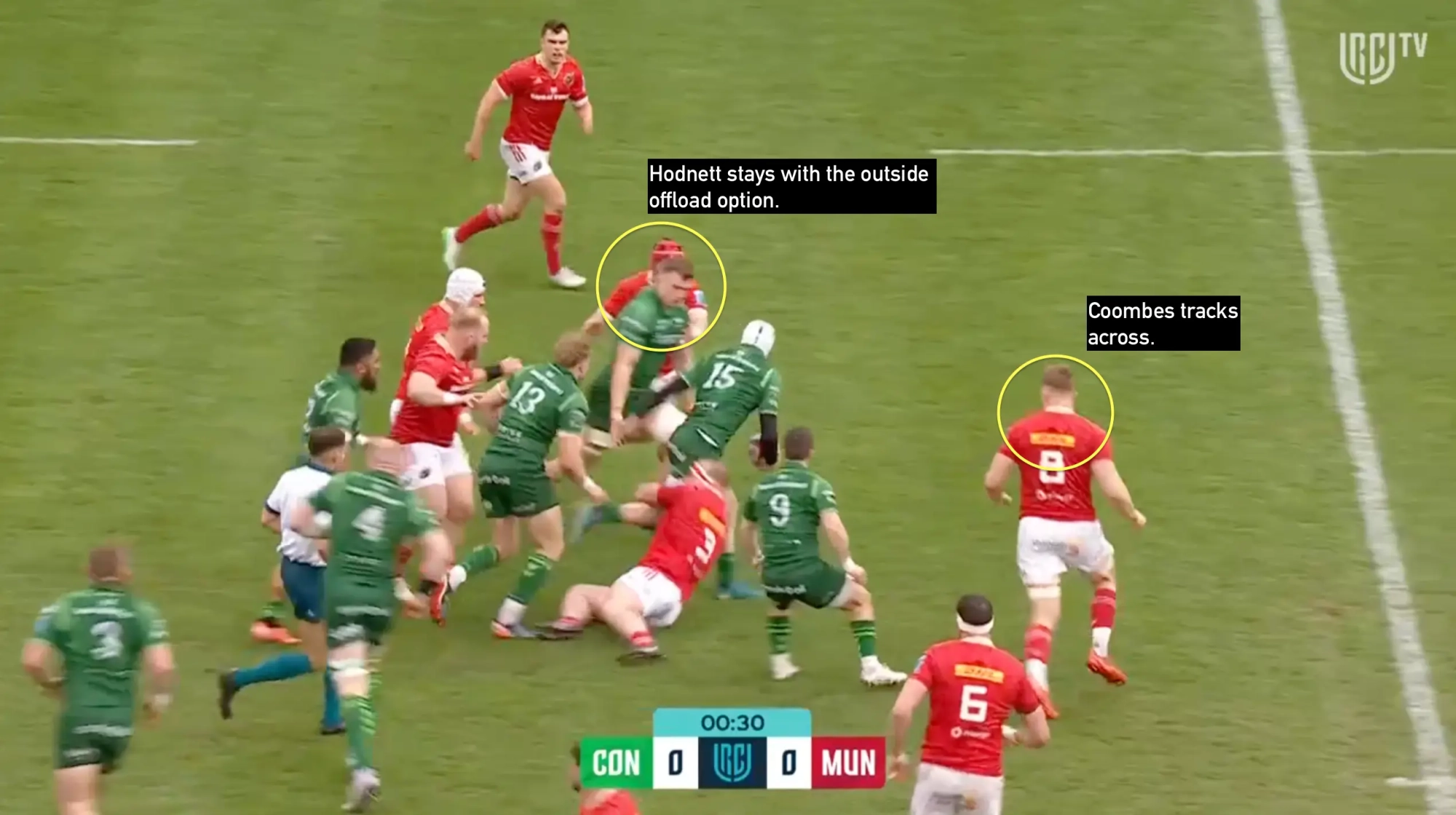
When Prendergast is brought to ground, Coombes is really unlucky to be penalised for what, to me, looks like a good poach. The principle is there to see, though. Contest central rucks, don’t let Connacht play with quick ruck flow, draw numbers out of the attacking line and move up to the next layer on the pass from the previous layer if you’re outside the ball, move across the field if you’re inside it.
We used the same principle on every single Connacht launch point. Here’s a good example of the principle on a scrum set piece.
Watch Munster stick to this principle all the way through the sequence. Hodnett contests the first ruck instead of pillaring up or following the play out.
When Farrell is defending the next phase, he steps up to the next layer only.
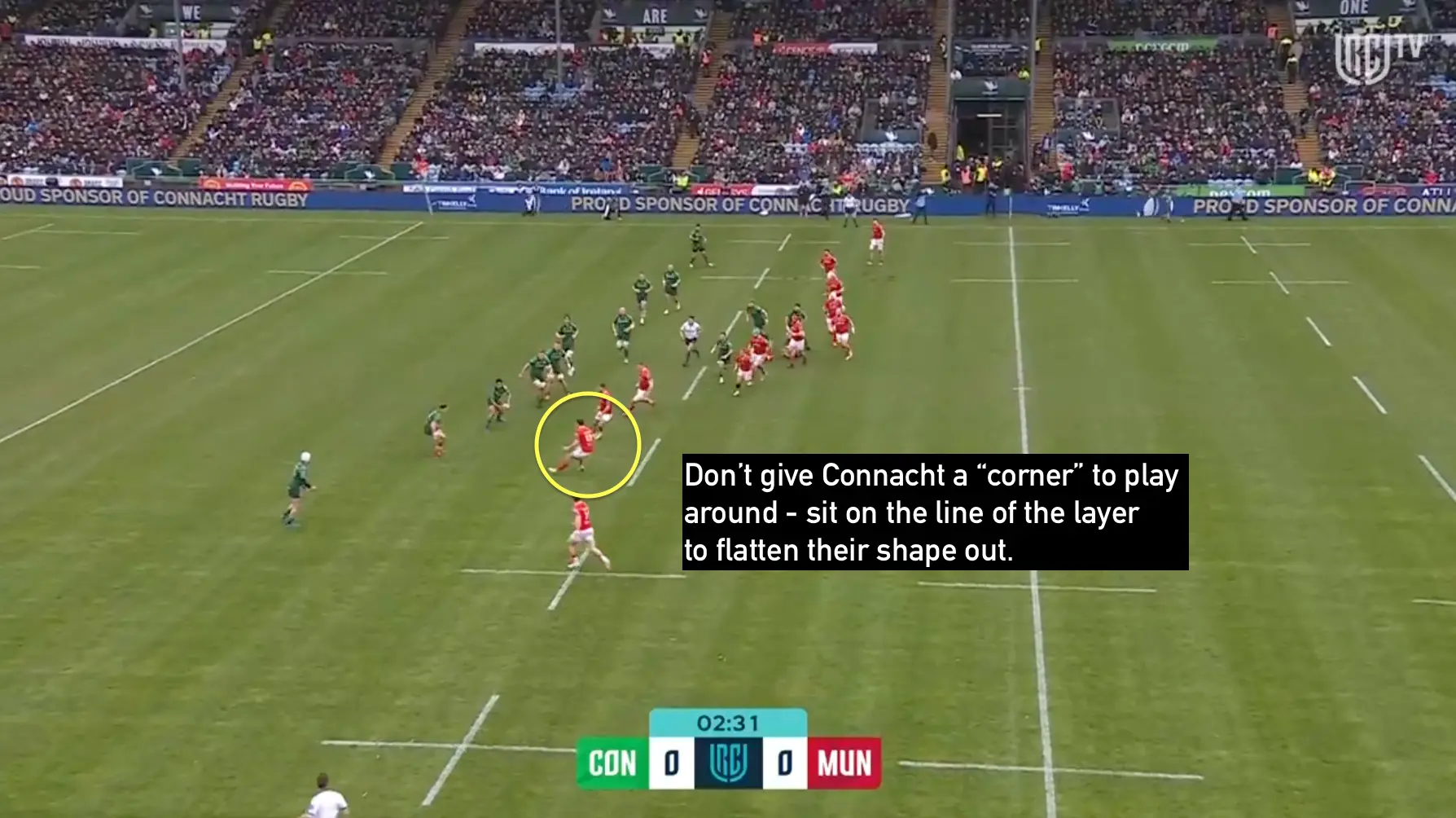
So there’s no dog leg or player to float a pass over. Connacht have to squeeze their layers tighter. Usually the opposition would look to kick after a phase like this but Connacht don’t really do that, as we know. They reset and try to get their deep layers working again.
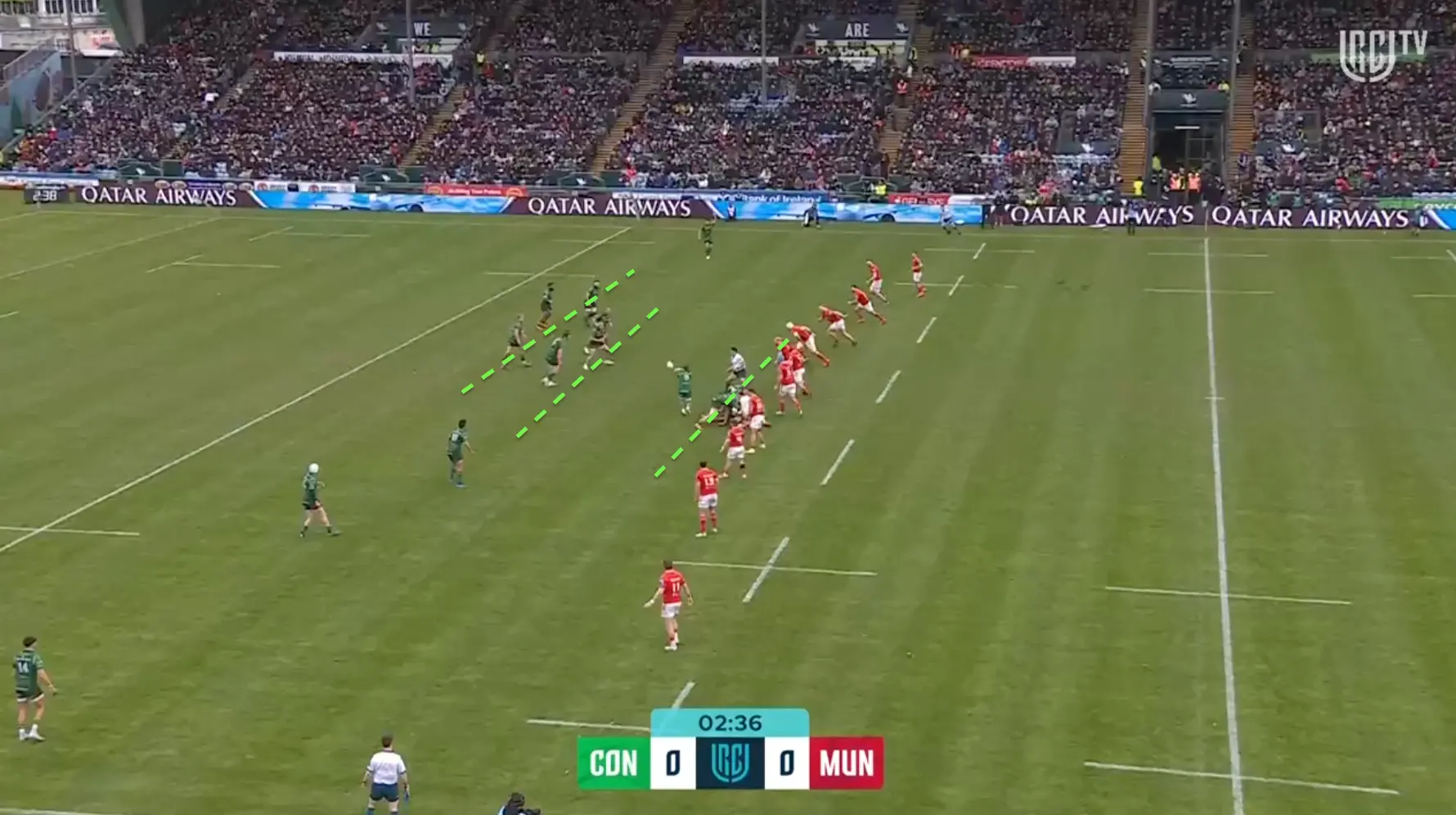
But these layers are only dangerous when you follow them into the deep waters where they can pick you off. If you move to the next attacking layer on the transit of the ball – up if outside, across if inside – then Connacht have nowhere to go if everyone sticks their tackles and follows the offload threat.
Casey does just that here and shuts down a screen pinch that would possibly put Gavin on an outside loop line.
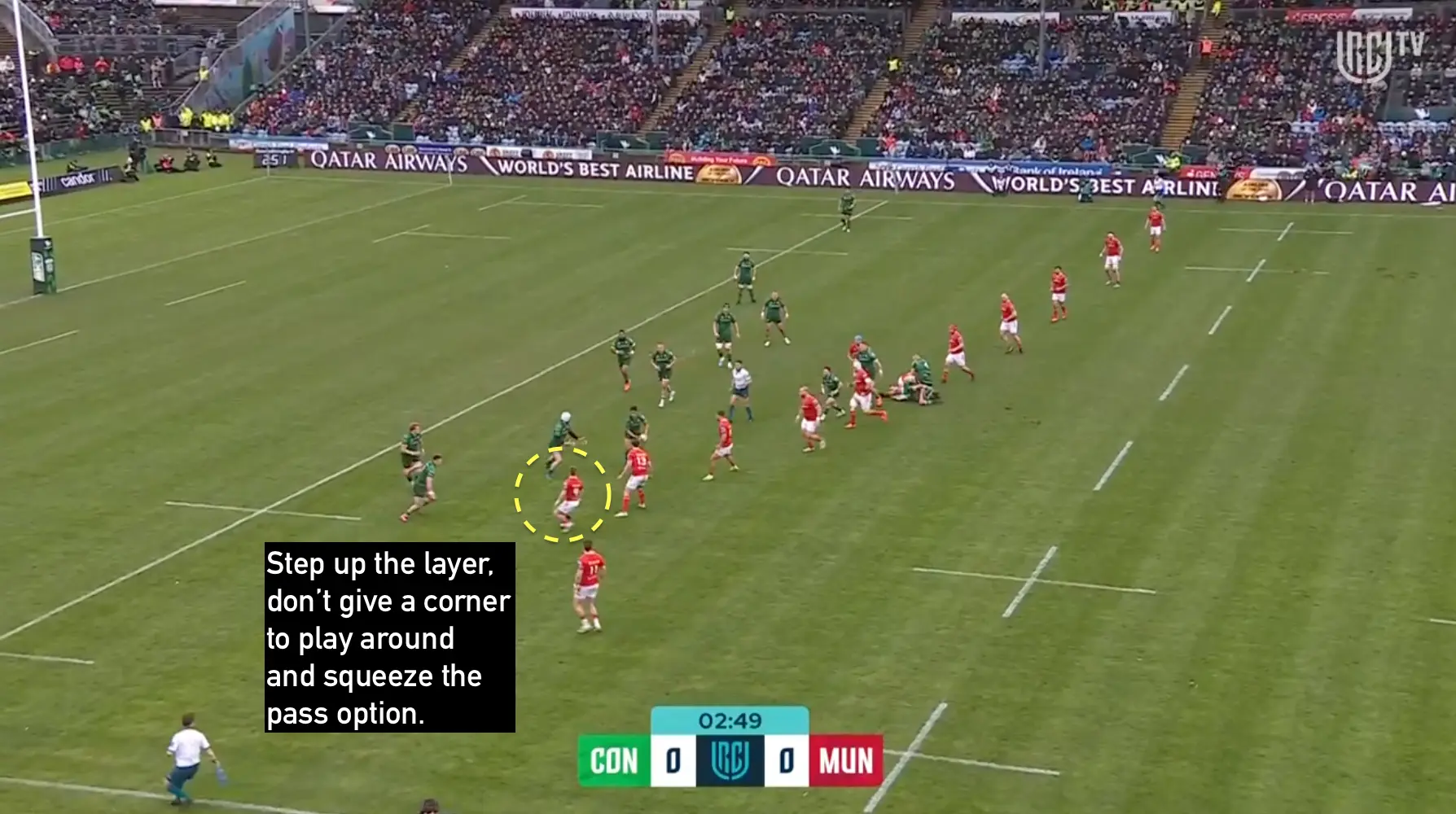
Connacht end up trying to burst through the cover off another heavily contested ruck and all it does is isolate Gavin on the ground.
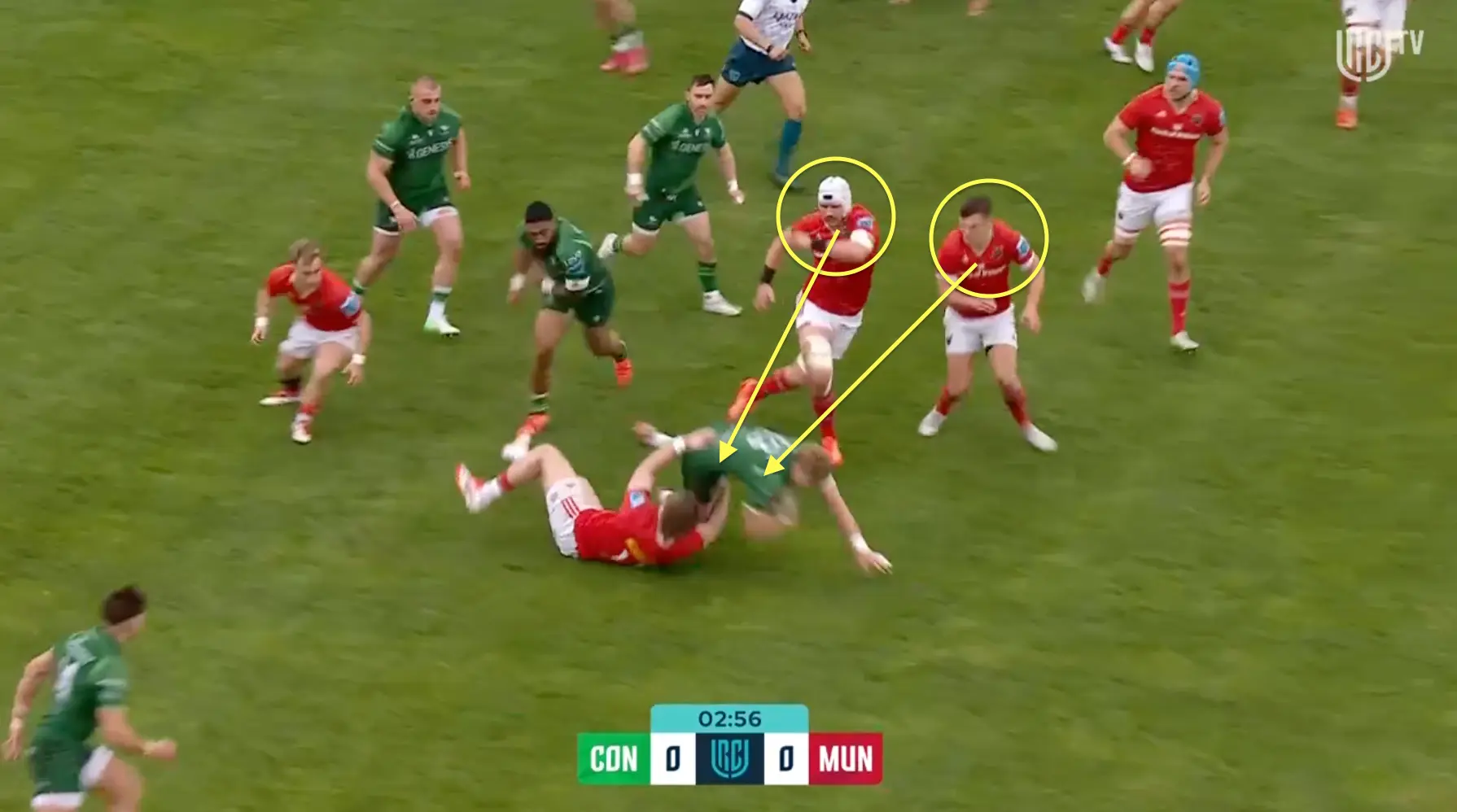
Watch the game back and you’ll see Munster using this principle to stuff Connacht repeatedly, even with some bad folds due to being down to 14 (and sometimes 13) players for most of the game included.
We knew Connacht’s scheme almost as well as they did and I fully believe that with 15 men on the pitch for most of the game, this game stays dead for the last 20 minutes, as opposed to shambling around like a crazed zombie from the Walking Dead.
***
The defining factor of this game was Munster’s halfback pairing of Craig Casey and Jack Crowley, who dominated the contest from bell to bell.
They played like two guys who wanted to remind everyone how good they were. They did all that and then some. When you’re playing for long stretches while down a player, especially with very challenging weather conditions that dictate how and where you can kick the ball, there’s a huge premium on your halfbacks putting you where you need to be.
Sure, both Crowley and Casey scored tries here – Casey should have had two, but that’s for another time – but even if they hadn’t, they’d be five-star performers purely on the strength of their management of this game.
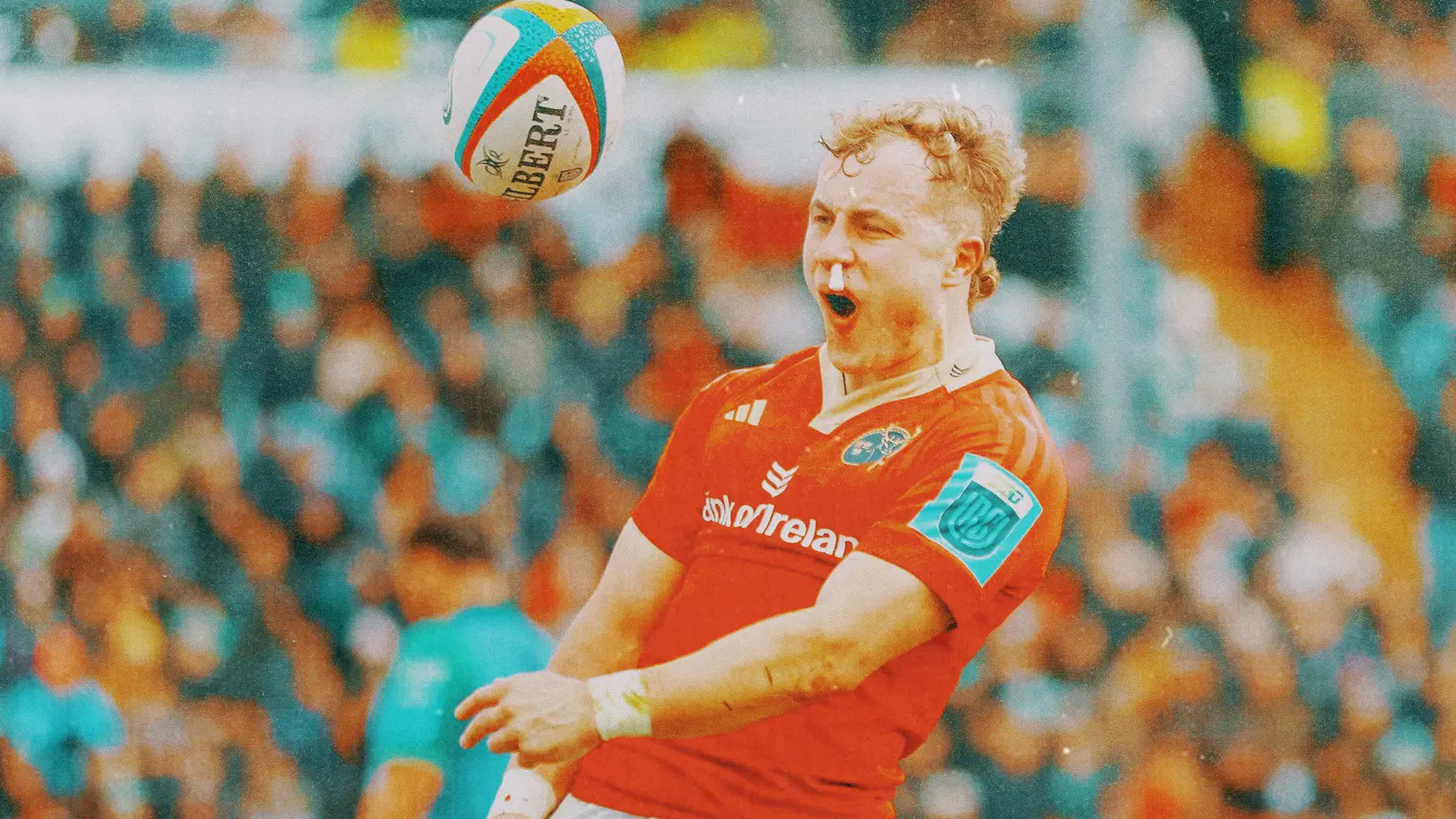
Tries are fantastic for half-backs – scrumhalves in particular – but I think sometimes they can overinflate bad performances and overshadow fantastic ones.
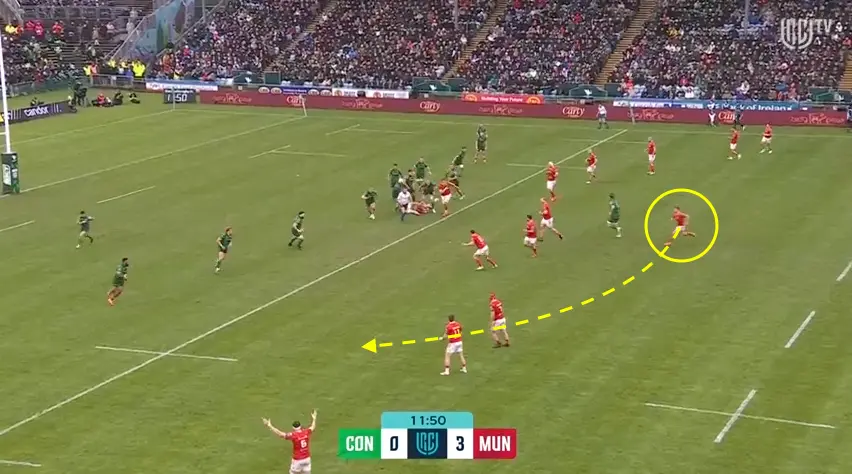
This is a small moment in the game, but it showcases what Crowley and Casey do well. Crowley takes a kick return pass from O’Connor and sees that there’s no realistic kick option because of the wind blowing from right to left diagonally on the clip below.
We’re down to 13 players here so Crowley knows that a long kick downfield – exchanging transitions – will give Connacht a huge edge on the far side of the field. So what does he do? He wins a collision and gives our forwards a chance to get back in support.
When Casey takes over, he bosses the next two phases, slows everything down, all while nailing a centimetre-perfect pass to Kleyn that allows him to barge over for a tight gainline win. Again, slowing everything down to give our chasers a chance to get set, he nails a contestable into the wind that allows Nash to get at Hanrahan while our chase line fills the field.
Connacht would turn over the ball a few phases later. Casey’s control of the game was superb, and the law change around not disrupting the #9 has taken a weakness out of his game – getting bounced and scragged by interfering defenders – and turned it into a super strength where he can showcase one of the best passes in the game, ruck after ruck and phase after phase. Casey’s biggest strength – in this game and generally – is that he sees himself as the facilitator to the attacking scheme, not the focus. He adds more and more value after the pass in the last 12 months, but he seems to get that his value is rooted in his pass quality, management and savage work rate for the team.
He’s already building a fantastic sniping and trail running game to go with the outstanding pass and staggering kicking improvements he’s made in the last two seasons.
On this one, again, while down to 13 men, Casey and Crowley showcase why their mixture of pass-first scrumhalf and run-dominant flyhalf has so much potential.
Crowley’s movement is one of the best parts of his attacking game. When I spoke to a coach who has coached against Crowley this year, he said that one of the things they were worried about was his ability to switch sides of the field so quickly, ruck for ruck. In a practical sense, you always want to keep eyes on the #10 in any game, but Crowley is really good at showing up on the openside of a ruck on one phase before popping up on the blindside on the very next phase, and nobody can tell how he got there.
When he gets the ball in that spot, he’s powerful and quick, so if he finds a gap or a mismatch, he’s gone. He can win collisions, and because opposition teams have to respect that, his pump fakes are very effective.
This is a really good example of that principle;
When Crowley rejoins the play after sending the kick through, he’s always looking to file to the open space. He doesn’t feel the need to step straight in at first receiver – we have players who can handle the ball and move it. He wants the killer play.
And he gets it.
Later in the match when we were down to 13, he and Casey were keeping us very tight in the middle of the field. At 11 points up, we knew that Connacht were going to overcommit to get possession back, so winning a penalty was quite likely, but we weren’t just going to sit there with the ball either. We knew we didn’t want Connacht to have possession, because their deep layers are almost impossible to defend with 13, so Casey and Crowley did one of their specials: bait.
Crowley takes a nothing snipe and inside pass to Nash that is almost purely to reset the play and make Connacht lose track of him.
He then bounces back around the ruck again with O’Connor running a pocket route to attack the defence that he and Casey had been narrowing in the previous phases.
Right here, Casey sees Crowley taking that route and knows where the next pass has to go – to Wycherley running a screen – because he knows Crowley is going outside. Connacht don’t.
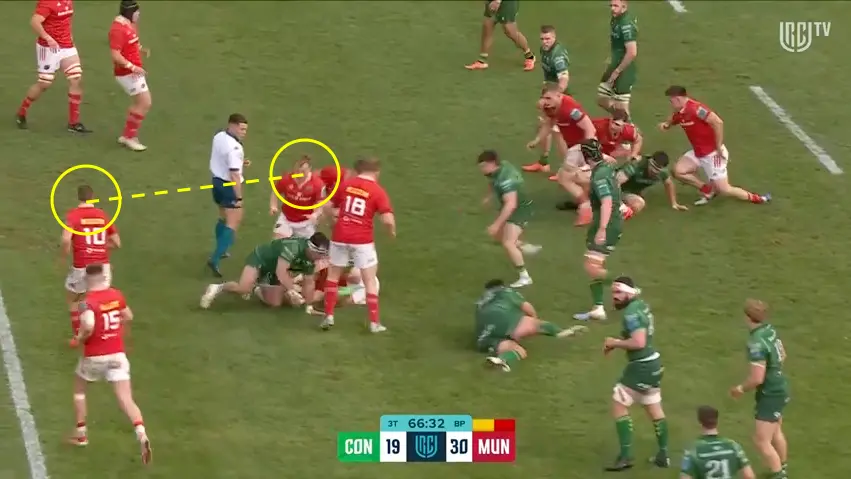
He uses this evasion and ability to get multiple touches on a play to make big plays – this one was particularly good in driving Connacht back and keeping the clock ticking over into the 70th minute.
Conserving energy, playing big moments and driving each other through the game – that was Casey and Crowley in Castlebar.
If they play like this in any game, this team has a chance against any team, regardless of the odds.
***
This bonus point win killed off Connacht’s chances of finishing in the top 8, with our rivals all due to play each other in the next few weeks. Not a bad place to be after a wobbly few weeks. The injection of quality from the test squad and the injury room really did the job for us, and with a few more bodies to come, things feel like they’re looking up.
We’re now two points clear of the moshpit and seven behind the Sharks in 4th place. We know now that a win over the Bulls in Thomond Park in a few weeks will all but seal our top-eight finish and allow us to start looking up the table instead of over our shoulder.
We showed in this game that we can play in hostile environments and get the job done. That will be a needed quality in the next few days and months.
| Players | Rating |
|---|---|
| 1. Jeremy Loughman | ★★★ |
| 2. Diarmuid Barron | ★★★ |
| 3. Oli Jager | ★★★★ |
| 4. Fineen Wycherley | ★★★★ |
| 5. Tadhg Beirne | ★★★★ |
| 6. Tom Ahern | ★★★★ |
| 7. John Hodnett | ★★★ |
| 8. Gavin Coombes | ★★★★ |
| 9. Craig Casey | ★★★★★ |
| 10. Jack Crowley | ★★★★★ |
| 11. Sean O'Brien | ★★★★ |
| 12. Alex Nankivell | ★★ |
| 13. Tom Farrell | ★★★★ |
| 14. Calvin Nash | ★★★ |
| 15. Ben O'Connor | ★★★★ |
| 16. Niall Scannell | ★★ |
| 17. Josh Wycherley | ★★★ |
| 18. Stephen Archer | ★★ |
| 19. Jean Kleyn | ★★★★ |
| 20. Ruadhan Quinn | ★★★ |
| 21. Conor Murray | ★★★ |
| 22. Rory Scannell | DNP |
| 23. Alex Kendellen | ★★★★ |
