


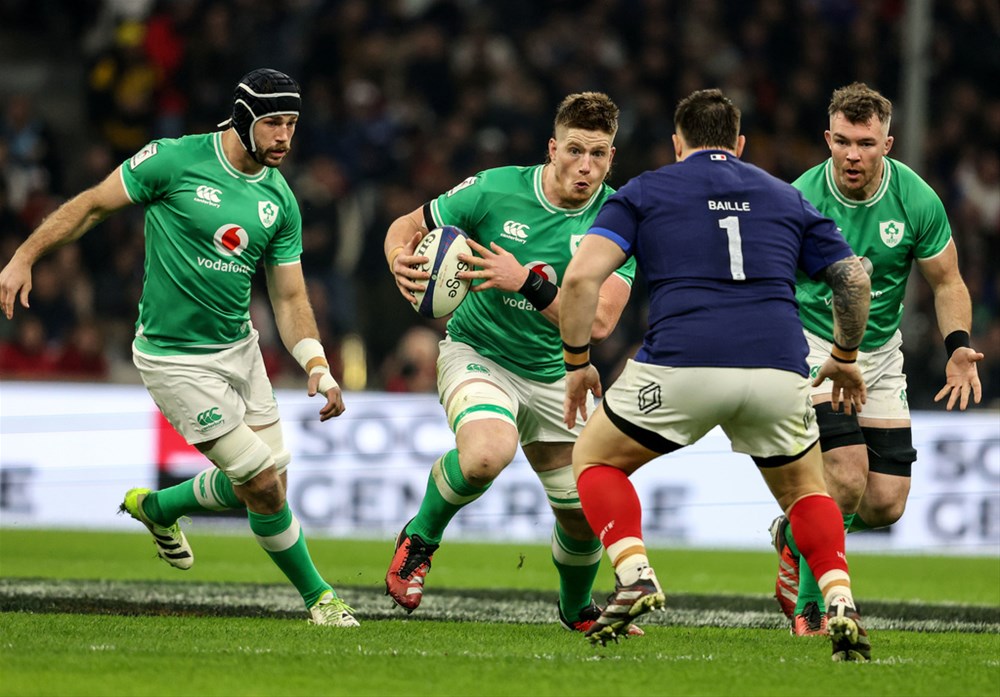
The biggest and, in my opinion, the best feature of Ireland’s game in the last three years is the quality and efficiency of our offensive breakdown.
As I’ve been writing in previous articles, Ireland’s ruck work is played at a higher pace and over more ground than Munster’s, the other team whose ORW and CORW I track in this detail. This is because Ireland is a counter-transition team that kicks at a high volume and over long distances to generate opportunities in defensive transition or the phases after a successful kick return by guys like Hugo Keenan or Calvin Nash. This is often expressed as kicking for “territory” but it’s more complex than that. Ireland kicks long to change the depth at which the opposition plays and, as a result, pace on defensive transition is an outsized part of Ireland’s requirements in the back five, midfield and outside backs.
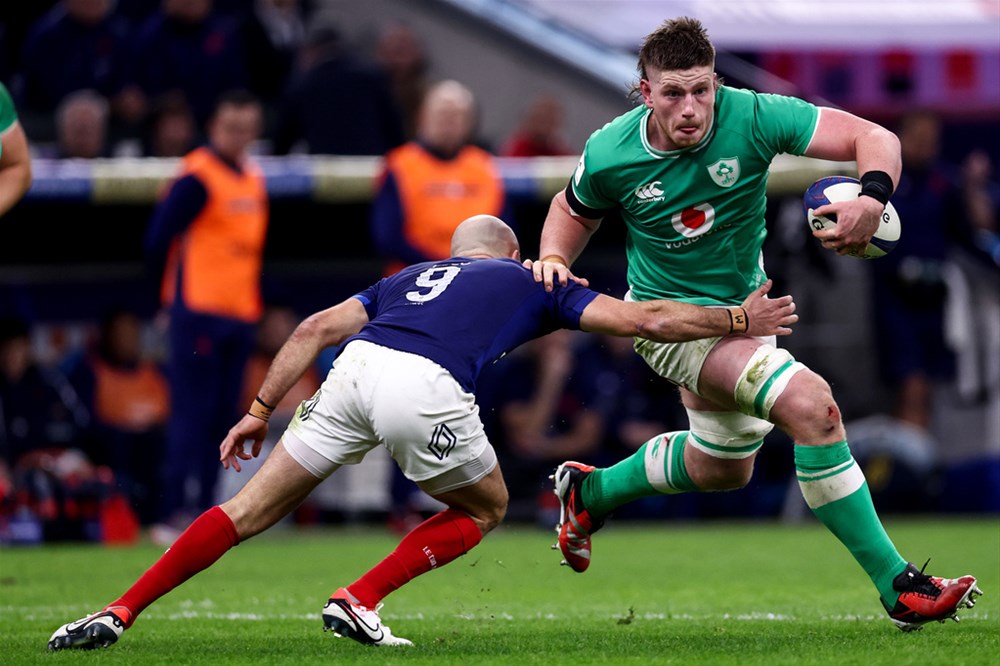
When Ireland gets the ball back – through a kick return or a ball kicked to touch – the ball is moved wide* quite quickly with a high value placed on efficiency at the breakdown from the back row. In settled phase play, the Irish locks do an outsized amount of ball carrying in the first two-thirds of the game with the midfield picking up the next amount of on-ball involvements.
* Wide, in this instance, isn’t across to the other touchline, it’s to the edge of the 40m space that exists between the two 15m lines.
This is consistent with a counter-transition team who want to extend the play beyond #10 on their chosen sequences. Ireland tends to have Beirne, Aki and Henshaw/Ringrose in those spots outside #10 with Doris mopping up extra carries if Ireland has an excess in possession as they did here.
As a result, against elite opposition, Ireland’s ruck work will usually take place quite far away from the previous ruck so pace, lateral movement and agility in the cleanout are highly valued, especially in the back row spots.
To get a look at what I mean, have a look at this week’s ORW scores.
IRELAND’S OFFENSIVE RUCK WORK SCORE VS FRANCE
- A Dominant Clean is an action that decisively secures possession when the ball carrier takes contact. A Dominant Clean does not have to be the first arrival at the breakdown but it is rewarded in the context of effectiveness. We will assign this action 3 points.
- A Guard Action is where a player plays a role in helping to retain possession after we have “re-won” the ball on the floor. Sometimes this can happen on a carry/ruck point where there is no active contention by the opposition. Let’s assign this action 2 points.
- An Attendance can be anything from standing as a “kick shield” on a ruck to adding a bit of bulk to ward against a counter-ruck to extending your leg to make space for a box kick. I’m marking this down as being worth 1 point.
- An Ineffective Action is a blown cleanout, a lean, a breakdown penalty or an action that I couldn’t see any direct benefit for. This will be worth -2 points.
| Dominant Clean | Guard Action | Attendance | Ineffective | Ruck Work Score | |
|---|---|---|---|---|---|
| Porter | 10 | 2 | 1 | 20 | |
| Sheehan | 2 | 12 | 2 | 1 | 30 |
| Furlong | 2 | 17 | 3 | 2 | 39 |
| McCarthy | 10 | 5 | 4 | 17 | |
| Beirne | 3 | 10 | 8 | 37 | |
| O'Mahony | 3 | 9 | 27 | ||
| Van Der Flier | 1 | 15 | 2 | 4 | 27 |
| Doris | 3 | 22 | 2 | 1 | 53 |
| Gibson-Park | 1 | 2 | |||
| Crowley | 1 | 2 | 1 | 5 | |
| Lowe | 1 | 2 | |||
| Aki | 3 | 9 | 1 | 28 | |
| Henshaw | 1 | 10 | 23 | ||
| Nash | 1 | 3 | 1 | 7 | |
| Keenan | 9 | 1 | 19 | ||
| Kelleher | 3 | 6 | |||
| Healy | 5 | 1 | 11 | ||
| Bealham | 4 | 8 | |||
| Ryan | 1 | 3 | 3 | 1 | 10 |
| Baird | 2 | 2 | 0 | ||
| Conan | 3 | 6 | |||
| Murray | 0 | ||||
| Frawley | 1 | -2 |
Top Five ORW Scorers
- Caelan Doris – 53 points
- Tadhg Furlong – 39 points
- Tadhg Beirne – 37 points
- Dan Sheehan – 30 points
- Bundee Aki – 28 points
CORW Map in 10-Minute Blocks
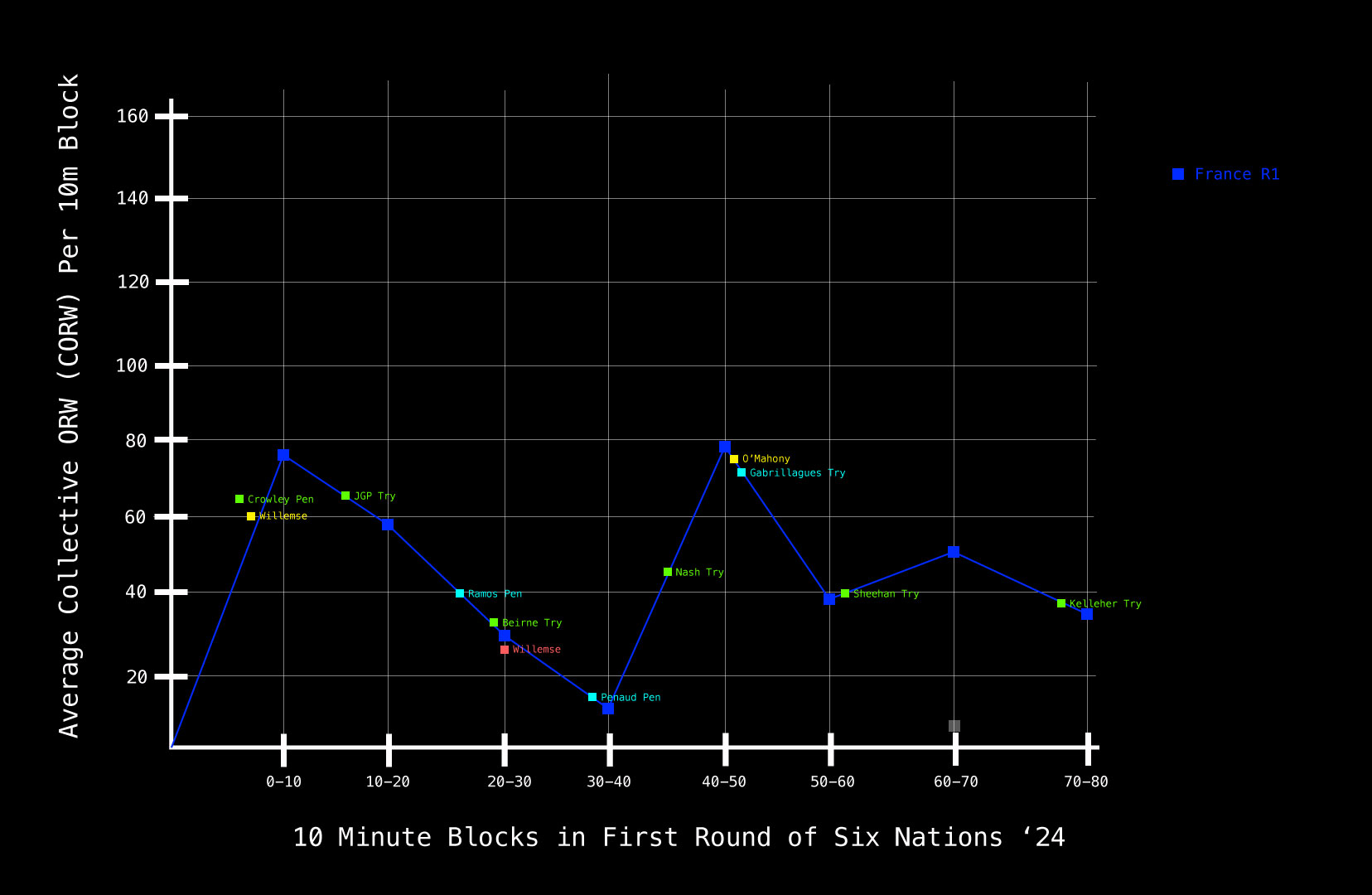
The CORW map of the game is really interesting because it shows Ireland’s efficiency really clearly. Munster – an on-ball team – scores points with phase pressure, which is expressed with high ORW scoring in ten-minute blocks. Ireland who kick way more and way further than Munster, has a much higher fluctuation in possession but with high-scoring ruck players in the back row, front row and midfield.
Munster’s Combined Offensive Ruck Work score is usually higher than 450 when playing well. Ireland’s is usually at its best when it’s 400 points or below and, just to illustrate that, it was 375 in this game.
In the last year, Ireland have produced the following in the games I’ve tracked (all but two);
- France (H) 2023 – 638
- Italy (A) 2023 – 383
- Scotland (A) 2023 – 401
- England (H) 2023 – 387
- England RWC Warmup – 261
- Samoa RWC Warmup – 294
- Romania RWC 2023 – 387
- South Africa RWC 2023 – 346
- Scotland RWC 2023 – 401
- New Zealand RWC 2023 – 523
There are two obvious outliers there – France (H) in the 2023 Six Nations and the quarter-final defeat to the All Blacks. They push the yearly average CORW per game to 402.1 but that isn’t a fair reflection of Ireland’s general output. Without those two games, the average is 357.5 per game.
As an aside, both of those games showcased games where Ireland lacked control for large periods. We lost the quarter-final to the All Blacks – as you know – and that massive CORW number showcases how hard we had to chase the All Blacks with long periods of on-ball rugby that we weren’t built to play at that point. The France game gets kind of memory-holed because it was such a good game to watch but we shouldn’t forget that France were only six points off Ireland in that game coming into the last 10 minutes and it was far from the kind of controlled performance we saw here.
Talking Points
Load Management
When you look at the individual scoring in the front row, you can see how Ireland schemed to save Andrew Porter’s energy for defensive ruck involvements, lineout lifting and scrummaging. Porter earned 20 points off 14 ruck involvements – which is really good – but I got the feeling that he was deliberately in positions where he’d be able to conserve energy for the scrummaging battle. Why? When I go back to that game against South Africa – a team with the same reputation for heavy tighthead scrummaging that France does – Porter scored 24 points off 16 offensive ruck involvements.
Sheehan scored 30 points off 17 involvements and Furlong scored an absolutely outstanding 39 points on 24 involvements. Furlong might not be the impact ball carrier he was but he’s transitioned into an impact support forward pretty seamlessly.
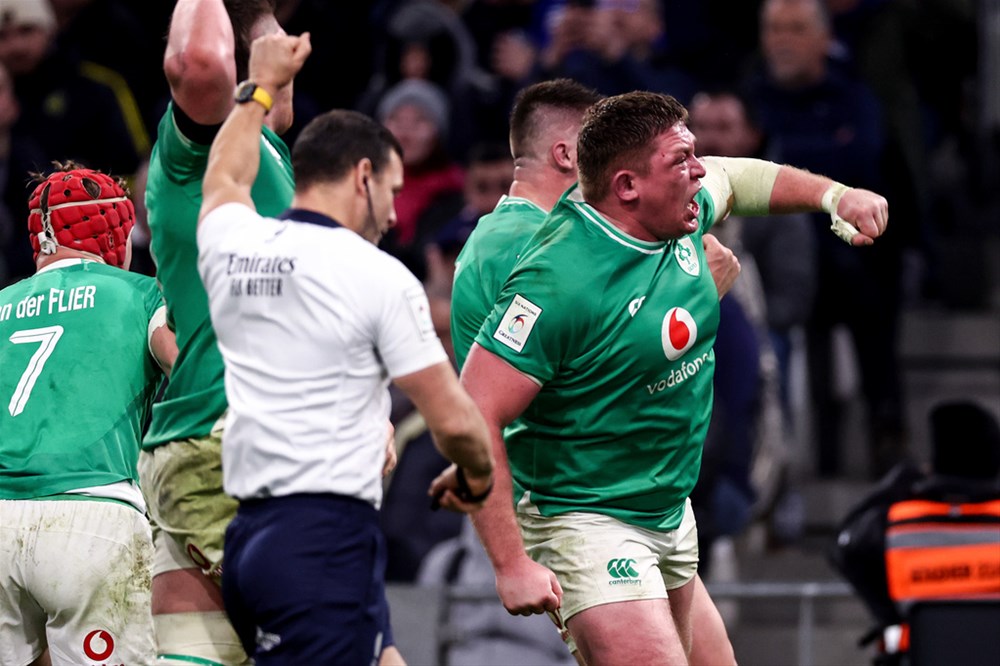
Sheehan is an interesting one in that he seems to be the proof that Ireland have moved away from a 1-3-2-1 style shape in settled phase play. Sheehan now plays very much as part of a 3+1 off the ruck that’s part of Ireland playing narrower in attack to allow a bit of oscillation between a 3-2 and a 3-3 in that 40m space.
O’Mahony’s elevated numbers show signs of this too. He was far more involved in central attacking plays much further out the pitch. Last season, Sheehan and O’Mahony took up edge forward roles with Van Der Flier as roving ruck support but Ireland seemed to deviate from this in this game.
It’ll be something to track as the tournament continues.
Importance of Build
You’ll have seen Joe McCarthy’s relatively low ORW numbers by now and wondered what they mean. Firstly, McCarthy is a young player with a very rare roleset in the modern game – a Lock Power Forward. Whether he becomes a super rare Tighthead Lock Power Forward remains to be seen but for now, Ireland want to get his dynamic tight carrying into the game quite often. That means that he’s expending most of his energy carrying the ball off #9, with the rest getting eaten up at the scrum and in the lineout. As a result, he’s going to be involved in the Offensive Ruck much less often. That said, getting 17 points on 19 involvements isn’t good and it’s a sign of some really inefficient ruck work that’s in his game, similar to James Ryan in the last few seasons.
In reality, that means that he’s often off-balance or late arriving to ruck situations at pace, and this hurts his ability to keep momentum going.
I would posit that it doesn’t matter at the moment though, because of the work of Tadhg Beirne and Caelan Doris in those central spaces. Doris’ score of 53 points on 28 involvements is elite-level stuff and it’s closely followed by Beirne, who was Ireland’s most used ball carrier, primarily lineout target and consistently involved on the defensive side of the ball. Beirne earned 37 points on 21 ruck involvements, which showcases how much he balanced out this pack as a unit and why, for me, he’s a certain starter going forward.
James Ryan had a decent return off the bench at the ruck but the quality of McCarthy’s ball-carrying make him a very hard man to take out of this starting selection for this weekend.
