


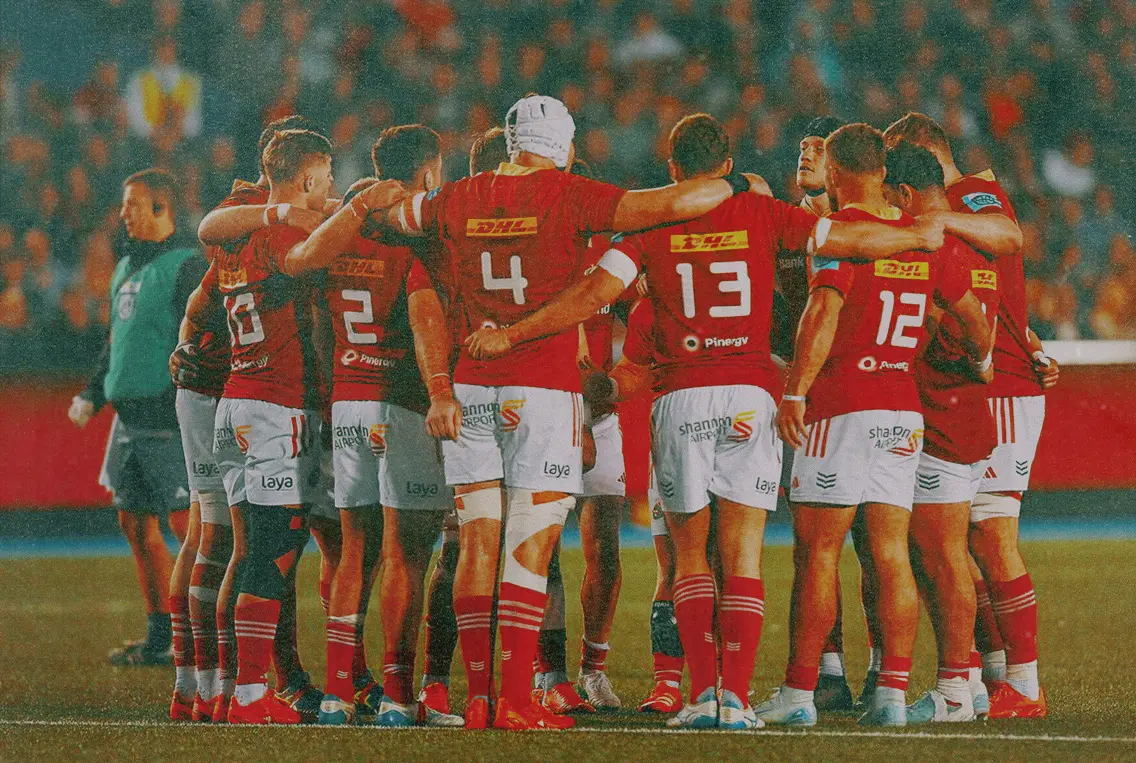
I’ve been doing this long enough that I can almost predict the messages I’ll get after a loss like this.
The one constant was “the Munster team of the 2000s wouldn’t have lost this game”. My answer to that is almost always, “you’re talking about stuff that happened twenty years ago”.
I suppose what people mean is that the Platonic ideal of Munster Rugby in their heads would never find themselves in such a position as this team now finds itself in, and that is broadly correct. The ideal Munster team in your head would never be in a scrap for European qualification. Never mind making semi-finals or finals, these guys are scrapping it out for eighth place. Platonic Ideal Munster compete in European Cup finals, in cotton Canterbury kits.
But that’s where this Munster team is. That is the reality. We are a pretty average team at the moment, albeit with a high ceiling and a rock bottom floor.
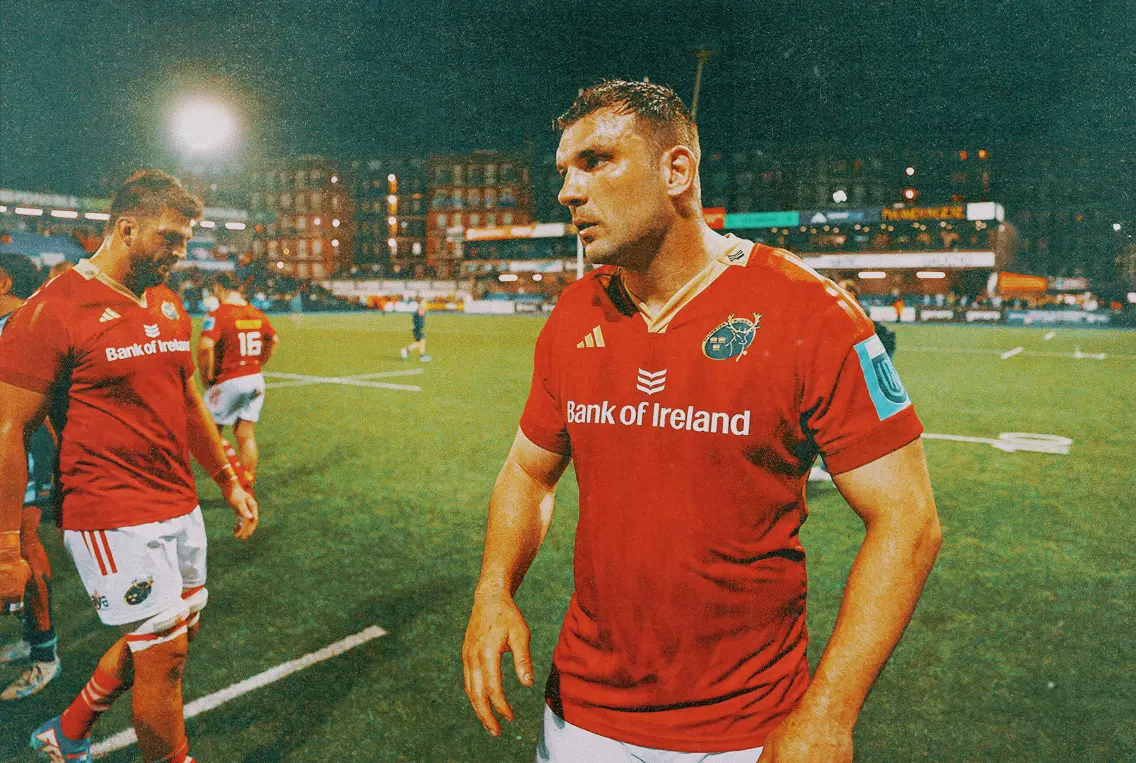
I’ve said for a while that we are capable of beating any team in Europe on our day, or losing to them. You saw evidence of that here against a committed and momentum-fuelled Cardiff side who grew in belief as the game went on. Munster were the opposite. We looked like a side who are badly feeling the weight of the schedule of the last few weeks. Players (and coaches) are looking mentally and physically fried from an intense six-game block that has gone week to week since that narrow loss away to Glasgow back in late March, just after the Six Nations.
Lads are snapping at each other on the field. The lineout is like an infection that has started as a problem in one game and turned into something that is overheating vital organs. Our phase attack, our transition work, our high ball work – it all looks like it’s being played by exhausted players who are sick to death of the pressure, both on-field from the opposition and in general.
By extension, our coaching team is under massive pressure and selecting like it. Injuries and lack of depth have meant leaning on experienced heads to bring us through difficult moments like this, and, if anything, it’s the experienced heads who are the ones doing the damage.
It has “doom-spiral” written all over it.
The only solution to it is what we have after this game by default – time. We have a down-week coming up – the first we’ve had since early March – and it couldn’t have come at a better time. The players and coaches will be able to get their eyes away from the game for a few days and get out of the grind of week-to-week rugby. This team have played seven games since the start of March, and six of them have been on the road.
Every kilometre travelled and every hotel bed slept in is showing on this squad at the moment. Downtime is vital for both the players and coaches ahead of two regular-season games that will define this squad.
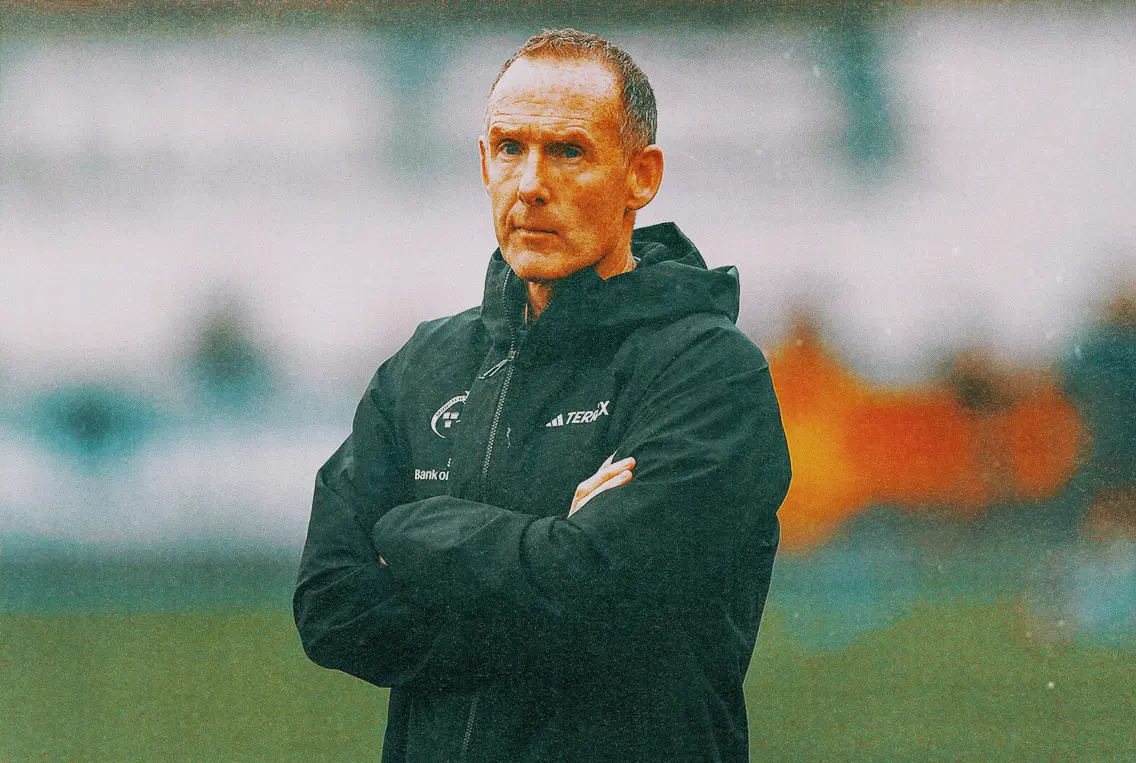
On top of that, our soon-to-be full-time lineout coach Alex Codling will be back in the HPC full-time on back-to-back weeks for the first time since the game against Edinburgh in Virgin Media Park at the end of February. That, alone, should fix most of what has ailed us in the last month. You’d hope so anyway.
I can’t shake the feeling that this team are only now beginning to show the wear and tear of a hugely disrupted season. A botched preseason and a disastrous first block of games, combined with the head coach, head of S&C and the forwards coach all leaving, left the squad in need of massive repairs to get them to the end of the season.
The likes of Costello, Prendergast, Leamy, Codling and Murray were able to jimmy rig the engine back together, but the need for a proper, experienced and authoritative head coach has never been more apparent as the flaws in our set-up flash like engine warning lights as we get to the end of the line.
All those engine warning lights showed in this narrow loss that, just like the defeat to Glasgow a few weeks ago, should have been a win.
I’ll get to why in the new paragraph after this, but even after reviewing this brutal performance, even with seeing us sit in ninth with two games to go, if this team can make the playoffs, they can be a nightmare for any side in the top four … on their day.
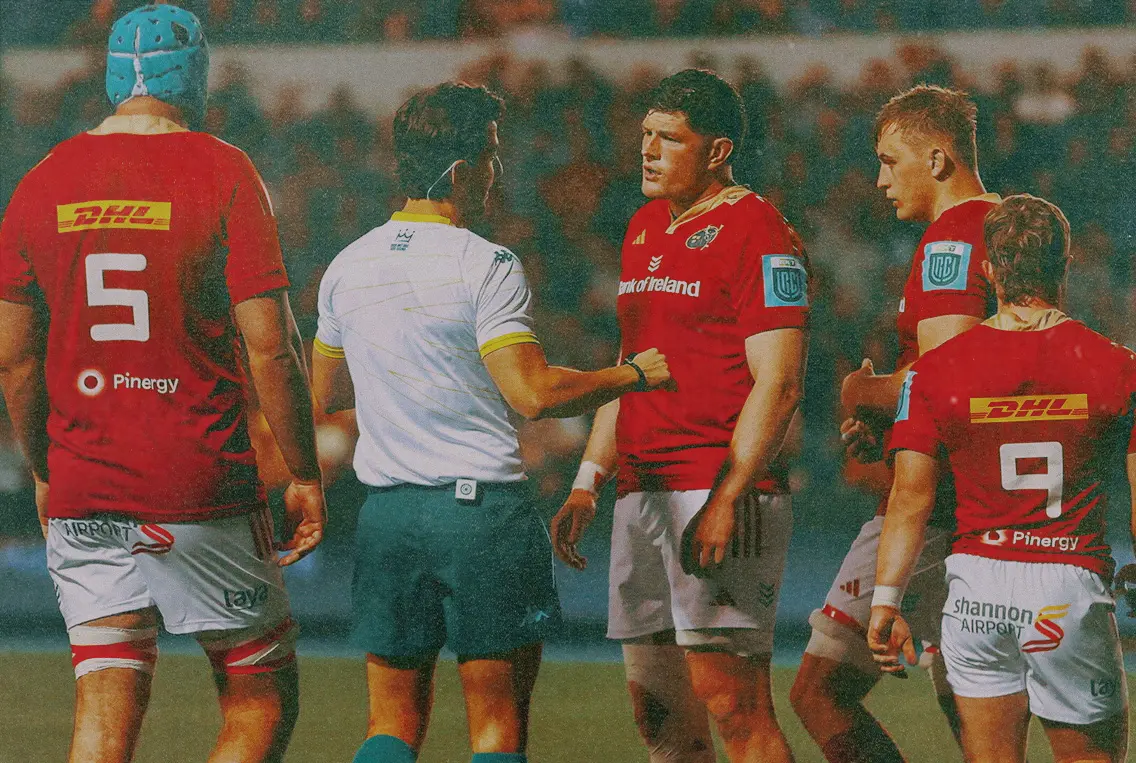
This game was lost in the direct aftermath of the score that took us to 21-12 in the 50th minute.
And, as with the last few weeks, the root cause is at the lineout. I won’t be going into the lineout in detail – again – but all of the problems from the last few weeks were visible. Calling, lifting, comprehension, jumping and throwing were all off, and it led to a turnover that directly resulted in a penalty try being conceded a few moments later.
Cardiff kicked off after conceding the try and were lucky to see the ball bounce onto the line of the 22. Munster would get the ball back at the lineout and should have been able to exit up the field.
We set up with a 5+1 structure. Straight away, you can see two contest zones – Donnell marking Beirne at the tail, McNally at the front marking Wycherley. The Cardiff tighthead has a partial starting grip on McNally at the front, and his fellow lock Williams has a partial back-lift grip in place while also partially acting as a defensive hinge.
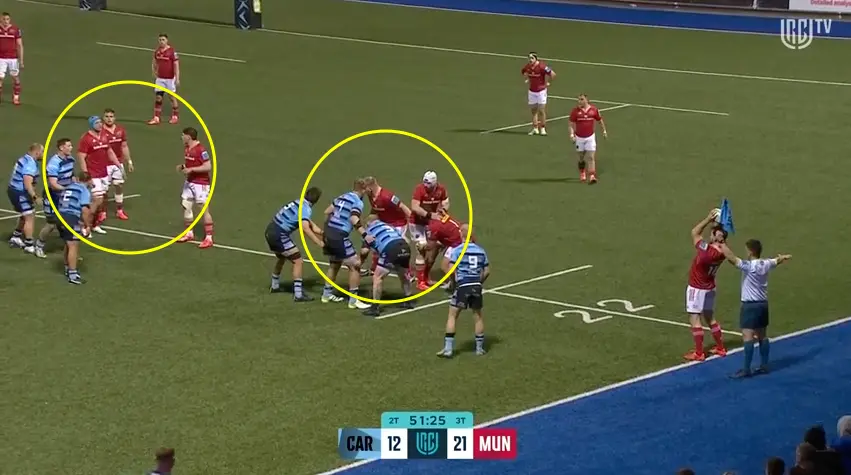
If I’m Beirne looking at this, the only call I want to make with a fresh hooker on the field and reading where Cardiff have set their defence on this 5+1 is to go here – O’Donoghue jumping in the middle to be lifted by Ryan at the front and Beirne at the back.
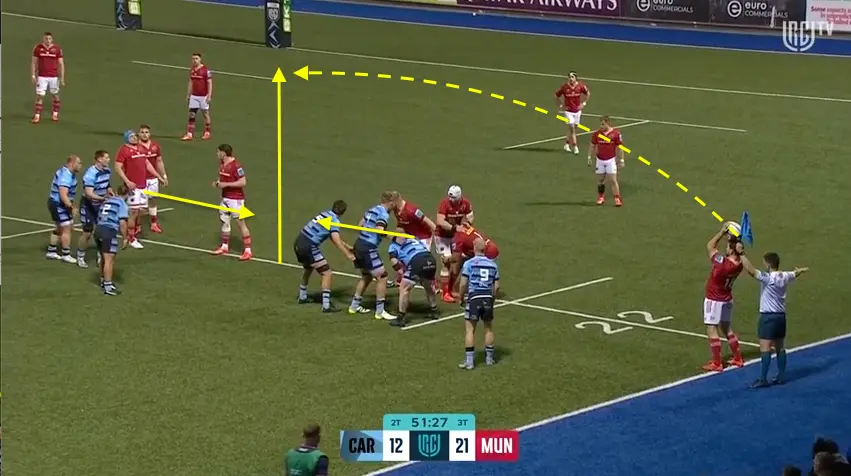
We’ve already lost a few lineouts at this stage, so maybe Beirne was cognisant of throwing into what looks like a Cardiff bait spot with no obvious counter-jumper available.
Beirne calls a ball to the front with Wycherley being lifted by Ryan at the back and Milne at the front. For me, this zone is too heavily contested to go jump for jump at this stage of the game. All three of this lifting pod have been hard at it all game at this stage, and Milne, in particular, was looking particularly tired after one of the best loosehead performances I’ve seen in a red jersey all season. Wycherley isn’t the springiest jumper with the (needed) weight he’s put on in the last 18 months, plus he’s giving up 2/3 inches in height to McNally, who’s marking him spot for spot.
Both McNally and Wycherley launch at the same time, more or less, but Milne slips off his lift a little and gets into a negative lifting shape. Look at how strong Assirati’s shape is relative to Milne here;
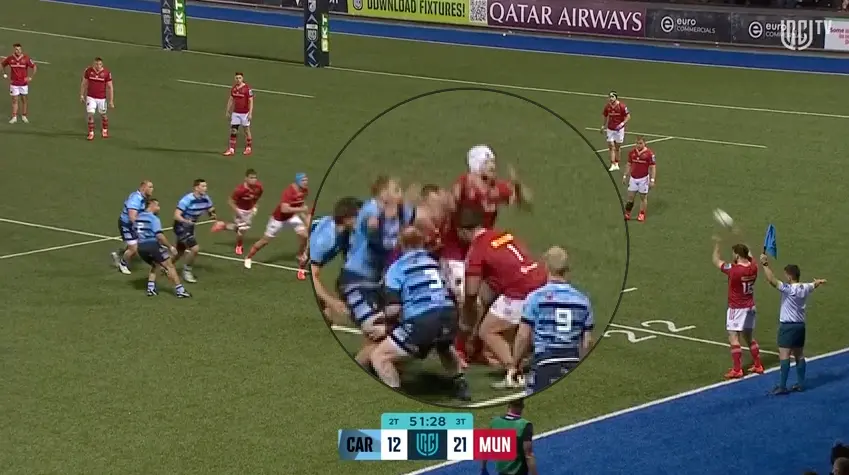
Milne does well to recover his shape on the next few frames, and Ryan’s backlift is OK – not explosive, but decent. Whatever happens on the lift, the ball is overthrown and Cardiff take possession. To be fair to Barron, this is a very, very difficult throw to make on your first action on the pitch. A 5.5m short lob with an on-throw contest?
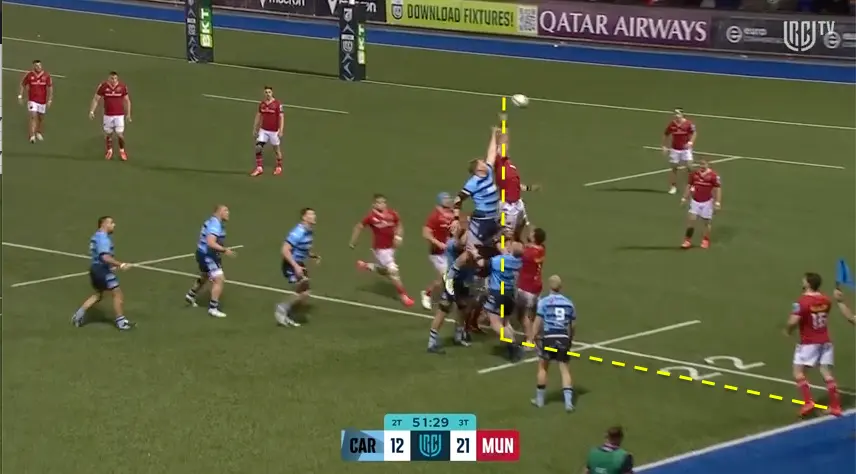
He’s just on the field – let him rip one to the middle at pace to get his eye in. For me, this is mainly bad, context-free calling mixed with tired lifting and jumping and a hooker just on the field being asked to make a fiendishly difficult throw.
We conceded three penalties in a row on the next sequence, leading to a penalty try and a yellow card for Jack O’Donoghue. After the last few weeks of refereeing blunders, you can add this one to the ridiculously harsh, but probably accurate pile.
Jack O’Donoghue hasn’t retreated enough along the side of this maul after it breaks. Yeah, you could argue about Belcher’s bind-or lack of it – but the real issue was being in a position to defend this maul in the first place against a team who we knew would be strong in this area of the game. It all started with our lack of accuracy at the lineout, which has been the root cause of almost all of our problems in the last few weeks.
But that wasn’t the only issue.
Our attack and transition work looked laboured, narrow, slow and shallow.
The shallowness was a real issue against Cardiff because, as we discussed before the game, nobody has more dominant tackles in the URC this season than Cardiff. You can see it here late in the game when we were back to 15 and chasing a winner. Nash does well on direct transition, but our work after that was… weak.
Barron gets absolutely stuffed in contact, to the point that it knocks him out of sync with his pod. That throws off the shape coming afterward because it looked for a turnover for a split second. We recovered and hit another narrow three pod, only to see Donnelly get held up for a maul turnover.
This seemed a little unfair but I checked it – it too 5.97 seconds for the ref to call a maul on this, and 6.2 seconds on a one for Munster earlier in the half. So it was consistent, and that’s what we always want.
The main issue here was how narrow we’d become against a team who do really well blitzing aggressively this season. Here’s another example; we had a post transition sequence where we did well to retain a contestable exit and had Cardiff scrambling backwards. We had a decent post-transition unit in place and Abrahams in a killer spot on the far touchline if we could get the ball to him.
Right from the start, this is all a bit narrow for my liking. John Ryan is too close to Crowley here to be an effective “corner”. In these moments, every player in the pod is important a viable pass option. There is absolutely no way that John Ryan is going to get this ball from Jack Crowley. This mainly comes from Jean Kleyn, who is a little tight to Crowley himself, so Ryan takes his cue from that positioning.
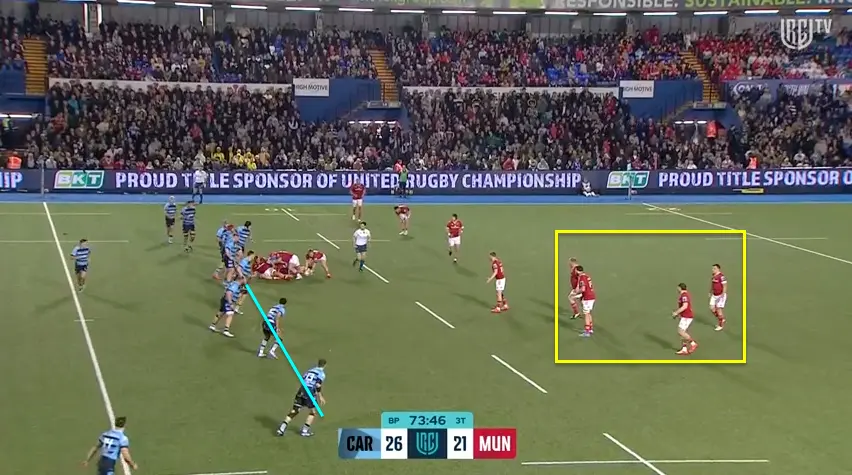
Quinn has decent width on the pod here and probably should have got the pass if a pass were to be made at all. I’d have liked Kleyn to just put the head down and truck into contact here with the hope that a good ruck point might open up some options for us on the fold.
Farrell looks for a screen ball, but the problem was already brewing when the ball left Crowley’s hands. Millard knows our structure and knows how narrow we are; to get outside Cardiff here, it has to be a screen ball to Farrell.
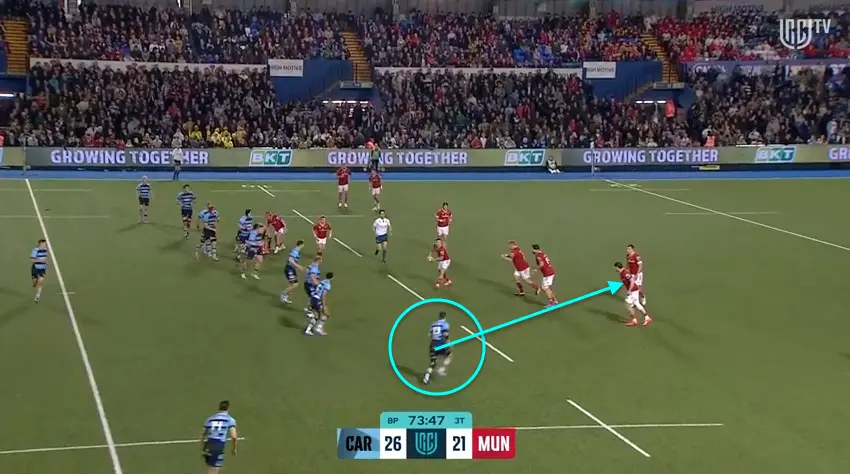
It’s a solid bet to make, and everything is so narrow and shallow, it’s a low-tax option. Even if the ball doesn’t go to Farrell, Millard can’t go wrong blitzing just in case, because every other option has a tackler in line. Sure, Kleyn’s pass kills Farrell because it’s closer to Millard than Farrell by the time the action swings into that layer, but it would have to be perfect to break this blitz.
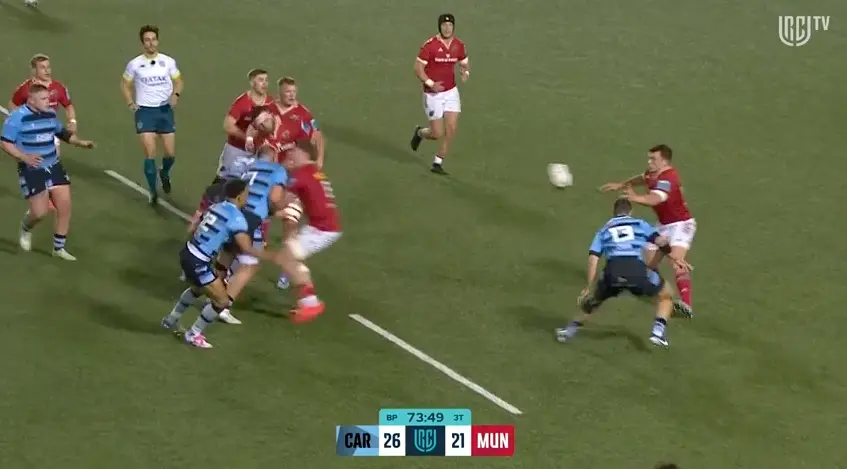
Have we become a little too predictable?
In some ways, yeah.
Cardiff essentially won this game in the second half by kicking the ball long to us. We had no territory, and most of our plays to get out of the kicking trap they set for us just gave Cardiff the ball back in a better spot than they had when they kicked it. We kicked short for most of the game and didn’t get much of a reward for it, especially in the second half.
We spent most of the last half an hour inside our own 10m line and left ourselves too much to do in the last five minutes to pull out what would have been an unlikely win, despite being up by nine points early in the second half. Coughling up the ball after a 24-phase sequence in the 83rd minute really sums this game up – no lack of effort, but everything being played on hard mode.
That kind of sums up the season; everything has been very, very hard and often at our own doing. In the last three weeks, we’ve been beaten by three variants of the same game. Cardiff have the most variance with the Bulls/UBB template, but their kicking volume and defensive pressure, combined with a specific set-piece super-strength, undid us over the 80 minutes.
When you look at Leinster this season, for example, they are built on broadly the same principles; kick first, defend second, set piece is king. We have chosen a different way, and right now, it looks like we’re struggling to live with that stylistic choice as teams bite down on our weaknesses in the video room. Cardiff didn’t really compete all that often in the lineout during the season, but the last two Munster games changed their mind in the preview – and it was effective. The lineout is poisoning everything like an infected wound right now, and nothing will change with this team until that is back to being average, let alone good.
We need this down week to get our heads straight and find a way to reset our game to a place where we can beat Ulster and Benetton and then see what comes in the playoffs.
If not, disaster awaits.
| Players | Rating |
|---|---|
| 1. Michael Milne | ★★★ |
| 2. Niall Scannell | ★ |
| 3. John Ryan | ★★ |
| 4. Fineen Wycherley | ★★★ |
| 5. Tadhg Beirne | ★★ |
| 6. Jack O'Donoghue | ★ |
| 7. Alex Kendellen | ★★★ |
| 8. Gavin Coombes | ★★★ |
| 9. Craig Casey | ★★★ |
| 10. Jack Crowley | ★★ |
| 11. Thaakir Abrahams | ★★ |
| 12. Alex Nankivell | ★★ |
| 13. Tom Farrell | ★★ |
| 14. Calvin Nash | ★★ |
| 15. Mike Haley | ★ |
| 16. Diarmuid Barron | ★★ |
| 17. Mark Donnolly | ★★★ |
| 18. Ronan Foxe | ★★★ |
| 19. Jean Kleyn | ★★ |
| 20. Ruadhan Quinn | ★★★ |
| 21. Paddy Patterson | DNP |
| 22. Tony Butler | ★★ |
| 23. Sean O'Brien | ★★★ |
