


Ireland’s difficulties against New Zealand have been pretty well documented at this stage, but one thing stuck out to me when I was on watchback #4.
Why were we so narrow?
Well, for a start, the pitch was only 64m wide. The minimum width determined by World Rugby is 68m, and most pitches are 70m across.
The tramlines have to be marked at 5m and 10m to make 15m, so we can calculate that the middle of the pitch was only 34m wide between the 15m hashes.
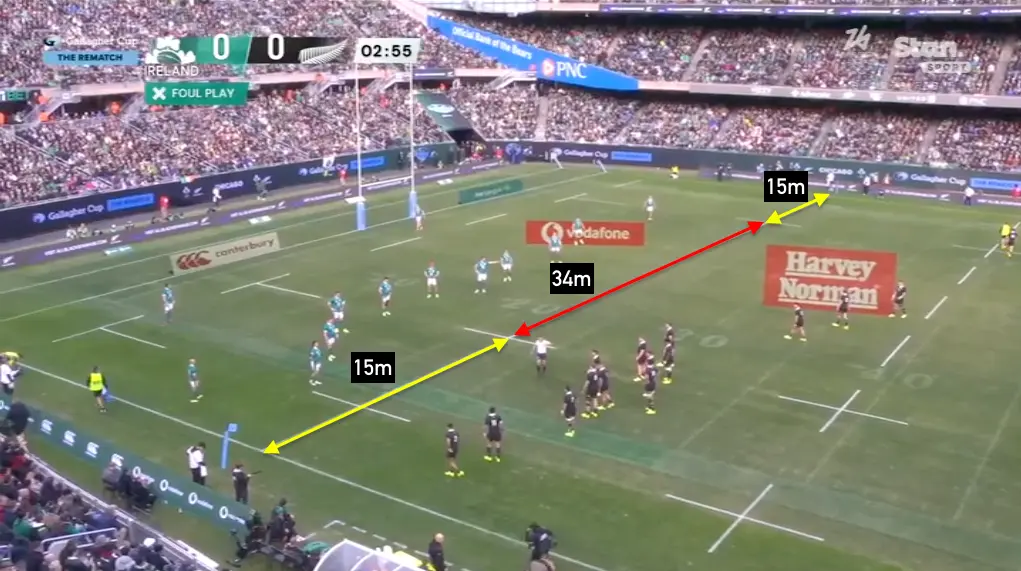
That means you’ve got an incredibly narrow space to work with off the lineout, for example, and it goes some way to explaining why nobody seemed to have any space when the ball came down off the top — which, admittedly, wasn’t all that often.
But, even with this, it felt like Ireland barely fired a shot during phase play.
Part of this comes down to our pre-game decision to kick at high volume to exploit what has been something of a weakness in the All Blacks’ game in the last year, but that doesn’t fully explain it either.
Ireland’s OFFENSIVE RUCK WORK SCORE vs New Zealand
- A Dominant Clean is an action that decisively secures possession or that puts the defending player on the ground and keeps them there. It is worth 3 points.
- A Guard Action is where a player plays a role in helping to retain possession and either secures against a counter-ruck or ensures the players we’ve put on the ground stay there. Let’s assign this action 2 points.
- An Attendance can be anything from adding a bit of bulk to ward against a counter-ruck to extending your leg to make space for a box kick. I’m marking this down as being worth 1 point.
- An Ineffective Action is a blown cleanout, a lean, a breakdown penalty or an action that I couldn’t see any direct benefit for. This will be worth -2 points.
| Player | Dom | Guard | Att | Ineff | Total Actions | ORW | Percent_Team_ORW | Actions_per_Ruck |
|---|---|---|---|---|---|---|---|---|
| Porter | 0 | 13 | 8 | 1 | 22 | 32 | 15.4 | 0.33 |
| Furlong | 2 | 10 | 7 | 2 | 21 | 29 | 14 | 0.31 |
| Baird | 2 | 10 | 4 | 1 | 17 | 28 | 13.5 | 0.25 |
| Sheehan | 1 | 13 | 1 | 3 | 18 | 24 | 11.6 | 0.27 |
| Van Der Flier | 0 | 10 | 4 | 3 | 17 | 18 | 8.7 | 0.25 |
| Ryan | 0 | 8 | 6 | 4 | 18 | 14 | 6.8 | 0.27 |
| Henderson | 2 | 4 | 5 | 3 | 14 | 13 | 6.3 | 0.2 |
| McCloskey | 1 | 3 | 1 | 0 | 5 | 10 | 4.8 | 0.07 |
| Osbourne | 0 | 4 | 0 | 0 | 4 | 8 | 3.8 | 0.06 |
| Doris | 0 | 3 | 1 | 0 | 4 | 7 | 3.4 | 0.06 |
| O'Brien | 0 | 2 | 1 | 0 | 3 | 5 | 2.4 | 0.04 |
| Aki | 0 | 3 | 0 | 1 | 4 | 4 | 1.9 | 0.06 |
| Bealham | 0 | 2 | 0 | 0 | 2 | 4 | 1.9 | 0.03 |
| Kelleher | 0 | 2 | 0 | 0 | 2 | 4 | 1.9 | 0.03 |
| Ringrose | 0 | 6 | 0 | 4 | 10 | 4 | 1.9 | 0.15 |
| Lowe | 0 | 3 | 0 | 2 | 5 | 2 | 0.97 | 0.07 |
| McCarthy | 0 | 1 | 0 | 0 | 1 | 2 | 0.97 | 0.03 |
| Crowley | 0 | 1 | 0 | 1 | 2 | 0 | 0 | 0.03 |
| Gibson Park | 0 | 0 | 0 | 0 | 0 | 0 | 0 | 0 |
| Beirne | 0 | 0 | 0 | 0 | 0 | 0 | 0 | 0 |
| Casey | 0 | 0 | 0 | 0 | 0 | 0 | 0 | 0 |
| Prendergast | 0 | 0 | 0 | 0 | 0 | 0 | 0 | 0 |
| Conan | 0 | 1 | 1 | 2 | 4 | -1 | -0.48 | 0.05 |
1. Volume vs Return
Ireland finished with an ORW of 207 on 67 rucks — that’s 3.09 ORW/ruck off 2.58 actions per ruck. On raw numbers, that’s pretty strong: high work-rate, high security. But it translated into just 2 linebreaks (2.99 per 100 rucks), which is a poor return for that much raw labour. Ireland won the breakdown, but not the right way.
2. Our Carriers are Our Cleaners
The core tight-five + VdF block:
- Porter, Furlong, Baird, Sheehan, Van der Flier, Ryan = 145 ORW
- That’s ~70% of Ireland’s total ORW.
Add Henderson and Doris, and eight forwards deliver ~80% of all breakdown value.
That concentration says that our key power/evasion threats are disproportionately tied up in ruck work and guard roles instead of repeatedly stressing New Zealand’s line as carriers/decoys.
Losing Beirne to a red card early in the game took away a two-way threat — he’s usually a good carrier and a high-volume cleaner — but that wasn’t massively meaningful as the game progressed.
3. Guard-heavy, dominance-light
The full game ledger:
- Dominant cleans: 8 (an unusually poor return)
- Guards: 99 (huge)
- Attendances: 39
- Ineffectives: 27
Ireland weren’t smashing New Zealand off the ball; we were protecting it. The ORW inflation comes from 2-point guards, not 3-point dominant shifts. That’s classic “over-insure the ruck” behaviour — it’s safe, but it flattens our attacking shape and blunts our threat on phase play.
It feels like our volume at the ruck is there to create lanes for Gibson Park to snipe, and if that gets shut down by the opposition, we just lose bodies over and over again.
4. Over-resourcing and attacking inefficiency
With ORW/ruck pushing above 3 via guard actions:
- Too many players are “tagged” into breakdown-adjacent roles.
- Next-phase pictures are short of hard options ahead of the ball.
- New Zealand see bodies near the ruck, not multiple layers of threat wider out.
- That means we exchange secure ball for low defensive stress. NZ have to tackle, but not make many bad choices.
Ireland’s problem here isn’t effort at the ruck; it’s that effort coming at the expense of line-breaking structure.
5. Bench & backs: selective impact
Henderson (13) and Doris (7): Neither player performed particularly well at the ruck, for me. Henderson, in particular, really struggled to make an impact initially.
McCloskey (10): efficient game, adds ruck value without bloat.
Ringrose (4 from 10 actions, 4 ineffectives) and Lowe (2 from 5, 2 ineffectives): their ruck involvements are mixed-to-costly; you’re not getting clean two-way value.
James Ryan had a notably poor game, for me, when we factor in how ineffective he was carrying the ball into the mix.
6. One clear red flag
Conan: -1 ORW (1 guard, 1 attendance, 2 ineffectives) – the only negative player on the ledger. Small sample, but in a tight contest, he stands out as value lost relative to everyone else, who was operating on a neutral basis at least. For Ireland, finding the balance in that back row is a real issue. Doris is the clear standout in this squad to play #8 as he offers a mix between carrying the load and central offensive ruck involvement.
It’s no real surprise to me that a game with no real edge space — literally, in this instance — that Jack Conan functionally disappeared from the contest. Ryan Baird did well in most of his involvements, even if I have reservations on the accuracy of most of his breakdown work, but he did almost all that was asked of him. Van Der Flier’s numbers are modest enough by his standards.
I think his overall output in this game was swallowed by a lung-busting amount of defensive transition work, where he was his usual busy self, but that translated to a somewhat muted game on the offensive side of the ruck.
-
Work-rate there, as usual: he’s one of the key cogs in holding Ireland’s ruck shape together, and you can’t fault his effort.
-
But it’s all “honest shift” stuff: guards and support, no dominant entries, and 3 ineffectives ding the overall efficiency.
-
Rank in context: comfortably in the top group for contribution, but behind Porter/Furlong/Baird/Sheehan on impact profile. More industry than his usual game-flipping output.
Do Baird, Van Der Flier and Doris match up with what we need to compress defences if Sheehan, Porter and Furlong spend most of their energy buried in rucks? That’s the core question for me, and it doesn’t seem like this squad has a natural alternative to that in the building at the moment.
How meaningful that becomes will be clear in the coming weeks against Australia and South Africa.
I’m Not Reading All That. Give Me The TL: DR
Ireland’s breakdown numbers look pretty good – a 3.09 ORW/ruck profile and almost 80% of the load carried by our front five and primary back-row.
But the detail is revealing.
This was a guard-heavy, dominance-light performance that over-insured the ball and under-populated the attacking line. Ireland kept the ball, but New Zealand kept their defensive shape, empowered by a narrower pitch that really highlighted our lack of game-breaking runners or creators in the back three and at outside centre.
Sixty-seven rucks and only two linebreaks = a lot of sweat for not enough compressions on the New Zealand defensive line.
