


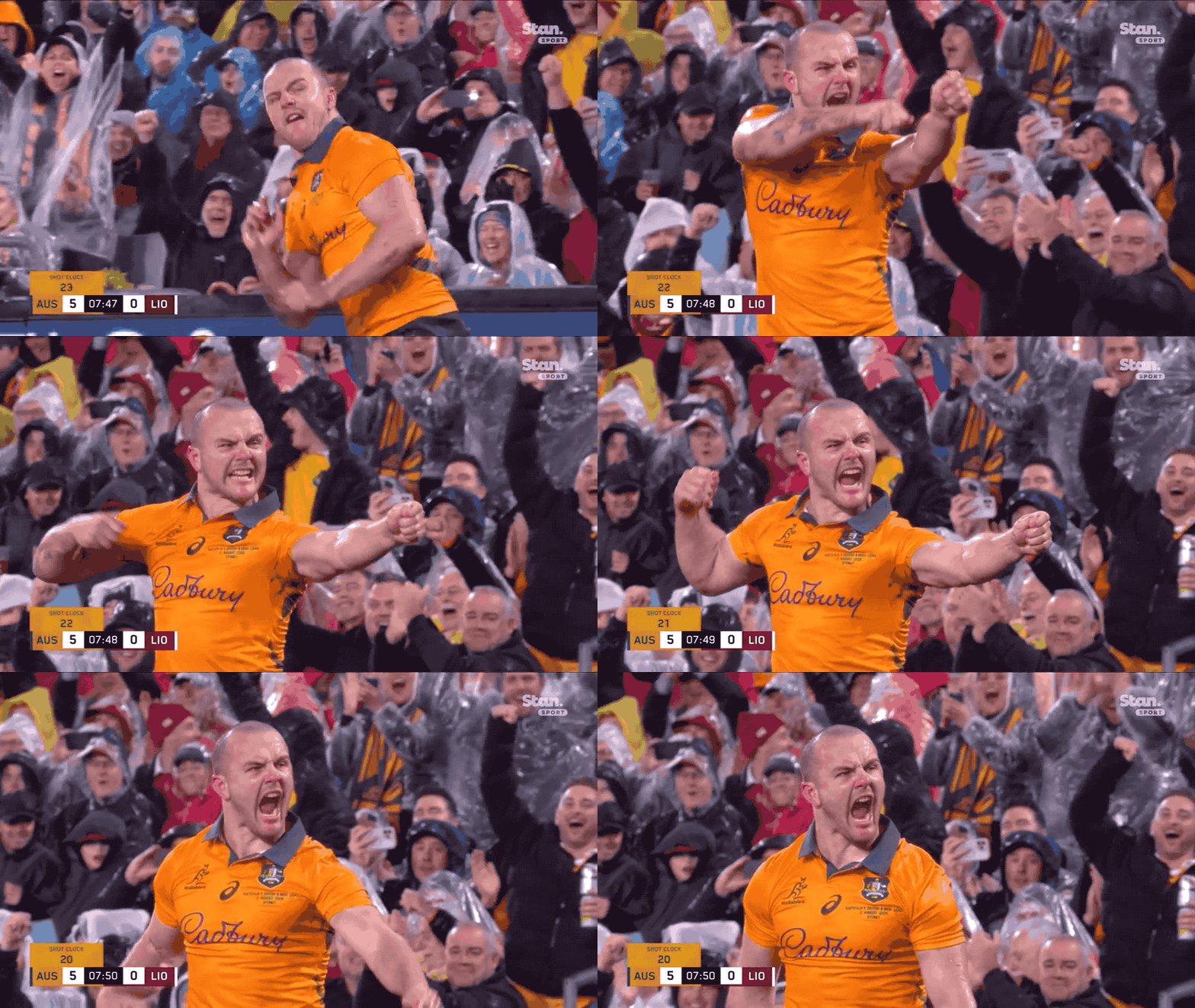
I thought before the game that the Lions would win to make this a somewhat historic 3-0 sweep.
This tour wouldn’t have deserved such notoriety, let alone the accolade of being unbeaten “on-tour” like the 1974 Lions. Whenever I saw the Lions using “on-tour” as the justification for that prospective unbeaten run — the loss to Argentina happened in Dublin, so, technically, not on the tour — it reminded me of a guy trying to avoid a divorce through the What Happens In Vegas, Stays In Vegas loophole. If it happened in a different hemisphere, it didn’t count.
I felt that this rhetoric was a double-down, of sorts, as if the entire Lions set-up knew that this series — this tour, actually — had underwhelmed and that only something remarkable, a clean sweep, would produce something notable from the undoubted effort that had gone into everything to do with this tour.
An inescapable feeling has pervaded everything since the Lions landed in Perth at the end of June; that Australian rugby is at a low ebb, both historically and relative to the recent test environment, and that as a result, this tour wasn’t so much Everest as it was Croagh Patrick. The injuries to Rob Valetini, Noah Lolesio and Will Skelton only added to that feeling that the Lions were playing a team ranked far closer to 10th in the world than they were to the top three, which is literally true in this case and from a broader vibes-based perspective.
The Lions are meant to be underdogs on these tours. That’s the point. Taking a bunch of players from four different nations and touring the traditional Big Two/Three southern hemisphere rugby nations is the entire challenge. Australia, for one reason or another, have been the easiest tour on this circuit historically. The Lions have lost two series in Australia ever, the last one coming in 2001, when this year’s Player of the Series, Tadhg Beirne, was nine years old. To find the next loss to Australia, you have to go back to 1930, when the Lions lost a brief 1-0 series (can one game be a series?) against the Wallabies on the way to New Zealand, which the Lions went on to lose 3-1.
What I’m getting at is this: the Lions normally beat Australia, so winning a series against them isn’t particularly notable by itself.
So, to make this series memorable, both relative to the current zeitgeist and historically, I think this Lions group felt they needed the 3-0 sweep. There was, of course, a mental challenge to come with that after clinching the series last weekend with a dramatic, last-gasp Hugo Keenan try, but it’s not like these lads were on the lash all week, either. Andy Farrell selected the same team that he would have if the series were tied 1-1. That’s the only way he knows how to select, sure, but the messaging inside and outside the camp was that they needed the 3-0. They should be judged on that intent.
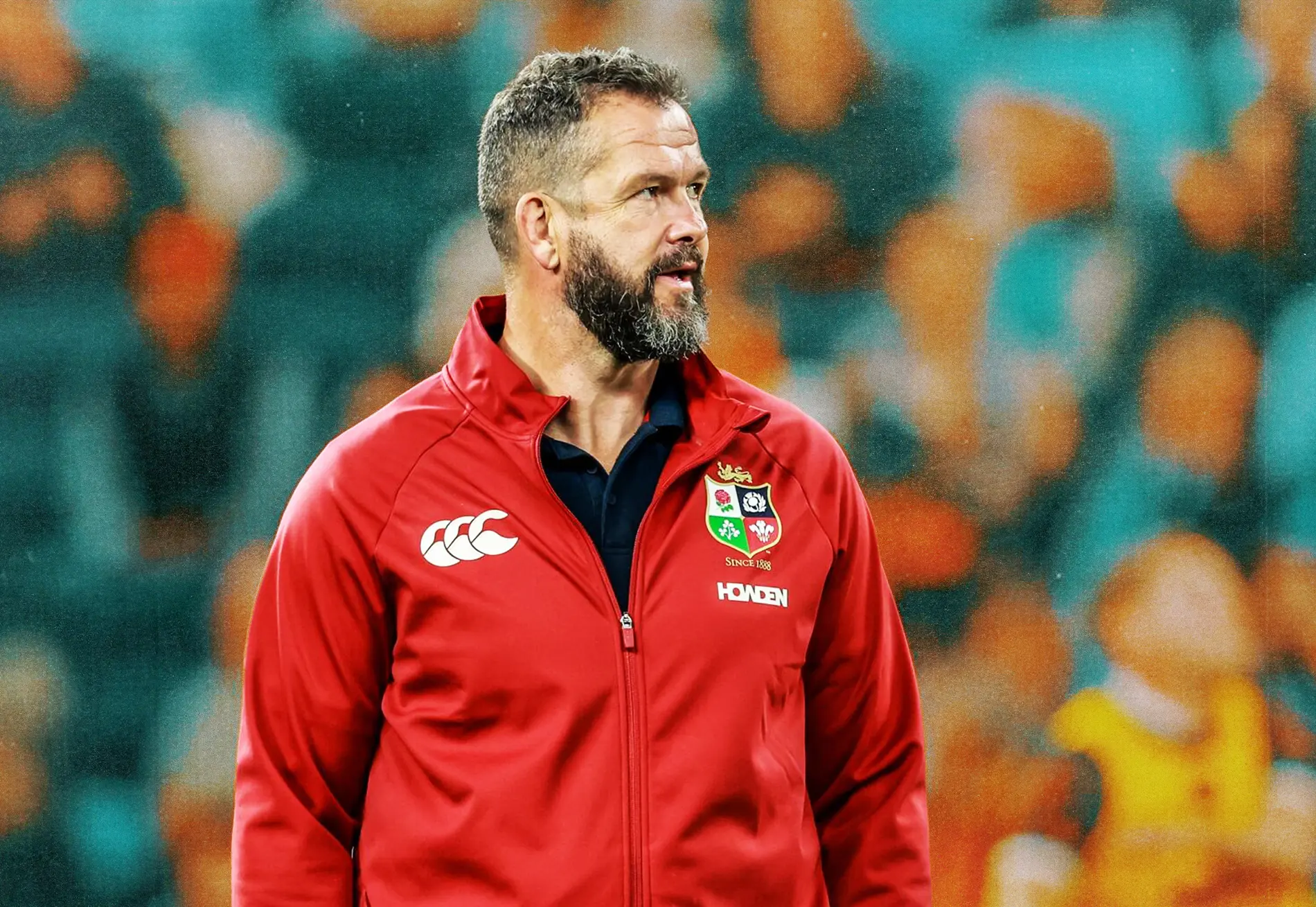
Ultimately, I thought the Lions would win this game because the Wallabies had, up to this point, shown a complete inability to prevent the Lions from winning 6+ offensive 22 entries per game and, then, being completely incapable of stopping the Lions from scoring once they got there.
That is a recipe for losing test matches, and the Wallabies have been cooking with it consistently for the last year.
With no reason to believe that the Lions wouldn’t get those entries again, it followed that the same defeat would follow, be it close or not so close.
Two moments in the first quarter minutes of this game told me that it might be different this time around. Two instances of the same thing, achieved differently.
A Curry slip before contact meant a de facto lost collision as the Lions were about to get a 22 entry, and the Wallabies pounced for a turnover. Penalty. Pressure lifted. Dylan Pietsch smashed Tommy Freeman outside-in on a 5m play, Wilson stepped in for the poach. Penalty.
Pressure lifted.
The Wallabies were finding collision dominance on the defensive side of the ball at key moments. Not only that, they seemed to rediscover the defensive concept they already deployed against Andy Farrell’s Ireland from last November. Surprise, surprise; it worked again.
The Wallabies were sticking into two-man tackles, not competing at the ruck unless there was a clear isolation and sending edge defenders high up into the #10’s passing lane as they realised that Russell doesn’t really hit the gain line unless he has a gap to exploit. He had the lowest percentage of gainline involvements of any of the primary flyhalves on this tour all season long.
If you only lose two defenders to a ruck, there won’t be a gap to hit, which means there’s additional value in swarming Russell in the pocket.
In practice, this meant putting someone in Russell’s eyeline in the second layer.
Make him throw over you with a slow ball, scramble, reset, make the tackle on the edge, jackal pressure there to draw numbers and then repeat the two-man tackle pressure.
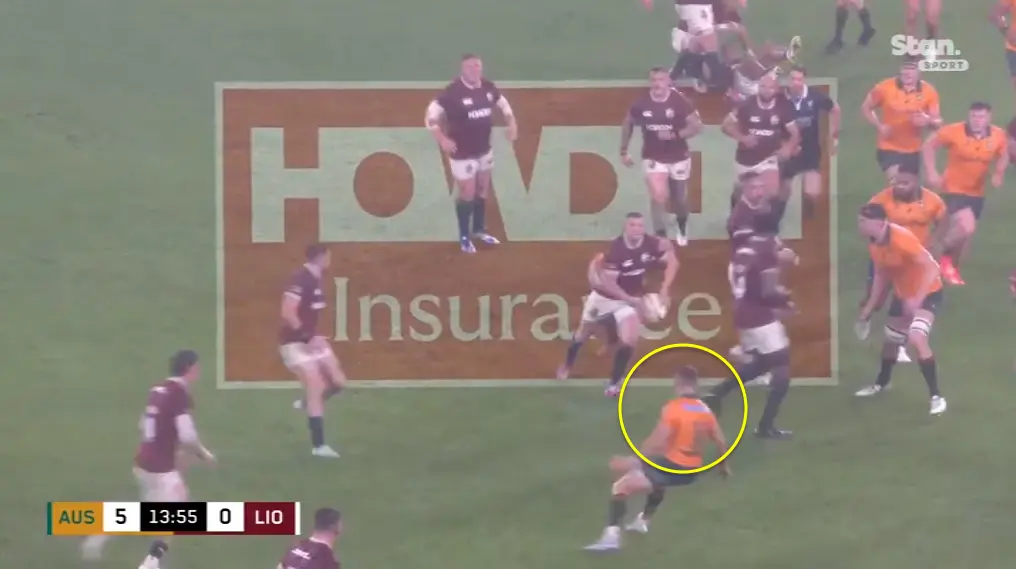
It worked in the wet conditions, but the frustrating thing for Joe Schmidt will be the realisation that it would have worked on the dry track too. They paid far too much respect to Finn Russell and Gibson Park in the first two tests, and it showed.
Throughout this test, the Wallabies got in Russell’s passing lanes and put pressure on him. Not the kind of pressure that shows up as a tackle, or a tackle assist, but enough to put the Scotsman off. Sua’ali’i does really well to cut off that initial screen pass option to Russell.
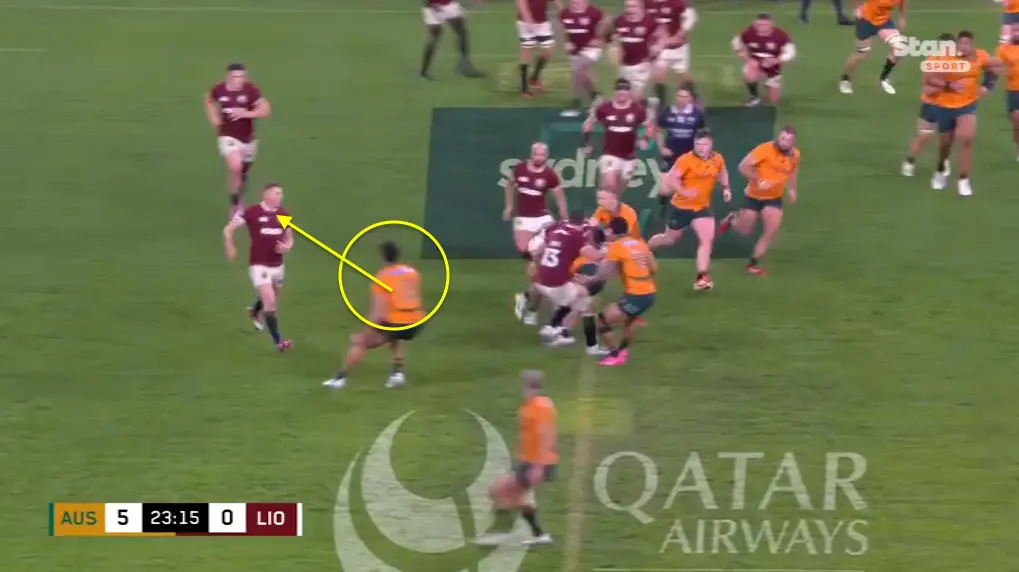
He roughs him up a little, challenges Russell’s focus, and Sua’ali’i gets the reward on the very next phase.
The biggest defensive moment of the first half — and the game, in my opinion — was right before halftime when the Lions had another entry that ran deep into the Australian 22, right on the 5m line. An 8-7 lead going into the second half is literally nothing at all, so the Wallabies needed to resist.
They did just that by sticking to the principles: two-man tackles, poach on isolation (ruck support over two steps away) and then challenge the Lions on the gain line.
At its core, Farrell’s offensive concept runs on rugby league principles.
That means you can’t lose too many forwards to the offensive ruck; it’s got to be one ideally, two max, and if you lose more than that, the #9 has to break into the space to restart the energy in the movement. When you lose multiple forwards to a ruck, the attacking fold is vital and Australia timed their defensive work really well.
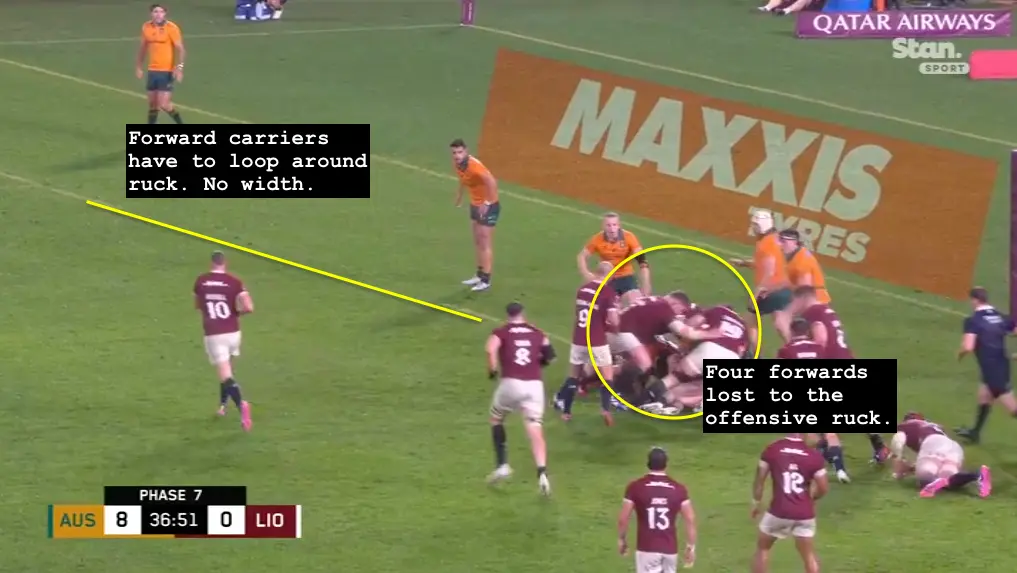
8-0 at halftime felt like a big lead.
The Wallabies were kicking really pragmatically, too, given the conditions. Once again, though, they’ll wonder why it took until the series was over for them to work out the right recipe. At halftime, they’d gone kick for kick with the Lions but, crucially, had worked out that kicking long was adding a lot of value when combined with the lack of contest on central rucks.
Their biggest weapon was the Lions’ relative lack of cohesion, and the killer score came from just that. A long kick, pressure up the middle and a Lions combination that had very few minutes with each other produced a killer error.
Why is cohesion important? Because in a high handling game-plan, you need to know what the guy passing the ball will do, and he has to know — not think, know — where you’re going to run and how you’re going to run.
Then the pass can go without thinking. Without cohesion, you get moments like this, where Kinghorn thinks Farrell is hitting Aki, Farrell is thinking he’s going to use Kinghorn to pinch Pietsch and then use that to pop to Aki/Sheehan, and Aki is thinking he’ll run a block line if he doesn’t get the ball.
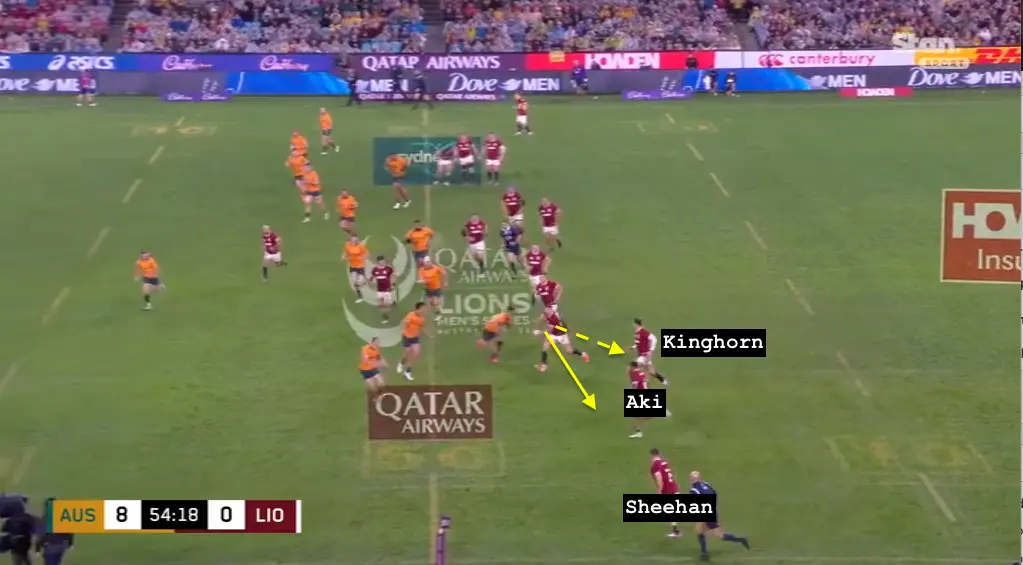
When Kinghorn gets the pass — one he clearly isn’t expecting — the move breaks down on the gainline and the Wallabies take a two-score lead with the guts of 20 minutes to go.
This was there for the Wallabies all along, but maybe the rain empowered them to go at it properly. They saw out the third test relatively routinely, with the Lions looking a lot like Ireland when Ireland loses games. Losing collisions, set-piece imploding, and a nagging feeling that Farrell’s system needs an unwitting opponent to work at its best.
How much of this was the Lions switching off with the series won? How much of this loss was their back five getting disrupted through Itoje’s HIA? How much was the Lions’ cohesion advantage — earned over the tour — disappearing against an opponent when they string three games together in a way that maybe seems familiar with the 2023 World Cup exit?
I don’t think Andy Farrell or his Lions staff will think too much about it. Neither will the players, most of whom go home with a once-in-a-lifetime experience, €100k in the current account, a winning Lions tour added to their Wikipedia, and 50k+ added to their next contract renewal with the IRFU.
What does it mean? In the end, just that. A lot will be made about the benefits the Irish players, coaches and wider eco-system will have gotten from this tour, and I’ve already seen articles to that effect. I can’t seem to work out the logic on that. The best English and Scottish players are now heading back to their home unions with the inner workings of Farrell’s system in their back pockets after a two-month-long crash course in its core fundamentals, how to adapt to opposition scouting and core instructions to keep it running under pressure. For a coach as fundamentally opposed to change as Andy Farrell, that seems more like a problem, but that’s a problem for Future Andy.
How meaningful will that be? That remains to be seen, but for now, the Lions won, the season is finally over, and that’s… something.
| Players | Rating |
|---|---|
| 1. Andrew Porter | ★★ |
| 2. Dan Sheehan | ★★★ |
| 3. Tadhg Furlong | ★★★ |
| 4. Maro Itoje | N/A |
| 5. James Ryan | ★★★ |
| 6. Tadhg Beirne | ★★★★ |
| 7. Tom Curry | ★★★ |
| 8. Jack Conan | ★★★ |
| 9. Jamison Gibson Park | ★★ |
| 10. Finn Russell | ★★ |
| 11. Blair Kinghorn | ★★ |
| 12. Bundee Aki | ★★ |
| 13. Huw Jones | ★★ |
| 14. Tommy Freeman | ★★ |
| 15. Hugo Keenan | ★★ |
| 16. Ronan Kelleher | ★★ |
| 17. Ellis Genge | ★★★ |
| 18. Will Stuart | ★★★ |
| 19. Ollie Chessum | ★★ |
| 20. Jac Morgan | ★★ |
| 21. Ben Earl | ★★ |
| 22. Alex Mitchell | ★★ |
| 23. Owen Farrell | ★★ |
Tour review of all players and coaches coming in Anatomy of a Lion article.
