


It remains to be seen if the odd frailties shown by the Lions in this game will come back to haunt them or, more pertinently, if this version of the Wallabies is capable of doing so. But Andy Farrell can go about fixing those issues on the front foot with a 1-0 series lead in his back pocket. For the Wallabies, they have six days to save the series and force a decider. Nobody of an Australian persuasion should be very confident that they can do that, at least on the evidence of what we saw here.
I felt last week that Australia would have to ambush the Lions, given how their calendar year had gone in general, but more specifically, the power they would have to do without in the pack due to injury. I felt they would need to kick at a high volume, kick well, and then take their chances going outside the Lions on transition if possible. They failed on every measure in a deeply naive performance that worsened with every subsequent viewing. I thought that Joe Schmidt would have a plan—not “strike movez” held back or anything like that, but a coherent strategy to get the Lions playing where they didn’t want to—but if he did, his players weren’t capable of executing either through nerves, tactical incompetence, or both.
If you want an example, you don’t have to wait very long; just 19 seconds.
Nineteen seconds for the Australian halfbacks to show the Lions that they didn’t really know what they were doing. Now, to be fair, the Lions came in with a plan directly focused on stressing out Tom Lynagh, who had the game from hell on his first start at this level.
Russell’s contestable restart—deliberately outside the Wallabies’ 22 to make sure the ensuing exit would be more complex— had the desired effect as Lynagh seemed to overchase a Lions’ soft edge that wasn’t there. At a fundamental level, running Sua’ali’i, or anyone else, into this scenario against three defenders, one of them being one of the best jackallers there ever has been or will be, when you only have one forward to clean out, and that forward is 10m away on the angle, is a bad play.
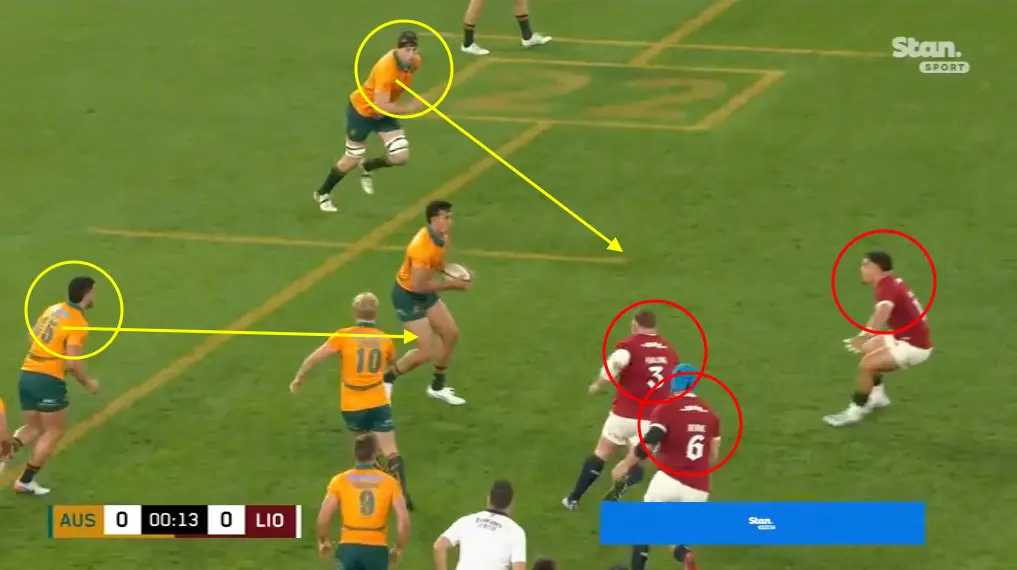
Doing it on the first play of the game, in the first test against the Lions, is as daft as it gets, but I think that comes back to inexperience more than anything else. Russell essentially asked Lynagh and Gordon how confident they were exiting from outside the 22 with their first touch.
It’s a tough one. I often focus on data or breaking down plays, but the human side of the game is as important. A 22-year-old son of a Wallaby great who was, no doubt, feeling the pressure of that alone, never mind having his first start in the biggest game for Australia since the 2015 World Cup final. How confident is he in getting that exit right? How pragmatic is he? How will nervous hands drop that ball onto the boot?
Of course, it’s insanely easy in hindsight to say what he should have done, but I think watching it back, Schmidt will probably tell his halfbacks that they needed to back their kick chase here. You won’t see them make that mistake next weekend, at least not inside the first 20 seconds.
But, in truth, this game looked like so many of Australia’s games over the last year, which is why it’ll disappoint them so much. At a base level, this is who they are right now.
Number Wang
As it’s summer, I’m working out my new Net Efficiency metric for the €10 tier, so consider this a half-experiment, half-advertisement.
Quick Numbers: First Test vs Australia Calendar Year Averages
| Metric | Season Avg | First Test vs Lions | Analysis |
|---|---|---|---|
| Attacking 22 Entries | ~8.1 per match | 7 | Slightly below typical volume. |
| Points Scored / Attacking Entry | ~2.8 | 2.7 | Almost exactly in line with season norm. |
| Defensive 22 Entries Conceded | ~11.1 | 9 | Better than average (fewer opp entries than usual). |
| Points Conceded / Defensive Entry | ~2.35 | 2.6 | Slightly worse than average efficiency allowed. |
| Net Efficiency (calc) | +0.51 | +0.3 | Neutral red-zone contest; scoreboard gap from volume + kicks/goals. |
Where the First Test Sits in Australia’s Seasonal Ranges
Let’s look at rough bands from the 14-game sample:
Attacking Entries (per match)
- High band: 10+ (Georgia, NZ 1, Wales 3rd meeting, Fiji)
- Mid band: 7–9 (most Tier 1 games)
- Low band: ≤6 (SA 2, both Argentina games, Ireland)
First Test = 7 → Right in the “Tier 1 mid band.” When Australia face strong, structured opposition, their 22 Entry volume commonly lands here, so this test looked a lot like most of their games in the last year.
Points Scored per Entry
- Elite (>4): Wales (2nd), Georgia, Argentina 2, England, Wales 3, Ireland (tiny sample 3 entries)
- Functional (2–3): Wales 1, Argentina 1, NZ 1, Fiji
- Blunt (<1): Both South Africa games
First Test = 2.7 → Functional, not elite — matches their Tier 1 “earn everything” output (SA/NZ pressure suppressed the number more; Wales/England loosened it upwards).
Defensive Entries Conceded
- Heavy pressure (12–16): SA (both), Argentina 2, NZ 1, England, Scotland, Ireland
- Manageable (8–11): Wales 1, Wales 2, Georgia, Argentina 1, NZ 2 (10), Fiji (7)
First Test = 9 → One of their better defensive entry counts vs a top opponent. They kept the Lions out of the 22 more effectively than they usually hold SA, NZ, or Argentina. This is something for the Lions to be slightly concerned about, given how they got these entries — more on that in a minute.
Points Conceded per Entry
- Tight (≤1.8): Wales 1, Argentina 1, Ireland, Fiji
- Moderate (1.9–2.8): Wales 2, SA 1 & 2, NZ 1, England, Wales 3, Scotland
- High leak (≥3): Georgia (3.2), Argentina 2 (4.0), NZ 2 (3.3)
First Test = 2.6 (after adjusting for 27 pts / 9 entries) → Right in the moderate concession band. Not a collapse, but not Test-winning stingy either.
Putting It Together:
What kind of game was the First Test for Australia?
It tracks very closely with their “mid-volume, mid-yield Tier 1 profile”:
| Characteristic | Typical Tier 1 Pattern (Aus season) | First Test | Match? |
|---|---|---|---|
| Attacking entries limited | Yes | 7 | ✅ |
| Must be efficient to win | Yes | 2.7 (solid but not elite) | ⚠ Needs more |
| Opp gets ~9–13 entries | Yes | 9 | ✅ Upper control |
| Concede ~2–3 pts/entry | Yes | 2.6 | ✅ Typical |
So: Australia got the type of Test they usually get vs high-end opposition; limited opportunity, fine margins in the 22 — but the Lions were just a touch more efficient and got more scoring value from their visits.
Why the Score Drifted (27–19) Despite Net Near-Parity
Even though per-entry numbers were close, the Lions had more entries (9 vs 7) and kicked at a higher territorial tempo (passes/kick = 4.1 vs Australia’s 6.8).
That meant that the Lions were able to generate repeat pressure, while also creating extra shots at goal through penalties, which then forced Australia to play more phase ball to reach similar scoring zones — increasing exposure to turnovers and offensive dead ends as a result.
So the score gap came from volume + field position + shot-taking more than red-zone strike differential.
Net Efficiency Summary
The First Test followed Australia’s familiar Tier-1 pattern: limited 22s, decent conversion, but not enough volume — and when the Lions squeezed extra entries out of a more territorial game, the scoreboard gap (27–19) opened even though efficiency stayed close on a per-entry basis.
But these are just numbers.
Watching the game back, the first 10 minutes were the killer from an Australian perspective, and it defined how the rest of the game would be played.
One offensive error = 3 points.
One dud pass off a lineout maul = scrum = a critical 22 entry. Again, this was avoidable.
One the Lions forced their way onto the 5m line, it became about whether or not the Lions could finish off this entry against a team scrambling on the back foot. It turned out that they could, but the roots of the try come in the second phase of defence after the Lions took a quick tap off the freekick at the scrum.
Alan Ala’alatoa bites in on Tadhg Furlong, which pulls in Faessler to cover a tip on to Genge, which opens up that cut line for Russell to slice inside before leaving off the perfect little pop pass to Sheehan behind the back of the defender for a huge gain.
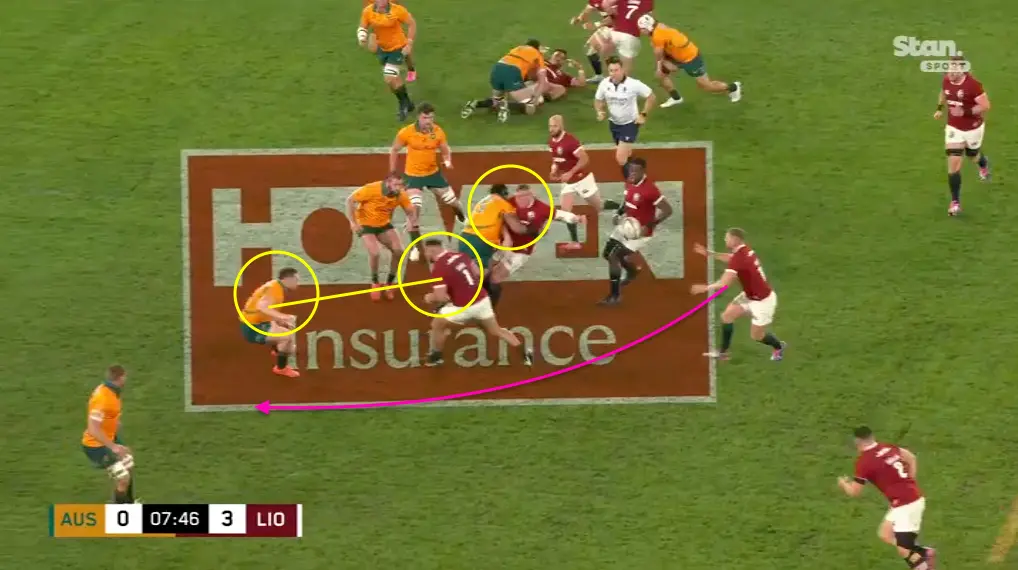
Give a Lions team whose entire game is based on that screen/layered phase game on a short sequence? Alan Ala’alatoa is going to have a hard time explaining his reasoning on this one.
But, for me, the decisive moment in this test happened when the Wallabies had a good scrum position just outside the Lions’ 22 a few moments after going 10-0 down after Hugo Keenan spilt a relatively routine catch.
The Wallabies got a decent punch off Len Ikitau, but were repelled after 11 tight phases where they deliberately engaged the Lions inside defence. They didn’t make it inside the 22. I’ve included the whole sequence because it is really interesting how Australia narrowed the game so much of their own volition, only to get decisively stuffed in contact repeatedly.
There’s a really key moment in there on phase 9 where the Wallabies load up a two-man latch on Harry Wilson to get absolutely nowhere on Maro Itoje and Joe McCarthy, with McCarthy finishing the tackle winning a one on three contest.
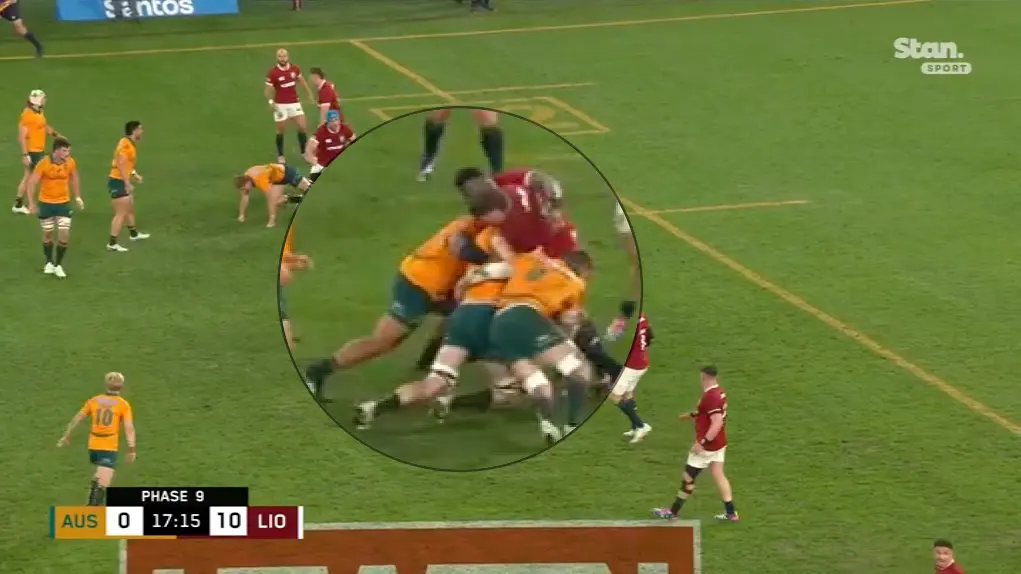
At that point, you know you’re in for a long day and it highlighted the big issue for the Wallabies in that Rob Valetini, Will Skelton and Taniela Tupou are the men you want for that trench warfare. Either way, it was a huge energy boost for the Lions, who kicked downfield and had a try ruled out after a first phase strike play for a double movement by Huw Jones for a finish.
The Wallabies did sneak a try back when Matt Jorgensen won an aerial contest with Hugo Keenan, leaving a free run to the try line, but that’s about as easy as it would get for the Wallabies in the first half. Tom Curry scored from a close-range sequence right before half time to leave the Wallabies staring up a slope.
Two minutes into the second half, they would be staring up a mountain.
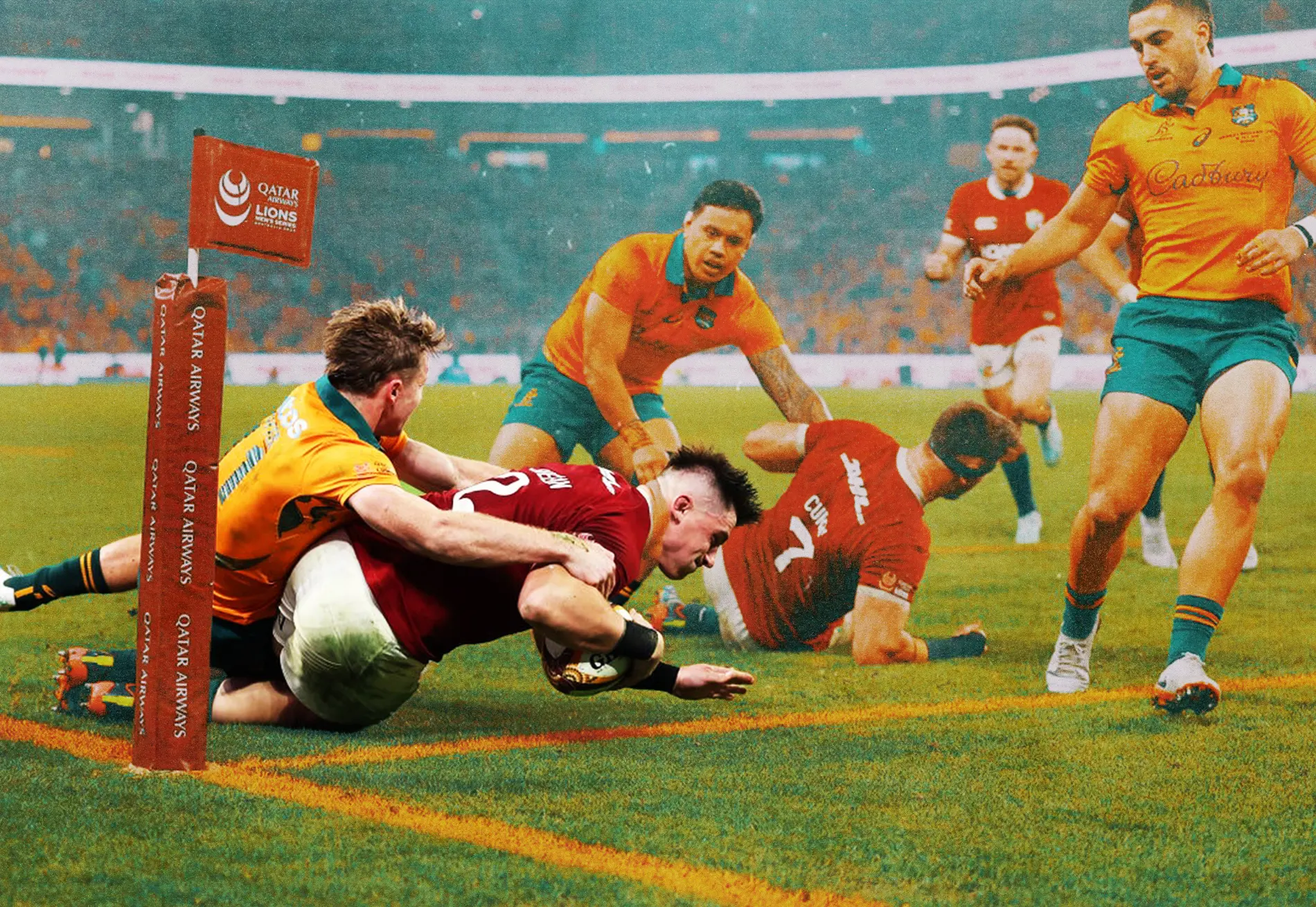
The Lions exited outside their 10m line from the restart. A Faessler throw over the top to Jorgensen was picked off by Curry, who offloaded to Russell, and the break was on. Sheehan finished in the corner, and the game finished with it.
***
Australia did start to fight back and began to find more success in the collisions as Furlong, McCarthy, and Curry all left the field.
The Wallabies weren’t winning these collisions in the first 50 minutes. They had one try ruled out, but scored another to make it 24-12. A 12-point game with 12 minutes remaining? Somehow, they were a bad bounce of a ball from making the game interesting, but the Lions forced a close-range penalty on their next settled possession. Now it really was game over, and even another late Wallabies try wasn’t going to be enough.
The only sensible thing to do was get the ball off the field, reset and go after the second test. That’s exactly what they did.
***
It’ll be relatively concerning for Andy Farrell that such a poor Wallabies side — poor basics, poor pass quality, weak collisions — were somehow able to drag 19 points out of this Lions defence, with most of those coming when Furlong, Genge, McCarthy and Curry were off the field.
McCarthy is an injury worry for the second test. As I wrote in the Lions Eye, McCarthy does not hit a ton of rucks, he doesn’t jump in the lineout all that often, he doesn’t usually make 10+ carries and tackles in a game, and he’s not a particularly notable scrummager in the second row, at least from where I’m watching. If you judge him in a traditional lock role set, you’re going to wonder what the hell he does in a game.
He carries the least out of all the second rows in the Lions squad, if you look at the entire season. He’s not particularly dynamic as a ball carrier because, as you’d expect, he’s very well scouted and normally gets hit with two or more defenders. In this game, he carried just five times anyway, so his impact there was negligible. So what’s the big deal with him?
Joe McCarthy has become a mainstay for Ireland and the Lions because of his work on the defensive side of the ball, where, again, he doesn’t rack up huge volume, but is incredibly effective. Across the 2024/25 season, McCarthy had a dominant tackle rate of 14.8%, which puts him fourth in the world for second rows across the globe this season, but when you add his defensive ruck disruption (21.4%), he’s almost double the rate of the players who rank above him in dominant tackle percentage (Martin, Etzebeth and Meafou).
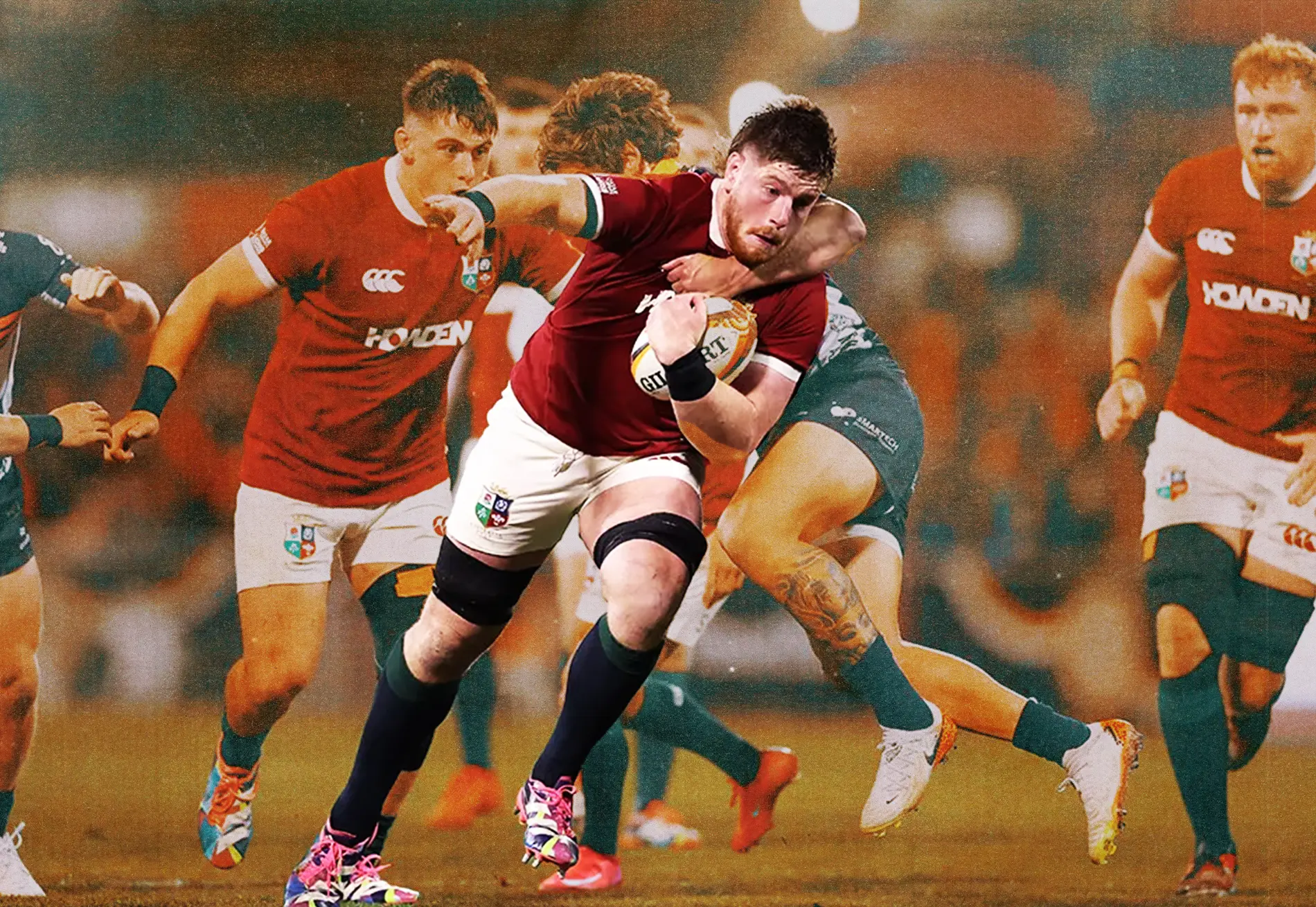
He plays like a second tighthead prop, and that means he’s got a huge impact on the defensive side of the ball. There’s nobody who comes close to his impact per involvement in the Lions squad, and if the Wallabies can get Skelton, Valetini and Tupou back in the saddle, there’s every reason for Farrell to be concerned that the last 20 minutes of this game might map onto the second test.
When you combine McCarthy’s impact with that of Furlong, Curry and Genge, alongside the raw tackle volume of Itoje and the defensive excellence of Tadhg Beirne, you have a brick wall pack that the Wallabies couldn’t live with. If you change up that recipe, the Lions will be concerned that the metrics and momentum will change. But for now, it’s advantage Lions.
| Players | Rating |
|---|---|
| 1. Ellis Genge | ★★★★ |
| 2. Dan Sheehan | ★★★★ |
| 3. Tadhg Furlong | ★★★★ |
| 4. Joe McCarthy | ★★★★★ |
| 5. Maro Itoje | ★★★★ |
| 6. Tadhg Beirne | ★★★★★ |
| 7. Tom Curry | ★★★★★ |
| 8. Jack Conan | ★★★★ |
| 9. Jamison Gibson Park | ★★★ |
| 10. Finn Russell | ★★★★★ |
| 11. James Lowe | ★★ |
| 12. Sione Tuipulotu | ★★★★★ |
| 13. Huw Jones | ★★★★ |
| 14. Tommy Freeman | ★★ |
| 15. Hugo Keenan | ★★★ |
| 16. Ronan Kelleher | ★★ |
| 17. Andrew Porter | ★★ |
| 18. Will Stuart | ★★ |
| 19. Ollie Chessum | ★★★ |
| 20. Ben Earl | ★★ |
| 21. Alex Mitchell | N/A |
| 22. Marcus Smith | N/A |
| 23. Bundee Aki | ★★★ |
