



In Part 1, we looked at Munster’s attacking and defensive composite indexes and landed in a pretty uncomfortable place: a defence-led team whose attacking output is consistently below league average in the metrics that matter most, and whose inability to turn defensive work into scoreboard separation is costing them in tight games.
The read was that the two biggest attacking levers — dominant carries and evasion — are both bottom-tier, and until that changes, we’ll keep losing games we should be winning based on the quality of our defensive platform.
In this article, we’ll look at the set piece data from the season so far and try to roll it into the bigger picture, which isn’t pretty.
The set-piece and movement data from the season so far add a harder edge to that conclusion. Because if the attack is struggling and the defence is carrying the load, you’d at least expect the set-piece to be functioning, giving us front-foot possession, shortening the field, and reducing the number of metres the attack has to generate on its own. It isn’t.
The Scrum
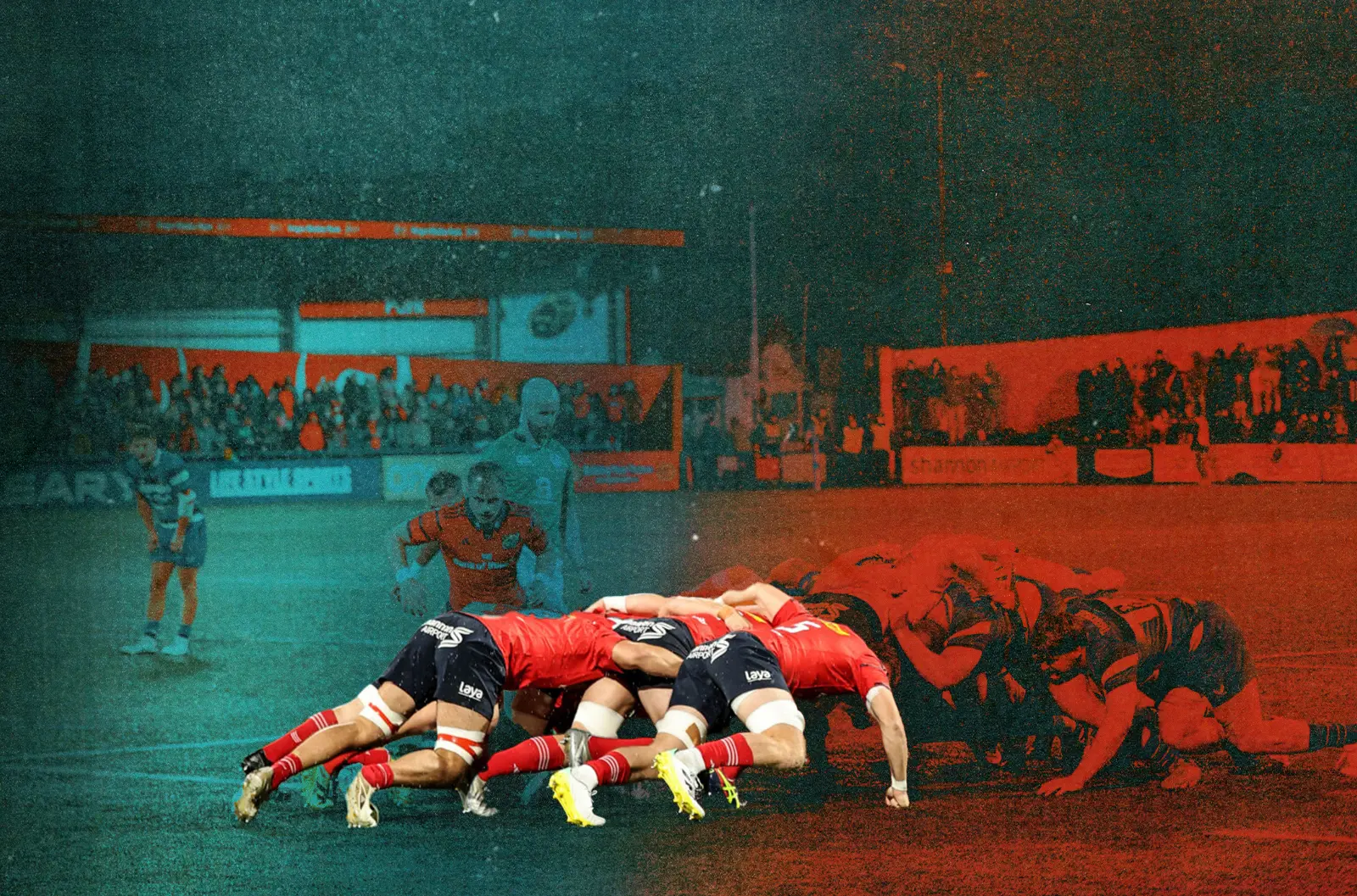
Munster’s own scrum retention sits at 86.2%. That is the second-worst figure in the URC, sitting just above Ospreys’ 81.5% and meaningfully below a league average that clusters in the low-to-mid 90s. For context, Edinburgh are at 95.9%, the Bulls at 97.0%, and Leinster at 90.5%. We’re not just mid-table here, we’re in the relegation zone of scrum retention.
This is hugely important because the scrum is supposed to be a platform-generating phase: an opportunity to get front-foot ball with a pre-set defensive alignment to attack into, or a penalty engine that can move you up the field when your attack is struggling. When you’re losing scrums at the rate we are — and we’re playing an attacking system that is already reliant on getting quick, clean ruck ball to compensate for below-average evasion and dominant carry rates — a leaky scrum is multiplying our problems. Every lost scrum is either a turnover or a penalty in a dangerous position, and either way, it’s placing the burden right back onto the defence to reset.
So the failure loops: poor scrum → concede possession or penalty → concede territory/points → restart → concede that too. Or, force a turnover, and then the exit issue from Part 1 (87.3% success, one of the worst) sits in its own, separate doom loop.
The set-piece, aerial contest, and exit data are all pulling in the same direction: Munster are structurally worse than most URC teams at the phases that determine who gets the ball and where.
The Maul That Doesn’t Score
The most striking single figure in this data is the maul-to-try conversion rate. Munster’s “mauls per try” figure sits at 58.0 — the worst in the league, and it’s not even close. The next worst figures belong to Ulster at 50.0 and Leinster at 40.0, while most sides in the URC sit somewhere between 6 and 22. Even accounting for variance in how often sides use the maul as a primary scoring tool, 58.0 is an outlier.
The “Maul Mileage” Index
You can derive a simple combined metric from the two maul data points: metres per maul × mauls per try = total metres of mauling required to score a try.
Think of it as a measure of how “expensive” the maul is as a try-scoring vehicle for each team.
| Team | Metres/Maul | Mauls/Try | Total Maul Metres/Try |
|---|---|---|---|
| Glasgow | 3.0 | 6.8 | 20.4 |
| Edinburgh | 1.6 | 12.8 | 20.5 |
| Cardiff | 2.5 | 8.8 | 22.0 |
| Munster | 1.8 | 58.0 | 104.4 |
| Leinster | 2.5 | 40.0 | 100.0 |
| Ulster | 2.3 | 50.0 | 115.0 |
Glasgow and Edinburgh need roughly 20 metres of mauling to score a try. Munster need over 100. The Irish provinces occupy three of the four worst spots by a large margin. For Munster specifically, the maul isn’t a try-scoring platform at all — it’s a possession vehicle that rarely cashes in. Which raises an interesting question: are we using it wrong (wrong positions on the field, wrong defensive reads), or is the driving technique generating such poor metres-per-maul that the whole sequence becomes unproductive before it even gets close to the line?
What this tells you is that the maul is being used as a possession vehicle or a metre-gainer in the short field, but it is not creating the “short field + maul + score” sequences that historically made Munster’s close-range possession genuinely threatening.
Combined with the first article’s finding that dominant carry percentage sits near the bottom of the league, what emerges is a picture of a team that is doing a lot of work in heavy traffic without any of it translating into scoreboard pressure. The effort is there. The outcome isn’t.
When we cross-reference that with the lineout — which has improved radically in completion across the season — I think we can conclude that, while the efforts we’ve made to stop losing 22/23% of our lineouts across the first block have resulted in a more static, “safe” lineout in the second block that gives retention, but not really a dynamic platform to play off.
The Movement Profile
The team movement data is almost a visualisation of how Munster’s attack looks from the stands. Just 7.4% of carries go for 20 metres laterally or more — the third lowest in the URC, ahead of only Benetton (5.0%) and Connacht (6.4%). Simultaneously, we’re running one of the highest blind-side play rates in the league at 16.4%, second only to the Sharks at 16.7%.
That combination tells a coherent story: Munster are repeatedly hitting into congested channels (high blind-side usage, short carry outcomes), rarely punching through for the kind of gain that shifts the defensive picture and then not really playing out to width because the compression isn’t there.
Three Red Kings · URC 2025/26
The Congestion Trap
Blind-side carry % (x-axis) vs 20+ metre carry % (y-axis). Top-left = wide and explosive. Bottom-right = narrow and congested. Dashed lines mark the league average on each axis.
Data: OPTA / URC · Visualisation: Three Red Kings
We’re right next to the Sharks on this graph, who have a significantly higher level of both dominant carries and evasion.
We’re actively choosing to play this narrow, with a view to what we build this season will improve us next season, and even later this season when we can add in better options — the likes of Gleeson, O’Connell, the Edogbo brothers — as pitches harden up and the flow of games turns a little more towards something that favours retention, but none of that will work unless we can functionally improve our scrummaging performance, which is the clearest drag on our season so far, both directly and indirectly.
Phase Abandonment vs. Kicking Rate
Munster’s possessions ending in a kick: 40.2% (dead average). Possessions reaching 5+ phases: 14.7% (below average).
For comparison: Glasgow kick on 33.6% of possessions and reach 5+ phases on 22.3%. Edinburgh kick on 43.0% and reach 5+ phases on 15.9%.
The interesting comparison is between Munster and Edinburgh here. Both have similar 5+ phase rates, but Edinburgh kick significantly more — which tells you Edinburgh are making a more deliberate tactical choice to exit possession early via kick, whereas Munster are reaching a similar phase ceiling without necessarily intending to. We seem to be getting stopped before phase 5 more than they’re choosing to kick before phase 5. Combined with the short, blind-side-heavy carry profile, the picture is of possessions hitting a wall at phases 2-4 and then being forced into a kick from a compromised position, which feeds directly back into the restart and territory problem.
The dominant collision problem directly intersects with this.
We don’t kick enough to justify our lack of collision winning at the moment, which means we often struggle to establish “verticality” in games. This visualises the lack of separation you can see when watching from the stands or on TV.
When we intersect this with our offloading work, the problem becomes clearer still.
Munster’s set piece — scrum and maul in particular — and our shape are all adding to this lack of forward progression that we saw across that middle block of games, but that in and of itself is not as bad as it seems.
Even with those clear issues, we’re there or thereabouts.
Since the end of November, our average margin of defeat has been 10.7 points.
The 10.7 average is somewhat misleading on its own, because it’s heavily skewed by the Bath outlier (–26). Strip that out, and the remaining six defeats average just 8.2 points — and four of the seven losses were by 6 points or fewer. The two Champions Cup losses to Toulon and Castres were both by 2 points. The Leinster derby was 5. The pattern in the data analysis we’ve looked at is right there in the scorelines: games being decided by single moments in the final quarter rather than Munster being systematically outplayed across 80 minutes.
The attack can’t manufacture a response when we cough up an early score, so close games become narrow losses rather than narrow wins. That’s 7 or 8 points of attacking output away from being a very different run of form.
The changes seem far away now, but I really believe that a few small tweaks to what we’re doing will have outsized results on performance, be it in a change in our scrummaging set-up, a little bit more kicking to contest, or some better penetration from our offloading, all in tandem with what we’re already doing.
