


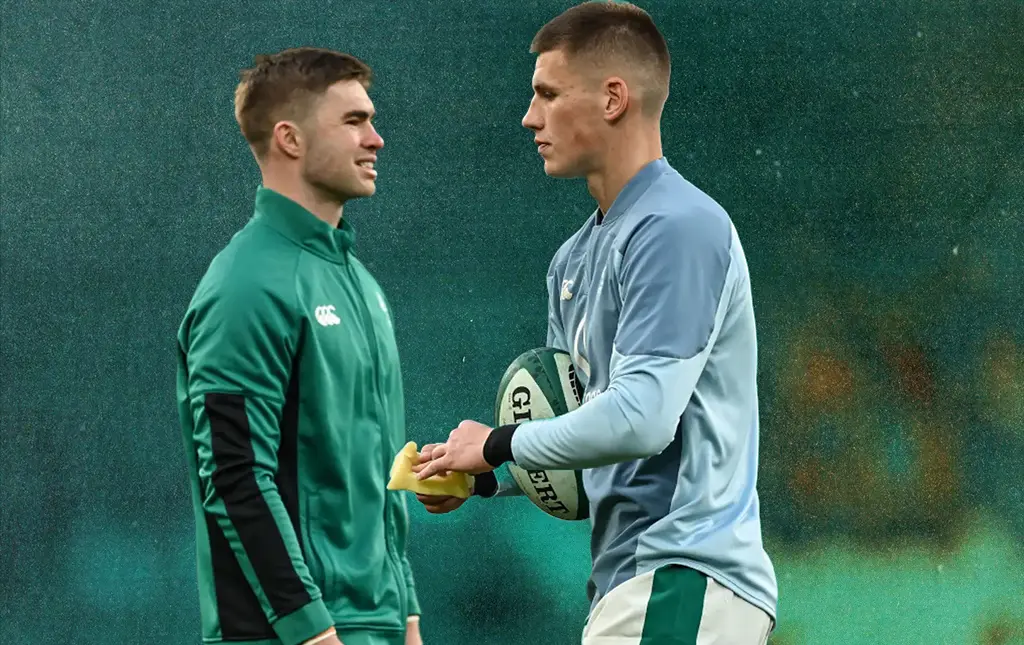
We live in times of great emotion.
Life is hard and scary. Everything is more expensive. What will the future look like? Will it be better or worse than now? We don’t know. If I were to guess, I’d say worse or so different that better/worse doesn’t even enter the conversation. So with the world being the way it is, I find a lot of extra emotional energy is being dumped into sports. I see it all the time on Twitter — as you’d expect — but I’m seeing it more and more on Instagram comments too.
I’ve been posting more video content on there, and on TikTok, in the last few months and on almost every one of those videos, I get five or more comments from people who are either gut-spewingly angry, trying to troll for attention (the main culprits), obvious bots or just genuinely hateful anonymous profiles. I hide the comments so nobody but me ever sees them. The people who make the comments don’t know this, so they just assume that nobody ever saw the comment in the first place. It’s like putting a pint glass on top of a wasp.
Whenever I see these comments, though, I look at the profile picture, and I almost always see a smiling man, pint in hand with his friends or a family man sitting with kids and a lovely wife or partner arrayed around him. I always think, “What would they think if they could somehow watch you type out that message and send it?”.
One man in his 50s/60s left such a nasty, vitriolic comment on a video of Ian Keatley kicking a drop goal that, when I looked at the beautiful family and teenage grandkids in his profile picture, I remember wondering to myself how those grandkids might perceive their, most likely, loving and affable grandfather writing like an absolute psychopath on a rugby page’s Instagram comments section.
This is the secret pandemic of our times. Anger. Confusion. Dopamine addiction. Anxiety — economic, existential or otherwise. Dread. It’s ignorance and stupidity. Most often, loneliness. And all of that is rolled into a toxic slurry with no real outlet, save for the thrill of getting the phone vibrating because people have finally seen you, even if what they saw was you being unpleasant. When I see these comments, all I think now is that these people want someone to notice them.
If you go on Twitter right now with any passing interest in soccer, you’ll probably end up seeing an account called Hater Central, a failed NBA Twitter account that pivoted to soccer when they realised millions of people just want to revel in anger, schadenfreude and that kind of one-sided “banter” that is anything but friendly. Hater Central realised the hate economy in NBA Twitter was too crowded, while soccer was fresh for the taking. They’ve generated a massive audience in just under a year because, just like the USA, there’s a lot of anger to be displaced all over the world.
But I know why people displace that anger, and do it now more than ever before.
Being angry about life can be scary and overwhelming, but being angry about the manner in which a ball goes around a pitch, and who’s doing the moving, gives you more control. That’s anger you can pour into a box and safely displace. I’m not existentially angry because life is big and frightening, I’m angry because of a rugby match. We’re in the displacement business now, but it’s like putting a ball of plutonium in your pocket because you like the glow. It rots you while you think you’re enjoying the sparkle.
Why does it work? Why is there an audience for this? It’s because nothing — literally nothing — generates clickthrough like the promise of displaced anger. The almighty algorithm rewards it. Clickthrough equals a user on the site. That user can be rolled into a pitch deck and sent to advertisers. Here is an engaged user, one of many we have, who could be looking at an ad for your company right now. That pitch deck will not suggest you’re only there because you want to tongue an ulcer, because it doesn’t matter why you’re there, only that you are there.
And that’s the problem.
***
When Leinster Rugby decided to use this particular image for their promo of this weekend’s game in Croke Park a few months ago, it was because they wanted to utilise the cultural flashpoint in Irish Rugby that we saw last season to sell tickets. Sam Prendergast vs Jack Crowley. It was more than a discussion about who the better player was. Far more.
When they used this image this week — Snyman, front and centre — it was to evoke the nastiness and fallout of his move to Leinster from Munster, again to sell tickets and create buzz.
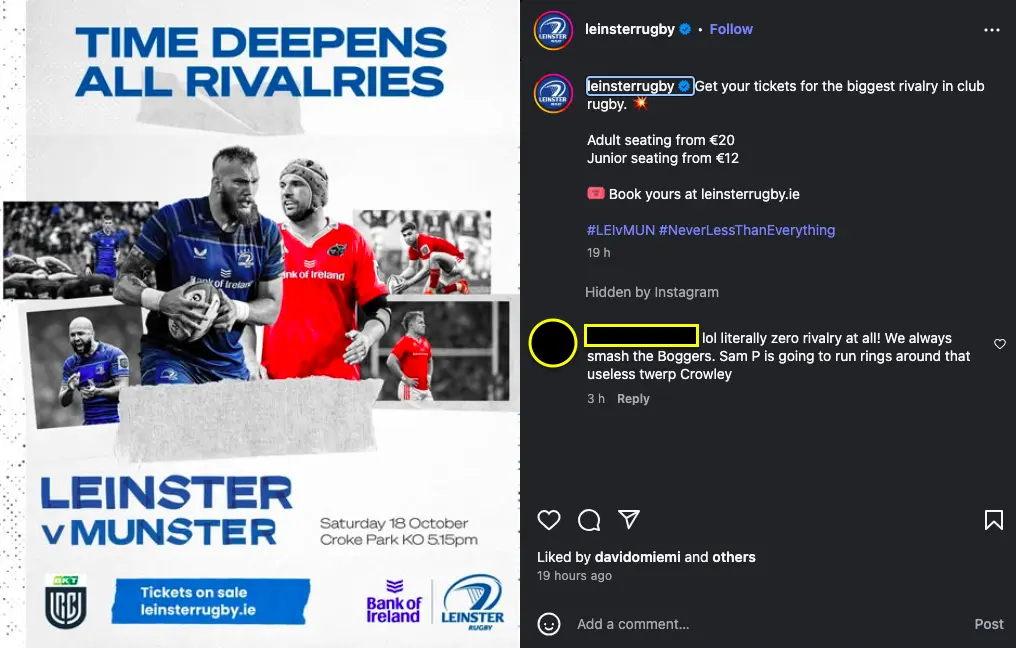
Remember the schadenfreude you felt when Leinster signed Snyman and announced him the week of the Leinster vs Munster game in Thomond Park? Buy a ticket for this weekend to feel that again.
You can see that comment below, too, of course, delivering the exact sentiment that this content was always going to provoke, as both a side effect and a motivating factor to engage.
By the way, here’s a post from that same Instagram account on their own page.

Self-care in the streets, psychopathy in the sheets. Displaced anger.
It works. It generates buzz. It generates enmity, rather than rivalry, though, because enmity sells a few more tickets per post. I understand the feeling, and they’re not alone in this; not by a long shot. The Irish media have been using this cultural flashpoint as a revenue generator for the last 18 months. Schadenfreude vs Seeth, on both sides of the cultural coin.
“Your man is out, our guy is in”
“Your man just dropped a stinker, ours saved the day”
“Our guy is a generational talent, Dan Carter reborn, and your guy is just a steady hand who never had a chance”
“That generational talent of yours can’t tackle or run to save his life; our guy is the more complete player”
Social Media is often blamed for this toxicity, but I have a few points on that. First of all, everyone talking about this, from journalists, pundits, ex-pros, content creators, aggregators, and regular users, is all on social media. When you say “social media” is the problem, you’re talking about yourself.
With that, the fundamental question I have is this: what came first? The rage? Or the bait?
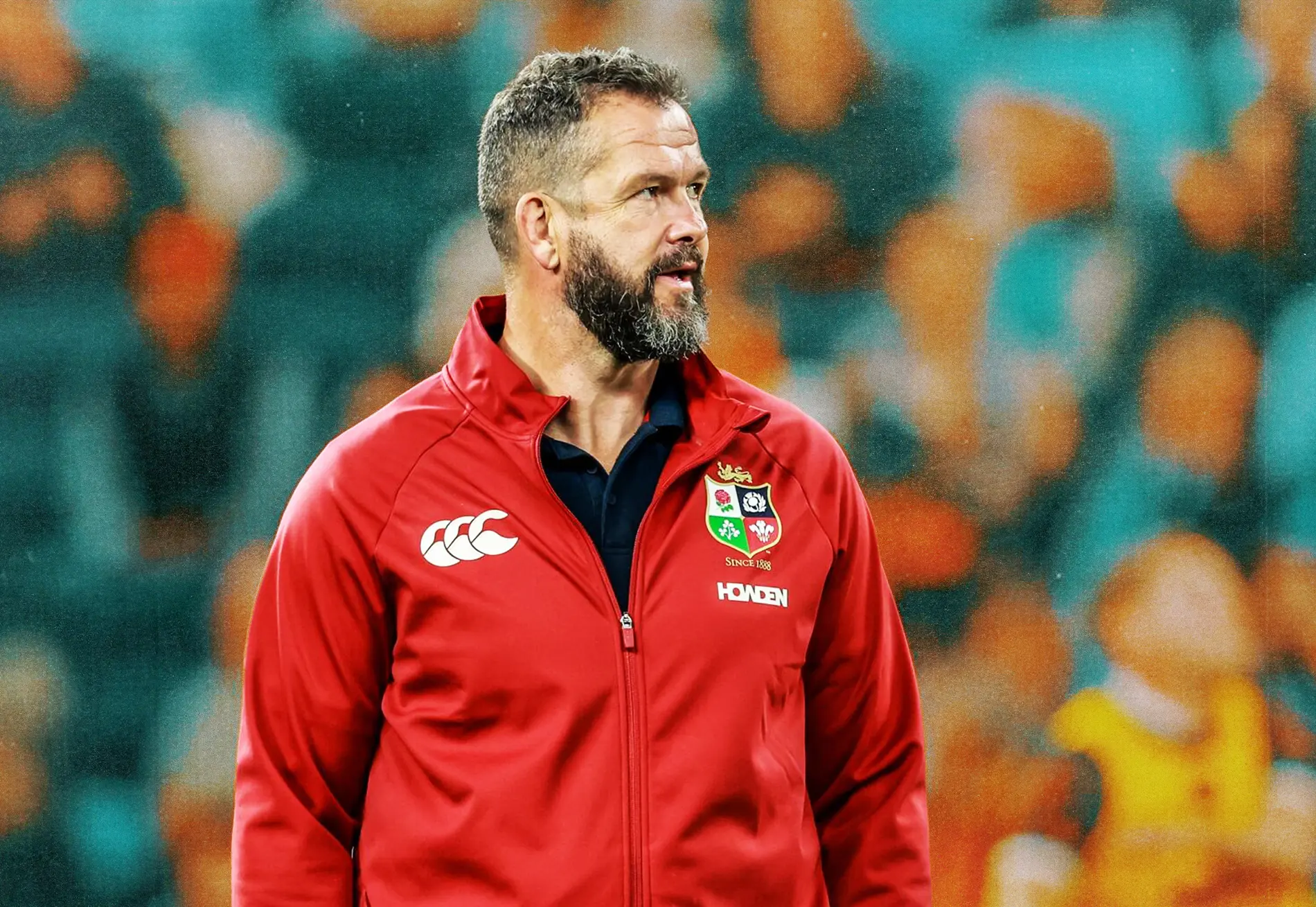
I think what we’re mainly seeing in these comment sections is people arguing over avatars. I would wager that most people invested in the Crowley side of the “battle” don’t have a problem with Sam Prendergast, the player, but rather the people promoting him as the next big thing. It’s not really about Prendergast at all, except as a homunculus for pundits and journalists who tried to push him at the expense of Crowley. This was done in big moments and small, but it was there. People on “both sides” saw the messages very clearly.
I think the people who have decided that Crowley is and always has been overrated are responding to the rejection of that narrative about Prendergast and seeing it as a rejection of them. Essentially, if you take X pundit and Y journalist at their word about Sam Prendergast — that he is exactly what they claim he is — and feel good off the back of that, anyone saying something to the contrary feels like an enemy.
It’s that, plus a million other small flashpoints, a lot of which aren’t even about rugby at all.
Ultimately, I think the main issue here is the volume. Most of the main legacy outlets pushing the Prendergast side of this flashpoint in the last 18 months are deeply embedded in the Dublin Rugby bubble. If you live and work there, regardless of where you’re from originally, you’re going to have a cultural lean towards one side. This also plays into who your primary audience is, something I am well aware of when it comes to my own content, too. It is natural, in a way. If your demographic is mainly Leinster fans, you’re going to be more forgiving of Prendergast’s faults and more enthused about the strong parts of his game. For me, it’s probably the opposite.
But I have had enough of it.
During this test window, I will only be covering the Ireland team from a perspective of rugby only. What happens on the pitch. Why it happened, as best as I can explain. Hard data when I have it, and what I hope is solid reasoning when I don’t.
I don’t need rage bait to make money. My model isn’t about the promise of tonguing an ulcer and then showing you an ad. I want to be about trust. You pay for articles and podcasts; I will give them to you without any cultural flashpoints.
And if you trust me on that, I won’t let you down.
