



Everyone can spot a team playing behind the curve of the modern game.
One recent — ish — example comes to mind. Remember Ireland in the 2019 World Cup, where it seemed like, in the space of a year, we went from being the top dogs in one iteration of the sport in 2018 only to crash headlong into a slightly new variant in 2019? Remember how jarring it looked — like we, all of a sudden — were playing Stone Age rugby and got torn up by Japan, and then New Zealand?
The game had moved on. We made a read that either the game hadn’t moved on, or that even if it had, what we were doing already would work at the level it needed to. Either way, we were wrong, and paid the price.
With 2026/27 less than two months away and preseason about to start, we have to ask ourselves the same question.
But the first question is this: what is the modern game?
That’s the fundamental question everyone is asking themselves, and it’s where the coaches and analysts make their money.
The next question is: if we know where the game is and where it’s headed, are we set up to play it?
So, two pretty important questions.
The first is understanding where the game is and where it’s going.
To do that, we need to parse what World Rugby is trying to encourage, either directly or indirectly. World Rugby seem to want a fast, possession-based game that is inherently transitional in nature, which means a lot of traded possession, unbroken ball-in-play sequences, and one that leans into the physicality inherent to the sport, with the set piece as a force amplifier.
Law changes and, more importantly, law interpretations will eventually lean into what World Rugby wants. Everything that World Rugby seems to be tweaking in the game is to make off-ball rugby as difficult to manage as possible. That doesn’t mean it’ll be impossible — either as a game state in general, or as a game-to-game adjustment — but I can’t help but think that what World Rugby see as the ideal game from a product perspective, as gross as that is to type, is something akin to what we see from UBB and Toulouse.
Everything from the escort law to the new interpretation around the ruck — referees are quite hot now on not rewarding turnovers to a poacher when there’s a tackler anywhere near the clearout zone — to the change in maul defence tells us something quite clearly: the avenues to a spoiling, off-ball-rooted game are going to be harder to manage. Not impossible, not completely locked out of the sport, but harder to do consistently.
Think about it.
- While the contestable kicking game is still super-charged by the change in the escort law, teams have now realised that it comes with as many drawbacks as it does advantages. For every “bat back” that lands on your side from a contestable, around half land with the opposition and nothing but broken field in front of them, especially with (a) referees now not calling anything but the most obvious knock-ons and (b) receiving teams are almost “escorting” the drop of the ball now in a way they used to do for their receivers.
- With jackals now harder to execute — tackle assist players on the ground will lead to a “hands away” call, if not a defensive penalty — the scope for kicking, slowing and poaching post-kick will be reduced, or made more high risk. That won’t apply to every game with every referee — the referee’s interpretation is still hugely important — but if the interpretation from the Nations Championships holds at even 50% of the interpretation, kicking the ball to force a turnover on subsequent phases post-transition has become a higher-risk game, rather than the pragmatic option. Essentially, has the threshold for a jackal or an effective “third man” to slow down or poach become more expensive than it was last season? I think it has.
- The new maul interpretation has tilted the sliders away from the other side of the sequence — kick to lineout and then frustrate, scrag and drag any subsequent mauls into a standstill. There is a higher penalty risk in this zone than last season, making that side of the off-ball game riskier and harder to defend legally.
Is it harder to win the ball back after ceding possession? Yes. That still depends on the referee, as always. Still, even with a loose interpretation, a more pragmatic game is now not so pragmatic at all, especially against bigger, heavier teams, which is the gate everyone will have to go through to win something at some point, either in the URC or Europe.
So where does that leave the three levers?
The escort change gives you the contestable kick as an option, but it doesn’t necessarily win you the ball back. It’s a coinflip. You can still fire a contestable up and win it, and when you do it’s a genuine weapon — but you’re now paying for the miss in a way you won’t be able to afford against any side with killer pace and creativity in transition, which is any team you’re likely to play on the way to a final.
Plenty of coaches select players specifically for the aerial contest these days — and it’s something that is spoken about in the game at large — but is it something you can ever really select to fully nail down? You can select players who specialise in the aerial game, sometimes at the expense of other traits, and the whole selection endeavour can be undone by a bad bounce.
Your receiver can do everything right with a contestable kick — get their depth, their timing, keep their eye on the ball, get into the air at the right time and still get disrupted by a chaser who only has to flap their arm in between theirs to spoil the entire selection policy. Chasers can do everything right — keep their eye on the receiver for their targeting queue so they don’t have to look over their shoulder; they can get their launch right, but even if they get a bat down, teams are now hoovering up those bouncing balls as they recover back.
If you can’t predict the outcome of a high contestable, why select specifically for it?
The breakdown change compounds that decision, because it takes away the recovery mechanism. The jackal and slowdown was (is) the safety net under the pragmatic game — kick, chase, don’t win it, but slow the ball and force a reset. Refereeing the tackler out of the contest removes the margins. You either win the collision cleanly, or you risk a defensive compression trying to affect a slowdown, with a fatigue cost attached.
And the maul interpretation closes the last door, because the other route back was territory: kick to touch, hold the lineout drive, force the error or the kick back. Spoiling lineout mauls is now closer to a penalty than a turnover, and against a heavy pack it always was.
Put the three side by side, and the picture is consistent. Every route back to the ball has been made either harder or more expensive. Which means possession stops being something you cede tactically and starts being something you have to want.
Not “kick less” — nobody’s kicking less — but that game alone no longer subsidises the teams who kick with a plan to disrupt after the kick. That is no longer sustainable as a base game state, in my opinion, although it might work against the odd opponent with other factors at play.
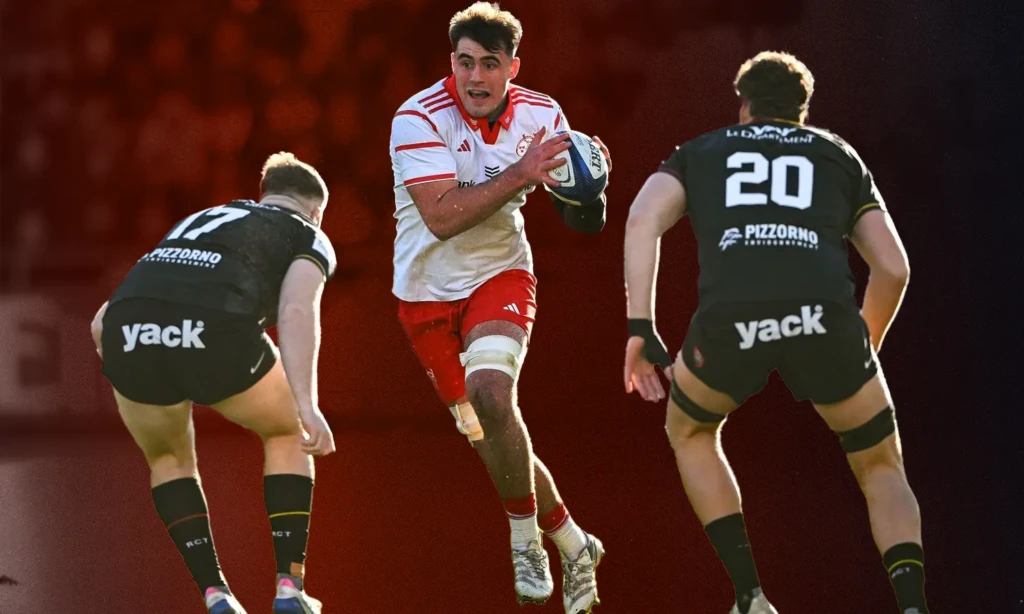
For Munster, our core decision-making comes back to understanding what we have relative to this game state.
In a general sense, as I’ve covered before, the main area that killed us last season was the scrum, by some distance. We’ve recruited significantly to fix that — on and off the field — so much of our game state will hinge on it being better than it was last season.
If you are conceding an average of 3.2 scrum penalties and approximately one scrum per game on our own put-in per game, everything from your possession to out-of-possession game will be played on a knife-edge. If the scrum stays the way it is, nothing about our change can or will change in a meaningful way.
You can’t kick constestably with any volume, and holding the ball becomes an active penalty threat. It has to be right, but, again, generally, the strength of your scrum in the modern game underpins way more than just the contest itself.
Last season, we were one of the biggest turnover sides in Europe — we won more turnovers and jackal turnovers than anyone in the URC on a really high breakdown contest rate, which is a very good return on investment — but we also got stung for not rolling away penalties at a rate equalling one per game. That combination will be poison for next season, so even with a hypothetically better scrum, I think the trends in the game are pointing us to tweak what we already have, rather than move to something completely new.
We were, generally, a possession-based team who didn’t really kick all that much at all, with a weak scrum and below-average collision-winning numbers ball in hand, who were outstanding at winning turnovers on a high contest rate at the breakdown.
I think we take the possession-based game that’s already there, tweak things like the depth we play from, the options we play off, add a little more kicking — of every variety — and, with a hopefully much-improved set piece, improvements should follow.
I believe the players we need to run a system like this are mostly already in the building and, more importantly, in the key areas required.
To Chiefs or not to Chiefs
For a start, any game that will be primarily based on holding the ball for long periods — in whatever area you consider your primary “go-zone” — has to have three things;
- A roster of dominant ball carriers capable of adding value across all four vertical zones of the pitch — Edge Left, Centre Left, Centre Right, Edge Right — with dominant carries and consistent gain line winning.
- Multiple handling options to utilise these threats without using too many rucks as a staging point.
- A pacey, connected backline that can pick their spots behind any compressions forced by the forward line.
Energy management has to play a part in this too, both in-game and across a full season. A lot of the on-ball game we’ve seen at test level in the Nations Championship in July might hint at a general trend shift, but I would posit that a high-ruck, high-collision game is viable when you have three games to manage over a month with a lot of downtime between blocks, and not so viable across what could be a 24-to-30-game club season.
As we saw with Glasgow — the purest example of a high-possession, high-ruck game — their energy and availability levels fluctuated badly as the season went on, so if you intend to win trophies in June, a style that burns players by design comes with baked-in risk.
It shouldn’t be a massive surprise that Clayton McMillan intends to move Munster’s style far closer to that of the Chiefs this coming season. Even then, that will come with energy caveats. What worked over a 19-game max season condensed into a five-month season won’t necessarily translate like for like over a ten-month season with intense periods of back-to-back games arranged around the November and Spring test windows.
Your prime playing group won’t be able to handle that kind of usage, so a balance must be struck to get you to where you want to go.
A second playmaker is a key part of marrying these two things together. The Chiefs regularly used the combination of Jacomb and McKenzie at 10/15 for core parts of their Super Rugby Pacific seasons under McMillan, and it allowed them to effectively spread their collisions across the park.
Last season, we spread the ball beyond first receiver quite a bit — ranked 10th in the world on that metric — but we suffered badly from a high error rate in the backline.
Shane Daly and Mike Haley — our most-used fullbacks last season — both ranked in the top ten for handling errors per game, and were #1 and #2 for the most dropped balls per game across the URC. We were the only club to have two players in the top 10 for turnovers conceded, with both averaging more than 1.4 turnovers per game. Shane Daly ranks in the top ten for bad passes per game.
This shouldn’t really be a massive surprise, though
Both players provide excellent defensive value, with Shane Daly ranking really highly with his aerial win% and attacking catches per game, Mike Haley ranking really highly on defensive catches, and both players doing really well in defensive duels. Shane Daly, in particular, ranks incredibly highly with his dominant tackle stats, which won’t be a surprise when you remember how often he bombs guys out of it with his trademark blindside hits.
Offensively, I would be comfortable saying that they are not really playmakers outside of one area — Mike Haley’s 50/22 threat. That doesn’t mean that they are bad players or that they don’t have value, because they absolutely do, but if we intend to be a possession team, we need far better handling and creativity in the backline to augment what Crowley does.
That roleset does not naturally fall in our midfield. We don’t use them that way, and they don’t naturally play that way either.
Nankivell is a dominant ball carrier, one of the best in Europe and one of the best defensive hitters. Kelly is a ball security specialist who maxes out in dominant tackles and tackle success, with high ruck arrivals and a low error count. He is best paired with Nankivell’s killer carrying impact, in my opinion.
Tom Farrell is one of the best and highest-volume offloaders in the game, with high work rate at the ruck, but low pass accuracy generally, and is the weakest defender of the three by some distance.
None of these players is a true playmaker in the traditional sense.
I think that hinders our ability — both historically in the last two seasons, and for any new system we impose — to play the type of rugby we want to consistently. I think this is why we signed Will Harrison, even as an NIQ player. Sure, he can cover #10, and he will be used there habitually, but his ability to be a playmaker at fullback offers something that can empower core parts of what we want to do with the ball. When you consider how often the ball died past first receiver last season, a player who can alternate with Crowley as a second #10 in a consistent, systemic way — rather than an in-game adjustment — could be the key to unlocking the good stuff we did last season.
For example, we were one of the best teams at getting to the 22. Not converting once we got there, which was a different problem, but we played most of our rugby around the opposition’s 22. We had no problem, relatively speaking, getting into scoring positions. Better strike plays off the back of a better lineout and scrum could be the core difference maker there.
Defensively, we conceded too many penalties and missed too many tackles — both directly related to our high breakdown contest rate, imo — but we had an excellent turnover rate that should be adaptable to preventing the leaks at the other end that stung us so badly as the season progressed.
That’s before we get to the most encouraging part of last season — we have excellent ball carriers who never quite got put into position to be as dangerous as their data suggested.
Brian Gleeson is tracking as one of the most dominant ball-carrying loose-forwards in the league when we look at dominant carries and post-contact metres. Sean Edogbo is tracking on the same path as Vincent Tshitsuka. Edwin Edogbo is tracking on the same playing identity as RG Snyman, without the offloads. Ruadhan Quinn didn’t get a ton of opportunities last season, but he’s got the kind of gainline stats and tackle numbers that make him comparable to a Josh Van Der Flier-type player.
All of these players have to develop in line with what they’re capable of, but the data suggests that if they do reach that marker in the right system, we will be a more dominant, dangerous team capable of showing the consistency that we missed for most of last season.
The Roots of Success
So we know roughly where the game is going, and we know what we’ve got. The obvious next question is whether any of this is actually true, or whether it’s just the story that sounds best when you say it out loud in July.
There’s a reasonable way to check. Take every club in the URC, the Premiership, the Top 14 and Super Rugby Pacific — 51 teams — and line up their attacking profile against how their season actually went. Because the leagues aren’t directly comparable, you standardise each team against its own competition, so a Top 14 side isn’t rewarded for playing 26 games and a Super Rugby side isn’t punished for playing less than that.
Then you ask a simple question: which of these numbers actually moved with results, and which ones just felt like they should?
The answer is not subtle.
Four leagues, 51 clubs, one season
What actually predicted a team’s season
Every club in the URC, Premiership, Top 14 and Super Rugby Pacific, 2025/26. Results are standardised within each competition so leagues of different lengths compare fairly. Hover or tap a bar for detail.
Pearson correlation. Significance at p < 0.05. One season of data, so treat the size of each effect as indicative rather than settled.
Gainline success is the whole ballgame. It correlates with points difference per game at +0.63, which in this kind of data is enormous — that single number accounts for something like 39% of the variation in how well a team's season went. Nothing else is close. Breaks converted into tries come second at +0.45. Ruck speed comes third at +0.32.
And then look at the bottom of that chart, because that's where the interesting part is.
The percentage of possessions a team ended by kicking has no relationship with success. None. The correlation is very slightly negative and nowhere near significant. The percentage of possessions a team took past five phases — the thing everyone points at when they want to say a team is grinding or a team is playing rugby — has no relationship either. It's flat.
That's the part I want to sit on, because it cuts against the way we usually talk about this. We spend a lot of time arguing about whether a team kicks too much or holds the ball too long, as if the volume dial is the thing that matters. On a full season of evidence across four competitions, it isn't. Kicking a lot doesn't make you worse. Holding the ball a lot doesn't make you better. What makes you better is what happens when you carry the ball into contact — whether you get over the line or you don't.
Which, if you think about it, is exactly what the law changes are pointing at. If the routes back to the ball are all being made more expensive — the contestable that's a coinflip, the jackal that's more of a penalty risk than last season, or more of a non-factor in winning possession back, the maul you can't legally spoil without power — then the sides who win are going to be the sides who don't need to get it back, because they never gave it up cheaply in the first place. Not because they hold it longer.
Because they go forward with it.
The second lever, and why it's a separate one
Here's the part I found genuinely surprising. Ruck speed and gainline success are almost completely unrelated to each other. You'd assume fast ball is just what happens when you smash the gainline — tackler going backwards, no contest, nine clears it in two seconds. The data says no. The correlation between the two is +0.16, which is statistically nothing.
And ruck speed still predicts results after you account for gainline. Put both in the same model, and you get gainline at +0.59 and ruck speed at +0.23, both holding up, explaining 44% of season performance between them.
So there are two levers, and they're independent. You can be good by going forward. You can be good by recycling fast. You can be very good indeed by doing both — which is precisely what Northampton did, finishing joint-top of all 51 clubs for gainline success and third for ruck speed, and winning a league.
But the reverse holds just as hard, and it's the warning that matters most for anyone planning a possession game. Montauban had the eighth-fastest ball of all 51 clubs last season. They won one game in twenty-six, shipped 854 points more than they scored, and got relegated. Fast ruck ball behind the gainline is worth precisely nothing. It's just a quicker way to arrive at the same problem.
Glasgow, and the other road
There is one team that breaks the model, and it's worth naming because it's the one I flagged earlier.
Find your club
Gainline success against how the season went
All 51 clubs of the URC, Premiership, Top 14 and Super Rugby Pacific. Season result is points difference per game, standardised within each competition, so zero is a league-average season. Hover or tap any point to identify a club.
Correlation r = +0.63. Glasgow, bottom left, are the outlier: third-worst gainline of the 51 and top of the URC, achieved on the cleanest handling in the four leagues.
Glasgow had the third-worst gainline success of the 51 and topped the URC table. That should not happen. The explanation is sitting in the same dataset: they had the cleanest hands in world rugby last season, 37.7 touches per handling error, best of anyone, alongside the second-highest rate of long multi-phase possessions of any club in the four leagues.
They didn't beat defences. They just never gave the ball back. That's a genuine third route to the top of a table, and it works — but it's also exactly the model whose energy costs I'd be nervous about over a ten-month season, and Glasgow's own back half of the campaign is the evidence for that. It's a road, but it's a demanding one, and you need a specific kind of squad depth to drive down it in June.
Where that leaves us
Put Munster through the same filter and the picture is uncomfortably clear.
Munster 2025/26
The possession is there, the damage isn't
Where Munster ranked among the 51 clubs of the URC, Premiership, Top 14 and Super Rugby Pacific on each attacking measure. Further left is better. Hover or tap a marker for the raw number.
Munster hold the ball, recycle it and finish their chances as well as most. What they cannot do is create the chances in the first place, or get over the gainline to make them.
We were 10th of 51 for ruck speed. 10th-lowest for kicking to end a possession. 11th for taking possessions past five phases. On every measure of wanting the ball and keeping it, we were already close to the top of the world game. The possession-based identity people describe when they talk about us is real, and it's measurable.
Here's the one that surprised me, though. We converted 41.2% of our line breaks into tries, which is 18th of 51. Not elite, but comfortably above the middle. When we made a hole last season, we finished it at a perfectly respectable rate.
Then the rest of the column. 36th for gainline success. 50th of 51 for dominant collisions. And 48th for the percentage of possessions that produced a try or a line break at all.
Read those together, and the diagnosis sharpens considerably. The problem was not finishing. We finished fine. The problem is that we rarely made a hole to finish — 9.2% of our possessions produced a try or a break, against 23.1% for the Chiefs — and the reason we didn't is sitting right above it in the same column. We couldn't get over the gainline when we carried, and we were the second-least dominant collision team of the 51.
That is the entire argument of this piece in four numbers. We already play the game World Rugby is legislating towards. We hold the ball, we don't kick it away cheaply, we recycle it faster than most sides in Europe, and we take our chances when we get them. We just don't generate as many as we should, because possession that goes sideways or backwards into contact never becomes a chance in the first place.
The good news is that it's the more fixable of the two problems. Ruck speed is systemic — it's technical, it's collective, it takes a squad and a season to move. Gainline success is much closer to personnel and shape. It's who's carrying, where they're carrying, how many defenders are in the tackle when they get there, and whether the ball has been moved somewhere useful before contact.
Which is why the Gleeson, Edogbo, Quinn and Nankivell group matters so much more than their minutes suggest, and why a second playmaker isn't a luxury signing. We don't need to become a different team, and we don't need to go looking for finishers — we have those. We need to become a team whose carries go forward. On the evidence of the last twelve months across four competitions, that is the single variable that most reliably separates the sides lifting trophies in June from the ones watching.
