


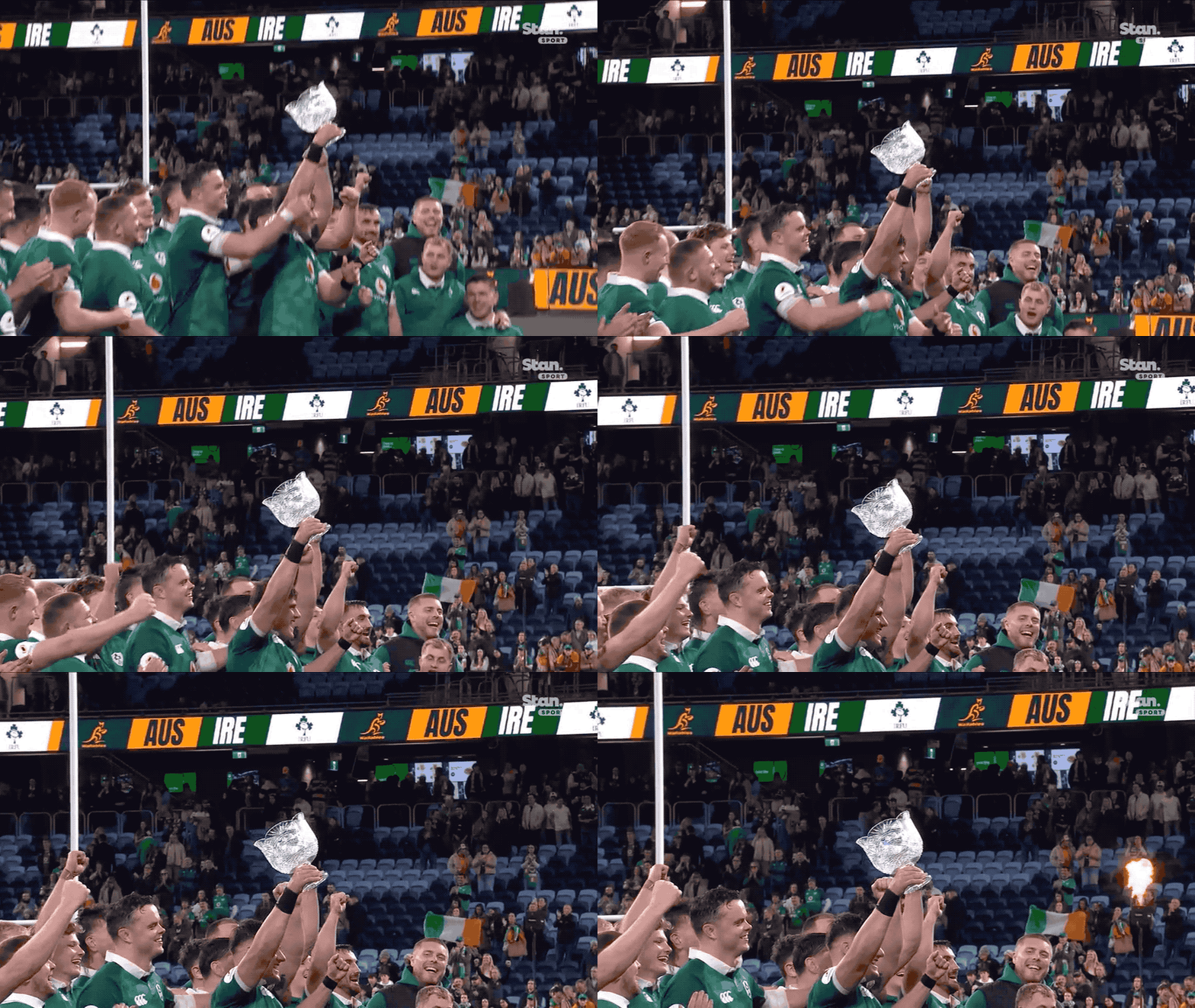

Ireland are still at a level where a team like Australia has to play incredibly well to beat us.
Is it slightly concerning that Australia didn’t necessarily play all that well and could (should?) have beaten us? Yes, it is, but this should not be a shock to anyone who hasn’t spent the last few months pretending a Triple Crown is worth anything to a side that should be judged by Slams, Six Nations titles and World Cup wins. It’s not 2006 anymore.
That doesn’t mean that this win isn’t worth celebrating — far from it — but it does give us a temperature check, especially when you compare it to what we saw during New Zealand vs France a few hours earlier.
In a general sense, I think Ireland are slowly drifting away from the very top end of the game heading into this 2027 World Cup. That doesn’t mean we have become a bad team, or even an average one. On the contrary, I think we’re an excellently drilled, highly intelligent and experienced team. Our main “super power” is exploiting opposition mistakes and indiscipline, which means that if you’re going to beat Ireland and you’re not France, New Zealand or South Africa, you’ve got to be mostly flawless.
Australia were decent here, but nothing close to flawless. So, like a challenger with decent credentials coming up against a crafty, veteran gatekeeper, they got put away — just — by losing just enough of the small moments for it to count.
Describing this Irish side as a “veteran gatekeeper” might seem like a backhanded shot, but I don’t really mean it that way. Watch France, New Zealand, and the Springboks; they are driving what stands as elite in this sport right now.
Ireland are not.
For a while — between 2017 and 2023 — we were at the forefront of the game, but I don’t think we are anymore. What we are, more so than a lot of teams, even the top three, is consistent. That’s probably our second super-power — consistency.
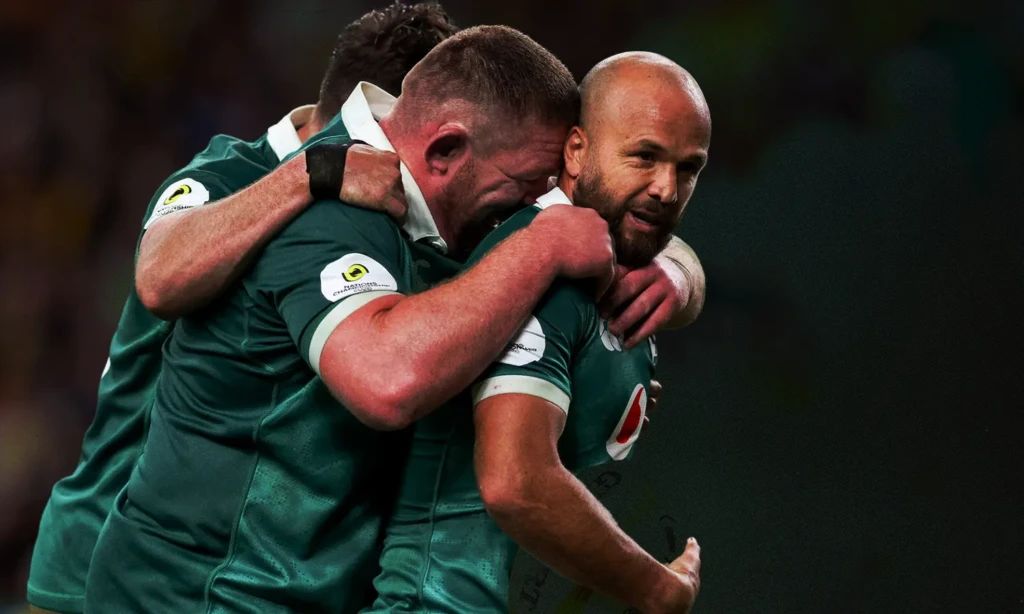
I suppose that consistency is a gift and a curse; at the moment, we’re consistent because we’re well drilled, and maintain a lot of selection consistency relative to most of the teams we play. But that consistency and familiarity also come with a hard cap on things like our athleticism, pace, creativity and unpredictability — rooted in the age and experience of our squad as a whole — as well as producing areas where we’re clearly on the downslope, like our scrum and lineout.
We beat teams that let us get into our spot.
It’s the DeMar DeRozan of it all.
(For the uninitiated: in basketball, a “spot” is the specific patch of floor a shooter has drilled to death — a favourite angle and distance where they’re deadly. Get to it with a half-second of space and the shot’s basically automatic; the entire art is manoeuvring your way there before the defence can wall it off.)
Watch DeRozan now, and you’re not watching an athlete — the first step is gone, the bounce that used to take him to the rim checked out a few seasons ago. What’s left is footwork, patience and a genuinely filthy amount of craft. He’ll feel his way to the elbow, get you leaning, and rise into that midrange jumper he’s buried ten thousand times. Give him a sliver of space on the way there, and it’s already over. He got to his spot. Two points.
But that’s the whole catch with a game built on getting to your spot: it only works if the defence lets you arrive. Run him into someone long enough, quick enough and locked-in enough to deny the catch, crowd the elbow and force the ball onto the floor, and all that lovely craft has nowhere to go. The three or four players actually bending the sport don’t need you to concede anything — they’ll shoot over the top, out-athlete you, invent something on the spot. DeRozan needs the spot. And, increasingly, so do we.
Australia let us get to ours — just about, and just enough.

So where is our spot?
The 5m line.
Four of Ireland’s five tries came from penalty access, and of those four, three of those penalties were earned off the back of poor Australian exits. Four of those five tries scoring sequence started on the 5m line. We got there in different ways.
In this one, for example, we earned a maul penalty thanks to a well-executed double feint at the front to draw out and isolate Australia’s counter-jump pod.
Australia counter-jumped on Ireland constantly — and were quite successful — because they knew how important the lineout is to Ireland’s scoring sequences.
They got it wrong here, however. Canham probably shouldn’t go to the air here because it left Rob Valetini defending a maul six on one. A penalty concession is inevitable.
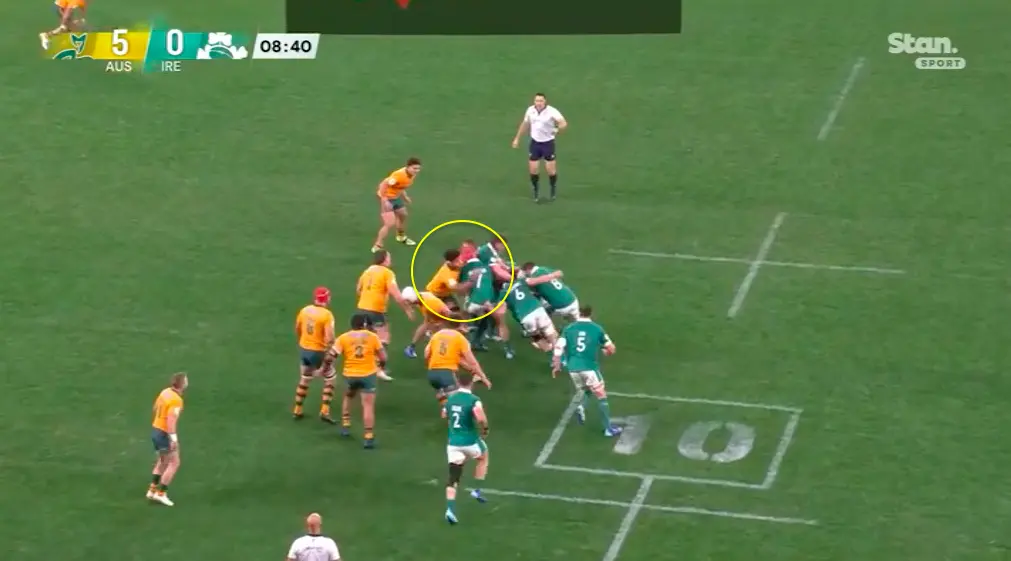
From that penalty, Ireland got to the 5m line, built a maul and played off it through McCloskey on the crash. Once we got to the tryline, a score was inevitable and it was Cian Prendergast who got his name on it.
Simple. Drillable. And consistently executable, as long as you get the position. Australia kept infringing in penalty range and let us get into our spot over and over again.
In a functional sense, Ireland’s phase-play attack is now mostly about generating penalties.
We still use the 3-2-2-1/2-3-2-1 forward shape that has mostly defined Farrell’s tenure but I can’t help but feel like it works best against a team that overchases at the ruck — we don’t mind a turnover if we win one penalty for every three — or one that has scatty edge defence.
On the third example here, Ireland’s third try, you can see Nasser making a critical mistake against a system like this, biting in too hard on a pass play.
When Nasser commits this hard to stopping Furlong, the minute Ringrose takes the pass, there’s an overload — Conan is the “1” at the edge of the 2-3-2-1 part of that oscillating system — and then it’s down to execution.
For the most part, though, Australia were relatively comfortable defending Ireland’s shape because we don’t have a whole ton of natural collision winners. We have players who are very well drilled, who know where to be and when, but we struggle against teams who can overwhelm us physically. That isn’t many teams, but it’s more than it was.
You can see the core principles of what we want to do on this clip — a 1-3-2-1 shape, which is a variant of the initial, and ideal, 3-2-2-1.
Beirne offers himself on the short side, the 3-2 central shape, which is consistent all the way through this system, and then the looped edges running off it.
Every back is expected to be comfortable stepping in behind that 3-2 pod shape*, and hinging into that wide support group when needed.
*As an aside, you can see how different in concept this shape is from Munster’s base shape over the last three seasons, which goes some way to explaining the low number of Munster players in the squad.
But because we are disproportionately reliant on generating a big collision that drags defenders off that #9 pod, everything looks that bit worse when we aren’t winning those collisions.
This example in the first clip I showed above is the best example of that.
Two poor collisions on the progression, and it ends with the turnover.
The question then is: what happens if we don’t get those penalties? In general, that means we struggle to move up the field. Our system doesn’t really produce line breaks, but that’s only a problem when we don’t get penalty access. A little bit like the Leinster loss to UBB in Europe — without regular penalty access, we can look like we’re playing a different sport to the very best teams.
But we’re good at forcing offensive penalties. Our “quick ball” is most often used to force offside decisions, and our pack have some of the highest ruck attendance and efficiency in the test game. We don’t need to dominate the physical battle to win games; we just need to make sure we get the right decisions from the referees.
How sustainable is that? Against “smaller” teams, it’s eminently sustainable. We tend to get “big team” calls at home and away, and as long as that holds, our consistency will hold with it.
How that translates to New Zealand in two weeks, however, remains to be seen. I don’t think what we saw here will be anywhere near enough to even finish within 10 points of the All Blacks.
The worry, for me, is that our consistency brings us through games like this, but we might well find out that the consistency required to outlast a game Australian side isn’t nearly enough when the levels jump up.
Had Donaldson’s kick sailed a few feet further right in the 81st minute, we’d be having a different conversation, of course.
I can’t say that Australia wouldn’t have deserved the win, but I think your read of this game comes back to how much better than the Wallabies you feel Ireland currently are.
I think we’re a lot closer to the Wallabies than most would agree with, especially away from home, so for me, this narrow win falls on the good side of the ledger. If you consider Ireland to be a few levels above where Australia are, however, this performance should gravely concern you.
| Players | Rating |
|---|---|
| 1. Tom O’Toole | ★★★ |
| 2. Dan Sheehan | ★★ |
| 3. Tadhg Furlong | ★★★ |
| 4. Joe McCarthy | ★★★★ |
| 5. James Ryan | ★★★★ |
| 6. Cian Prendergast | ★★★ |
| 7. Josh Van Der Flier | ★★★ |
| 8. Jack Conan | ★★ |
| 9. Jamison Gibson Park | ★★★ |
| 10. Sam Prendergast | ★★ |
| 11. Jamie Osbourne | ★★ |
| 12. Stuart McCloskey | ★★★ |
| 13. Garry Ringrose | ★★ |
| 14. Jimmy O’Brien | ★★★ |
| 15. Hugo Keenan | ★★★★ |
| 16. Ronan Kelleher | ★★★ |
| 17. Jeremy Loughman | N/A |
| 18. Tom Clarkson | ★★★ |
| 19. Tadhg Beirne | ★★★ |
| 20. Nick Timoney | ★★★ |
| 21. Craig Casey | DNP |
| 22. Ciaran Frawley | ★★★ |
| 23. Bundee Aki | ★★ |
