


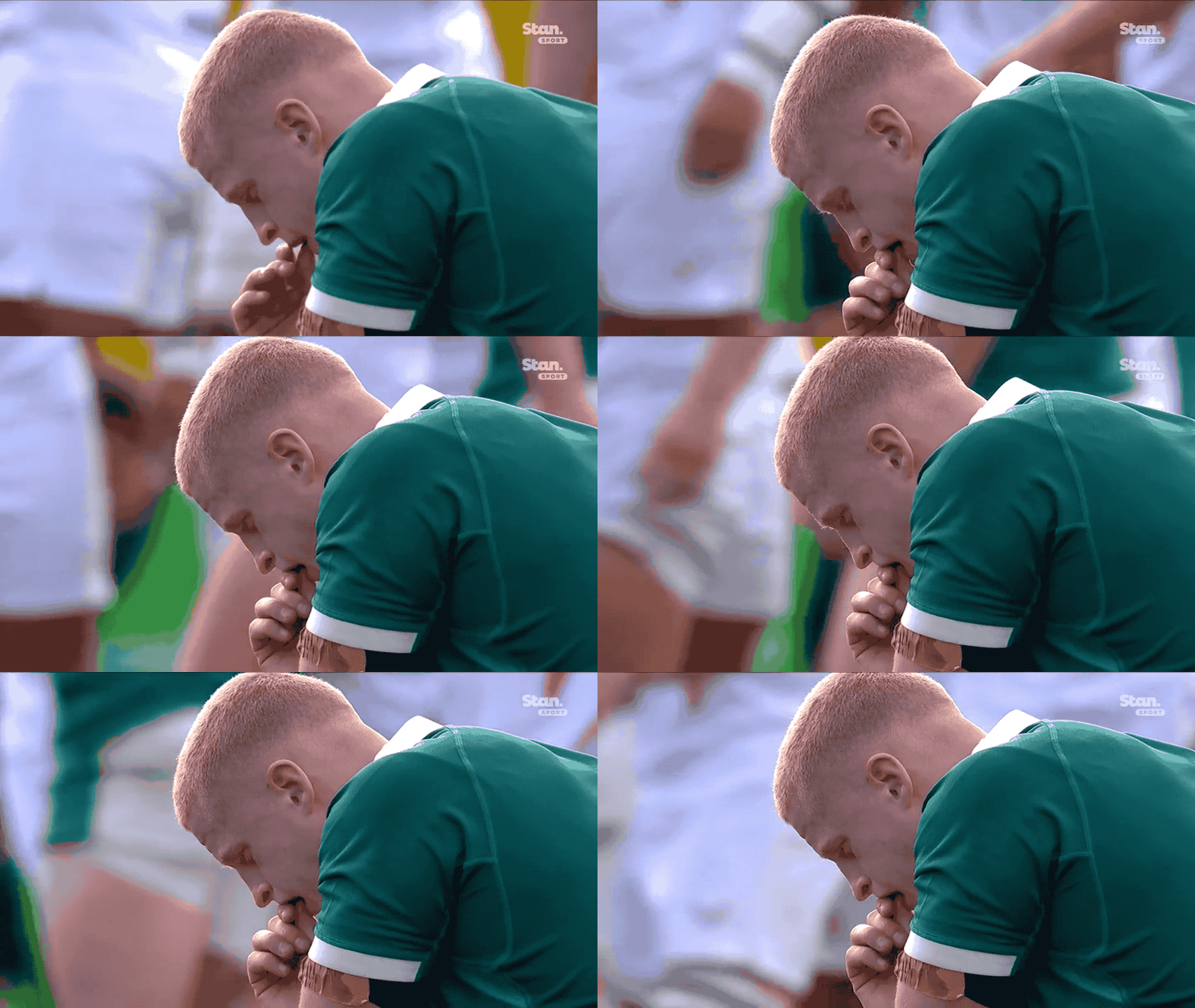
Watching this game live, and then back, I was left with one abiding thought. We should have won it.
That we ultimately didn’t comes back to how you want to assign the blame.
Was it the goal-kicking? Well, we left eight points on the tee from conversions in a game we lost by seven points, so sure, that was a factor. Was it the two yellow cards in the first half, during which we conceded 21 points? Absolutely. Was it a disastrous lineout performance? That played a huge part, yes.
Whichever one of those you want to focus on, or a combination of them, you’re probably going to be mostly right. They all played a factor, one way or another.
It’s a bit more complex than that, as it always is.
That we were good enough to beat this English team, but ultimately didn’t, isn’t going to define our chances in this tournament. I’m not sure how good this English team is, or how they stack up with South Africa, France and New Zealand, so the rugby maths aren’t mathing quite yet, but there was enough here to show that, with a little more focus and better discipline, we can be a match for most of the top sides in this tournament.
Stylistically, this Irish 20s side is far closer to what we’ve come to expect from sides at this age grade. Last season, under Neil Doak, was a complete regression from the previous seasons. While some of that could be down to a generation of players that were perhaps less talented as a collective than previous ones — which is always a factor at age-grade level — I never quite felt that they were getting the best possible coaching, either. Everyone, regardless of position, was a flanker of some description, or expected to be. If you saw one sequence of Ireland’s attack under Doak, you saw it all. One out, hit the ruck, one out, hit the ruck, pass to width for the midfield to crash it up, hit the ruck, hit the ruck, repeat in the opposite direction. It was, at once, a bad facsimile of Richie Murphy’s style and, somehow, something entirely alien to it, all in a hostile, self-aggrandising environment.
That’s what happens when you put yesterday’s man in as head coach — you get yesterday’s rugby.
Under Andrew Browne this season, the Irish 20s have played a style far more in keeping with what we’re traditionally good at at this age grade. As a result of Andrew Browne’s approach on-field and off, we have a happier, infinitely better-managed camp. This game was a good example of that, as almost everything we did well had its roots in both of those ideas.
What are we good at? For me, it’s three-part strike plays off the set piece; that’s where this team shines. I’ve gone back and forth on this in the last few seasons about the difference between being “scripted” and being more comfortable playing unstructured rugby. What’s better? What’s the winning strategy? And the truth of it is that whatever works, works.
There is no right or wrong answer.
Irish teams seem to be better when we have a package of strike plays that we can drill relentlessly, execute with clear, precise roles and jobs and leave room for a bit of improvisation when it’s on. The same is true for managed transition opportunities.
Our opening two scores came from strike plays.
Set piece, strike play, execute.
The thing is, with strike plays, they aren’t usually designed to walk the try in for you, but they are great at helping you predict what a defensive picture might be, and how you might try to exploit it.
We’re good at this. You don’t always score from them — in fact, you mostly don’t — but when you execute them well, you’ll usually end up in a better position than where you started the play.
One of the core reasons for this loss (our lineout imploding) was especially damaging in this regard, as it robbed us of the most readily available strike play starter.
We took the lead because we were incredibly efficient at converting those early chances, but England dominated the entry battle for the rest of the first half. In part because of an incredibly fussy referee — sometimes you look at a ref’s haircut and know instantly they’re going to be a fusspot — but mostly because we couldn’t get stops consistently in the edge spaces.
For example, we were caught narrow on this play, and then conceded a yellow card after the break.
We conceded a try on the subsequent drive.
Right from the restart, the weirdly strong breeze took O’Shea’s restart dead, so England had a scrum launch.
This is a good launch, firstly, but I think the key moment is Carney holding on the #10s line a little too long — I think he has to push out and trust Barrett can get a scrag — and everything flows from there.
That said, I think our defensive set-up left Barrett, Carney and Ryan with a lot of work to do. Carney is lined up on England’s #10 — Hugh Shields — and Ryan is tight to him from the start. The intent here is to read and push, with Barrett closing the door on the break if England go left.
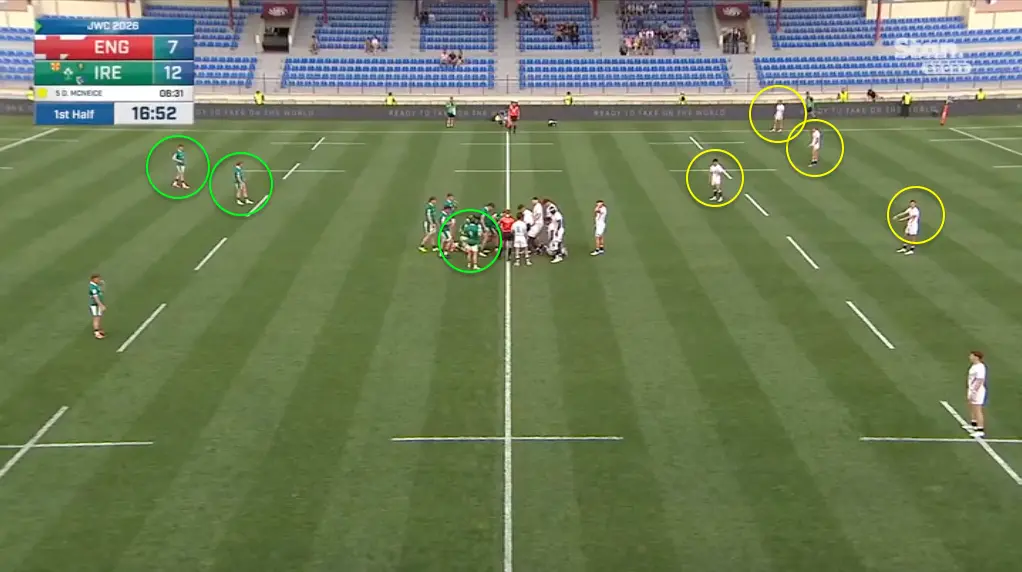
Byrne is in the backfield, looking to step up and close the door, but he steps up a little too late once Carney stays on Shields’ line.
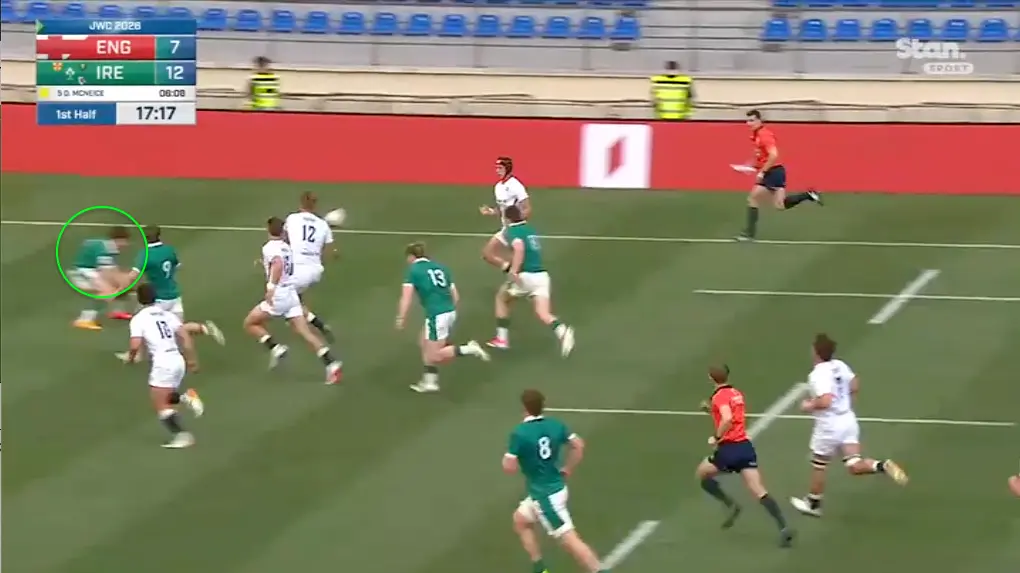
Barrett and O’Shea did well to close the space, and O’Shea took the offload and ran it into touch.
England scored from the maul and close phases that followed. 14-12.
An offside on the next England sequence — marginal, but correct — gave England another lineout, then a pretty harsh ruck penalty gave them a 5m maul. Penalty try. Another yellow card. 21-12.
We worked our way back up the field, won a penalty, but lost the lineout that followed. A late lift at the front on Neill led to an overthrow. Neill’s already on his jump here. McNiece left his step-in and lift a little too late, so the height on the jump wasn’t what it should have been.
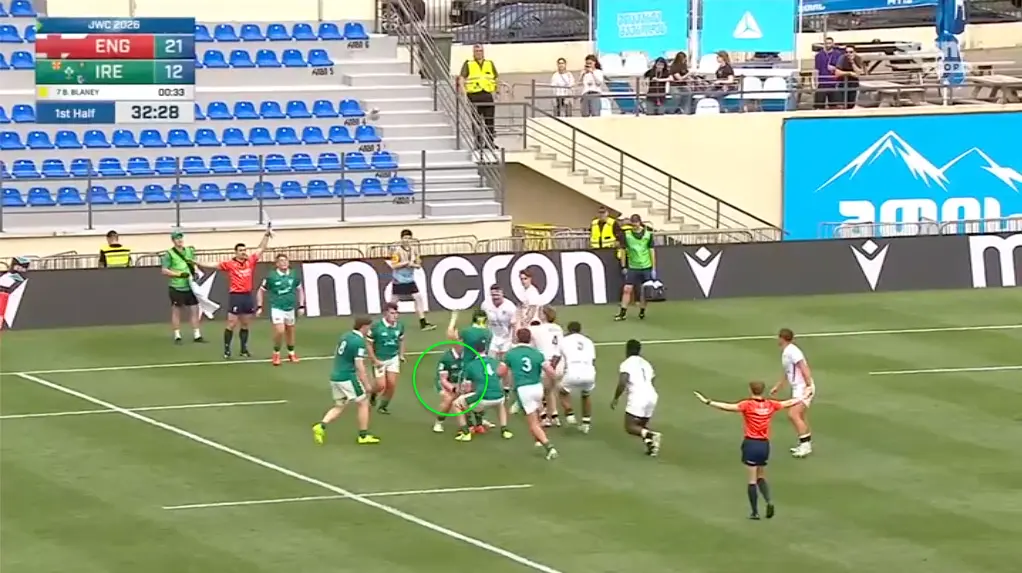
Chance gone.
A bad exit from the subsequent England kick led to another marginal offside, and England kicked the penalty. 24-12 at half-time. Not an insurmountable lead, but we were lucky it wasn’t more.
Another late step up from Byrne gave England a great position. We gave up another offside, but England kicked that penalty dead.
Right after halftime, another strike play got us right back into the game.
Barrett and O’Shea were excellent on this off the back of a great Irish scrum — top-end pace, intent to attack and superb support running from Ryan.
That kind of pace and deceptive running is a killer on a scrum moving forward, and, as I said, this Irish team is really strong on these strike plays. Our scrum is a real strength, and you can tell that we’ve put a lot of focus on making sure it’s strong.
Another poor exit — hurt by the wind — gave England a launch platform off a lineout, and we didn’t defend it well. The key moment here was Blaney sitting down on a decoy line as the second defender, which left Knight with a clear line straight through our cover.
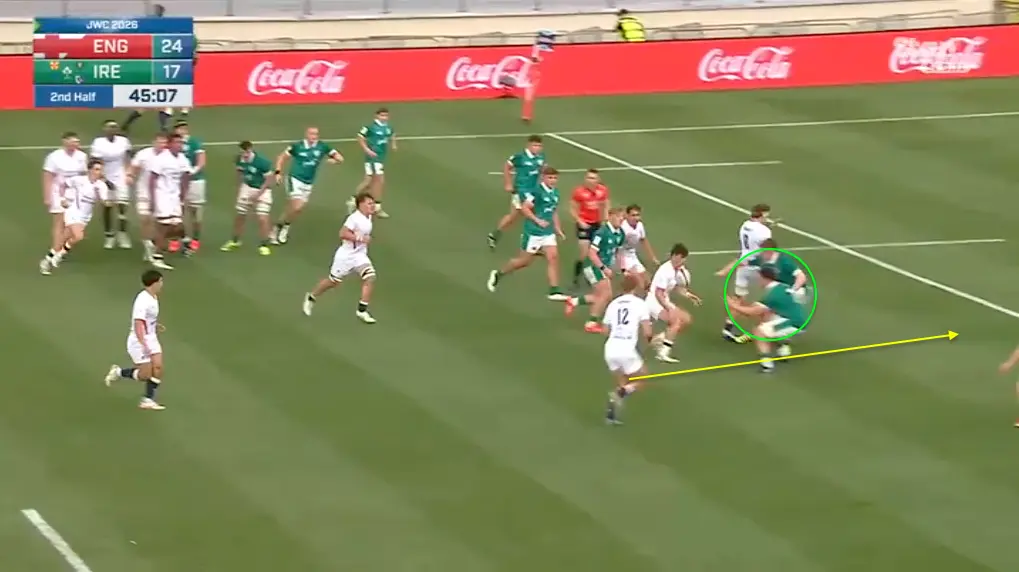
It was a well-executed play, but we didn’t defend it as well as we could have, which was a constant story in this game.
We had several good positions, as the game wore on, but our lifting looked scatty and disorganised at key points.
We scored tries, another with a set-piece origin, and two on transition, but we couldn’t pin England down with our lineout consistently, and that allowed them some key exits and momentum, aided by the strong wind in their favour.
That wind was a key part of our missed conversions too, because our tries were scored on the edges — any kicks into the wind were on a diagonal, making them harder to execute. Those missed points in the second half, in particular, left us needing a try at the end, and that seemed to add to our nervousness at the lineout.
England sealed the deal with a late penalty, and we’d have to settle for two losing bonus points, which could well be vital with Argentina up next.
If we can sort the lineout, keep up our efficiency with our strike plays, and sort out our set piece defence and back three positioning in defence, I think we’ll beat Argentina. We won’t be able to challenge the top sides at this championship without those fixes.
Top Performers: Chris Barrett, Max Doyle, Charlie O’Shea, James O’Leary, Jack Deegan, Daniel Ryan.
I don’t do full star ratings for U20 games as I think it’s unfair to either over-praise or over-criticise young players.
