


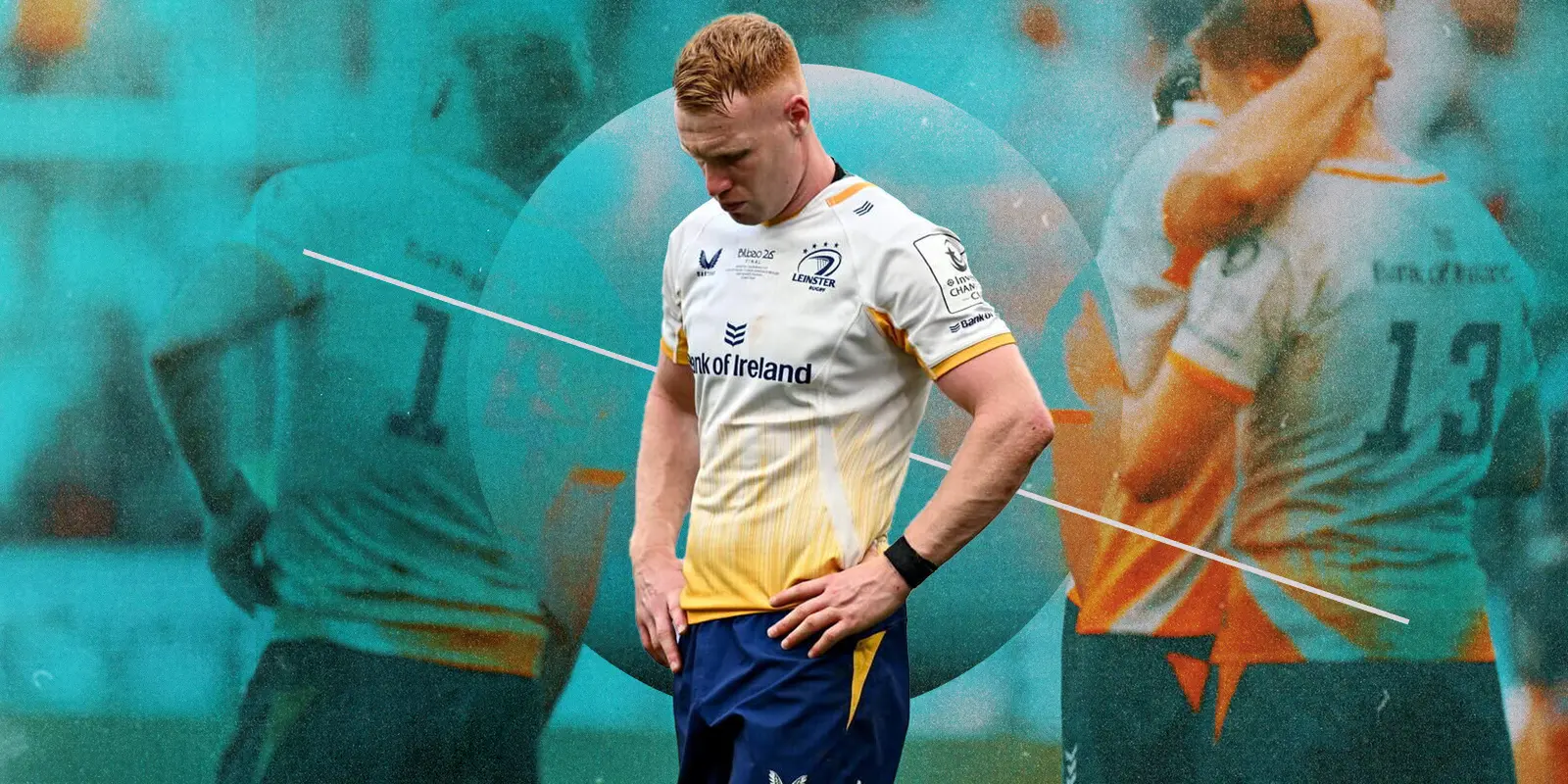
Every great team is built by hungry men and undone by satisfied ones.
The dynasty and its downfall wear the same jersey.
Leinster have not yet reached the second half of that sentence — but they have started to hear it. Not in the league table, where they remain what they have long been: the side most everyone measures themselves against, perennial finalists who never seem to leave the room empty-handed for long.
The decline, if that is what this is, is narrower and crueller than that. It lives in one place only — the final hurdle in Europe, the prize that tells Leinster who they are — and there, the men who wanted it more, who were better equipped to take it, have worn a different jersey four times in five years. A dynasty rarely dies at the bottom of the table. It dies at the last hurdle, the one it is built to clear, while almost everything else still looks like proof that nothing has changed.
Munster could have told them how this begins. Our fall did not start with a thrashing either, although Croke Park 2009 looked like that in the end; it started as a near-miss, a semi-final that got away, by a side that still felt invincible right up until the years revealed it wasn’t.
That is the quiet terror of the cycle: it does not ask you to play badly. It only asks the hungry men to be somewhere else, getting hungrier, while you mistake one more final for the natural order of things. One more game. One more win, and that will be enough to kick you against the feeling you can’t quite shake; that the golden cycle is over, or about to be.
Tonight, Leinster face the Vodacom Bulls in Croke Park in a URC final for a second time in two seasons. Last year, Leinster came into the final hurting and speaking openly about a narrative that they weren’t quite being respected enough. A sickening defeat at home to Northampton in the European Cup that year — a year they looked, for all the world, like European Cup champions in waiting — had thrown their season into disarray. The signings of RG Snyman and Jordi Barrett, along with their array of Irish test stars, made them look like an unstoppable force at a time when their traditional immovable object — Toulouse in a final — had fallen away.
37-34.
Northampton would go on to lose to UBB in the final. Leinster might well have lost that game too, but the feeling at the time was that this was Leinster’s big opportunity, at home, against a side they would expect to put away handily, coughing up their opportunity to finally get back to the summit of European rugby for the first time since 2018.
In the intervening years, Leinster had found a way to lose multiple finals of that calibre to the last gasp of Prime Saracens, twice to an emergent La Rochelle, and then finally to Toulouse in 2023/24. I think Leinster could have lived with losing to Toulouse again, if it came to it, but not Northampton. In a home semi-final.
The criticism that came their way afterwards from the Irish media — however grudging — stung them. They openly spoke about using that negativity for the remainder of their URC campaign, and it worked. They beat the Bulls comfortably in last year’s final, driven by an outstanding Jordi Barrett performance. Leaving their best player on the bench was a mistake they would only make once that season.
Without wanting to speak for any large group of Leinster fans — I’m in no position to do that for Munster fans, never mind Leinster — I think that URC title rang hollow.
And I don’t say that to be cruel. I say it because Leinster said it first.
Go back to 2023, the week before they met La Rochelle in a home European final they were expected to win, and listen to what Andrew Porter told the media about what the season was really about. It was about, he said, “getting that fifth star on the jersey.” The URCs, the PRO14s, whatever you want to call them — you don’t wear those. You wear the stars. That was the prize. As far as Leinster were concerned, in that moment, it was the only prize that counted.
He wasn’t wrong.
The stars are what get remembered — we know that in Munster better than anyone. There is a peculiar danger in a great side saying the quiet thing out loud, in ranking the trophy it cannot win above the ones it can, because the game has a long memory and a meaner sense of humour than any of us. Leinster lost to La Rochelle that year. They went home with nothing. And Porter, to his credit, came to admit he’d gotten ahead of himself.
Which brings us back to last year, and the Bulls, and a title that arrived dressed as something resembling redemption and felt, to anyone watching closely, like consolation. They had told us themselves what they were chasing, and it wasn’t this. In a way, it felt like lifting that URC title was more of a spiritual rebuttal of their critics than it was about the trophy itself, but that felt a little hollow, too. Like everyone involved had to pretend, for a time, that there was a form of vindication there for someone. Nobody was quite sure who.
You cannot spend two seasons, either directly or implicitly, that the stars are the only thing worth having, and then hold up a URC trophy as if the wound has closed.
The jersey knows the difference. So do they.
That brings us to tonight. Same venue. Same opposition. Same feeling that Leinster are looking for candles in a dropped birthday cake.
To a lot of Leinster fans, the season ended in Bilbao a few weeks ago when Leinster were, almost painlessly, put away by a UBB side that spent the entire second half of that game wondering if they brought their ski goggles for the champagne spray in the dressing room.
That wasn’t how Leinster are supposed to lose finals. Everyone accepts that a final has a winner and a loser, and that a small moment of brilliance here, a small mistake there, can be the difference. Losing like how they did — dismissed like a second-rate opponent that had no business being there — was a cruel mental blow.
Will beating the Bulls tonight expunge that? Absolutely not.
Will it help save a season? Of course. Lifting a trophy will do that at the bare minimum. It’s not the trophy that Leinster are constructed to win, though, and that’s meaningful when we talk about cycles of great teams.
Every great team has their window where they have to maximise the trophies that dictate its legacy.
The great Saracens side of the middle to late 2010s won three European Cups and five Gallagher Premiership titles in their prime before financial irregularities — to put it mildly — broke up that squad permanently. They haven’t been close to the same side since, even allowing for the Premiership title they won in 2022/23.
The Toulon side of the early 2010s won three European Cups and a Bouclier — they should have won more than that domestically, but ran afoul of Toulouse and then Castres in a final. Never the best place to play either of those two teams.
La Rochelle had their peak in the early 2020s and won two European Cups back-to-back, losing their TOP14 finals to Toulouse, who emerged around the same point; they would go on to win two European Cups in the same period, and four TOP14 titles.
All of these great sides had their moment at the top, won big — Toulon and La Rochelle perhaps underperformed domestically — and then fell away.
La Rochelle are a great recent example of this. For three seasons under Ronan O’Gara, they were the best side in Europe, or close enough to it.
They lost one European Cup and two TOP14 finals to Toulouse between 2021 and 2023, before beating Leinster in back-to-back finals between 2022 and 2023.
Then it seemed to collapse. They finished seventh in last season’s TOP14 and were knocked out in Europe by Munster. This season, they scraped into the TOP14 playoffs before losing heavily to Stade Francais, before falling into the Challenge Cup, where they would be beaten heavily away to Ulster.
How do you go from European Cup champions to looking like a middle-of-the-line team in two years?
It’s easy.
Players age out together. Connections break. A few signings don’t work out. A few can’t-lose prospects don’t quite meet the mark of the guys they aim to replace. Your genuine game-changers get injured or feel the attrition of the years so much that they no longer alter games as they once did. A few of your irreplacables get injured, retire, move on or sometimes all three. The quality is still there in that squad, but they look tired, like they’re running on fumes. What worked before isn’t working now. They require a serious rebuild.
Yet, if you told La Rochelle, as they were lifting the trophy in 2023, that this was as good as it would get for them over the next two or three years, they’d scarcely believe you.
Toulouse, as good as they are, are feeling the same hot breath on their back this season.
UBB, freshly crowned back-to-back European Cup winners, will feel the same next season. What is their legacy like if they can’t win the Bouclier?
That’s all the teams that exist at this level of expectation are: a legacy in progress. And what defines these great teams is their togetherness. The alchemy that makes this guy at his peak playing with that guy at his peak, and empowered by these guys, is the magic. Sometimes you get lucky, and a guy is either signed or emerges who can synthesise what worked before, and you continue for a time, but it is luck.
There’s no guarantee that you will be able to recreate what worked before. The bigger your budget, the better your production lines are — that helps, but it’s no guarantee.
Leinster, like these teams, are in a similar spot.
By any measure, they haven’t been the same team we’ve been used to seeing over the last few years this season. Some of that is post-Lions attrition, but the other signs are there, too.
Game changers picking up injuries. A few signings not working out. A few prospects not quite meeting expectations.
A team can lose a game-changer to injury and survive it. It can carry a signing that didn’t work, a prospect who came in a size too small for the boots he was handed. It can have a tired season, a flat season, a season that ends in the wrong city against a side wearing ski goggles.
Any one of those, in isolation, is just rugby. The cruelty is that they don’t arrive in isolation. They arrive together, the way they always do, because the same clock that ages one great player ages the twenty-two around him, and the togetherness that made them — that word again, the only word that ever really matters — frays at every cord all at once. You don’t notice the rope wearing. You notice the day it breaks.
For this Leinster side to have just one European Cup in 2018, even allowing for the great teams who denied them in the years since that, isn’t what they were built for. Winning four PRO14’s in a row that season, and in the COVID years that followed, isn’t a legacy they’ll be remembered for. It barely makes a mark today, just five years on from that stretch.
Last year’s URC win, their first since the big four South African sides arrived in the league, was barely enough.
And here is the part I can tell you for nothing, from the other side of it: the team is always the last to believe the rope is wearing. We didn’t believe it in the late 2000s and early 2010s. We had a season like this one — the quality still there, the names still frightening on paper, the performances just slightly off the boil — and we told ourselves it was attrition, a bad bounce, a rebuild that was really just a refresh. We were not lying. We simply could not see the shape of the thing from inside it. You can’t. The view from the summit is the one view that doesn’t show you how steep the slope is.
So Leinster will fight it, and they should. That is the only honest response a great side has to its own ending — to refuse it, loudly, for as long as the legs hold. They’ll win tonight or they won’t, and either way they’ll come back in September convinced the stars are still in front of them, because a team that stopped believing that would already be a different team. The refusal isn’t delusion. The refusal is the last and best symptom of greatness. It is also, every single time, the last tell.
I don’t want them to lose tonight. I want to be clear about that, because a Munster man writing this could be read only one way, and it would be the wrong way. There’s no joy in watching a great rival hear the whistle start to blow on its era — only recognition, which is a colder and more honest thing. Leinster getting worse won’t make Munster any better. You don’t celebrate a mirror. You just look into it a little longer than is comfortable, and you remember when the face looking back was yours.
Every great team is built by hungry men and undone by satisfied ones.
Leinster are not satisfied. Not yet. But they have been well-fed for a long time now — not as much as they should and could have been, but still — and the hunger that built all they have is a harder thing to summon the second time around, when you feel the window on the trophy you actually want starting to close.
The hungry men are somewhere else tonight, getting hungrier.
