


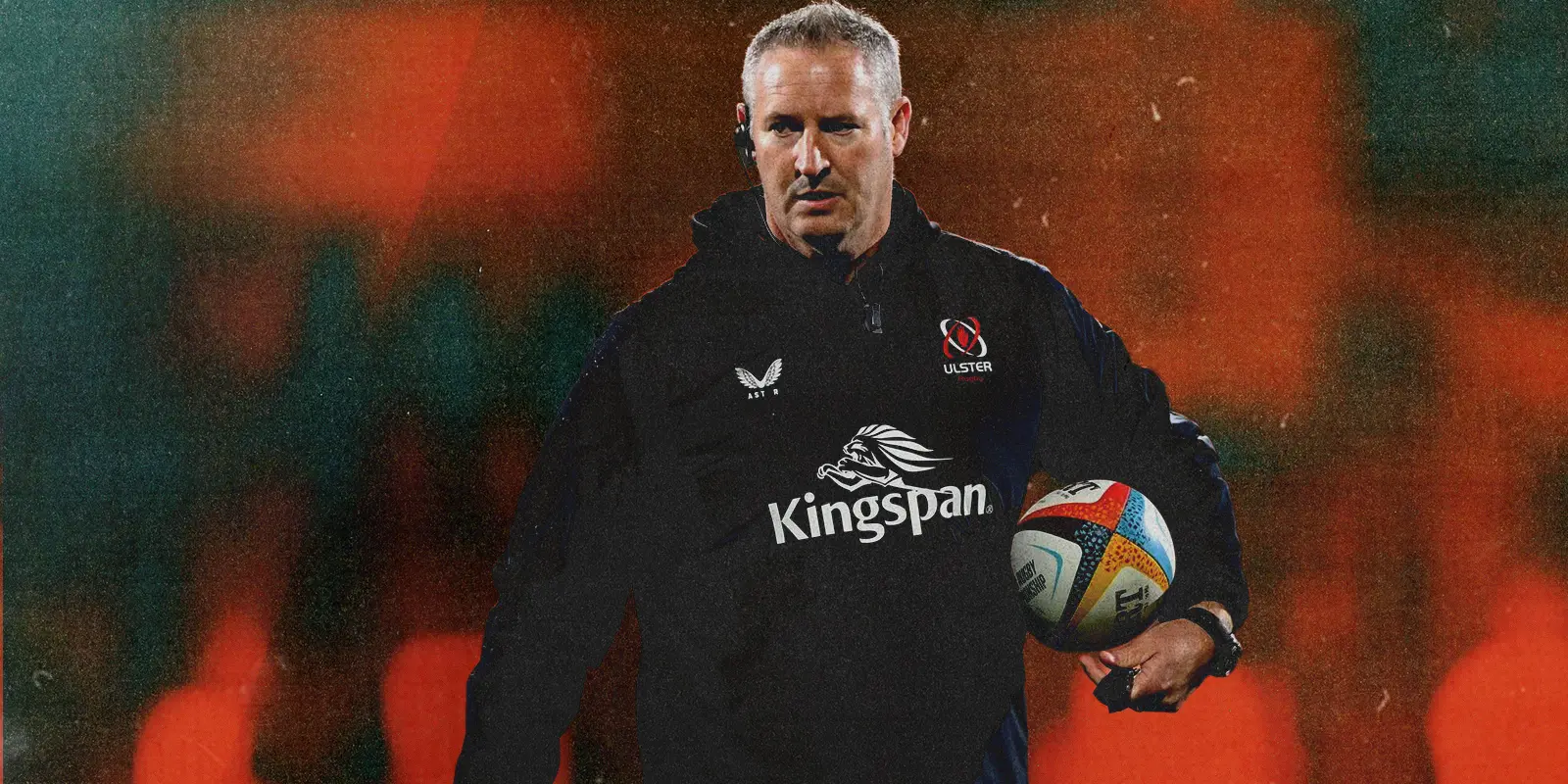
Jimmy Duffy is heading south.
The Galway native, who only this season committed his future to Ulster by signing a fresh two-year deal, before cancelling it to move closer to home for family reasons, will join Munster as forwards coach this July, taking charge of the scrum, lineout and elements of our breakdown.
It is a homecoming of sorts for a coach whose reputation was forged on detail and graft. Few understand that better than Ulster hooker Rob Herring, who admitted Duffy’s exit had landed as a shock in the dressing room and was quick to spell out what Ulster would be missing, and what Munster are now getting.
Herring pointed to a work ethic he rated as second to none, joking that he didn’t even want to know how many hours Duffy clocked up on the laptop each week poring over scrum, lineout and breakdown detail. He also credited the coach with dragging the pack forward, describing the work Duffy had brought to Ulster’s scrummaging as brilliant and praising a willingness to move forward rather than stand still.
For us, it points to a like-for-like brief: the same complete forwards portfolio Duffy carried in Belfast.
Duffy’s coaching journey has taken him a long way from where it began. Forced to retire from playing at just 20 after being diagnosed with a heart condition — having represented Connacht more than 20 times and played for Ireland at under-21 and ‘A’ level — he stepped away from the game for three years before finding his way back through the coaching ranks, starting at Our Lady’s Boys Club in Galway.
He cut his teeth in Connacht’s development system, working as an elite player development officer in the academy and as a grassroots coach development officer, before Pat Lam promoted him to the senior setup as forwards coach in 2015. It proved an inspired call: Duffy was part of the coaching team that delivered Connacht’s fairytale Pro12 title in 2015-16, the proudest day in the province’s history. He stayed on under Lam’s successor, Andy Friend, before turning down a contract extension in 2021. He worked with Tonga on their Northern Tour that same year, before his next move reunited him with Richie Murphy, the partnership that has shaped the rest of his career.
Duffy was forwards coach for Murphy’s grand-slam-winning Ireland Under-20s in the 2022 Six Nations, before heading to Australia for a two-year stint with Super Rugby side Western Force in Perth. There, he was regarded as a world-class addition, the Force’s management praising his service as invaluable on his departure.
In 2024, he came home again, linking back up with Murphy at Ulster as forwards coach. Now, two seasons later, he is on the move once more — this time down south to Munster.
So what’s the story with Jimmy Duffy?
Duffy’s big strength, and a large part of what attracted Munster to him once he became available, was two specific things.
- He coaches both scrum and lineout
- He specialises in working with young talent
Initially, Munster were looking at Duffy as a scrum coach exclusively, with the idea being that Alex Codling would continue for another year. When Codling ultimately decided that he wanted a new challenge in France — he’s never spent longer than two seasons at any club or country across his twenty-year career — it became clear that we needed a lineout coach too.
I wouldn’t be shocked if McMillan himself took a bigger role in that unit for next season, with Duffy focusing more on the scrum, half in half on the lineout, but that’s got to be confirmed officially. Just my own read.
So what does Duffy bring?
At a base level, Ulster’s scrum and lineout this season was no better than ours. Last season — 2024/25 — it was a different story, but let’s deal with what’s recent.
Ulster’s lineout held up across 2025/26 — 194 won, 31 lost, an 86% success rate, with 17 steals on the opposition’s ball. Solid work, if shy of the 92% the Stormers and Leinster operated at, and a long way off the 41 steals that made the Sharks the league’s great disruptors. Ulster’s maul was better than ours, but that’s hardly a boast. It wasn’t near the elite mauls in either the URC or in wider European competition.
It’s the scrum where the gap between reputation and return opens up. Ulster won 87% of their own feeds — 14th of the URC’s 16 teams. In their favour, they kept it tidy: 48 scrum offences conceded across the season, comfortably fewer than most. The problem was the other side of the ledger — just 11 scrum penalties won, fewer than any team in the league. Set against the Stormers’ 62 and the Sharks’ 51, that’s a disciplined scrum that held its own ball without ever turning the screw.
If Duffy can cut our penalty concession rate down by one or two penalties a game, he’ll immediately have been worth it.
The unit waiting for Duffy at Thomond Park is cut from a rougher cloth. Munster’s scrum posted 89% on its own put-in last season and was, by far, the more penalised of the two — 60 scrum offences conceded, the second-most in the entire league behind only the Dragons, against Ulster’s 48. It did at least carry a little more bite, winning 17 penalties to Ulster’s 11, though that’s still a thin return. Our lineout, meanwhile, is the steadier of the pair: 88% success and 18 steals, marginally ahead of Ulster’s, but with no real mauling threat to speak of.
Two provinces, two somewhat reliable lineouts, and two scrums sitting in the bottom third of the table on their own ball — one tidy but toothless, the other far messier but no more dangerous. The brief at Ulster, in other words, travels south with him.
What the numbers won’t show you is a finished article. Strip Ulster’s set-piece back to its 2025/26 output and you find a unit still very much under construction. Ulster’s issues all season long were in the second row, Munster’s in the front row. The lineout was the dependable half of Ulster’s operation: 86% success across the season, 194 won off 31 lost, with 17 steals on opposition ball. Functional, reliable, rarely a liability, but not really a weapon.
The scrum is the harder read. Ulster won 87% of their own put-ins, which ranked 14th of the URC’s 16 sides, and they won just 11 scrum penalties all season — fewer than any other team in the league. For a set-piece meant to manufacture territory, that return didn’t match the graft Herring described.
Both things can be true at once: a coach can be excellent, and the unit can still come up short on outcomes, for reasons — props available, injuries, the churn of a rebuilding pack — that sit well beyond a forwards coach’s control. An honest framing isn’t that Duffy presided over a dominant Ulster eight in terms of the set piece. I think it’s fair to say that he was handed a scrum that needed work and was visibly in the middle of doing it.
Which is exactly why the move makes sense for Munster, because the in-tray waiting for him in Limerick looks remarkably familiar. Munster’s scrum was, on the raw output, slightly worse than the one he’s leaving.
We aren’t signing a man who has already solved this; we’re signing a coach we believe can do so, especially with the brief of working with younger talents, which he’ll be doing in every single unit that he holds sway over.
The difference, if it comes, will show up in these columns a year from now.
One of the areas where Duffy really specialises is his work with young forwards when it comes to ball carrying, aggression, and physicality.
While the set piece numbers don’t show a whole lot last season, Ulster’s ball carrying and physicality through the forwards definitely did. They were top six in the URC for dominant forward carries and gainline won, while being the fifth most efficient team in Europe when it came to converting possession into tries, all while having one of the highest possession rates across all three major European leagues.
And that’s before you get to his work with the Irish 20s. At the time, I’d heard that Duffy could be a very tough, aggressive coach to work with. That comes with the territory. You can’t argue with his results — that was arguably the best U20 pack we’ve ever had, and he had a massive influence on that with players like Evan O’Connell, Brian Gleeson, Ruadhan Quinn, and plenty others. Even at Ulster in the last two seasons, you could point to guys like Bryn Ward, Cormac Izuchukwu, David McCann, Scott Wilson, and James McNabney (pre-injury) coming on in leaps and bounds.
With the profile of player that we’ll be building around in the next few years, Duffy has the perfect CV for the role. He already knows the vast majority of our young forward core — he’s already coached them for the 20s in most cases — and that means very little time getting his feet under the table.
There’s work to do with our scrum and maul, and I’d back him to do it as it stands. We don’t need the scrum to turn into a penalty-generating machine like the Bulls, we need solidity — a platform — and I really do think he can do that with what’s already here.
