

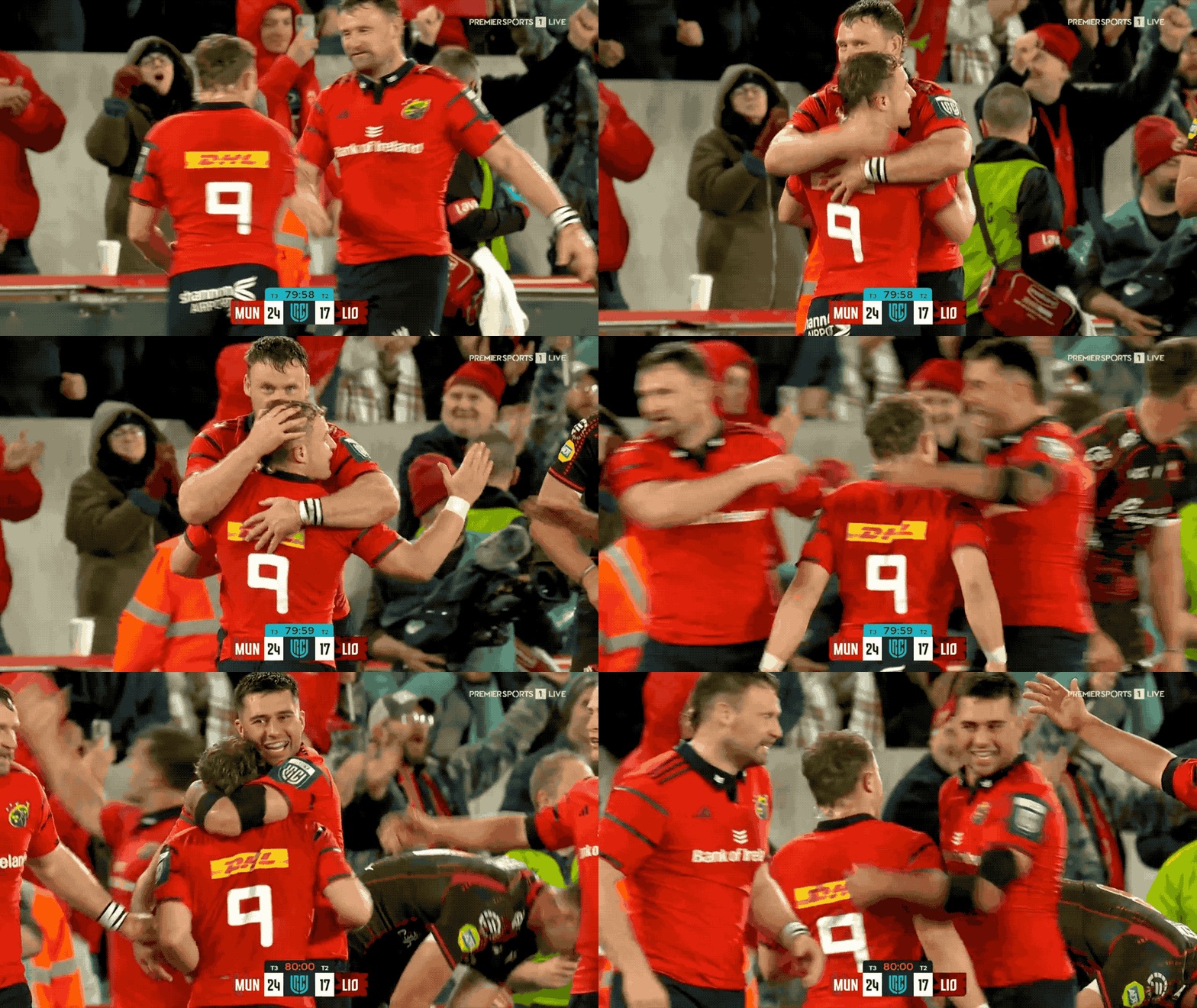
Hello from Beziers.
On Sunday morning, we set off for Shannon and, thanks to the very specific mental illness I have — my mood is heavily dictated by how Munster Rugby do at the weekend — it was with a spring in my step.
When we finally arrived at the Eurocamp, I found three very interesting things.
- The English guy running the facility sounds just like Graham Rowntree. Same accent, same tone, they are voice twins.
- My French is nowhere near as good as I thought it was; I ended up ordering a pizza with Roquefort cheese all over it in the local pizzeria off camp because it was named after Bixente Lizarazu, the only French celebrity whose name I recognised on the menu, and all the pizzas were named after them. The pizza looked like it had bad acne. I still ate that shit though.
- The guy in the mobile home next to us is French, and when I saw him wearing a Montpellier top — Montpellier is an hour’s drive away — I said, “rugby?” across the gates while our two daughters began waving at each other. He said “oui!” and when he saw the red poking out under my hoodie, he said “Munster?”
Maybe it was the very big, very Irish head I have up on me. French people do not have big Irish heads, even though they have big heads in their own way — well, some of them. But he was right, the Munster is written all over me. We spoke for a bit in broken English and broken French about rugby. About Antoine Dupont. About how Montpellier will do against Ulster (he has literally zero doubts that Montpellier will win that handily). About how the Leffe I was drinking was 9.0% ABV, which made me turn and look at the can like he’d just said there was plutonium in it.
About Munster for a bit, too.
When he would say “Munster”, he would sometimes do this hulking up gesture with his arms because some of the few words he said in English were “ah Munster, very tough, very hard”.
You’d be surprised at how many people think that about Munster. It’s that really interesting perspective that belongs to people who half-know the thing you’re incredibly interested in. You can learn a lot from those distant, almost passive perspectives. You can learn who you are, or who you should be.
Munster is a club built on toughness, hardness, and bitterness.
The bitterness was always the secret sauce. If you go to most rugby clubs, a majority will tell you how hard or tough they are. No, you don’t get it. Music plays a big part in their social gatherings; they are very big into family, and their nan’s stuff them full of food before they leave. Unique, just like everyone else.
What makes Munster different is, and always will be, the bitterness.
This win over the Lions was built on it.
It’s hard to put into words how difficult this week was for Munster. A few extra injuries after the loss to Connacht, a few guys picked up knocks during the week, and, by Saturday morning, there was a real feeling that this whole thing might spin out of control. If results went our way on Friday night, I have a feeling you’d have seen a radically different-looking side take the field on Saturday night than the team named on Thursday.
But the results didn’t go our way.
Connacht walloped Edinburgh. Cardiff beat a Stormers side that didn’t seem to realise they could actually book a home semi-final in that game, and while Ulster lost to Glasgow — barely — they came away with two losing bonus points.
On Saturday morning, we knew we’d need a losing bonus point — at least — just to put us in 8th so we could worry about Ulster nabbing our Champions Cup spot from us for the next week.
It would have to be a win, but by the time the game kicked off, we were down eleven starters through injury, with an entirely rejigged outside backline, a late change in the second row, and a dangerous, motivated Lions side against us.
For the Lions, their business was mostly done the night before, but they also knew that a win would give them a playoff game against the Bulls in Praetoria. They’ve already won there this season, and it’s an hour’s drive up the road for them.
So not only could they play without fear of consequence because, win or lose, they were in the top eight, they could play with the freedom of chasing something positive, without the chain-wrapped-around-the-stomach feeling of what might happen, what couldn’t happen, if you lost.
The other factor in this game was the very real knowledge amongst the players and staff that if they lost this game with nothing and finished ninth, it would cost people’s jobs, contracts and genuinely affect people’s livelihoods in a very real, palpable way. When you combine that with the injuries, especially the late withdrawal of Jack Crowley, you can get a picture of the challenge this squad had to overcome.
This wasn’t just a game.
It rarely ever is, but this was an existential scrap for a lot more than four or five points.
Munster always seem to react to blood on the table.
It’s a good thing, and a bad thing. In an ideal world, Saturday night wouldn’t have been a do-or-die battle into the last minute. In an ideal world, we’d have been home and hosed in the top four a few weeks ago.
In the real world, as soon as I saw JJ Hanrahan running out instead of Jack Crowley at the kickoff, I thought to myself, “We’re winning this”. Not sure why. Maybe it was a delusion. It’s almost like losing Crowley — who I was convinced we needed to win the game — was the key to activating the Kings of the Hard Way cheat code that only Munster can access.
We started the game somewhat on the back foot, but I think it suited how we wanted to build into the game. A close-range maul set into red zone defence is, obviously, very stressful, but it’s a chance to show how much you care. Skills are hard, putting your body on the line is as easy as deciding whether you actually want to do it or not.
We did.
This is mid-way through the defensive set, but you can see the core principles: two-man stops, second man goes high to kill the offload, fill the field and make them reset.
Hard work, desire, guts, and then a 50/22 to lift the siege.
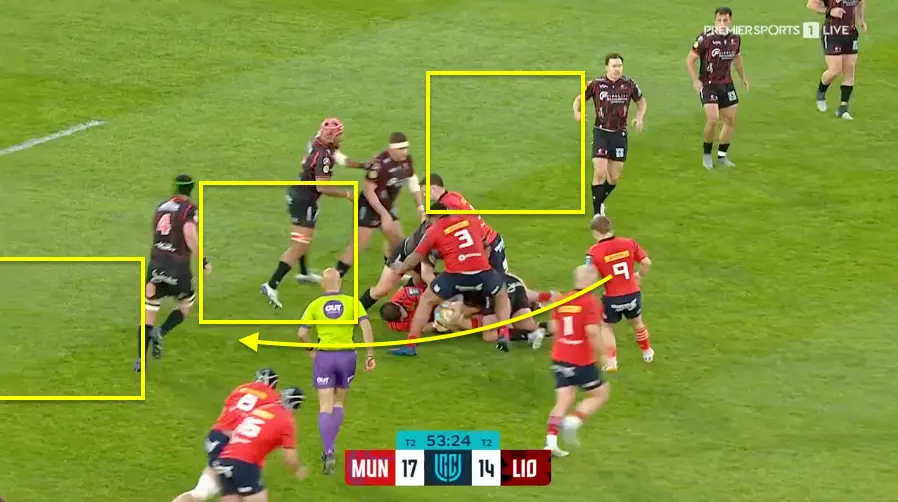
We scored from that lineout strike, with a few interesting wrinkles at the ruck.
We knew that, post-set piece, the Lions struggle to get their front five into position quickly, so predictable ruck positions and phase progressions are exactly what they love.
We mixed it up with a really sharp pick and go game that consistently forced a break in the Lions’ defensive fold.
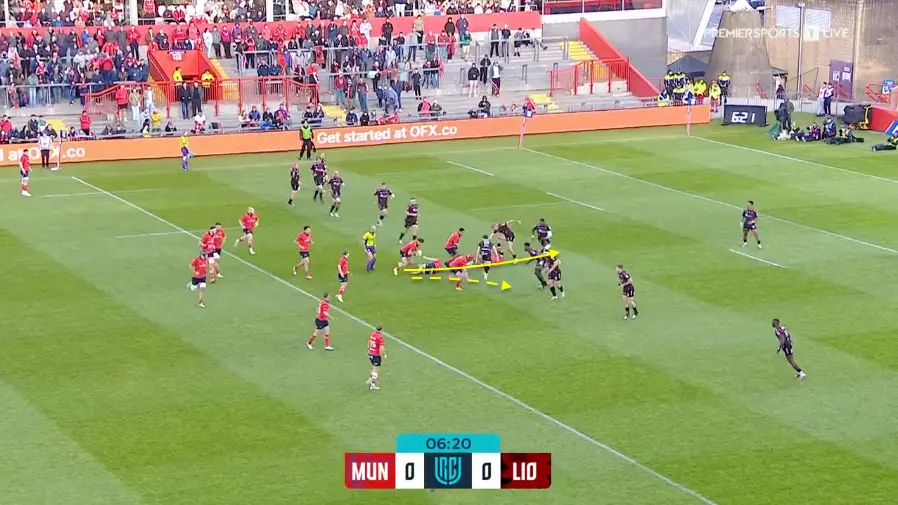
Hodnett faked a pick and drive — not 100% legal, admittedly — and that opened up the space for Daly, and then O’Donoghue to drive through the fringes of the ruck.
That’s where the space was all night long, and when we had possession, it was our most potent weapon. We looped our wingers in tight all game long to add a quick sniping option, but our best work was done after targeting the seam of the lineout.
That set the Lions’ tight five defence rolling across the line, and when they start rolling, they leave a lot of gaps.
That gave us the points we needed, but the game was won, functionally, during the a period in the first half where we were defending for six minutes with 13 players while up 10-7. This segment of maul defence summed it all up. Niall Scannell and Jack O’Donoghue get the killer stop while down to 13 on our 5m line, when a try would have led to 10-12/14, and likely another conceded off the restart for 10-17/21.
Had we lost control of those six minutes, we’d have blown the whole season. We had to expend huge amounts of energy to hold that last 14 minutes of the half while sinbinned, but we did, and it saved the game.
The last 20 minutes were all about guts, desire, and making that feeling of “we’re not losing this a reality”.
The Lions were held up or stopped in goal twice, the best one on 70 minutes, where Alex Kendellen got himself under the ball to prevent a try that would have given Smith a kick to tie it up with 10 minutes to go.
If they’d gotten that score, I think they would have ended up winning.
Instead, we kept shooting up to make tackles, even though the Lions’ big runners were powdering us. We kept our accuracy at the lineout. We kicked and chased incredibly well.
And we saw it out to the end.
| Players | Rating |
|---|---|
| 1. Jeremy Loughman | ★★★ |
| 2. Niall Scannell | ★★★ |
| 3. Michael Ala’alatoa | ★★★★ |
| 4. Tom Ahern | ★★★★ |
| 5. Evan O’Connell | ★★★★★ |
| 6. Jack O’Donoghue | ★★★★★ |
| 7. John Hodnett | ★★★★ |
| 8. Brian Gleeson | ★★★★ |
| 9. Craig Casey | ★★★★★ |
| 10. JJ Hanrahan | ★★★★ |
| 11. Shane Daly | ★★★ |
| 12. Sean O’Brien | ★★★★ |
| 13. Dan Kelly | ★★★ |
| 14. Andrew Smith | ★★★ |
| 15. Mike Haley | ★★★★ |
| 16. Diarmuid Barron | ★★★★ |
| 17. Josh Wycherley | ★★★ |
| 18. John Ryan | ★★★★ |
| 19. Gavin Coombes | ★★★★ |
| 20. Ruadhan Quinn | ★★★ |
| 21. Ben O’Donovan | DNP |
| 22. Gordon Wood | N/A |
| 23. Alex Kendellen | ★★★★ |
