


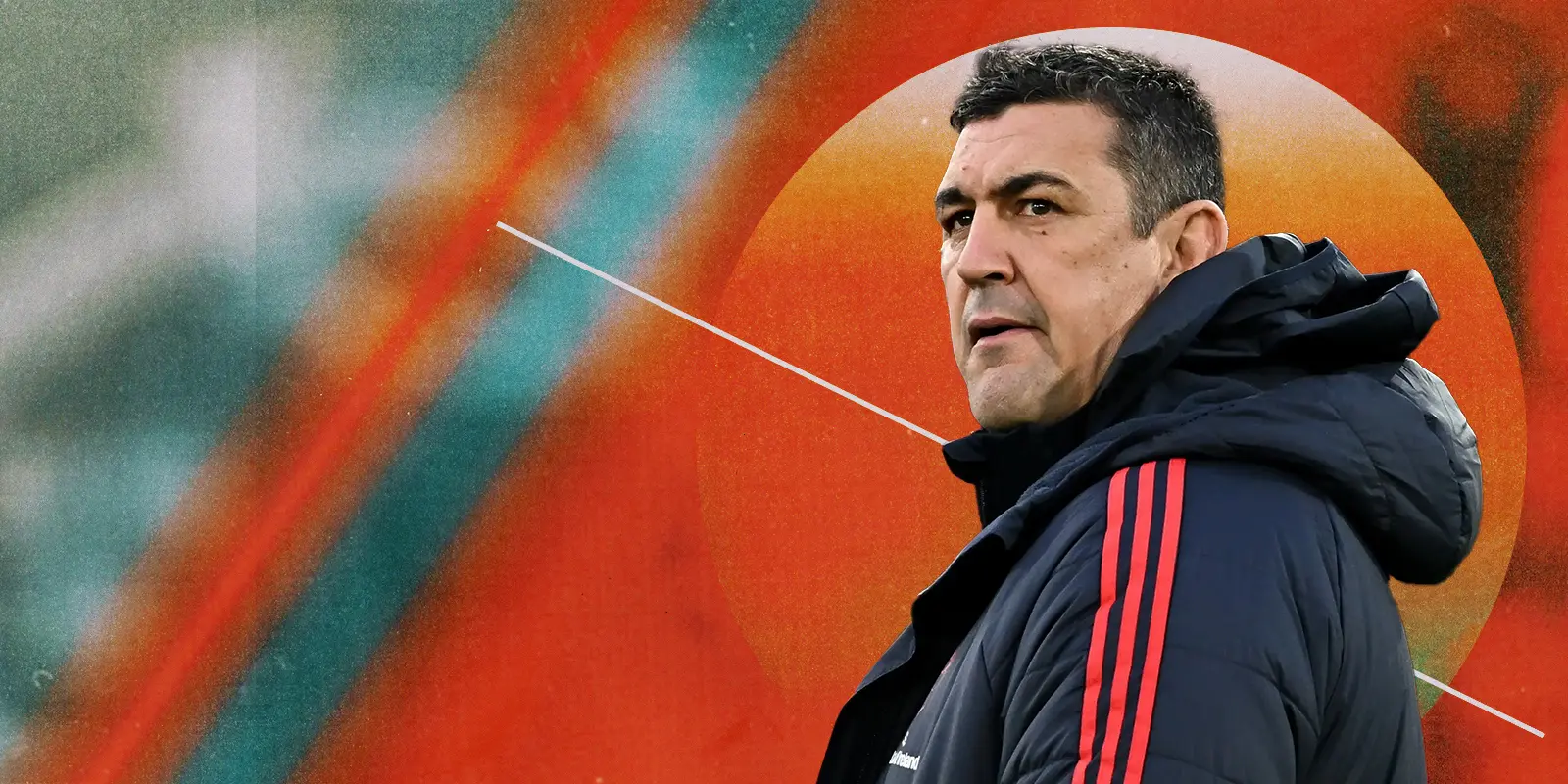
“Time is the longest distance between two places.”
— Tennessee Williams, The Glass Menagerie
Sometimes, you’d forget that there are rugby games to be played. Since Thursday of last week, time seems to have slowed to a standstill. That wasn’t the worst thing on a Bank Holiday weekend, all things considered, but it was a gift and a curse.
Everywhere I go, I am The Rugby Guy. In adult life, you end up becoming good at small talk, and small talk most often starts with the Thing you are most known for, as long as that thing, whatever it is, is relatively mainstream. My fiancée is big into Limerick hurling, so when she meets someone she knows in passing, hurling is one of the first things that gets mentioned. As I said, I am The Rugby Guy, so over the weekend, when I bumped into people I know around Castlegregory, the first thing they asked me was a variant of “jeez, there’s some mess in Munster at the moment” or “what’s going on with that Munster coach?”
I can’t help but deliver a mini-podcast in reply.
The cancellation itself has become the story. The Streisand Effect, named for Barbra’s 2003 attempt to suppress photos of her Malibu home (the picture had been downloaded six times before her lawsuit, and several hundred thousand times in the month after), describes how trying to bury something tends to do the precise opposite.
Munster announced Randle’s appointment in mid-April. By the end of the month, after a steady drumbeat of resignations, op-eds, internal wrangling and fanbase unease, they’d reversed it.
For context, I was still very much The Rugby Guy when he was first announced, and I generally heard absolutely nothing about it. The reversal of the deal, however, had reached deep into the Small Talk Cinematic Universe.
A 30-year-old allegation that the average Irish rugby supporter had never heard of — one Randle has consistently denied, and which never went to trial — is now common currency, and the man’s name has been raked over the coals all over again for a job he won’t even be doing. Whatever you make of the U-turn, the one thing it hasn’t done is quieten anything down. Which is partly why I keep finding myself nine minutes into an unsolicited monologue about Professional Games Board governance outside a sand-filled playground in Castlegregory, with one eye on my three-year-old daughter to make sure she doesn’t do a frog splash off the top of the slide. She is well capable of it.
That was all juxtaposed with Leinster’s European Cup semi-final against Toulon on Saturday. Sure, it was one of the lowest-key semi-finals in recent history, in part due to the EPCR thoroughly trashing one of the great institutions in this sport over the last decade, and in part due to an emotional investment crash in Leinster Rugby in a general sense after eight years of falling at the last or second-to-last hurdle. After too many years of that, people stop caring, as Munster, before the 2006 final, could probably tell you. At a certain point, you’ve just got to do what you’re capable of, or a healthy percentage of people will decide you’re not worth their time when they could be thinking about or doing literally anything else.
But these are normal problems for Leinster Rugby Guys. “How do you think ye’ll do at the weekend?” Man, I’d love for that to be the extent of my Rugby Guy conversations in the last few days.
Randle not coaching Munster next season isn’t the end of the story, not by a long shot. I realised this during my second monologue on the beach near two appropriately dead dolphins that had washed ashore.
A bad omen over flat whites.
Until we know more, everything is still up in the air, or half-beached if you want to continue the dolphin analogy.
We know that Randle won’t be here in July — and unlikely to holiday here anytime soon — but we don’t know anything else. Will McMillan be here in September? Will he be here next week? We don’t know. If he goes, will Martyn Vercoe and Brad Mayo go too? Don’t know. Will Ian Costello and Ian Flanagan, the other part of the triumvirate who were the driving forces behind Randle’s initial hiring, be here in the summer? We don’t know.
Who will be the new attack coach? Don’t know. Who will be the forwards coach to replace Codling? What are you asking me for? I don’t know.
It’s May.
I was looking through my posts on Sunday morning and realised I probably need to delete the What’s The Story With article about Randle. But what does that mean?
It means that almost everything we thought we knew about next season is on hold, and the challenge now, up until the end of the season, is making sure we get the three points we need to guarantee top eight, and then see what happens from there in the playoffs. Whatever happens after will happen regardless of whether we’re worrying about it or not.
For the playing group, things are simpler. The arithmetic of the Connacht game hasn’t changed. It’s a far bigger game for them than it is for us as far as the table is concerned but we need something, make no mistake. We need a good performance and a win to blow away the sitting-in-the-shower hangover of the last week, like a tactical Red Bull and a jambon.
More than anything, whatever we see next from Munster has to actually relate to what this is supposed to be about — a rugby team playing rugby games to win rugby tournaments. We’ve had three weeks of a town-hall production of Succession, now we need to get back to reality.
But how? I’d love to end the article there, but how do we get back to reality?
All the uncertainty has me mentally reaching for a forgotten wallet halfway through a flight.
At this point, radical change is required, and might well be required depending on how the long weekend of thinking went.
What does that change look like? It’s hard to say without flaccidly demanding that people with mortgages, bills to pay, and kids to support lose their jobs when, at best, even in my position, I know approximately 30% more than the average punter, but that’s still less than 75% of the full story. These are real people, with real lives, who wanted the best for Munster Rugby as they saw it. It hasn’t worked out the way that anyone wanted.
There is a review into this situation and the fallout; fallout that inevitably cost money the organisation could not afford to lose. The review will have to be done quickly and decisively, whatever the outcome. The original mistake — foreseeable, unforeseeable, or some mixture of the two — has been made. Another foreseeable mistake would be to drag out the processes that need examining, or, having reached an outcome, fudge it.
The danger now is malaise, and malaise spreads like black mould. The only thing that kills black mould is clear, radical action. Sometimes, when the three-year-old really looks like she might do that frog splash, you’ve got to stop talking and let her jump into your arms instead.
Everyone — internal and external — needs to know what the structure will look like for next season in the next two weeks. If not, rumours will do the job for them until whatever the structure ends up being is inadequate by default.
