


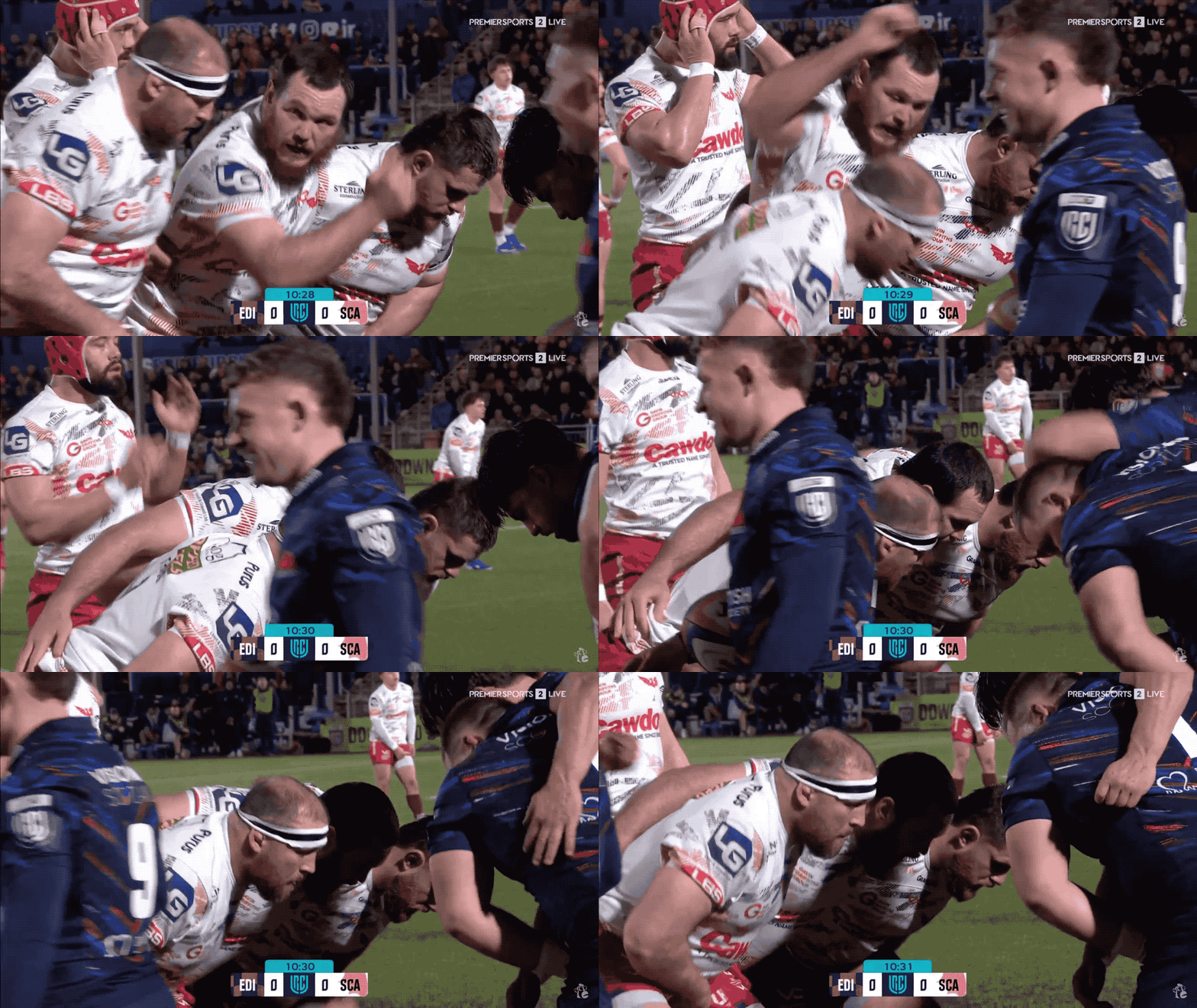
Munster’s scrummaging issues this season have been profound, and while the need for tighthead props is clear and obvious, one area has already been shorn up for next season in Marnus van der Merwe.
A lot of the focus this season has been on tighthead and, yes, they have a huge say — as does the loosehead — but what has been lost in the shuffle has been the importance of the hooker in this equation.
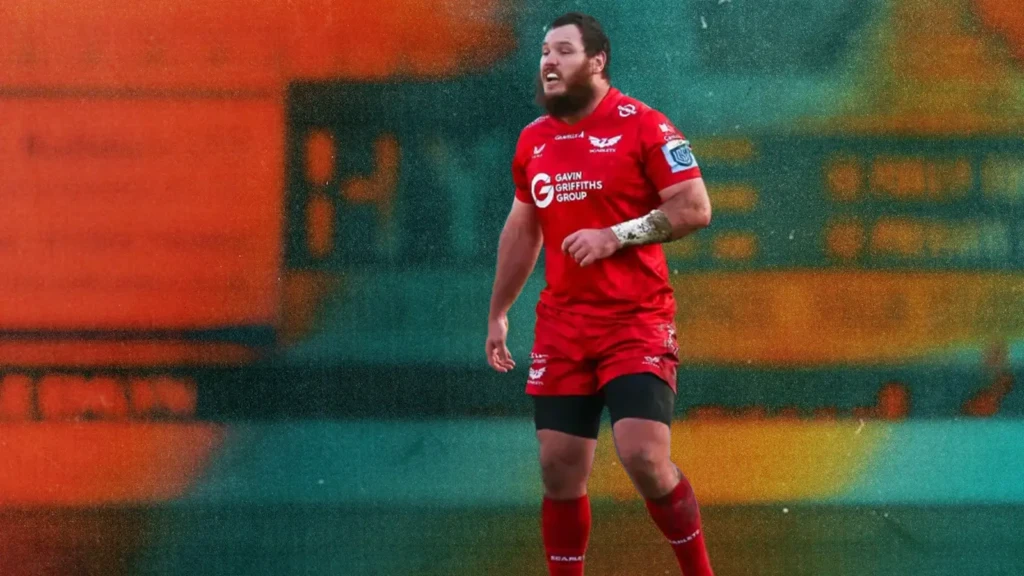
A few weeks ago, when Clayton McMillan was speaking about the impact that van der Merwe will bring next season, he mentioned his scrummaging as being a big part of the equation in signing him. I later found out this was why he was so highly sought after in England and France, as well as back in South Africa.
As scrummaging hookers go, van der Merwe is one of the best around. Genuinely. Yes, he’s a powerful carrier, an impact defender, a good thrower and an elite jackal threat, but arguably his biggest quality is his scrummaging.
This season, as our scrum has come under pressure, a lot of people have been confused by the continued selection of Niall Scannell, who, at this point in his career, is not the most mobile or impactful around the pitch, but he’s not there for that — he’s there for the scrum.
Of the three senior hookers in the squad, Scannell is still the best. Lee Barron is more mobile, impactful in the carry and a bigger threat off the back of the scrum. Diarmuid Barron is a mix of the two, playing like a heavy wing forward in phase play with a balanced set-piece game. Niall Scannell can’t do what the others can around the field, and the lineout throwing is pretty even between the three, but what he does better than both at the moment is scrummaging.
To understand why, we have to look at what a hooker does in the scrum.
The scrummaging hooker is the most constrained player on the field — bound on both sides, locks tucked between the thighs, a #8 behind them — and yet it’s the most technically demanding to play well. Every other forward in the scrum, at heart, a force provider in varying levels of increments. The props do the most, the locks the next, with the flankers and #8 adding power and stability to a lesser degree.
The hooker must be a force provider and the keystone through which all eight channel their effort. It is why Ox Nche, one of the best looseheads in the world, recently described the hooker as the most important player in any scrum. A sub-standard scrummaging hooker degrades everyone around him. An elite one lifts the whole unit.
It starts with body shape. The biomechanical literature on this is unusually precise: the ideal hooker position sits at around 40 per cent of standing height, with hip and knee angles close to 120 degrees. In plain terms, the hooker must sit into the scrum rather than bend at the waist — hips low, knees loaded, ankles driving. At 6’1″ and 115kg, van der Merwe has the raw architecture for it. The harder part is holding that shape as the scrum starts to move, which is what catches out taller hookers with longer backs.
Long and Down
Most hookers, when the pack goes forward, naturally rise — the hips pop, the spine shortens, and the referee suddenly has a decision to make. The standard set by Malcolm Marx, the man van der Merwe has been deputising for occasionally in green and gold, is to stay long and low even when winning. It takes the call out of the official’s hands.
The spine is the main variable throughout. “Hollow the back, chin off chest” is repeated at every level of coaching for good reason. A long, flat spine under load keeps the force travelling horizontally through the unit; the moment it buckles, that force scatters and the hooker becomes a liability rather than a conduit. If you have a shorter back and a thicker neck, you can channel that power more effectively. This is part of the reason why hookers have usually been around 6’2/6’3″ max, but usually shorter again. It’s why Dan Sheehan took so long to get an academy deal at Leinster, for example, because it was felt that he was too tall to properly survive the scrum at an elite level and, to be honest, the jury is still out on that, given the issues Ireland and Leinster have had against elite scrummaging teams.
The longer your spine, the harder it is to control when you’re coming under “slip” pressure from opposition tightheads (or looseheads) who exert diagonal upward pressure on you.
Think of it like trying to pop up a trapdoor that is 2m long — as an example — compared to trying to do the same to one 1m long. You have more leverage on one and not the other.
The related quality for a hooker, and harder to coach, is staying alive — continuously reasserting downward pressure through the three or four seconds of sustained push, rather than absorbing the hit and hanging on for dear life. It is the difference between a hooker who survives scrum contact and one who dominates it.
Binding
The hooker’s bind creates the mechanical linkage on which everything else depends. The hooker grips both props around the shoulders, clasping the jersey below the shoulder blades. The contact point matters: too high and the props’ shoulders are pulled up; too low and the connection to drive forward is lost. A properly bound front row should show six shoulders in a straight line. Any asymmetry — particularly on the loosehead side, where the opposition tight-head will hunt all afternoon — opens a seam, and seams are where scrums get blown up. Van der Merwe is approximately the same height as Milne and Loughman, or at least close enough for seams not to be an issue.
Not to overharp on Dan Sheehan — who is an excellent, world-class player — but one of the big issues that Ireland have with Porter at loosehead and Sheehan at hooker is the height difference between the two. You can have a taller loosehead and not see a problem, but when the hooker is taller, that natural seam is exaggerated, which increases the “up” pressure on the hooker’s back as he tries to stay straight and down.
Because van der Merwe is so good at maintaining that bind — empowered by his ability to stay low — he very, very rarely gets popped.
Striking
Striking, even in an era when the contest for the feed is largely notional, still demands balance between competing aims. The striking foot sets forward as a brake, stabilising the front row through engagement, then withdraws and sweeps in a triangular motion to hook the ball back between the loosehead’s legs. The difficulty is that a badly timed rotation interrupts the push. The high standard — Marx again — is to generate forward momentum while the strike happens, rather than treating ball-win as a separate, static moment.
Van der Merwe is particularly good at this transfer — gets the strike, but doesn’t have to rise out of his shape to do it.
The ultimate measure, though, is whether a hooker makes his props better. A secure bind, a long spine, and constant activity through the push all remove the compensatory burden from either side of him. The loosehead and tight-head can pour their energy into horizontal drive forward rather than structural repair inwards, which produces collapses and scrums that collapse diagonally inward.
If you want an illustration of Van Der Merwe’s scrummaging style, this still image from a scrum where the Scarlets are under pressure.
His loosehead has been crushed under the drive of the Cardiff tighthead, and the loosehead’s bind on van der Merwe is broken. But look at Marnus.
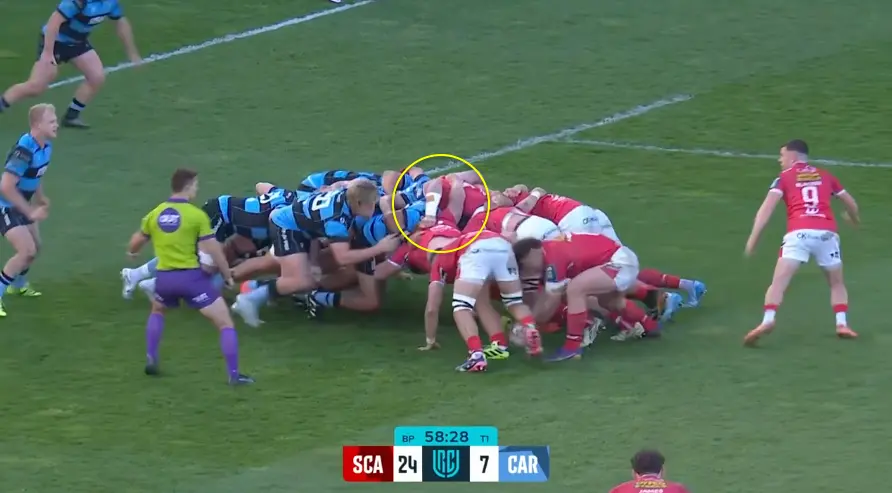
He’s still holding his shape even while going backwards against the scrummaging pressure of the Cardiff tighthead and hooker. He knows that if he pops up here, it’s a penalty.
Look at the quality of the strike, too.
Not every scrum is going to be a march forward, and what you see here is a hooker who understands how his action under the pump decides what is and isn’t a penalty.
Here’s another example of a scrum that went against Scarlets but it’s worth watching how Van Der Merwe keeps driving forward and down the entire time, even as Boan Venter (the Edinburgh loosehead) trims the Scarlets tighthead and onto van der Merwe, while the same happens on the loosehead side.
This is really impressive by van der Merwe, even with both props getting pumped. Look at that body shape. The Edinburgh hooker pops before Marnus does, and up to that point van der Merwe is handling the upward pressure of both the hooker and Boan Venter.
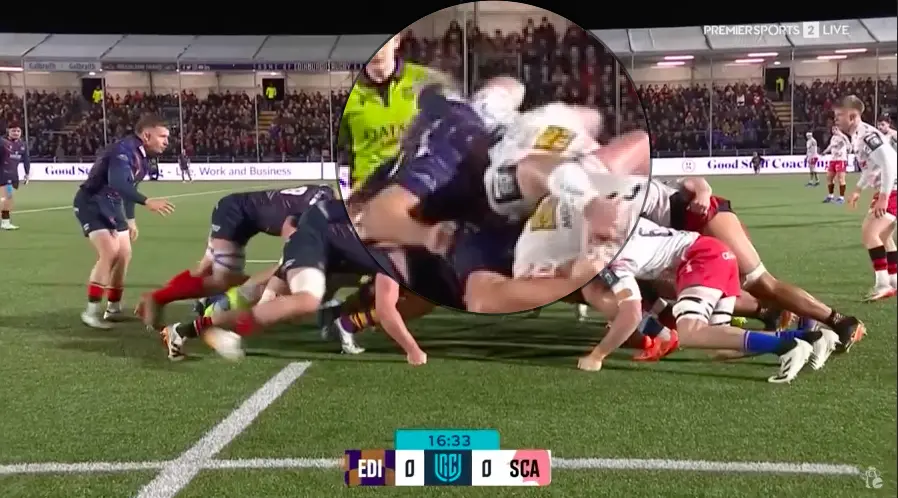
His tighthead is getting pumped, but he’s still locked down. He’s not going to pop — it’s that drive to stay low that you really can’t coach.
Here’s another great example of his drive to stay low, helping his props.
He loses his bind right at the end, but look at the way he braces his loosehead and resists the drive from the Cardiff tighthead Sebastian, despite the loosehead getting pumped. Van der Merwe doesn’t pop up, so there’s no obvious penalty.
Offensively, he also hits really fucking hard on the engage. Look at the venom on this one against Connacht, as an example.
And then look at this one, and how little his body shape moves when he strikes the ball before being the pivot that the Scarlets use to attack on the tighthead side.
Munster’s scrum needs a lot of work to get to a stage where it’s a penalty-winning machine — it has stabilised up to 90% completion rate from a low of 86.2% back in February, to be fair — and you could look at coaching and our tighthead rotation with regards to that. Both would be true.
But you can’t underestimate the value of a good scrummaging hooker, and the impact they can have. If Ox Nche believes it, it’s good enough for me.
