


These games are often a hiding to nothing.
With Ulster fully rotated — and I mean, down to the rivets — Munster’s win was assured before a ball was kicked or carried in anger. I don’t mean that to sound disrespectful to Ulster, but it’s true.
Their great start — empowered by a frustrated Munster side looking to skip to the part where we ran in six tries and moved onto a week off — didn’t really change anything about that equation. We were going to win; the only question was whether that was with a bonus point and a healthy points difference buff, or not.
As it turned out, it was both. A bonus point, +27 in the points column, and onto the next. The four quite serious injuries to Jager, Kleyn, Farrell and Nash were a blotch on that — and the rest of the season — but if you wanted the guarantee of both the bonus point and the points difference, you had to lean into the team selection you made before you were sure that Richie Murphy would essentially send the Ulster Ravens to this game.
That discussion is next week’s problem.
For now, it’s about seeing where we stand after Round 16, and how we got there.
The opening twenty minutes were pretty frustrating. The game started with a knock-on by Farrell at the restart — the timing and placement of our restart lift pods were a little off all game — which allowed Ulster an early 22 entry, from which they almost scored. Whether it was a rotated Ulster side or not, they are clearly all well-drilled in their core possession structure: multiple screens, lots of ball past #10, and trying to stretch teams that blitz them.
Without their core backline and forward carrying rotation, they probably played a little wider than they usually would, but that was OK for Ulster too — they wanted to cheese possession when they had it in our half because when they had the ball, we didn’t, and I think they knew that if we had the ball for long, we would crack them open.
Our own mistakes were the entry point; that early knock-on, a hasty decision on a transition attack, a scrum penalty, a penalty for shouting at the ref (!), one bad goal-line drop-out, and then another one.
That was, essentially, an own-goal. A self-inflicted 22-entry kick transition, and Ulster scored from it.
7-0. Not ideal.
Off the restart, we knocked on the exit, won a penalty off the Ulster lineout, and then got turned over close to the 5m line.
Frustrating.
It had the feel of one of those games we’ve often experienced in Thomond Park this season — and in the last two — where we seem to be half a second late, or too early, to what we’re trying to do, and end up missing the window to an easier game.
When Ulster won another penalty off the next sequence for another 22 entry, it really did feel like one of those games, but thankfully, we got a stop, and a few minutes later, burned a yellow card out of Ulster, kicked it to the 5m and mauled over for the first try.
In between that, you could clearly make out the “rush” that we were in to get up the field.
In that first clip, the “mistake” was a bad pass read. For Hanrahan, the right pass was to Beirne, here, if the intent was to drive through the defensive mismatch off the Ulster pillar.
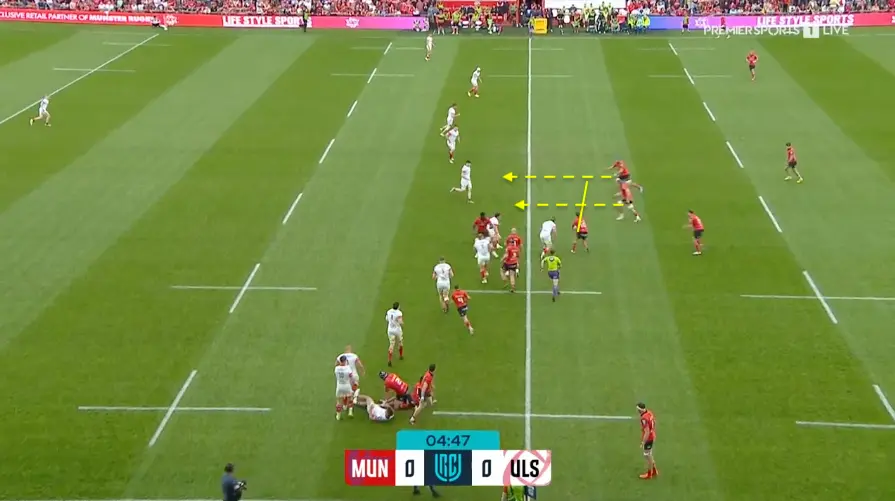
Hitting Coombes, it meant any pass to Beirne to chase the linebreak would be functionally impossible at the pace they were running at.
Good idea, good shape, and then a high-percentage option leads to a very low-percentage one.
Same with the second example. A good carry, the low percentage option, and then a really risky high percentage option lead to a knock-on.
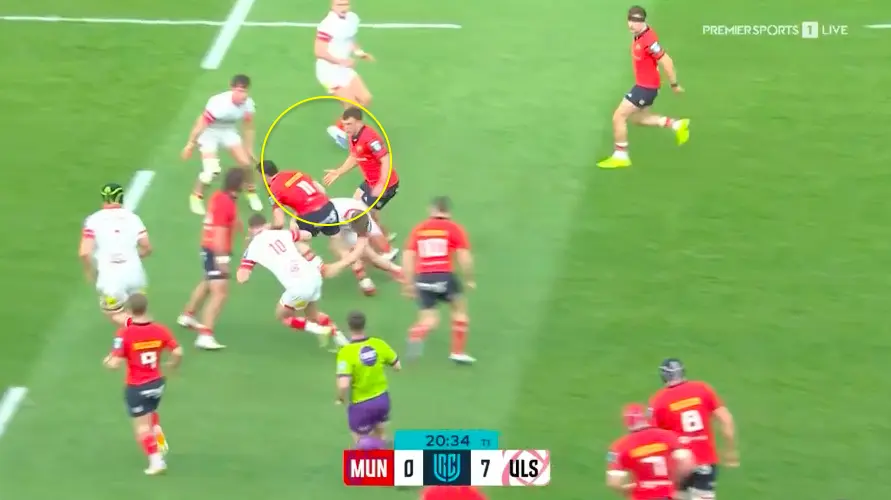
Like I said, rushing.
When we went direct — threw in a few high tempo pick and goes — we looked a lot tighter. Hodnett had three excellent involvements here, but my favourite was the decision to go quickly off the quick ruck to double down on the pace of the play.
That Edogbo assist on the latch at the end is worth watching over and over again.
That took us to 12-7, and a frustrating last ten minutes of the half allowed Ulster to see out the half with a ton of credit. You could tell, though, that they were flagging quite a bit. Holding the ball as they had was really good, but it takes a toll.
In the second half, Munster blitzed them in the opening 20 minutes and the game, and the bonus point with it, was done.
Hodnett’s third try, Munster’s fifth, was something really special — players expressing themselves in space and the confidence that the game was in the bag — but it was Munster’s third try that really stood out to me.
A tight forward formation once we got into position, direct carries and then the move to space once we got the look we wanted on the release.
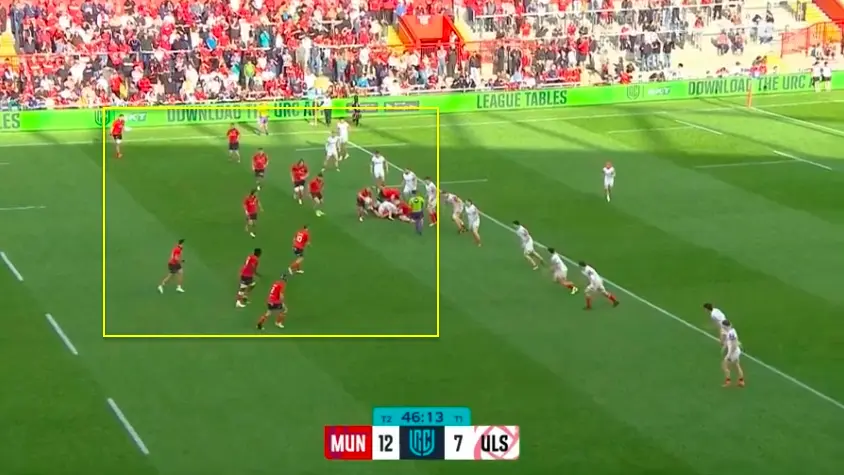
Ahern is holding the edge here, but it’s as part of a narrow structure, and his work on the pinch is fantastic.
Really good animation, but he continues his line after the decoy to play a massive part in finishing off the play.
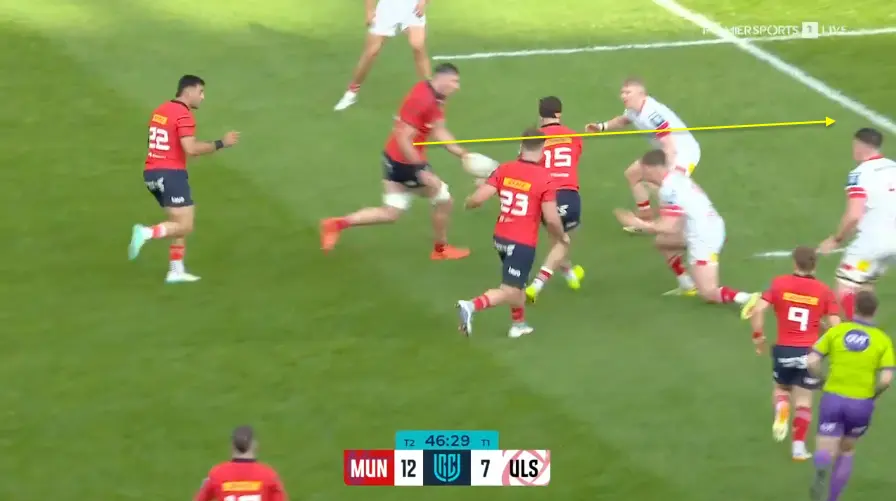
Once we get to the 5m line, Kendellen doesn’t overthink it — he picks and goes for the easy finish.
He did the same a few minutes later, and we were out of sight. This try, on kick transition, was the exclamation point.
In the second half, we were far more direct and narrow. That, in turn, removed some of the errors in the first, and once that was combined with Ulster’s physical blow-out and their bench rotation to even more inexperienced players, everything clicked into place.
What does this mean for the rest of the season? Have we turned a corner?
It’s impossible to say, on the evidence of this game. Ulster were always going to be beaten here — their selection guaranteed it — so the question became whether or not we could do so with a bonus point and a buffer, or not, and we did.
The sloppy opening half, which looked like a lot of our home games this season, should be looked at as the spluttering start-up of a machine that tends to do that, especially without Jack Crowley, who pulled out late in the warm-up. Like a car with a tyre pressure sensor issue that alerts because the sensor isn’t there. It doesn’t mean you can’t get to where you’re going, but you should probably get it fixed at some point, and maybe have a check of the tyre pressure when you get a chance, too.
But we pulled it around. A lot of the overplaying (and the errors that came with it) I saw in this game seemed more to do with the level of the Ulster side we were playing and the stakes — we needed a bonus point, and a points buffer — more so than a repeat of some of the issues that hurt us earlier in the season.
We will know more after the Connacht game, where we’ll be facing a team playing at home in a game that is a World Cup final for them every year anyway, but who now have the existential dread of missing out on the top eight baked into it.
What this win ultimately does is give us the freedom to approach that game looking up at the top four, rather than looking at the trap door. That has value, too.
| Players | Rating |
|---|---|
| 1. Jeremy Loughman | ★★★ |
| 2. Diarmuid Barron | ★★★ |
| 3. Oli Jager | ★★★ |
| 4. Jean Kleyn | N/A |
| 5. Tadhg Beirne | ★★★ |
| 6. Tom Ahern | ★★★★★ |
| 7. John Hodnett | ★★★★★ |
| 8. Gavin Coombes | ★★★★ |
| 9. Craig Casey | ★★★★ |
| 10. JJ Hanrahan | ★★★ |
| 11. Andrew Smith | ★★★★ |
| 12. Alex Nankivell | ★★★★ |
| 13. Tom Farrell | ★★★ |
| 14. Calvin Nash | N/A |
| 15. Shane Daly | ★★★★ |
| 16. Lee Barron | ★★★ |
| 17. Michael Milne | ★★★ |
| 18. Michael Ala’alatoa | ★★★★ |
| 19. Edwin Edogbo | ★★★★ |
| 20. Brian Gleeson | ★★★ |
| 21. Ben O’Donovan | ★★★ |
| 22. Dan Kelly | ★★★★ |
| 23. Alex Kendellen | ★★★★ |
This was a pretty good performance, all told.
A 27-point win, seven tries, and no bonus point for Ulster, who now have to look at the trapdoor in our place. A good day’s work. Not a great day — the injuries saw to that — but a bonus point is what we needed, and we have it. Ten points in two weekends have all but sealed Champions Cup rugby for next season and some form of a playoff run.
As base standards go, after that nightmare middle block, it’s pretty good. In fact, as I hypothesised back in February, the real killers were not getting a bonus point against either Dragons or Zebre. Had we managed those, we’d be tied with Leinster on points. If we’d managed anything near a coherent performance in Durban to earn a losing bonus point of some description, we’d be clear in fourth.
That doesn’t seem to sync with the noise around the province, on-field anyway, but it rarely does.
My top performers in this game were John Hodnett and Tom Ahern.
Hodnett has had a weird season where he’s had a few knocks and, at times, looked a little lightweight as an edge forward, but then here, he put in one of the best winger performances of the season for 40-odd minutes. Make it make sense. I can’t.
Sure, he didn’t have to do any of the boring business that wingers have to deal with — backfield chess or kicking — but he showed the value of, essentially, positionless rugby. If you give him the ball in space on the edges, he will finish.
Tom Ahern showed, once again, why he’s become one of Munster’s most important players. Half-lock or lock? It doesn’t matter. He can gain ground up the middle and essentially play like the biggest outside centre you’ve ever seen in the edge spaces while being a dominant lineout forward. He’s a unicorn, in reality, and he stitches so much of what Munster does well, when we do well.
I also really liked the performance of Andrew Smith. Sure, he has holes in his game, but he’s a manic hardworker that covers an unbelievable amount of ground on kick chase, defensive transition and on loop plays.
There was a nearly 2.5-minute-long sequence at the end of the first half where he ran two big loop lines, lost the ball after a scrappy pass, and then tore around the field for the next two minutes, making multiple cover tackles and breakdown entries, before running himself into the ground to chase a kick upfield to touch.
That’s the kind of hard work, grit and hunger that you can’t really coach into guys. It’s either there or it isn’t, and Smith has that in spades. The rest will come with match sharpness — better hands under pressure, better kicking, better decisions — but we’ve needed guys who have his pace, his directness and game IQ for a while. He showed his value here, clear as day.
