



Is it a turning point?
That will only be knowable in hindsight, but, for today at least, it’s as badly needed a win, with a performance to go with it, as you could ask for, given the context of Munster’s season since December, and the very specific results around us at the weekend.
I always felt that Munster could win this game, but that came with the creeping dread that it would end up being something of a shootout. Benetton are good. They haven’t been anything close to the sum of their parts this season — much like ourselves — but you look through the team they named for this game, and you see a ton of internationals and quality players. If they click, especially at home after a disappointing loss the week before, they can shred you.
You know the script of how that game might look. Concede early. Strike back. Nick a try off an error. Go in at the half two points up, or down, and then stay locked into that nerve-shredding tension until a decisive moment, one way or another, kicks the legs out from someone. Maybe Benetton, maybe us.
That it looked nothing at all like that — not even close — was a pleasant surprise, equivalent to that of finding a €20 note in the pocket of an old coat, not a €50 note worth of a pleasant surprise, to be clear, as there’s a lot of work left to be done in the next three games, but we can look forward to those games with the knowledge that we are capable of a ruthlessly competent and physical performance with the pressure cranked up.
And let me be clear, the pressure on the squad ahead of this game was acute. When Munster are on a bad run, it’s not the same as with other clubs. Play as Munster have since December, with the losses to match, and it becomes an existential problem. It can’t simply be that there are squad depth, systemic and tactical issues affecting the squad — often against either top-quality sides, or sides that are a specific bad match-up for those game issues — it becomes a supposed sign of an all-encompassing “rot”.
For me, and you can see through my analysis in the last few months, the issues have been, broadly, that we were playing a system that didn’t suit who we were this season, and that was compounded by both a scrum and lineout that oscillated between decent and abysmal week to week, game to game. We would have a decent scrum one week, but the lineout would collapse. Then, the opposite.
When those issues are faced without our pillar players — Craig Casey, Jack Crowley, Tadhg Beirne and, as it turns out, Oli Jager — we have no floor as to how bad we can be. Clayton McMillan has learned that the hard way, which is the only way that things can be learned, I’ve found.
Before we kicked off last night, that left us in 9th. A loss would have genuinely crashed the season, even with a bonus point. That would have left us a win behind Connacht, with two interpro games to follow against Ulster and then Connacht in Galway.
What this win did was push us to within touching distance of second, with a game to come against an Ulster side with a Challenge Cup semi-final to manage the week after, as well as a growing injury list.
It can’t be overstated how important this win was, but the manner of the win is what really stands out.
For most of this game, we used a deeper and narrower 3-2-X forward shape, which is a significant departure from the flat 3-3-X we’ve used for most of this season.
This play ended in a penalty for an off-the-ball tackle on Loughman, but two things stick out to me — one, we decided to run a kick right after a scrappy phase, as opposed to doubling down on a chaotic spacing alignment in the defence, and two, that shape change.
This is significant.
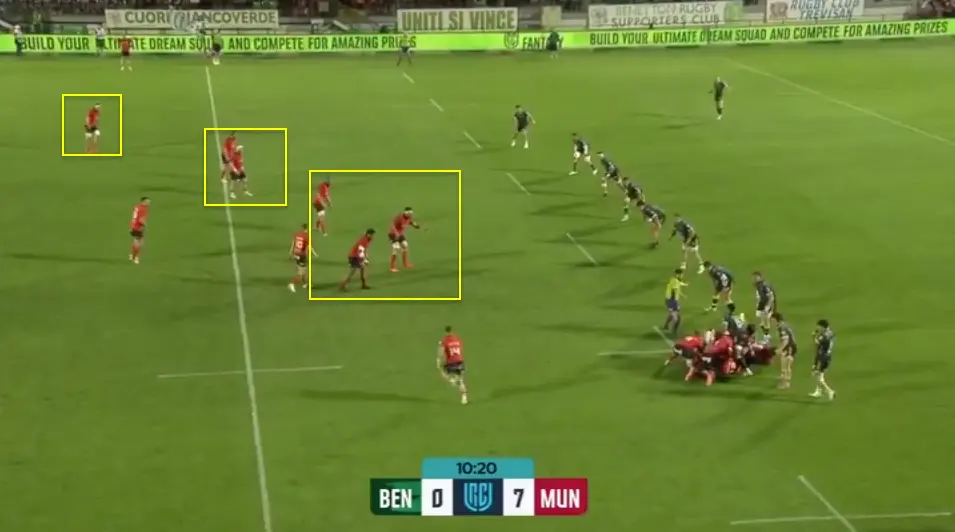
Sometimes we’d use a 3-3 shape coming from post right to post left, where the last man in the pod off #10 would be recessed, but we consistently snapped back into a 3-2 on the next progression back across the field.
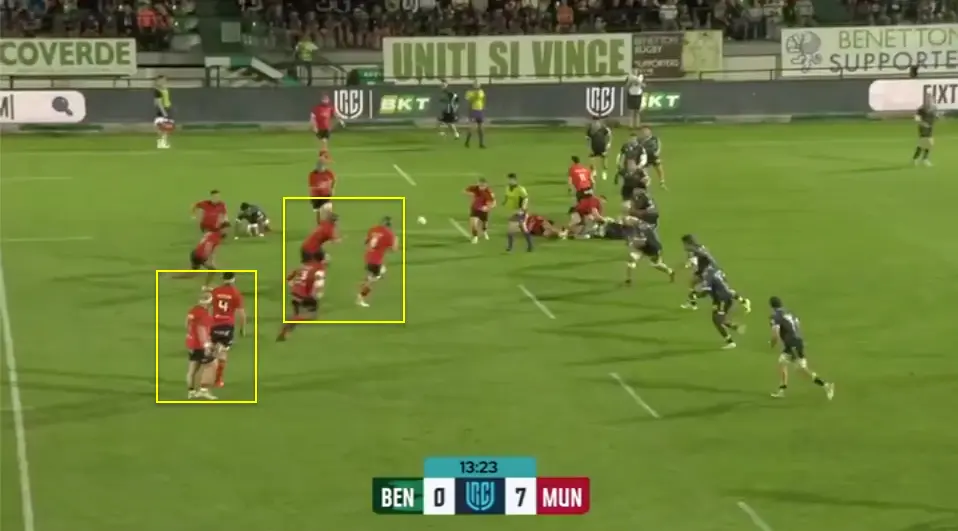
It’s not that Munster haven’t run 3-2 shapes in the last few years, but when we did, it was almost always on transition.
That wasn’t the case here.
Is that why we looked more physically comfortable here? Regardless of Benetton’s recent run — a tough loss to Exeter last week after being on the go since Round 13 post Six Nations — they had a base defensive style that was a bad matchup for us on paper.
We’ve struggled against teams that broadly ignore the ruck point and fill the field with defenders to smash up our flat, high-possession shape. We didn’t play like that here, and that’s as much to do with how we set up as it did with how we chose to use the ball.
We were far more comfortable kicking to contest off #9 and #10, and then backing our defence to sap the energy out of Benetton in possession.
A combination of better field management, possession management and energy management meant, for me anyway, that we had way more pop and venom in almost everything that we did.
This was a more patient and “switched on” performance than we’ve seen in some time. This sequence is a good example of that, where, on the watchback, I kept thinking about how many times this season I’ve seen us lose patience in a tactical battle like this and go chasing after a half-gap in transition that isn’t really there.
It’s a minute long, but it’s worth looking at to see the decisions being made, as much as anything else.
This was a really important sequence in the game itself — we scored the third, killer try right after — but mainly, for me, because of what it showed about our approach.
We weren’t chasing the game at any point. Sure, that comes back to starting well and getting points on the board in the first quarter and preventing Benetton from scoring 10+ points in a short burst at key times.
With that scoreboard control, our cognitive control of the game increased exponentially.
By far the most pleasing aspect of this game was our scrummaging performance. It has completely undercut us at key times during this season, and it was really important to nail it here.
We did so. Michael Ala’alatoa played 40 minutes of each half, and it was amazing to see the difference in our scrummaging control off the back of that. Ala’alatoa had his best performance in a Munster jersey during the first half, and I wonder how much of that was down to him knowing that he had, in all likelihood, 40 minutes max to play. Benetton were trying a mix of pull-downs and sliphits to sell him belly flopping, but they were mostly unsuccessful and with a simpler phase play game, he could focus on what he does well — big stops in defence, and crunching cleanouts.
Jager showed exactly why he’s been so badly missed in the second 40 minutes with a really strong showing at the scrum, but in the maul particularly.
He is our best back lifter and pillar driver in the front five, and by some distance. Scrum stability — we didn’t dominate Benetton, but we didn’t get dominated either — meant we could hold our set launch positions in attack and stop easy metre leakage on their put-in.
That alone makes any game incrementally easier.
In defence, we did an excellent job of meeting Benetton’s narrow attacking pressure in possession and Tom Farrell, in particular, did a great job of closing the space on Menoncello for most of the game, so they had no real release.
Hodnett, Coombes, and Barron did a really good job of chopping Benetton down in those narrow spaces, and we did a great job overall of slowing their ruck ball down without overcommitting to the poach.
That sequence above is a great example of what I’m talking about there. It’s not perfect defence — defence rarely is — but there’s excellent scrambling, really good spacing and defensive pillar management, and sticky tackles that always demand a clearout at the very least.
In the last few months, we have often been the team that has blown itself out on attacking phases — multiphase attack is so much more draining than multiphase defence, despite the received wisdom to the opposite — and because our defence and set piece held here, we were far more impactful when we did choose to push the button offensively.
Combined with better efficiency — this was our best points per 22 entry score in months — it led to a lopsided score that fully reflected Munster’s superiority on the night.
What that means for the last three games of the regular season remains to be seen, but on the face of it, anything close to this level of coherence against Ulster, Connacht and the Lions will see us finish comfortably inside the top eight.
We can only hope.
| Players | Rating |
|---|---|
| 1. Jeremy Loughman | ★★★★ |
| 2. Diarmuid Barron | ★★★★ |
| 3. Michael Ala’alatoa | ★★★★ |
| 4. Jean Kleyn | ★★★★ |
| 5. Tadhg Beirne | ★★★★ |
| 6. Tom Ahern | ★★★★ |
| 7. John Hodnett | ★★★★ |
| 8. Gavin Coombes | ★★★★★ |
| 9. Craig Casey | ★★★★★ |
| 10. Jack Crowley | ★★★★★ |
| 11. Andrew Smith | ★★★★ |
| 12. Alex Nankivell | ★★★★★ |
| 13. Tom Farrell | ★★★★ |
| 14. Calvin Nash | ★★★★ |
| 15. Shane Daly | ★★★★ |
| 16. Lee Barron | ★★★ |
| 17. Michael Milne | ★★★★ |
| 18. Oli Jager | ★★★★ |
| 19. Edwin Edogbo | ★★★★ |
| 20. Brian Gleeson | ★★★★ |
| 21. Ben O’Donovan | ★★★ |
| 22. Dan Kelly | ★★★ |
| 23. Alex Kendellen | ★★★ |
