


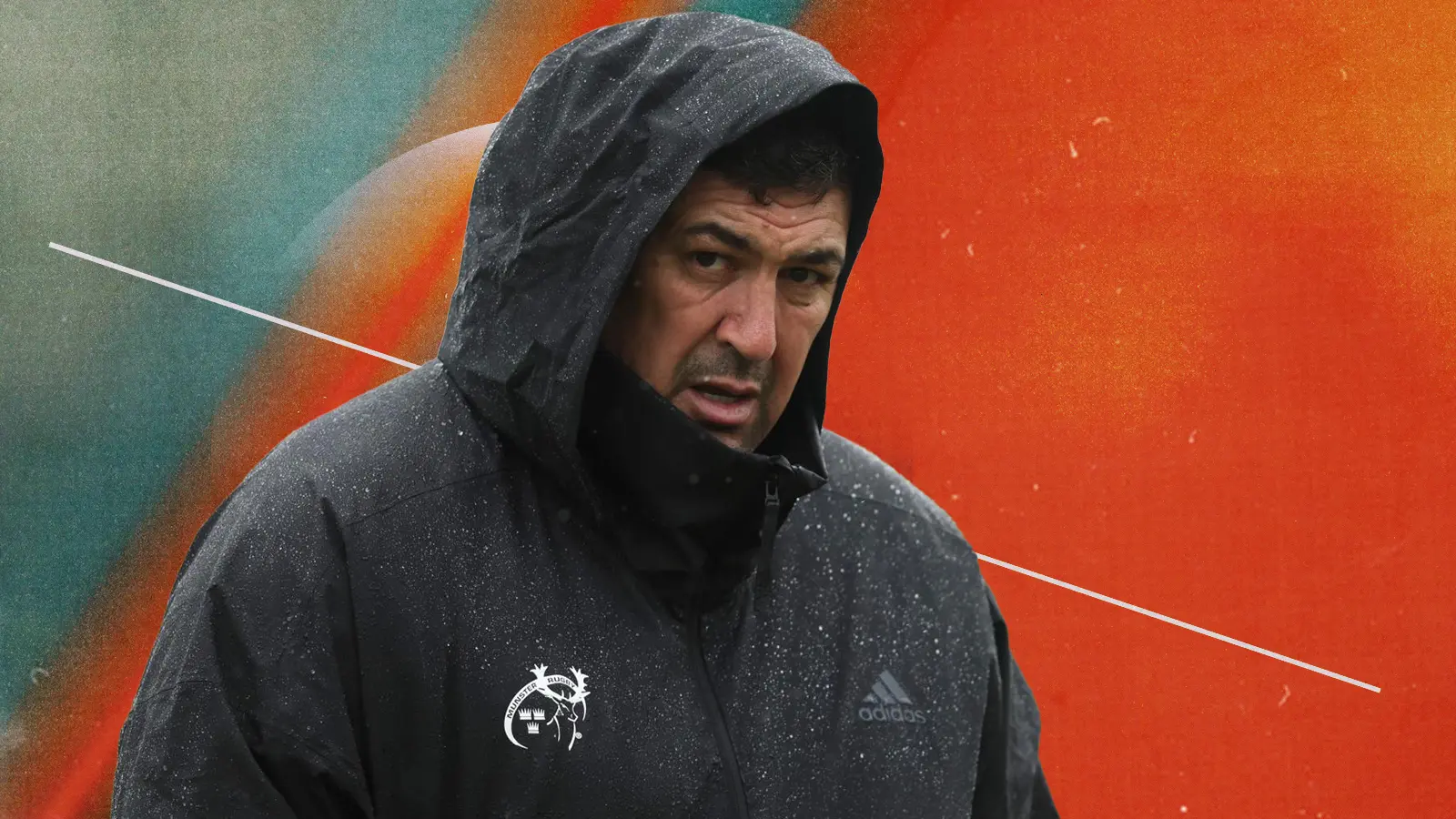
Believe it or not, we’ve come into regular-season run-ins in a lot worse shape than this, but this is the worst it’s felt since 2015/16, at least at the time of writing.
The last four weeks have been incredibly attritional mentally, emotionally, spiritually and when it comes to the tawdry reality of wins and losses in that context.
We have too many losses, not enough wins, and that’s why we are where we are, as much as anything less.
Sport is a fundamentally sleazy business. Munster are no better or worse run organizationally than we were at the start of the season, where we won five from five, but losing seven out of nine in 2026 so far is like trying to run through a sandstorm. Veneers have been sandblasted away, like a birthday cake in a wood chipper.
We are exposed. Vulnerable.
From a playing perspective, the squad are in a tough spot when it comes to putting together a performance this weekend against a quality Benetton side, albeit one that has been playing broadly below their level this season — much like ourselves.
I’m sure the squad spoke about standards, effort, performance, heart, and pride before the Exeter game two weeks ago. It would be natural. It was a big opportunity to arrest the slide of the previous few months.
They then went out in the first half, stepped on every single rake available two times over and lost the game before the coaches had made their way down the stairs for halftime.
Sure, it’s a fact that the South African tour on the previous fortnight, a short week, they all contributed to the flatness we saw, but that doesn’t tell the whole story. You’ve seen this team completely implode in 10/15 minute blocks multiple times this season: the Stormers, Bath, Ulster, Castres, Glasgow, and the Sharks. It’s like you’re playing a video game and, at a key point, the controller stops working.
Is it a lack of concentration, individual and collective? Is it discipline? Is it system failures? Is it our set piece? Is it a lack of quality, in general and in the moment, that kills us? It’s all of these things.
As usual, I wanted to examine this feeling to see if it was reflected in reality and, well…
Munster 2026: when the wheels come off
An analysis of nine matches, focusing on concessions after yellow cards and multi-score bursts.
Points conceded within 10 minutes of a yellow card
Six yellow cards were issued against Munster across the nine matches. Four led to points conceded, two didn’t.
Worst concession burst per match
Highest points shipped inside a 10–15 minute window in each of Munster’s nine matches.
The key findings
The yellow-card picture is bimodal: four of six cards led to a concession, two led to nothing. When Munster got punished, they got punished hard — Tadhg Beirne’s card against Toulon and Tom Farrell’s against Castres each cost 14 points in the 10-minute sin-bin window.
On the bursts, every match outside the Zebre win had a 10-point-plus window. Three of the top five bursts coincided directly with a yellow card (the coral bars). The Sharks and Bulls losses stand out as the exceptions — those 19-point bursts came in open play with fifteen men on the pitch.
The yellow cards in detail
- vs Toulon (Beirne, 35′): 14 points conceded. Domon try and conversion at 39’–40′, White try and conversion at 43’–44′.
- vs Castres (Farrell, 63′): 14 points conceded. Palis try + Hervé conversion at 67’–68′, Ambadiang try + Hervé conversion at 72’–73′. Swung the game from 22-17 up to 22-31 down.
- vs Glasgow (Abrahams, 38′): 7 points conceded almost instantly — McKay try and Lancaster conversion inside a minute.
- vs Toulon (Nankivell, 54′): 3 points (a Domon penalty on the edge of the window).
- vs Exeter (Beirne, 72′): Zero points conceded — Munster actually scored through Crowley.
- vs Glasgow (O’Donoghue, 82′): No time left on the clock.
The worst open-play collapses
- Toulon, 39’–50′ (11 minutes, 21 points): three tries conceded across the half-time break.
- Sharks, 76’–80′ (4 minutes, 19 points): three late tries in the 45-0 defeat.
- Bulls, 45’–60′ (15 minutes, 19 points): two converted tries plus a Pollard penalty.
- Glasgow, 6’–8′ (2 minutes, 14 points): two converted tries from the opening whistle.
- Exeter, 13’–40′ (first half, 31 unanswered points): four tries, three conversions, a penalty.
If you want to see the problem in the last nine games, there it is in stark relief. We don’t just concede — every team concedes — we concede in bursts.
The question is why?
And there’s no one answer to that.
If we duplicate those implosions against Benetton, we will lose, and this is a game we cannot afford to lose for any number of reasons. In a broader sense, our top eight prospects are as tied to those around us as they are to our own performance, given how compressed the URC table is coming out of the Six Nations/European knockout block.
But the maths for Munster are simple — 12 points in the next four games will be enough for some flavour of a top-eight finish. Anything more helps vibes and feelings. Anything less increases the pressure incrementally.
So it’s simple, really.
Just win.
Munster Rugby: 15. Shane Daly; 14. Calvin Nash, 13. Tom Farrell, 12. Alex Nankivell, 11. Andrew Smith; 10. Jack Crowley, 9. Craig Casey; 1. Jeremy Loughman, 2. Diarmuid Barron, 3. Michael Ala’alatoa; 4. Jean Kleyn, 5. Tadhg Beirne (c); 6. Tom Ahern, 7. John Hodnett, 8. Gavin Coombes.
Replacements: 16. Lee Barron, 17. Michael Milne, 18. Oli Jager, 19. Edwin Edogbo, 20. Brian Gleeson, 21. Ben O’Donovan, 22. Dan Kelly, 23. Alex Kendellen.
Benetton: 15. Matt Gallagher; 14. Louis Lynagh, 13. Tommaso Menoncello, 12. Malakai Fekitoa, 11. Paolo Odogwu; 10. Jacob Umaga, 9. Alessandro Garbisi; 1. Destiny Aminu, 2. Nicholas Gasperini, 3. Marcos Gallorini, 4. Giulio Marini, 5. Federico Ruzza; 6. Sebastian Negri, 7. Michele Lamaro (c), 8. Lorenzo Cannone
Replacements:16. Bautista Bernasconi, 17. Ivan Nemer, 18. Tiziano Pasquali, 19. Riccardo Favretto, 20. Jadin Kingi, 21. Alessandro Izekor, 22. Andy Uren, 23. Leonardo Marin
Sylistically, Benetton have been very similar to ourselves this season. You could argue that results have been broadly similar too.
They take a long time to score, they aren’t hugely efficient at the set piece, and they struggle to convert opportunities, while coughing them up at the other end at a pretty high rate.
On paper, this looks like a game that could have quite a lot of points in it.
As a base starter, expect Benetton to kick to contest quite a bit in this game as they look for position and transition starting points. No team in the URC has scored more tries from kick returns, so they will be looking to generate space and opportunity from that launch point. No team in the URC contests more kicks than Benetton this season so far.
We will have to answer that particular challenge, and the radiating threats around it, especially as Benetton have a funny habit of “generating” blocking penalties on their chases for easy metres up the field. We can’t get lazy or cute in these zones.
They’re particularly dangerous on turned-over lineouts. They will likely feel they have an excellent chance of catching us here, and if they do, they are lethal on the edges.
Their own set piece isn’t necessarily anything to write home about. They have a good scrum — better than ours, on paper — and a decent lineout, but they don’t really have the kind of punishing maul that we’ve suffered from in the last few weeks.
On phase play, they tend to play very narrowly relative to the previous ruck, usually to set up a contestable to lean into the drop and then post-transition.
As a result, they are prone to giving up isolation on those narrow carries that we can target with our core of jackals. Strategically, I think we have to kick contestably quite heavily in response to their kick pressure, and try to win the battle on the ground, and off the set piece.
They have a lot of errors in the phase play game, they are after two attritional weeks, and they tend to be the kind of narrow — without the dominant carries or gainline — that we can live with. I think we want them to have the ball around their halfway/10m line. I think that’s how we can generate enough position to win this game.
If we are disciplined, if we can avoid handing them 10/14 points in a short burst, we have enough to win this game.
