


The attack lead is probably the most important coaching signing that a club can make. If defence showcases your spirit, your attacking concept is your personality — it’s how you’re defined as a team.
In the last four years, Mike Prendergast has fundamentally changed what Munster’s “rugby” looks like, and, although the initial success of late 2022/23 has faltered since then, I think it’s fair to say that we play a radically different style of rugby — forget about recent results — in 2026 from what we’ve been typically known for over the years.
In light of Prendergast’s departure, an outside hire was always on the cards for this role. It’s too big for an internal promotion, even if the club love the detail and imagination that Mossy Lawlor has brought to his role in the last two seasons as skills and backs coach.
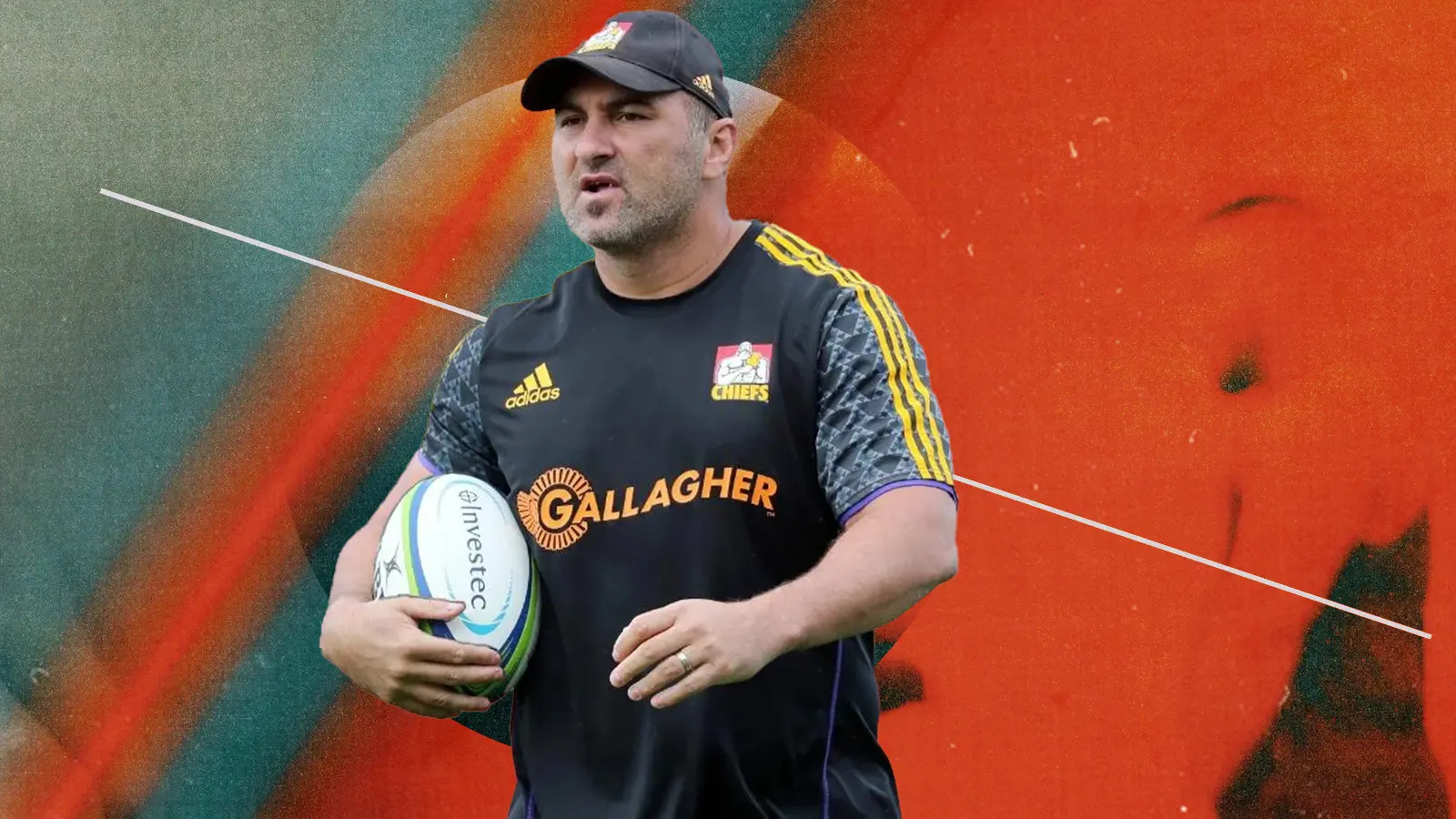
He will be a key part of the attack side of the house going forward, but he will be working with the Chiefs’ Roger Randle, who joins Munster on a two-year deal this summer.
Roger Randle is not a name that will immediately mean a great deal to most Munster supporters, and that’s fine. He’s a coach, not a player, and attack coaches rarely get the kind of profile that makes their appointment feel like headline news to a fanbase. But if you’re willing to spend five minutes with his CV, what you’ll find is a pretty extensive coaching background.
Randle came into the Chiefs’ setup in 2019 as assistant backs coach under Colin Cooper, which is a decent enough entry point, but what matters more is what happened after that. He grew into the Attack Coach role, and his coaching career now spans over a decade across both provincial and international rugby. That progression matters because it’s one thing to be handed a role and hold it; it’s another to be trusted with more responsibility over time, and Randle has been given all of that and more. That tells you something about how the people inside that environment rate his attacking vision.
The Chiefs’ context is also important to understand properly. Clayton McMillan took over as head coach in 2021, and together, he and Randle helped guide the Chiefs to three successive Super Rugby finals from 2023 to 2025. The attack that Randle was shaping during that run was direct, aggressive, and consistently capable of hurting teams across the full width of the pitch.
His coaching philosophy, shaped heavily by his background in rugby sevens, is built around a fast-paced, opportunity-driven style — which, given what we want Munster to become under McMillan, is not the worst foundation to be working from. The question now is whether he can translate that into the URC/European context, with a different roster, a different(ish) climate, and a fanbase that will have very little patience for a slow start.
The answers to that won’t come until the autumn, but on paper, the background is there.
So What Is the Story With Roger Randle?
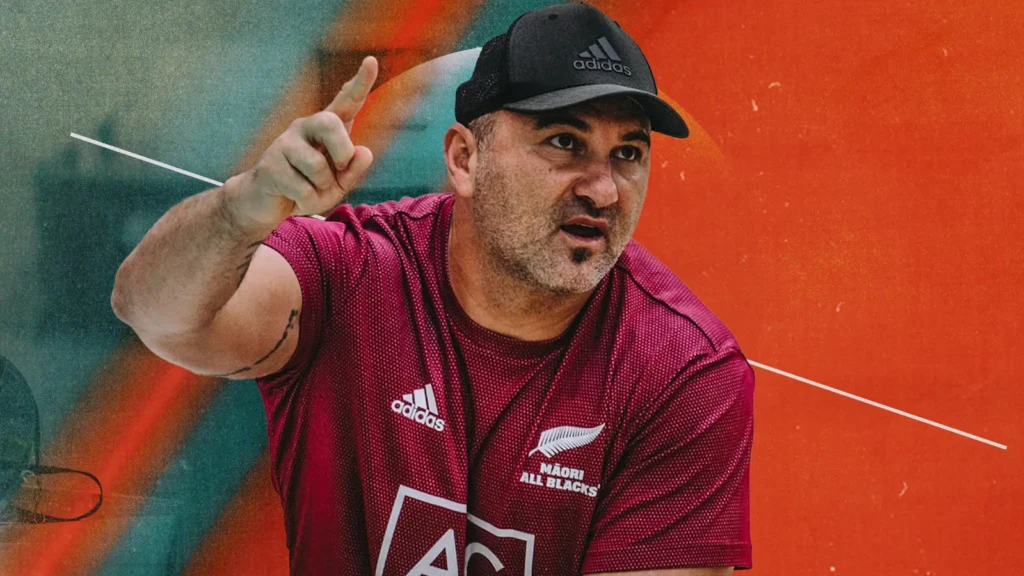
Roger Randle’s base-attacking style has been the Chiefs’ main identity over the last five seasons — direct, played with a lot of role simplicity, and heavily focusing on strike plays and exploiting transition.
The important thing to realise about the Chiefs’ structure under Randle is how simple it is, and how that empowers the directness and punch within it. At its core, it’s very high energy — they carry a lot, hit a ton of rucks and don’t use a whole lot of sweep plays (usually defined by tip-ons or pullbacks to a screened runner). It’s not that they never run forward-passing plays, but they use them relatively sparingly and with space to work. At the moment, most of our forward passing work is done right at the gainline to empower our possession structure, but the Chiefs don’t do that.
If anything, the Chiefs’ carry volume is done in very specific zones and scenarios — they will go to high tempo, around the corner direct carries after lineout launches or on some scrum plays to compress the opposition, but only inside the opposition half or 10m line.
What you won’t see the Chiefs doing all that often is moving through multiple screens and layers between the 22s, with one exception: transition.
On transition, you’ll often see them playing wider screen balls as part of a wide 3-2-2 forward shape. This is one of the few times you’ll see the Chiefs run multiple screen plays in a sequence.
In almost every other instance of possession, you’ll see them play tight, direct shapes off #9 with tight — but not flat — pods of three/four forwards playing centrally, with the midfielders and wingers offering width and release.
When they do stretch out in attack, it’s got depth baked into it. The fullback is looping across here, but the backline positions are mostly static in relation to the forward shape, which is a tight stack off #10.
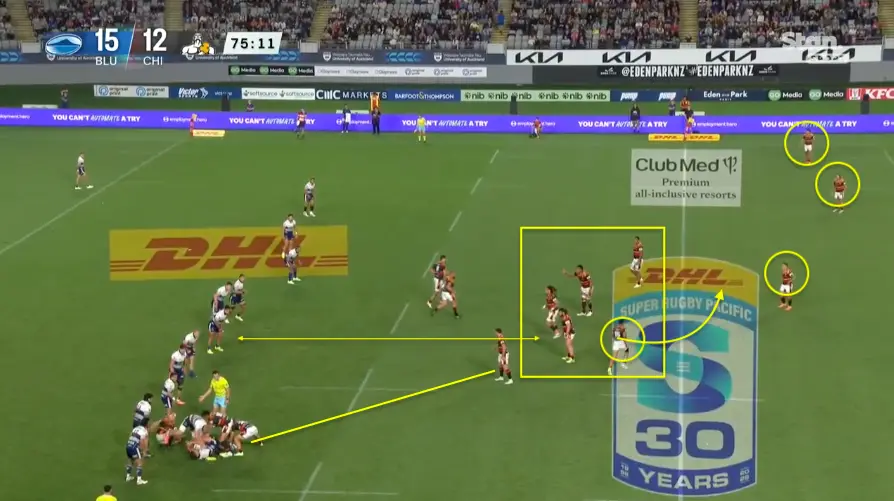
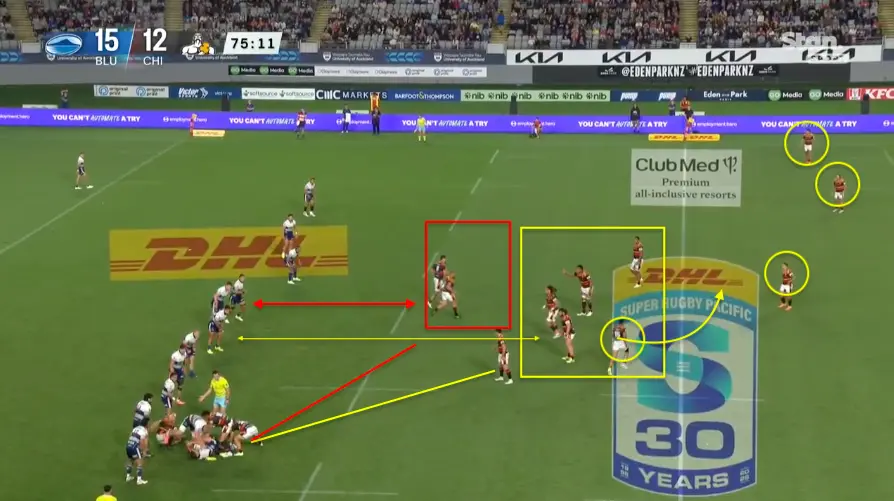
When the play rolls through, you can see how much more time and space the players have to make a read on the play, and how much more momentum they can play with.
As we’re currently constructed, we might well run a similar shape but I think we’d be here (red graphics).
We try to play through the opposition at the moment, but in a very specific way — we want to use our flat lines to empower Casey’s width off #9 in a way that stretches out the opposition defence and supercharges late passes on the line, be they tip-ons or screen balls.
In practice, this has put a big squeeze on the skill set of our forwards, who are often getting the ball a heartbeat or two before the defender pressures them, and this leads to suboptimal collisions, slower rucks and more easily defended structures. This system change, assuming it comes in like-for-like, will look to change that as a core concept, as well as simplifying the cognitive load and cardio demands of our wingers.
We use split midfielders quite a bit on almost all of our multi-phase plays, but the Chiefs don’t really use that structure at all. You’ll often see the Chiefs midfield alongside each other, or in a stack on the same side.
What that means, in practice, is that the Chiefs run a version of 2-3-2-1 with the extra central pressure coming from their midfielders, where we’re currently stacking forwards and wingers playing a much more traditional role.
You can see on this sequence here — a tight 3-2 shape — that the draw is the narrow structure, not the usual width of a 3-3.
The depth is also visible here. The Chiefs aren’t afraid to give their runners space to attack vertically, which will put pressure on their pace, ability to hold defenders and, ultimately, win collisions to offload out of them, rather than using a flat shape that allows the line run and the timing of the pass to beat the defender.
The Drawbacks
The Super Rugby vacuum has to be addressed, too. The whole “defence optional” side of Super Rugby is very much overdone, as is the idea that they play every game in perfect conditions — that certainly isn’t true in Hamilton, anyway — but there is a very different defensive profile there, which will need to be examined, both in the broader sense of European and URC rugby, and in the personnel and unit strength we have available to us.
This is a good example of a Chiefs strike play, and you can see straight away how certain points of it will rely on a different profile of player than what we’ve been using for most of this season.
I look at the roles here, I look at the tight, high-tempo phases leading to a strike release through depth and see, yes, absolutely things we’re good at, but a lot of roles that don’t fit with core parts of the forwards.
This will require very mobile and impactful second rows. It will require heavy-hitting ruck first props that generate quick ball almost every single time. It will require a back row of pretty much all-hitters, rather than the usual small-forward/combo-flanker roles we’ve been using for the last while. It will require two punchy midfielders. It will require a second playmaker role somewhere.
Marnus Van Der Merwe is an exact fit for the Samisoni Taukei’aho role, almost like for like, but I have questions about several other spots, especially in the back five, midfield and back three combinations.
The Chiefs actually kick a lot more than Munster on a per-game basis — Munster have 24 kicks across 14 games during the URC so far, the Chiefs average 27 per game across nine so far in Super Rugby — and also way longer, so that will change elements of our chasing structure too, if the same style translates.
That usually means that the Chiefs’ scrummaging is normally done on their put-in after a forced turnover on transition defence. It’s not that they don’t fumble the ball or botch a pass — they do — but their primary scrum mode is usually on the attack, forced by their transition defence, so our unit there has to be leagues better than what it has this season, or none of it will work.
Fundamentally, does this style translate as is, or will it need systemic tweaks to accommodate what we have or, rather, are comfortable using?
Immediately, large swathes of this style put certain role types that we have in abundance under pressure. It’s simpler, yes. Stripped down, it encourages big direct carries with arrowed, immediate cleans with no need for a tip-on option. Do we have the horses for that outside of Van Der Merwe, Edogbo, Gleeson and maybe Coombes?
It will also need a fundamental rethink of our wingers. Pace is, obviously, important to any winger, but especially so when they are mostly going to be straight-line runners. They’ll mostly need to be able to punch holes in those wider channels, too. Who does that suit? Who does it deprioritise?
These filters have to be applied to a lot of next year’s squad, and it might produce unusual results.
Fundamentally, if Randle’s playing style at the Chiefs comes up here in any meaningful way, it will require a younger, more athletic core at the heart of it in almost every single instance.
That will be the core stylistic question, and how next season will ultimately be judged on-field. There won’t be much time for bedding in, or much patience for a slow start.
The pressure starts immediately.
