


The moral of the story is I chose a half measure when I should have gone all the way. I’ll never make that mistake again. No more half measures, Walter. — Mike Ehrmantraut, Breaking Bad
There comes a point in every Munster coach’s career when they realise either the squad has to change, or the way the squad plays has to change, or sometimes both.
This has been true at every point since 2009. Sometimes it takes a few seasons, sometimes it takes a few months, but it always happens.
At a fundamental level, this has been because one or both of these things add to an undisputable fact — we are not at the level expected of a team with Munster’s history and prestige. You could argue we are where we should be right now relative to our current collective ability, if not budget, but that’s a circular debate that could go on for 5000 words or more.
The truth of it is simple; we aren’t where we want to be, but we are where we currently deserve to be. Out of Europe, and worrying about a top-eight place in the URC.
In truth, that has been the case for most of the last few seasons.
This is because another fundamental truth has not changed — the squad. If we go back to the squad that lost to Glasgow in the URC semi-final of 2023/24, we can see many familiar faces.
Munster: 15. Mike Haley ; 14. Shane Daly, 13. Antoine Frisch, 12. Alex Nankivell (Blood substitution O’Brien ‘46, Nankivell ‘57), 11. Simon Zebo (O’Brien ‘61); 10. Jack Crowley, 9. Craig Casey (Murray 57′); 1. Jeremy Loughman (Ryan ‘65), 2. Niall Scannell (Barron ′45), 3. Stephen Archer (Jager ′45); 4. Fineen Wycherley (Snyman ‘45), 5. Tadhg Beirne (C); 6. Peter O’Mahony, 7. John Hodnett (Kendellen ‘72) 8. Jack O’Donoghue (Coombes ‘54).
Replacements: 16. Diarmuid Barron, 17. John Ryan, 18. Oli Jager, 19. RG Snyman, 20. Gavin Coombes, 21. Conor Murray, 22. Sean O’Brien, 23. Alex Kendellen
If we highlight who has left the side, either through taking a contract elsewhere or retirement, we have;
Antoine Frisch, Simon Zebo, Conor Murray, Stephen Archer, RG Snyman and Peter O’Mahony. Of those guys, I would argue that Antoine Frisch and RG Snyman were at anything close to the peak of their careers. The others were good to great players, at differing points, but were at the tail ends of their careers one way or another.
Jean Kleyn was missing from this squad, as were Calvin Nash, Tom Ahern, Roman Salanoa and Edwin Edogbo. Only Edogbo is playing at a higher level since that point — arguably Ahern too, when fit — and the rest have not contributed at the level expected, albeit with the proviso that Salanoa, Nash and Kleyn have had a litany of knocks and full-blown mid-to-long term injuries since that point.
Everyone else in that squad is still in situ, in more or less the same position they were two seasons ago.
Veteran players then are clearly on the downslope of their careers now, if not already so two seasons ago: Niall Scannell, John Ryan, and Jack O’Donoghue. John Ryan was a veteran tighthead cover guy in 2023/24, alternating with Stephen Archer, who was also veteran cover at that point.
Injuries dictated that Archer would play 19 games the following season — before he retired — and Ryan would play 20 times. Ryan has played 12 times so far this season, with another four or five guaranteed before the end of the season in one form or another. Michael Ala’alatoa — another player added as veteran cover — has played 13 times this season. Oli Jager, our 1A tighthead in theory, has played six times this season so far, to go with the 14 Munster games he managed last season. Ten games across two seasons.
In his and Salanoa’s absence, 53 games have been covered by a Munster tighthead aged 34 or older, either starting or on the bench. For most of this season, our starting and finishing tightheads have had an average of 35.
If we were to look at everyone else in the squad since that loss to Glasgow, the vast majority, outside of Crowley, Casey, Nankivell, Edogbo and Beirne (arguably), have either stayed at broadly the same level they were then or, as in most cases, have degraded in effectiveness and output. Some have had injuries — Kendellen and Hodnett — some have gone on a year or two too long, some have not fully kicked on to deliver the potential they showed at one point or another.
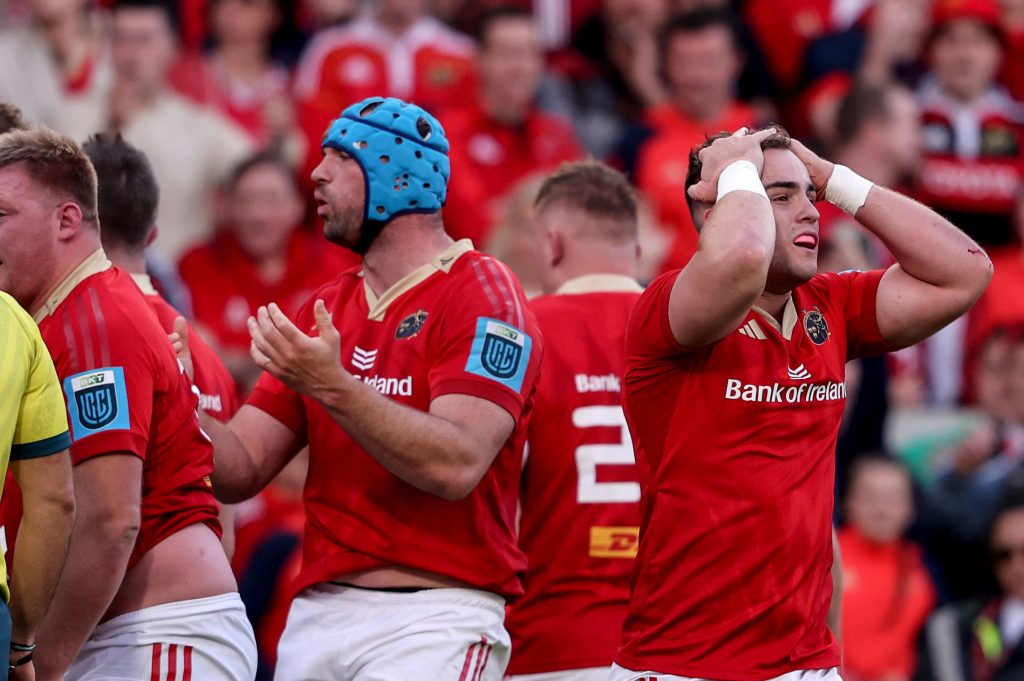
Our tight five rotation, in particular, looks like a group that have, collectively, gone on for one or two seasons too long. Outside of Edwin Edogbo and Michael Milne, most of the guys we’ve been using this season are either systemically dependent on others being the main physical threat — Diarmuid Barron, Tadhg Beirne, Jeremy Loughman — or an active “hindrance” to a physical threat being established, either at the set piece or in the loose.
That sounds harsh, but it isn’t meant to be. It’s simply establishing a fact. As we are currently structured, neither John Ryan, Michael Ala’alatoa, Lee Barron, Diarmuid Barron, Niall Scannell, Fineen Wycherley, Jean Kleyn, nor Josh Wycherley is capable of meeting or overcoming the collective physical threat any decent opposition front five might pose in any facet. All of these players will look better in a squad where others are carrying that physical load, but they don’t drive it at an elite level on their own, or with others in that group at the level we need to compete with the best teams in Europe.
The median age of the front five — starting and replacements — that we actually used for longer than 15 minutes on Saturday against Exeter was 32.5. If Jean Kleyn was fit to play, the median age would have been 33.
Remember when Rassie Erasmus lost the plot with the Munster squad after losing to Cardiff in 2016/17?
After we suffered a narrow 24–23 home loss at Musgrave Park that season, Erasmus let fly at the squad in a brutal Monday morning review session. As Keith Earls describes it in his book, Erasmus “put the fear of God” into the players. At the team review, Erasmus put a series of numbers up on the board — and nobody had a clue what they meant, bar Darren Sweetnam.
Rassie then revealed they were the ages of the Cardiff pack, telling his players that they’d essentially let a bunch of old men beat them. A few players were given a pass, but the rest had to go to him one by one afterwards to explain “why they were cowards.”
Exeter might well have done the same this Monday just gone had they lost to us.
You can see the issue there quite clearly.
That then radiates out to the back row and beyond, where it’s telling that we’ve often deployed Tom Ahern and Tadhg Beirne as offensive half-locks to try to move them away from the problem areas.
In midfield, I think we’ve got an issue where, arguably, our two best midfielders are Dan Kelly and Alex Nankivell, and both would arguably be better suited to playing outside a more physical threat at #12, in an environment where our “centre line” of forwards has such an issue in open-phase play.
Niall Scannell, John Ryan, and probably even Michael Ala’alatoa will all retire at the end of this season, so their race is close to run. There’s no shame in that. They are who they are.
Tadhg Beirne will likely retire in the next 18 months, so what we could and should expect from him going forward is limited. He is a top #10 player in the world on his day, but he can only be that when he’s augmenting power elsewhere.
Tom Farrell — player of the season for Munster last year — looks a shadow of that player this season at 32 going on 33. You could argue that he’d be better as a #12 in our current set-up, but what’s expected of both midfielders in the current system is pretty much the same. They both end up as auxiliary wingers, one way or another. Tom Farrell can’t be that guy as it stands.
Our attacking system asks a lot of our outside backs, but our wingers, in particular, where they are often schemed to loop inside to act as auxiliary midfielders. Calvin Nash, at his best, is a great example of this, with Shane Daly as a more than serviceable option, but it feels like whatever combination we use this season has been overloaded by the task.
They need to be chasers, aerial duelists — the modern game demands this more so than usual — but also be comfortable handling in central areas, while also offering a late-arriving loop threat in the second layer, while also being straight line finishers.
None of our back three has met all of those criteria consistently this season. The players we have that are fastest don’t meet most of the other criteria we need. The slowest back three players arguably do meet most of those criteria, but their relative lack of top-end pace is a hindrance in a wider way. With those players, we create but struggle to finish. With the others, we struggle to create, so there is nothing to finish.
What does this mean in reality?
In a very general sense, we contract players for systemic and environmental stability, for depth, and continuity, while trying to tie down our generational, elite talents and build around them. Which is all sensible. This season, though, it feels like sensibility has left us in something of a rough spot. Almost as if we tried to muddle through a difficult last season with no permanent head coach for most of it, and no idea of who would be the head coach until after all of the contracting was done.
Last season, our primary mode of player departure from the group of players most often used was retirement. We parted ways with Billy Burns after a rotten season, where almost every negative to his game showed up in one game or another when he was fit, and then some players lower down the depth chart at that point like Rory Scannell, Scott Buckley, Liam Coombes, Jack Daly and Cian Hurley, with Jack Oliver taking up an opportunity in Scotland, where he’s qualified for test rugby.
This season, I think we have to be more aggressive. Most of the contracting is done, at this point, so we’ll see what comes of it, but already you’ve seen Munster move on from Jean Kleyn as one of the bigger moves, with Thaakir Abrahams to follow.
Jean Kleyn is, and will remain, a Munster legend for what he achieved here, but the last two seasons of his contract — this one included — have been below expectations. I feel like in seasons gone by, he’d have gotten a two-year deal he’d have probably signed, so it’s good to see more proactive measures being taken.
At the same time, Tom Farrell signed a two-year deal earlier this year that nobody would have blamed Munster for offering — he ended up getting an Ireland cap soon after, before going on to the Six Nations squad — but it looks like less than stellar business at this point, although I’m hopeful of a turnaround for Farrell in particular with a slight role change, or improvements in other areas of the squad.
In a general sense, though, Munster are not at a point, systemically or budgetarily, to take half-measures when it comes to our squad for the next two seasons. It’s pretty clear, having spoken to people around the club, that a lot of the players on expiring contracts this year or next expect to either be offered lower terms than they’re currently on, or no terms at all, with a view to large-scale rebuilding. Some feel they may be given the dreaded “if you can get a deal elsewhere, you can go”, even with a contract that expires in July 2027.
Munster and the IRFU are pretty clear that Munster have enough talent in the academy and young senior ranks, and that this talent has to be backed. Some academy talents — and NTS players — have been offered moves elsewhere that Munster have staved off with equivalent offers either in status or financially, which is a great indicator that we are where we want to be, but this also squeezes the “middle” of Munster’s squad, and the retention of it.
At a certain point, we have to realise that depth players are useful for training, and for habitual usage in lower-tier games, but they become a net negative when you’re using them for higher-level URC and European Cup games, of which there are far more of now than there ever were in the 2010s.
You could get away with a lot of solid citizens in the old PRO12, where you might play six or seven high-level regular-season games a season, depending on the venue.
Leinster home and away, Ulster home and away, Connacht away, maybe Glasgow away, and then whichever one of the Welsh sides had an ascendancy in that cycle. Europe was, well, Europe. You could build to that separately, almost. That’s not possible now. Everything is too integrated.
In the URC, you have twelve or thirteen of those games in a regular season.
Leinster home and away, Ulster home and away, Connacht home and away, all four of the South African teams, be it home or on tour, Glasgow, Benetton, Edinburgh and then Cardiff. Even teams like Zebre and Dragons are now far from an easy rollover.
Your depth, more so than your top-end, defines you.
Our squad, from a depth perspective, has to be better. If that means it gets broadly younger, and the uncertainty that comes with it, that is a “bubble” we have to work out of our system at some point. I’m not saying to rush guys in before they’re ready — that leads to broken prospects — but it’s got to happen soon. That also doesn’t mean cutting everyone over 32, either, because they do have value, but the middle layer of our depth chart, which has a lot of players that would struggle to get deals anywhere other than the English Championship, has to be pruned because, more often than not, they make up 30/40% of a matchday squad.
It can’t be done in just one contracting season — it will take two — but the process starts by accepting that half-measures lead to bad outcomes more predictably than risk does.
At a base level, the question should be this: if we have a few injuries, would you be comfortable with a player aged between 23-32 being a core part of the spine of this team for 2/3 months in must-win games?
If the answer to that question is no, they probably shouldn’t be here.
