


I’m not going to tell you anything you don’t already know.
This was bad.
We were as feckless in the first half as we’ve been since the games against Bath and the Sharks. Self-uppercut after self-uppercut until we staggered off the field at halftime.
In the second half, we were better, but that should only be viewed in a relative sense. We owned the ball, but only tenously. Bar Edwin Edogbo, we never really looked like getting over the gainline on back-to-back phases, but that’s almost a nonsensical point in and of itself. We were 31-0 down at halftime. What, realistically, can anyone do with that?
If I had a fiver for every time we’ve collapsed in the first half of a European game in England during challenging weather conditions this season, I’d have €10, which isn’t much these days, but it’s weird it’s happened twice. You can’t actually buy anything with €10 these days either. It’s illegal. If you try to buy something with €10, they throw you in jail.
Getting to the root of this problem — the inverse happened in Durban, where we collapsed in the second half — is that this team have nothing reliable to fall back on. I’m not telling you anything you don’t already know. I said that at the beginning of the article, and I’ve said it repeatedly since November.
Scrum? A lottery, at best.
Holding onto the ball? Can’t do that for too long before we run out of carriers, or patience, or both.
Build off the lineout? We still have players forgetting their lifting routes in April.
Kick and contain? We don’t have the wingers for that, or the scrum, which brings us back to the first point.
You can’t build a cohesive game state from that. You end up muddling through games where you have no real means of dominating the opposition in any facet, and all of that is enhanced — if that’s the right word — by a withering error rate.
This is a good example in the build-up to Exeter’s first try.
We’d worked our way into Exeter’s 22 with the score still 0-0. We’d just weathered a big early push from the Chiefs, and we had an opportunity to take a big lead into the wind.
We narrowed up off the lineout to flatten out Exeter’s defence, but got confused as we came across the pitch, leading to a knock-on, which led to a scrum penalty, which then led to an Exeter lineout in our own half.
Lee Barron was trying to make a screen pass to Crowley, John Ryan read it as a latch and narrowed up on the carry, and the pass hopped off his chest and forward.
The play was here — attack Varney on the edge — but Ryan’s line was muddled to start with, and he couldn’t react quickly enough.
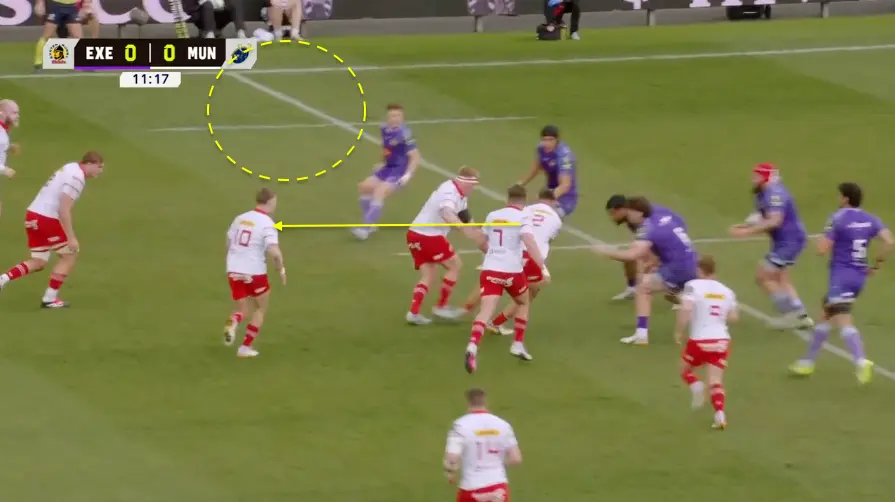
Two set pieces later, we had conceded.
It was a decent — but not great — strike play by the Chiefs.
The first error was Farrell tackling nobody and taking himself out of the next play. The second error was Abraham’s getting bundled over on this pinch line like a traffic cone.
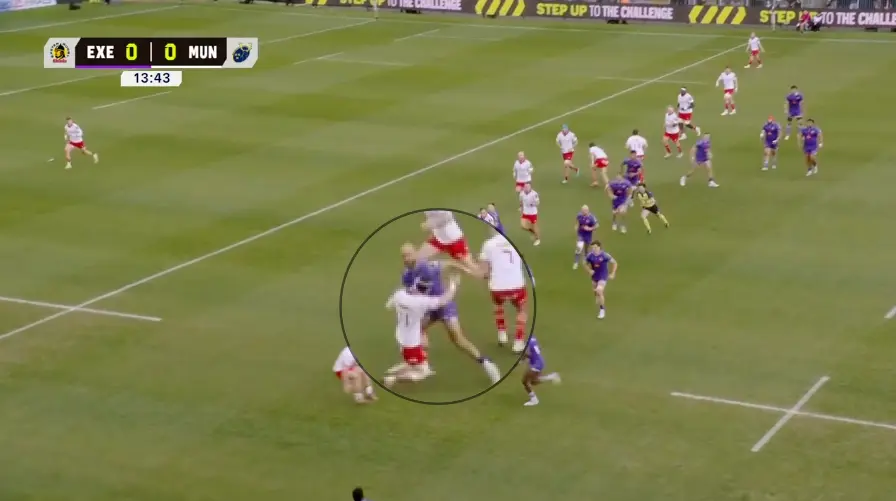
That left a functional 3 on 1 at the edges, down Farrell and Abrahams, and Exeter did the simple thing well — give it to your power winger, let him cause damage.
We had an opportunity to strike back immediately, but a good last-ditch tackle by Woodburn on Jack Crowley after a Coombes linebreak was enough to discourage Crowley from throwing an off-balance offload.
At the point of release here, this offload is as likely to go forward as it is to Craig Casey, but it still should have gone regardless.
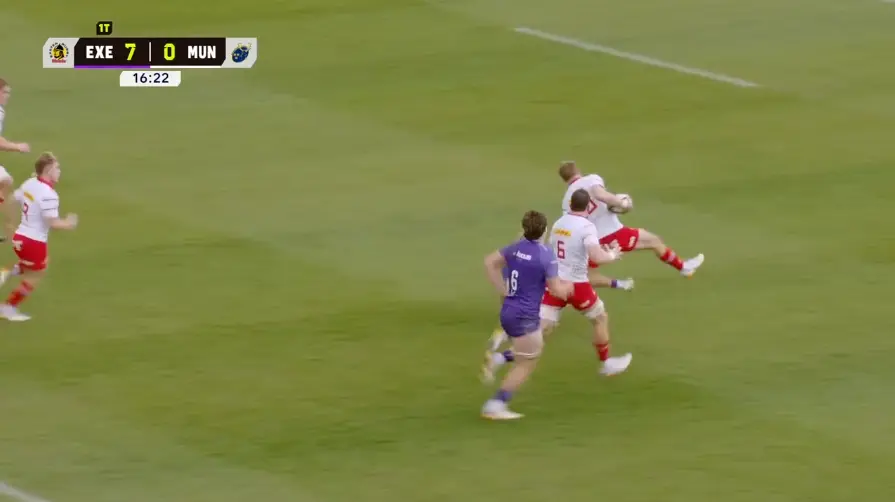
Exeter got a little lucky with the breakdown penalty that followed, but it was an opportunity missed.
From there, we had ample opportunity to settle into the game properly. We knew we’d have a big wind in the second half, so patience was required.
We were using the modified 2-3-3-0 narrow forward shape we’ve implemented in the last few weeks, which alternates into a 3-4-1 on the reverse.
It stacks two players on the blindside, and then runs the forward shape on one half of the field, looking to cut down on errors, commit defenders to the same side of the pitch and then leave a backs isolation on the edges.
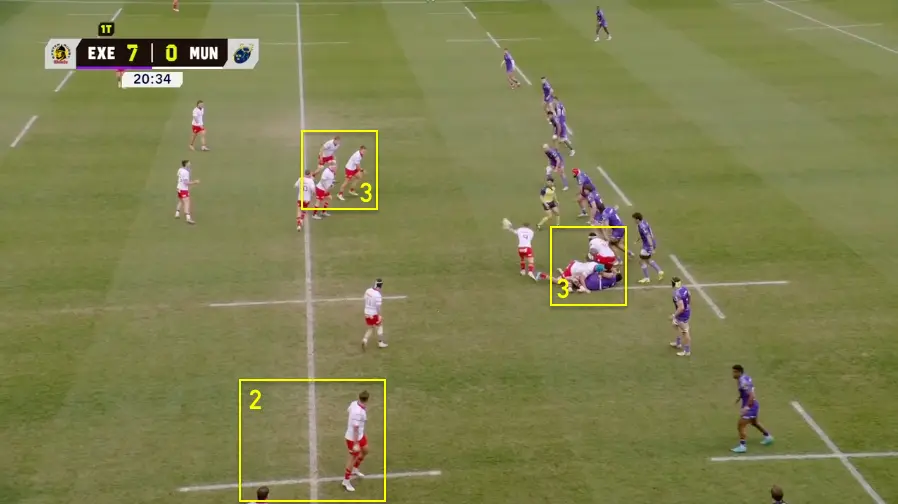
The issue here is that we weren’t dominantly winning collisions, which led to an early release to the openside of the pitch, and our execution deserted us, which lead to the second, killer try off an intercept.
I’ll get to the intercept in a minute, but at a base level, this is a coherent forward structure that gives us workable options, albeit with a few substandard options in important roles.
Why is Lee Barron the lead carrier in the central pod? Wouldn’t Coombes be better there? Why is Loughman the lead carrier in the narrow pod? The narrow tram two-pod of Kendellen and O’Donoghue isn’t necessarily scaring anyone either, or drawing too much defensive attention.
John Ryan, too, isn’t a legitimate carrying option at this range, so the impact in the middle “stage” pod is automatically weaker.
Right before the release to the edge, we had a five-second collision point when Barron got wiped two-on-one, with Coombes and Ryan taken out of the game with the backward movement. Neither man was able to get back to get the ruck done quicker.
Then we went wide to the back’s release, probably a little too early, and ran into a common problem — badly timed lines and handling errors. This was intended to be a decoy screen pinch hit, designed pre-game.
We knew that Exeter had a mix between a blitz and a drift defence, and that they would be incredibly focused on shutting down Jack Crowley. Crowley’s loop line to a wide screen here is designed to draw up Slade, which he does, while the wide structure from the previous ruck was designed to isolate that segment of the Chiefs’ defence.
With Slade and Fisilau targeting Crowley, with Skinner trying to stop Nankivell, that gives Kilgallen a clean, against-the-grain line to attack Rigg, who was naturally stood up by the play.
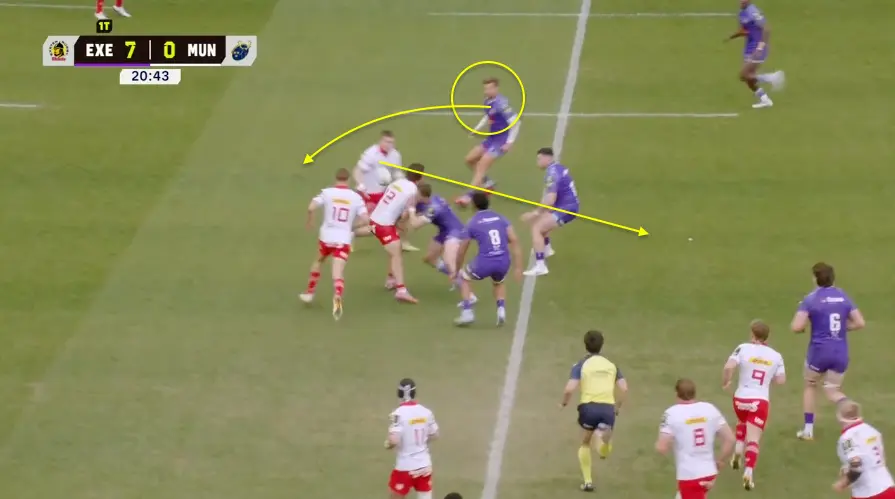
Kilgallen spills the ball, Slade picks it up, 14-0 Chiefs.
There’s no two ways about it for me. That ball has to be caught. Maybe you don’t break the line, maybe you knock on after contact, but you can’t spill that ball in front of the defence. The pass was OK, a little behind but good shape, good height. Kilgallen overran the line slightly, but this error can’t happen there.
At 14-0, we were under massive, massive pressure. At 17-0, that pressure became even more profound.
We worked a decent position, used our narrow shape to gain ground before going too quickly on a release.
O’Connor ran onto a screen ball and made a bad call on the play. Intercept. 24-0.
O’Connor did everything right here, until the pass. That’s the spot he should be in; he should be looking at a pass in that circumstance, but the scramble that came before this phase meant that his only targets here were John Ryan — who Exeter didn’t care about as a carrying threat — or shoot for a 30/70 ball to Kendellen, hunting a linebreak.
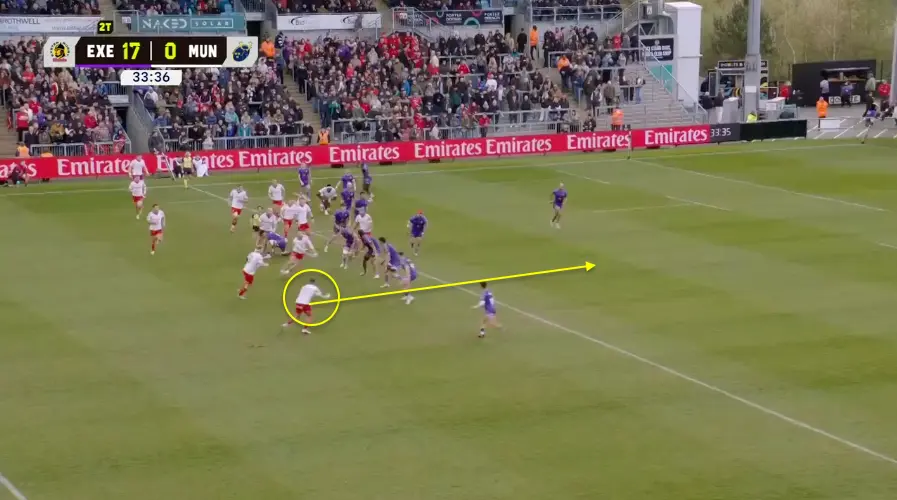
I see what he saw, but Exeter had no reason to hold their blitz here because John Ryan is an immediate turnover threat for Munster in this particular spot. The pass shouldn’t have been thrown at all. A tough lesson for O’Connor to learn, but he will.
Even then, 24-0 wasn’t insurmountable. The lethal blow came right before half-time.
A transition hit up. We over-chased an isolation and couldn’t secure the ruck. Exeter scored on the transition.
I see the intent. Use Crowley on the loop to try to work Kilgallen up the edge, but there’s hesitation in Casey’s pass — he doesn’t know if it’s the right play, I feel — but 24-0 down needs a reply before halftime.
When Nankivell gets stuffed by Fisilau, Abrahams has to secure the ruck against Vintcent, but he can’t. Everything after that is low percentage defence once that pass goes to Feyi-Waboso. Every single defender is trying to make a stop against a power runner from a negative angle. Only Kilgallen and, perhaps, Coombes, should be looking to do better in this instance, but the problem started at the isolated ruck before it.
We chased something to work with in the second half, and instead, the game was functionally lost from that point.
The second half was “better” in that we scored three tries, but Exeter, like Bath earlier in the season, could afford to defend in depth, stand off rucks and use our lack of a full power carry rotation to burn our ruck count and frustrate us.
24-0 might well have been chasable. 31-0, as it turns out, was not.
Why does it keep happening?
We have no confidence. One thing goes wrong, and it seems like half the team think — we’re fucked. One side of the team has no confidence in the other. We can’t slow it down and kick to pressure, because you can tell that the minute a scrum is called, it’s a 50/50 that we’ll be marching back down the field.
And then that often happens, so it’s not an unfounded fear.
We get a decent lineout position to work with, and it’s like we’re so concerned over what comes next that players forget the points before that next thing. We have no maul we can work with, so everyone is half-thinking about getting out into position for phase, phase, phase, phase.
In those phases, we’ve tried to narrow the play to compensate for the attacking failures from earlier in the season, but at key points, those errors still arrive. Are we latching, or is it a screen? It functionally doesn’t matter because unless it’s Edwin Edogbo carrying, we’re losing the collision anyway, so the purported threat of a tip-on or screen is always on the back foot. And the structure that is meant to spring from that can’t function fully either, because nothing is for sure. I lost count of the number of times isolated forwards were smashed two-on-one, with the guys in the pod outside them watching on helplessly.
We’re in a halfway house where we’re trying to react to the problems from earlier in the season, but with the same weaknesses in personnel and the same base concepts running through everything. Do we want to offload? Or do we want one more ruck? Do we want to play narrow, or run through screens?
The narrow shape can work if we can cut out the errors that our “ambition” keeps promoting. Ultimately, we need to figure out what and who we actually are — and fast — to stop the rot.
| Players | Rating |
|---|---|
| 1. Jeremy Loughman | ★★ |
| 2. Lee Barron | ★ |
| 3. John Ryan | ★ |
| 4. Edwin Edogbo | ★★★ |
| 5. Tadhg Beirne | ★★ |
| 6. Jack O’Donoghue | ★ |
| 7. Alex Kendellen | ★★ |
| 8. Gavin Coombes | ★★ |
| 9. Craig Casey | ★★★★ |
| 10. Jack Crowley | ★★★★ |
| 11. Diarmuid Kilgallen | ★ |
| 12. Alex Nankivell | ★★★ |
| 13. Tom Farrell | ★ |
| 14. Thaakir Abrahams | ★ |
| 15. Ben O’Connor | ★★★ |
| 16. Niall Scannell | ★ |
| 17. Michael Milne | ★★★ |
| 18. Michael Ala’alatoa | ★★★ |
| 19. Tom Ahern | N/A |
| 20. Ruadhan Quinn | ★★★ |
| 21. Ben O’Donovan | ★★★ |
| 22. Sean O’Brien | N/A |
| 23. John Hodnett | ★★ |
