




Reading the vibes this week, as I am wont to do, tells me that there isn’t a whole ton of enthusiasm amongst the general Munster audience for the Challenge Cup, knock-out game or not.
It’s seen as a failure. A consolation prize for a damaging Champions Cup campaign in a tough group that saw three losses out of four, topped off with an excruciating defeat at home to Castres in the last round.
A team we should have beaten. A team that all the metrics during the game say we would have beaten. But somehow, we find a way to lose all the same. It’s become a hallmark of this group of players over the last few seasons, and old habits die hard when the pressure comes on.
How else do you explain an opening eleven minutes where we conceded ten points? I spoke in the Blood & Thunder podcast about how, if we went down on the scoreboard early, that this game could get incredibly messy, and that’s exactly what happened. Instead of making Castres check out, we gave them all the encouragement they could want that we were fragile, mentally weak and there for the taking.
A lazy offside penalty. A missed tackle off a maul. Ten points down, and revealing ourselves, once again, to be our own worst enemy.
Worse than that, though, it feels like we’re the only side that turns up to Thomond Park and plays down to the occasion. At the end of the match, the Castres players and their supporters were jumping around with each other in ecstasy while we ambled to the sideline, waiting to clap them off, with the fans streaming out of the stadium.
Just like the Stormers. Just like Leinster.
Like most things in this sport, we are where we deserve to be. That doesn’t mean that nobody cares about this game either — they’ll certainly care if we lose — it’s just that the Challenge Cup comes with a message that you weren’t good enough for the top competition, and that’s a tough pill to swallow. Hard truths always are.
That the form of Castres and Toulon fell off a cliff right after we played them only adds to the frustration, but what this season’s Champions Cup pool showcased quite clearly is that our squad is not where it needs to be.
Not athletic enough, not coherent enough stylistically, and bedevilled by set-piece implosions and uniquely vulnerable to individual brain farts. As I wrote in the Wally Ratings;
With those weaknesses, we play phases for nothing. Ambition for nothing.
That turned a game where we scored 29 points at home — enough to win any game we’ve played this season, and all but two in 2025 — into a loss. We swung for the fences and clocked ourselves in the jaw.
And now we’re in the Challenge Cup.
This season, Exeter have been transformed by the thing that almost always transforms a squad — massive investment in players. This offseason, they signed Andrea Zambonin, Bachuki Tchumbadze, Joseph Dweba, Stephen Varney, Tom Hooper, and Len Ikitau. That has taken them from 9th in the Gallagher Premiership last season to chasing a top-four spot this season.
That shouldn’t be a surprise — better players almost always mean better performances and better results as an outcome. It can be as simple as that.
As a result, they will be a difficult opponent, as they usually are in Sandy Park. Our approach to this game, the mindset we have for it, will dictate a lot.
If we see this for what it is — a chance at silverware that teams like Bath, Toulon and the Sharks have won recently — then we will attack it accordingly. Win here, and we might well be at home in the next round; from there, we can build towards a possible final in May. It’s not what we wanted, but there are only two possible trophies you can chase in any given year, and this is our shot at the one European one we have left.
I think it’s a deeply winnable competition, looking at the teams left in it. At the same time, nobody is looking at Munster right now and feeling the fear; we can change that this weekend.
I’d rate Exeter at a level below Toulon, and similar to Castres, which is to say, they are eminently beatable, even away from home, with the right approach tactically and emotionally. We’ll need the scrum to be more solid than it has been to give us a platform, and a lineout that, at the very least, holds our position when we have it.
Anything close to what we produced against the Bulls will be enough to give us a massive chance. If we can do that without the self-imposed try concessions, we’ll win it.
Time will tell if we’re capable of that.
Munster: 15. Ben O’Connor; 14. Thaakir Abrahams, 13. Tom Farrell, 12. Alex Nankivell, 11. Diarmuid Kilgallen; 10. Jack Crowley, 9. Craig Casey; 1. Jeremy Loughman, 2. Lee Barron, 3. John Ryan; 4. Edwin Edogbo, 5. Tadhg Beirne (c); 6. Jack O’Donoghue, 7. Alex Kendellen, 8. Gavin Coombes.
Replacements: 16. Niall Scannell, 17. Michael Milne, 18. Michael Ala’alatoa, 19. Tom Ahern, 20. Ruadhán Quinn, 21. Ben O’Donovan, 22. Seán O’Brien, 23. John Hodnett.
Exeter: 15. Olly Woodburn; 14. Paul Brown-Bampoe, 13. Henry Slade, 12. Will Rigg, 11. Immanuel Feyi-Waboso; 10. Harvey Skinner, 9. Stephen Varney; 1. Scott Sio, 2. Jack Yeandle, 3. Jimmy Roots; 4 Dafydd Jenkins (c), 5. Andrea Zambonin; 6. Tom Hooper, 7. Ross Vintcent, 8. Greg Fisilau
Replacements: 16. Joseph Dweba, 17. Ethan Burger, 18. Bachuki Tchumbadze, 19. Rusi Tuima, 20. Finn Worley Brady, 21. Tom Cairns, 22. Will Haydon-Wood, 23. Campbell Ridl
Stylistically, Exeter are quite similar to what they always were at their best; a narrow, possession-based team who look to break you down up front through repeat, hard-to-turnover phase play, and who consistently look to attack on turnover ball and kick returns.
The tactical breakdown is simple; they want to boss possession and then, when you look to off-ball them, kill you with pace and evasion post-kick, with a decent — but not elite — lineout and scrum. Their maul, as always, is hugely efficient from anything inside 10m.
If I were to give them an easy-to-visualise label, it would be that they are like a narrower, slower version of the Glasgow Warriors with way less pace at the ruck — because they play much narrower — less variety off #10, a less reliable set piece, but every bit as dangerous in transition and off the maul.
As for their approach here, it won’t have missed their attention that we are incredibly ropey at the scrum as it stands, so they may look to bump their kicking game off the back of that, but the presence of Casey and Crowley will give them pause on that — if our post-transition game is as good as it can be, we have a workable way to off-ball them directly.
Kicking-wise, what worked against the Bulls in Loftus Versfeld should also work here, and the challenge we face from a stylistic perspective is broadly the same.
One area we really match up well with them is our ability to deny momentum in tight channels through our two-man stops, but also our jackal threat in those spaces. The more numbers they have to resource on each ruck, the more threat we have on the next one; that nullifies a lot of their base game, but as with the Bulls, we have to be careful with penalty ladders up the field for offside on their narrow carries, and for getting trapped in the collision.
This is a good example of what Exeter like to run, stylistically. Tight runners, working in a short space, looking to get a narrow punch through the middle or force a compression that they can release to their pace on the edges.
They do compete quite a lot in the air, and they’re usually pretty good at it too — they contest a lot, and retain a lot.
A lot of their phase play offence is designed to bait offside penalties as the pillar and A defenders jump early to get an edge on those narrow carries. This is a good example.
Once they have the advantage, they look to go through the edges where you’ll see a kick to pressure, or an attempt at a killer offload.
They’re really dangerous off their setpiece strike plays — scrum, lineout and maul — so we’ll have to be really dialled in on the edges and the inside ball, because it’s most often sent to those zones; the flank of the maul or scrum on second phase, or wide-wide to catch out a bad read by a winger or midfielder.
Defensively, Exeter switches between a blitz and a drift depending on the read. They aren’t solely a drift and cover team, in the way the Bulls were, but they tend to drift more than they blitz.
You’ll often see them drifting on wide-position rucks like this.
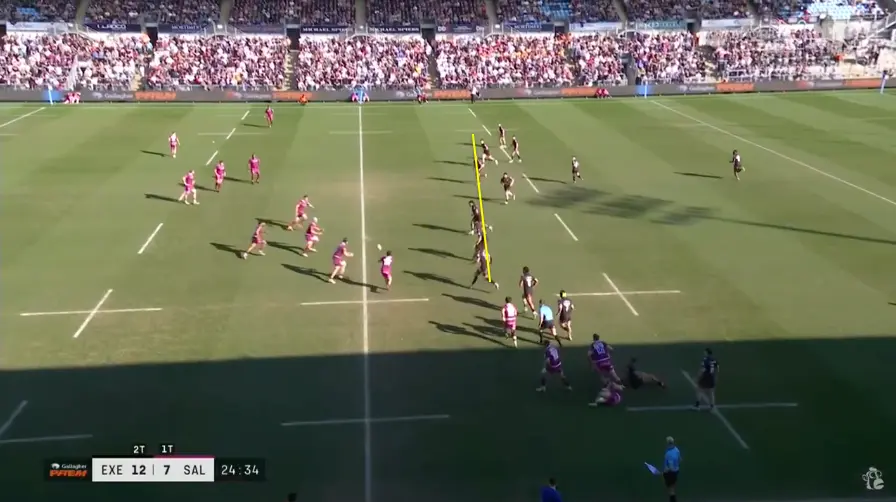
We can work with that.
Especially with the wingers we’ve selected. I think it’s fair to say that Kilgallen and Abrahams haven’t had a very complete first one and a half seasons at the club outside of some excellent individual games, but what they do have — both of them — is killer speed.
That can be very useful against a side that likes to mix and match between blitzing and drifting depending on the zone.
We’ve had a real issue converting our offloads into linebreaks this season, but with that speed on the edges, against the right defence, they can be lethal if we can work them into a position to be lethal.
