


The first thing you notice about James O’Leary is that he’s an absolute tank of a young fella. I first spotted him as a fifth-year playing for PBC in the Munster Senior Cup. What struck me was that he was arguably bigger, broader, and more physical than many of the forwards playing that entire year, as a fifth-year student. That’s not all that remarkable in the grand scheme of things; rugby attracts big guys, as you know. But what was remarkable was that he was as big as he is and playing in midfield.
The temptation for any school or underage team is to put a guy like O’Leary somewhere in the back row, or try to convert him to hooker or prop.
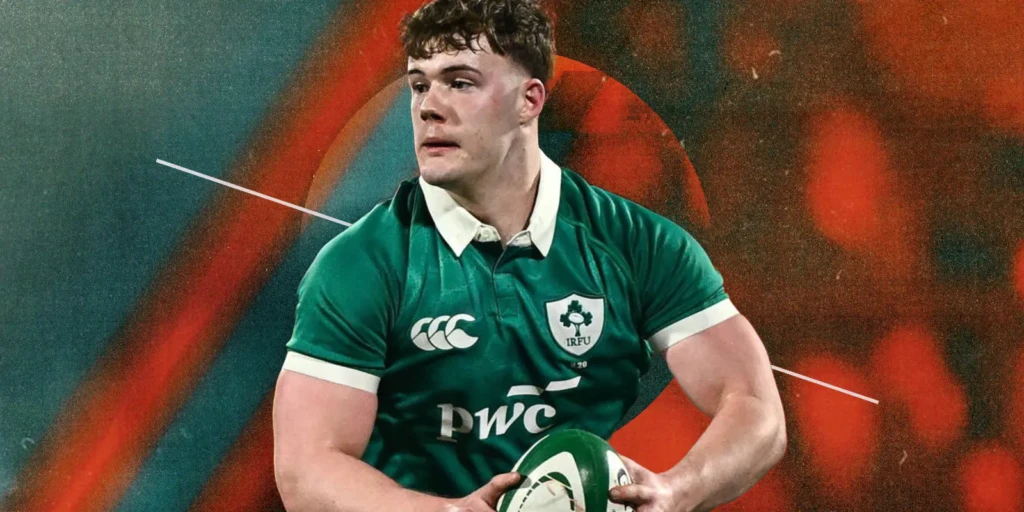
But PBC — coached by the excellent Ger Burke — resisted that obvious temptation, and I think James O’Leary is an infinitely better player and prospect as a result.
He was ever present for the Irish 20s this Six Nations as the starting inside centre, and consistently impressed with his physicality — obviously — but also with his ability as a ball player.
In O’Leary’s second year in the Munster Senior Cup with Pres, I was really taken by how restrained Pres were with using him as a direct ball-carrying target. Again, that would have been easy. Instead, Burke and PBC challenged O’Leary’s ability to use the compressions he forces naturally as a ball handler.
It arguably led to a less impactful campaign for O’Leary overall — you get a lot more attention when you run guys over — but it really rounded out O’Leary’s game coming into his year playing adult rugby with UCC, and then into his 20s.
Ger Burke took a guy who could have been a backrow, who could have been just a crashball guy, and turned him into a far more interesting prospect, and it’s a credit to the player himself that he met every challenge along the way. It would be easy for a guy built like O’Leary to lean into what he’s good at and keep it there; a smart player, a guy with his eye on higher-level rugby, knows he can’t just be one thing as a modern midfielder.
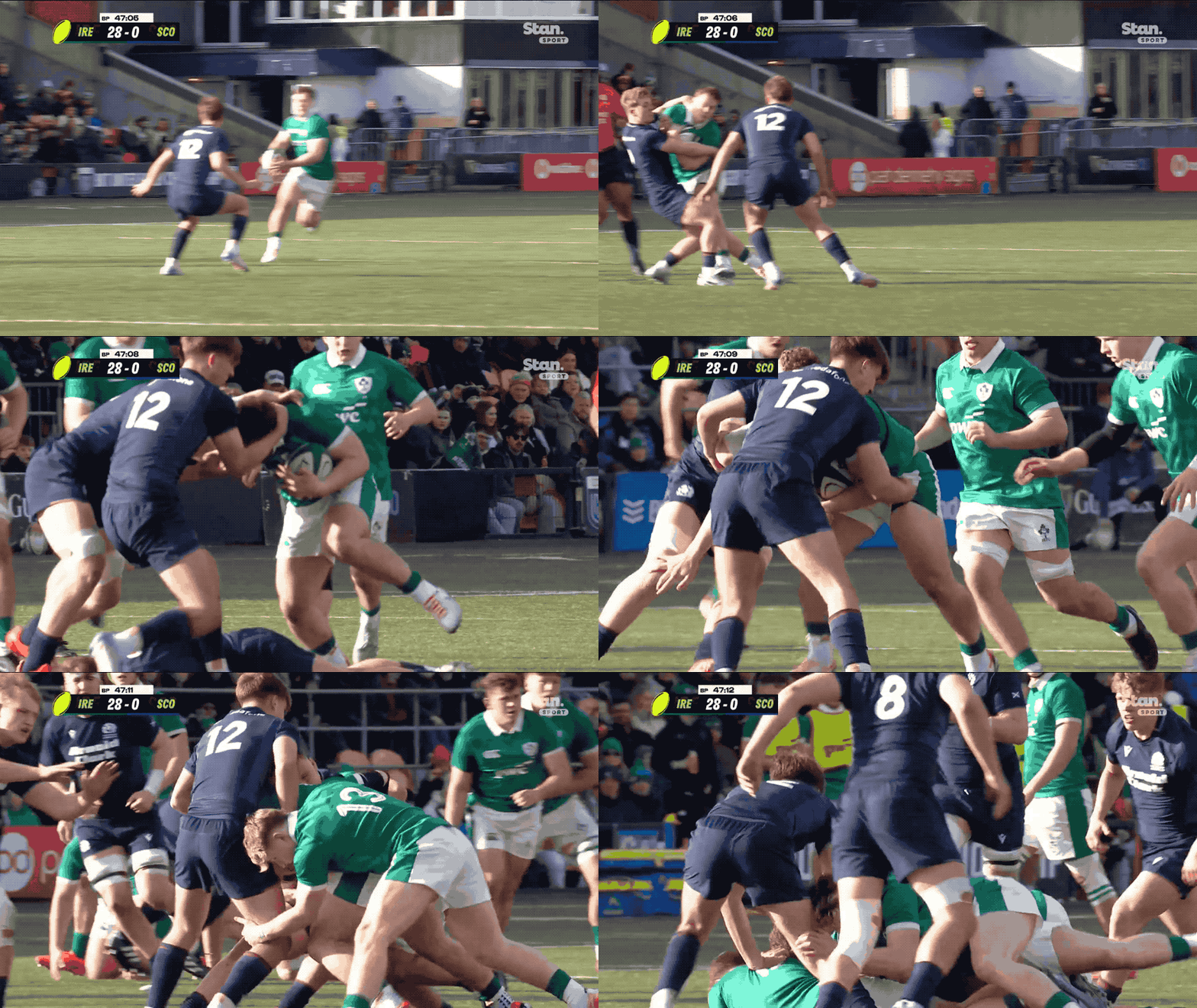
At a base level, O’Leary’s best game is based on gravity — he’s really strong at playing as the lead runner in a triangle.
He was executing this pull back passes and tip-ons for the entire Six Nations, dovetailing incredibly well with Rob Carney and Tom Wood. I used this compilation for Tom Wood’s Young Bucks article, but it would equally apply to O’Leary, as he’s the pullback passer and compression guy for the majority of the best work here.
He’s also really comfortable stepping in at first receiver, with a crisp pass off his left side, albeit he doesn’t look as confident slinging it at distance off his right side.
You’ll often see him reject the pass option off the right side for a cut back into carry, so it’s something of a work-on, but one that should be easily remedied. Even then, hitting contact is rarely a bad idea for James O’Leary.
He’s got a low centre of gravity, massive leg drive and enviable upper-body strength, as well as an aggressive, abrasive style. Off scrum or lineout, or a reset from the second layer, or as a lead on a triangle, he consistently makes ground, gets over the gainline, and draws defenders.
Defensively, he’s really strong in direct contact and over the ball, as you’d imagine. He’s got the build of a heavy openside, and he uses that to be a proper threat over the ball.
He does tend to get a little compressed on the direct threat off lineout and scrum, and can struggle to adjust across, but that will come with more experience and as he builds out his engine as a professional midfielder.
As much as any other position, midfield probably has the highest combination of cognitive and physical load. For a guy in O’Leary’s general role set — an impact hitter — he’s expected to have the carrying physicality of a #8 off the set piece, the defensive coverage of a traditional openside, with the offensive and defensive breakdown work to go with it, as well as the handling of a ball-playing midfielder, and across the full 80 minutes.
His closest player comp, for me, is Bundee Aki. He’s got a lot of similar qualities — core skills, physique, and aggression.
That will take time to adjust to at full professional level — the speed and intensity of the URC and beyond is a world beyond AIL and under 20s — but he’s got all the tools to do just that. He’ll go into the Munster academy this summer, and what I’ll be really interested in is how he responds to the full rigour of professional S&C. He’s a bit of a freak athlete as it stands; he could be something really special.
