


What does “pride in the jersey” actually mean?
It’s a nebulous thing. On the one hand, it’s just a jersey. No more meaningful than any other bit of kit. On the other hand, it’s what the jersey represents. It represents everyone who wore that jersey before you, and everyone who will wear it after you’re gone.
That red jerseys means something. It doesn’t always mean winning, because no team can win every game. It means you fight to win every game.
This week, Munster fought, clawed and scrapped for everything against a good side away from home… and lost. There’s no shame in that. It’s all anyone can really ask on any given day.
That we were, for large stretches, the architects of that loss is neither here nor there. We never stopped fighting for the points we needed, for each other or for the jersey.
In doing so, we came away with two points that will be absolutely vital to our URC campaign, and turned a tour that looked like it could be a complete washout into something that can be put into the rear-view mirror with something to build on.
Not much, not what was ideal pre-tour, but something.
These two tour games can be separated quite clearly: those with Jack Crowley and Craig Casey, and those without.
This should not be unusual. Munster are uniquely reliant on Crowley, Casey and Beirne to make large swathes of our ideal game work with and without the ball. At this stage of our squad development, almost everything good we do is rooted in these three players. When they are not there, levels drop in ways that are both quantifiable and unquantifiable.
The unquantifiable part is harder to nail down. They drive standards, they show moments of leadership, big and small, and probably most importantly of all, they instil confidence that isn’t there when either. You can’t fake confidence in your halfbacks, and when Crowley and Casey are there, you don’t have to.
The more quantifiable part of their game is what they produce moment to moment, phase to phase. Their pass quality, variety, physical impact and tempo are on a different planet to the lads backing them up.
Here’s a good example.
Before the game, I wrote about the Bulls defending with a flat drift, rather than an aggressive outside blitz and how it would suit our attacking style when Casey and Crowley were playing.
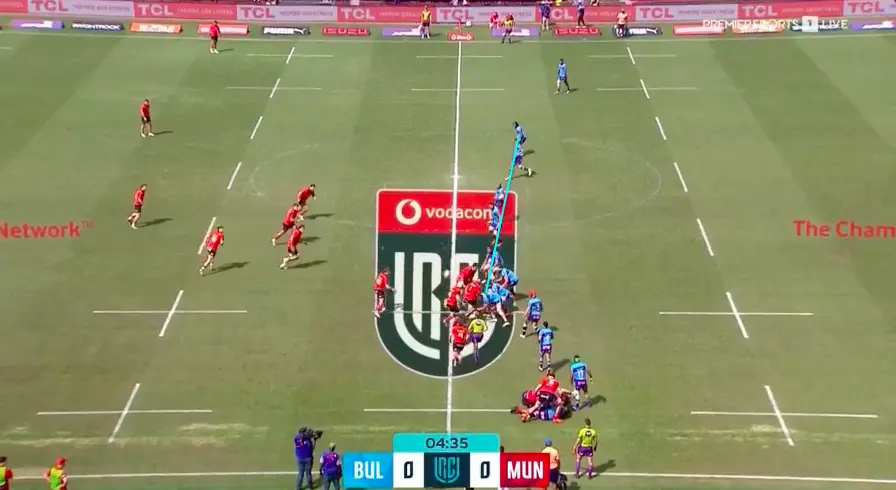
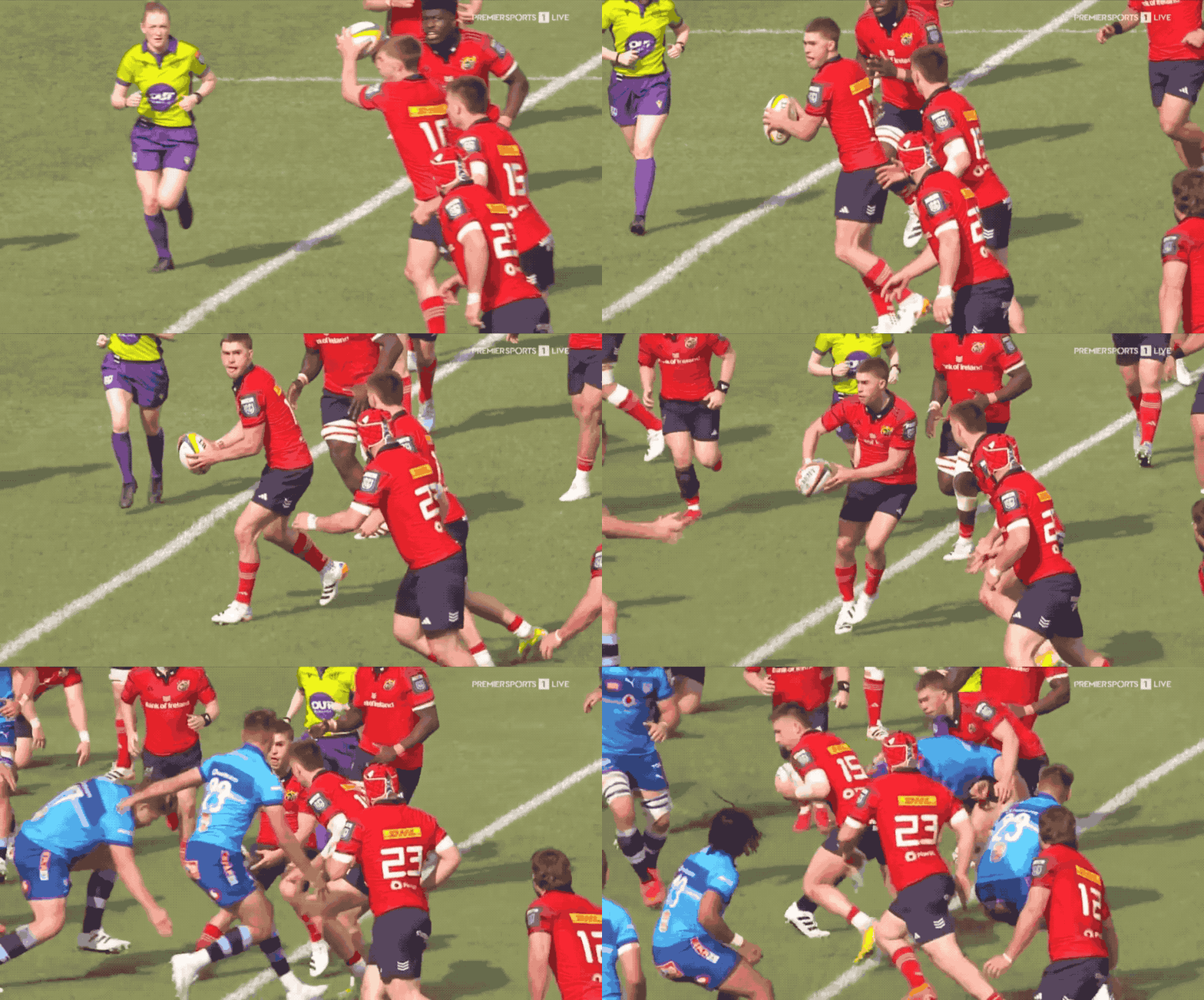
You can only activate that properly against the Bulls’ size if you have top-class passing quality from #9, and a multi-vector threat at #10.
Milne doesn’t have to adjust his body to take this pass on the run, so he can get it across his body perfectly for the screen pass.
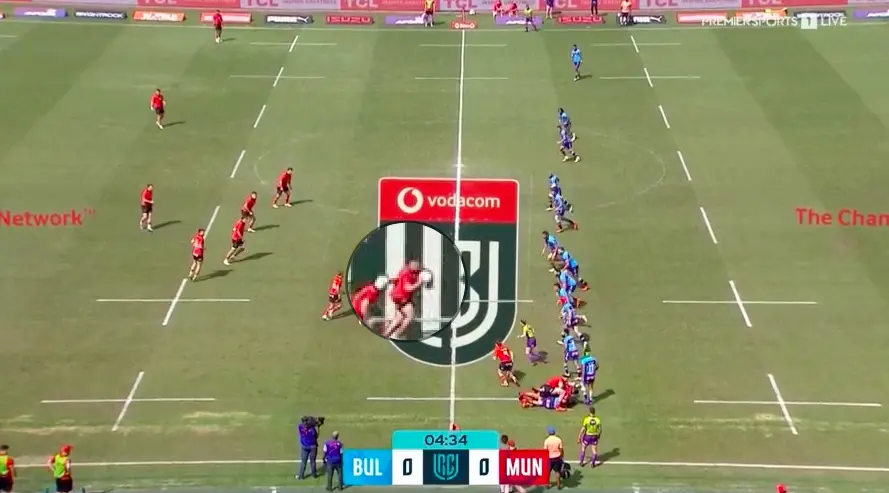
Crowley’s running threat draws the defender in, which opens up the short ball option to Gleeson. If that’s Hanrahan, you don’t need to worry about that carry inside off the screen pass, but with Crowley you do.
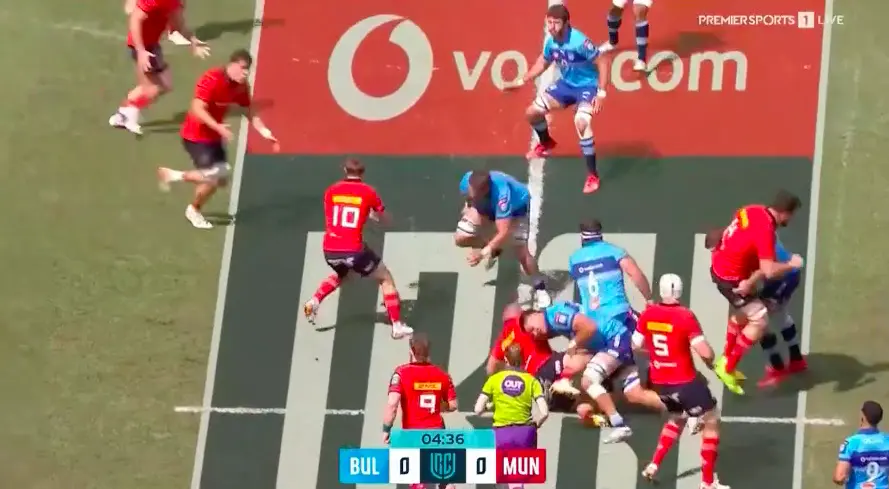
When we run the play through, we see it very clearly in the next phases, too.
And, because the Bulls are still flat, it gives Crowley the space to make a play on the fly, which he does really well, off the back of more quick, excellent tempo from Casey after the linebreak.
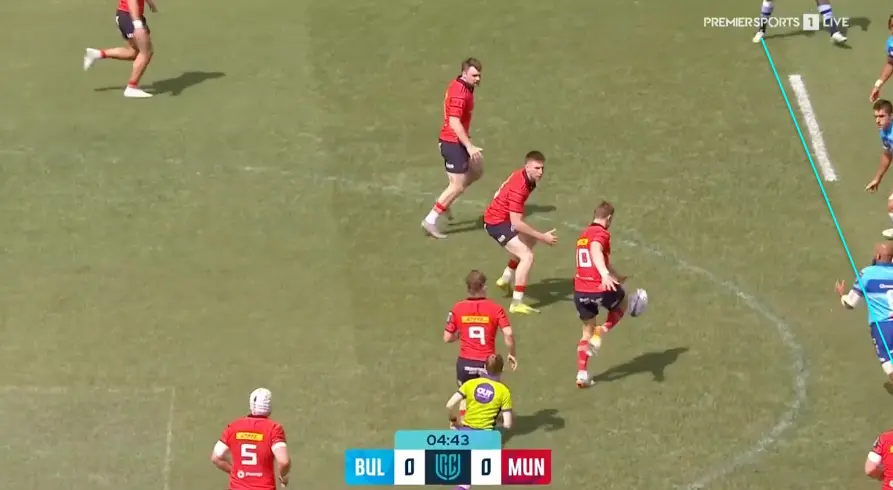
It’s hard to overemphasise how much easier things are when the pass selection and pass quality off #9 are this good, and when you have a true multi-vector threat at #10.
Here’s another good example. Watch Casey’s passing, and how often it hits the ball carrier on the run, and how that then empowers Crowley to make a read.
When you’re a team that attacks on small margins, those margins exist in the quality of your passing and service off #9, and how that then empowers #10 to use his running threat and game IQ to unlock the opportunities that come from it.
Our first try was built on it. Nankivell doesn’t have to adjust to run onto this pass, so it’s a better, punchier carry.
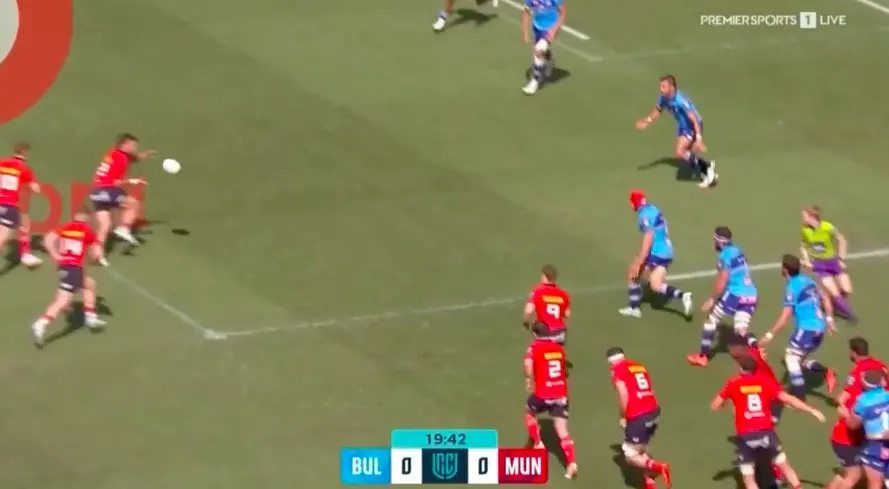
Gleeson doesn’t have to adjust to take this pass, so he can get it across his body cleanly with Ahern remaining a possible target until after the ball is gone.
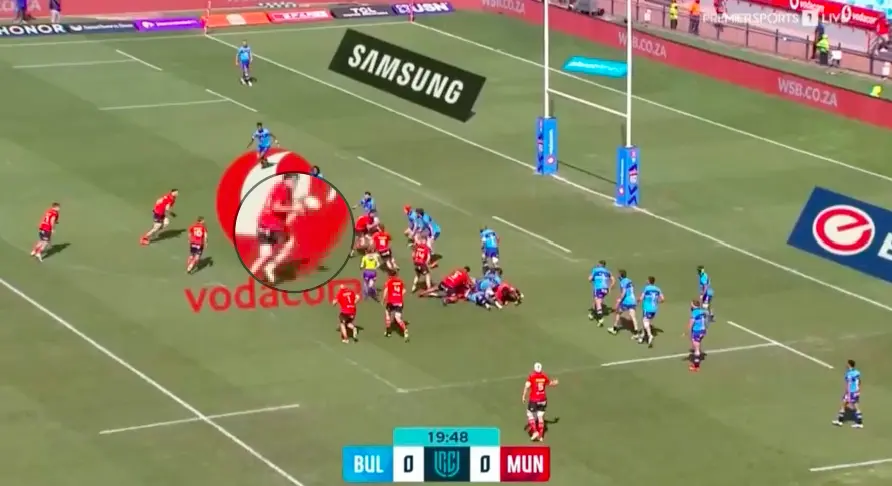
And that means Crowley is in a position to manipulate Moodie on the edge with a pump fake, before putting Kendellen clear to get the finishing pass away to O’Brien.
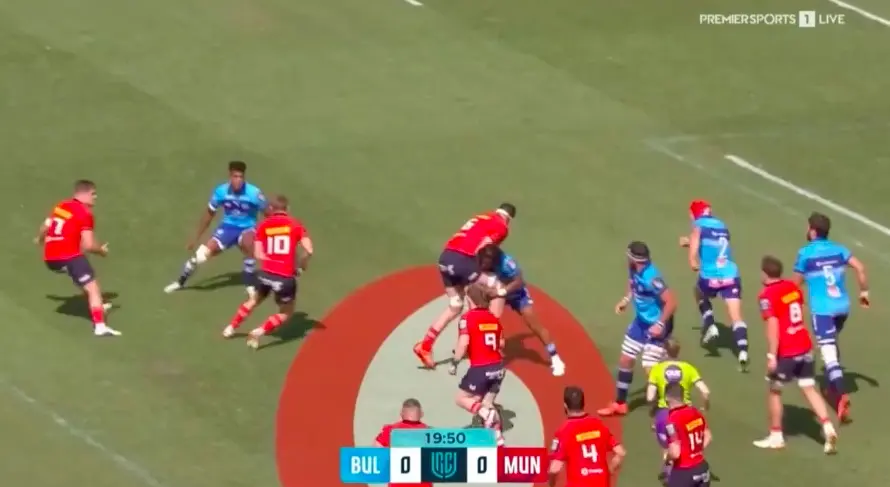
It looks simple, but it isn’t. This is the difference that your best players make for you when the team is built around what they do well.
That was empowered by a smart exploitation of the Bulls’ main weakness — contestables into the backfield. I wrote about this pre-game too, and Munster went right after it immediately and consistently, for huge gain.
Watch them enough this season, and you’ll see that aerial duel issue over and over again…
So that’s my starting point. Kick contestables off #9 and #10 at a pretty high volume, contest absolutely everything and then try to swarm the drop before their forwards get back in line, which you can do almost every time, especially if you launch away from the set piece.
All of a sudden, we were right in the game, before errors crept in. We gifted the Bulls three tries.
A scrappy maul build that had Ahern covering a break by Papier — high risk. A knock-on under zero pressure after a scrappy lineout leads to a turnover try — avoidable. A forward running a badly timed pinchline knocks a pass meant for Nankivell out of the air and right to a Bulls player, who kicked through for a foot race between Papier and Hanrahan — bad luck.
This kind of thing has undercut us all season long; we’re particularly vulnerable to individual errors like this.
The only structural one was Papier’s first; we matched up our back row off a shortened Bulls lineout, with a late switch out to match Gleeson with Coetzee.
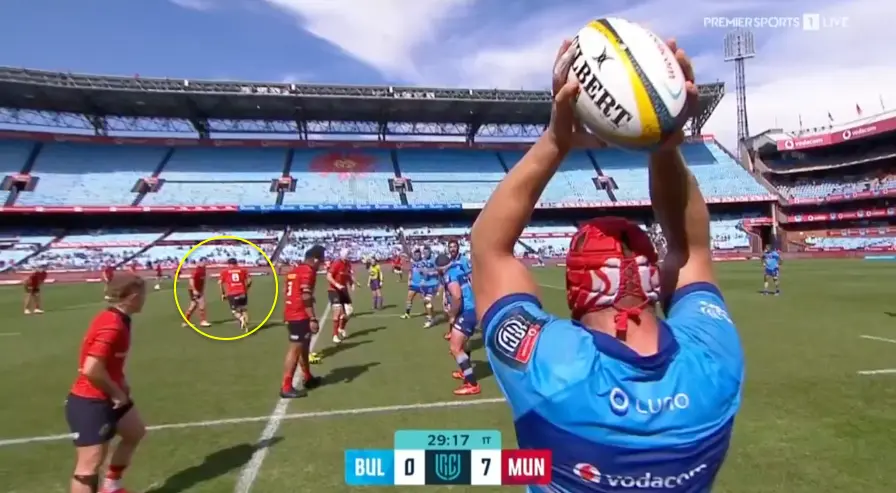
As the maul developed — again with a blown half-lift at the front from Ala’alatoa on Kleyn — Ahern ended up defending the flank of the maul, which is far from ideal with the pace of the Bulls off the break.
Ahern gets stepped by Papier on the break, but that was always likely to happen — a 6’9″, 120kg lock getting cut up on the inside by arguably the fastest, most nimble runner on the pitch outside of Arendse.
The others were bad outcomes piled on bad outcomes.
Could Nankivell have tackled a bit lower on Gans here? Absolutely. But we knew coming into the game that the Bulls offload a ton — especially in this very scenario — so we would have to tackle high to try and disrupt that.
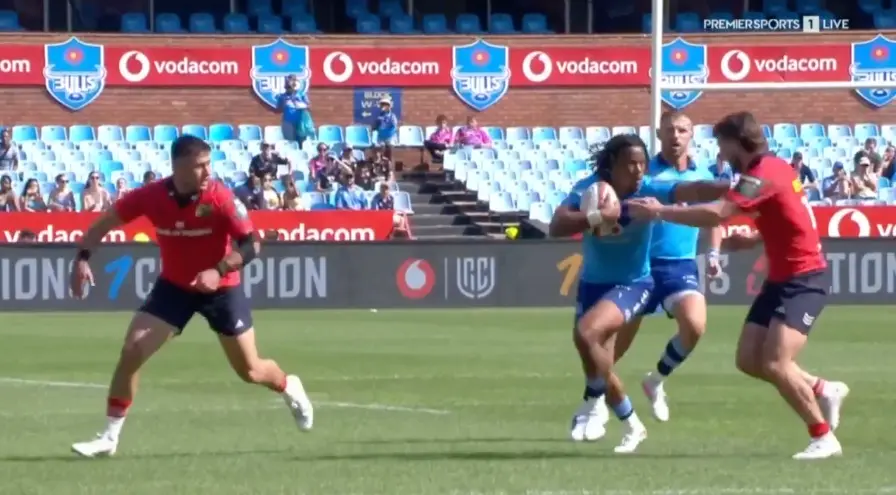
The real damage was done after the knock-on, which led directly to this picture right here; everything after this was going to be at increasingly lower percentages of execution when it came to getting a stop.
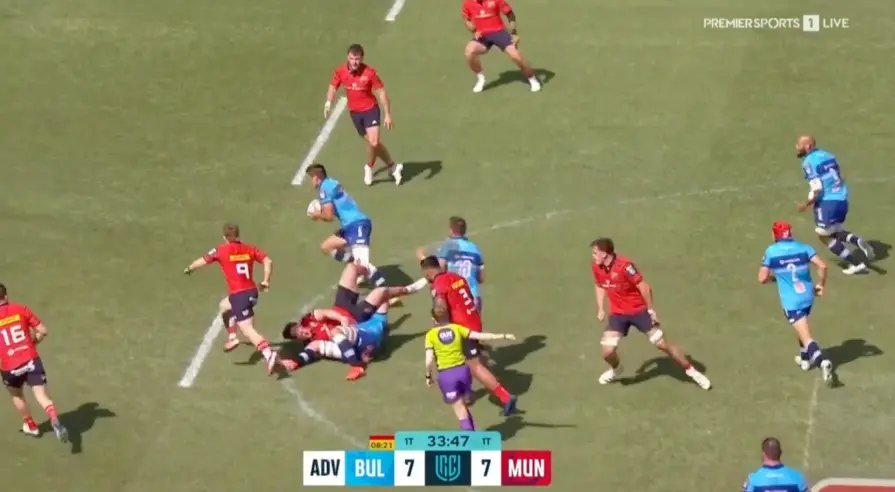
In fairness to Gleeson, I think he was in two minds as the ball neared his hands because there was a huge opportunity outside of him. A tip on to Kendellen probably leads to a linebreak, but a pullback to Nankivell likely leads directly to a try or a very dangerous linebreak.
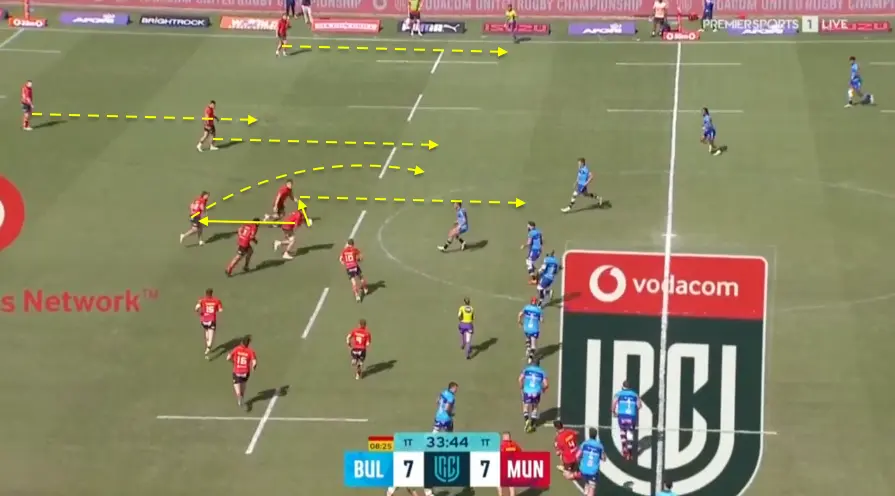
But we didn’t let these errors get us down.
Right after half-time, we cut up the Bulls directly. This is our 3-3-X shape working exactly as intended, with the added booster of playing against a drift defence.
Look at the pass quality from Casey to Ahern, and how that empowers Ahern to make a better pass to Crowley.
Look at Crowley’s pass execution across the line to the space.
Kendellen and Sean Edogbo power through; we have the quality to finish. Efficient. Incisive.
And it kept us in touch.
A close-range Ahern try — his second — got us right back into the game before we got stung off a Bulls lineout strike. Nankivell got it in the neck for this on comms, but have a look at the key moment and see where you think the issue started.
If Kendellen goes after the ruck here, then the inside has to fold across to give Nankivell the go to push out onto the Bulls’ pod loaded around the corner.
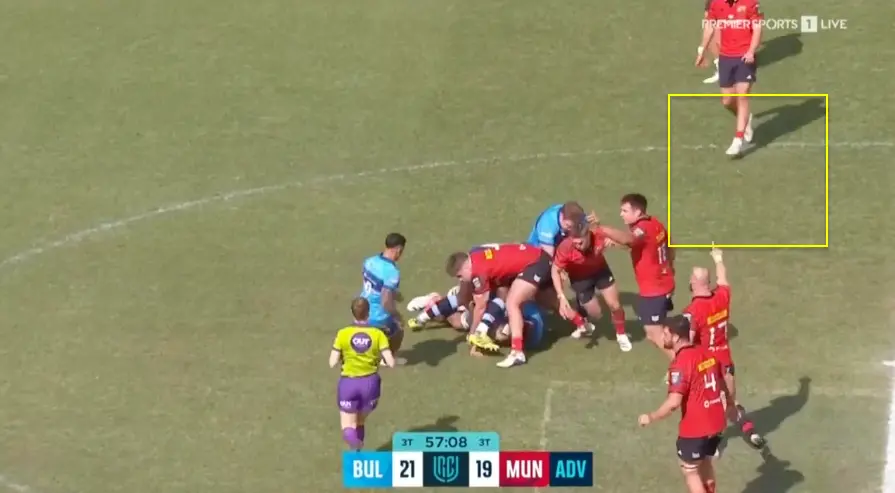
With that pillar empty, Nankivell has to cover Papier AND then also cover the outside pod.
So he’s here, instead of being two or three steps further out, which would also allow Kelly to cover the space more directly.
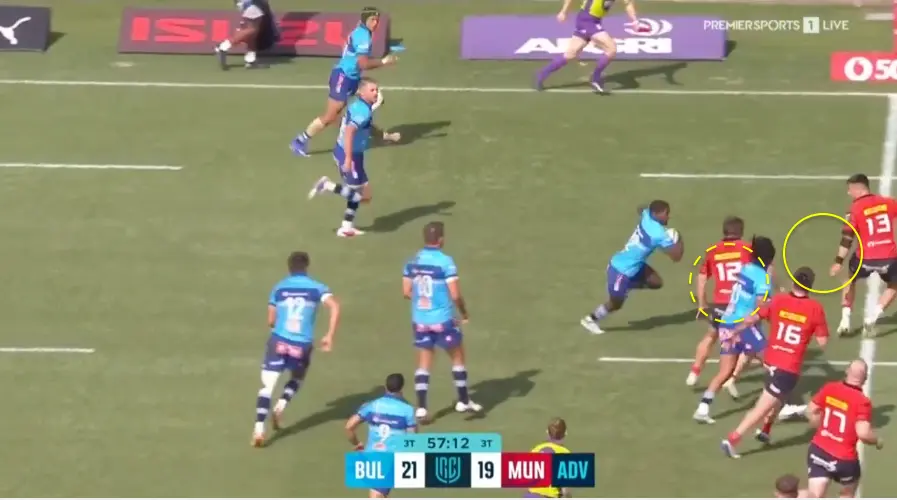
Against elite speed on hard ground, there’s no possibility of recovery after the break.
After that, we were stung by two penalties. One deserved for a miscommunication that led to a clear obstruction, which Pollard converted from the halfway line.
In between, Jack Crowley cut up the Bulls again to put O’Connor away for our bonus point try.
Again — look at the deception on the pass, the pump fake to draw the blitz and then the timing of the run inside from O’Connor.
Loughman was penalised for coming in from the side of the maul a few minutes later, and Pollard converted that one too. It felt harsh enough watching it live, but it seemed fair enough on the watchback. A good Bulls lineout to the tail left a scramble that Loughman was almost illegal on by default.
34-26.
But we never stopped scrapping.
The Bulls knocked on the restart, and we had a great scrum launch position. Kendellen and then Sean Edogbo made two huge carries to get us into position.
From that position, Edwin Edogbo eventually powered his way over to make it a one-score game, before killing a maul a few minutes later to give us a shot to win the game.
But we weren’t accurate enough. A pass didn’t go to hand, Hanrahan kicked for position, but we conceded a 50/22 soon after — a little like last week against the Sharks.
We stopped the Bulls’ maul — which secured the losing bonus point — and the game was done, but there was so much to take from this, other than the hugely valuable two points.
What we showed here is that, with Casey and Crowley — and Beirne and Jager to come shortly — we are a good side that can go to tough places like Loftus Versfeld and come away thinking that, without the 21 points we conceded through errors, we’d have had enough to win this game.
We showed that while what happened against the Sharks is us at our worst, this is what we can be when we’re decent. If we can cut out the mistakes and do something with the scrum — Jager will help — we can show what we’re like when we’re firing on all cylinders, and that’s a team that’s infinitely better than we’ve shown for the last four months.
Of course, cutting out the mistakes and fixing the scrum are the hard parts, but there’s talent in this squad. If they can get a consistent belief to go along with that, belief in our halfbacks, belief in our set piece, we have the firepower to hurt absolutely anyone.
| Players | Rating |
|---|---|
| 1. Michael Milne | ★★★ |
| 2. Diarmuid Barron | ★★★ |
| 3. Michael Ala’alatoa | ★ |
| 4. Jean Kleyn | ★★★ |
| 5. Fineen Wycherley | ★★★ |
| 6. Tom Ahern | ★★★★ |
| 7. Alex Kendellen | ★★★★★ |
| 8. Brian Gleeson | ★★★ |
| 9. Craig Casey | ★★★★★ |
| 10. Jack Crowley | ★★★★★ |
| 11. Sean O’Brien | ★★★★ |
| 12. Alex Nankivell | ★★★ |
| 13. Dan Kelly | ★★★ |
| 14. Calvin Nash | N/A |
| 15. Ben O’Connor | ★★★★ |
| 16. Niall Scannell | ★★ |
| 17. Jeremy Loughman | ★★★ |
| 18. John Ryan | ★★★ |
| 19. Edwin Edogbo | ★★★★ |
| 20. Sean Edogbo | ★★★★ |
| 21. Paddy Patterson | DNP |
| 22. JJ Hanrahan | ★ |
| 23. John Hodnett | ★★ |
As performances from your halfbacks go, it doesn’t really get much better than this. Craig Casey, as captain, would have had a lot of pressure on him coming into this game. As much as anyone else, Casey is the heart of this team. Technically, of course, his pass quality and consistency are leaps and bounds above most scrumhalves playing the game at the moment, never mind in our squad, so that, coupled with his pass selection, kicking game, and IQ, is always going to be vitally important.
Like putting the right fuel in your car.
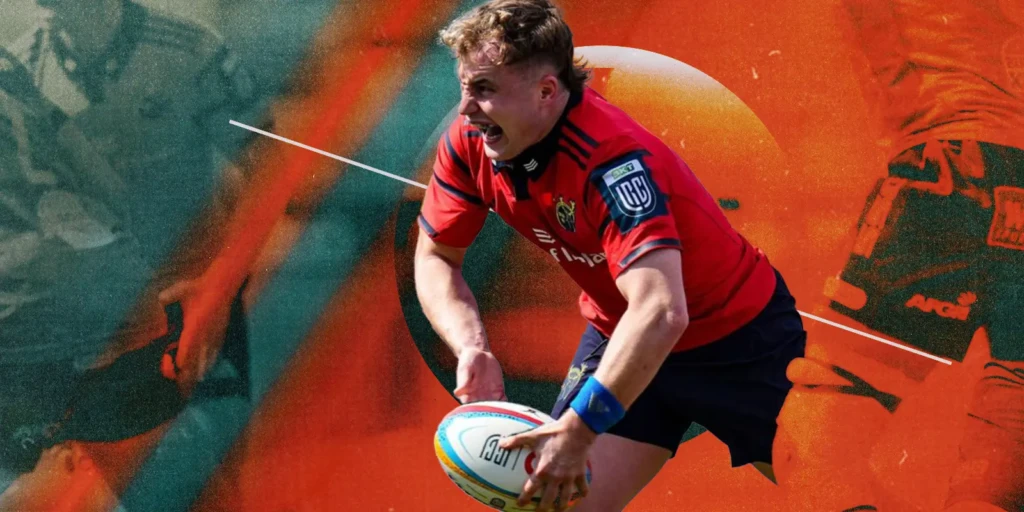
We are a better team with Casey playing, and that’s an indisputable fact. Equally as important is his presence as a leader. It’s another nebulous term, but I think at a basic level, a good leader is someone whose presence makes everything better. A bad leader, on and off the pitch, is someone around whom everything gets worse.
To describe him as vital to this squad is somehow underselling it.
Jack Crowley had the type of performance that screams “higher level”. There was focus on the two missed kicks off the tee — neither was a gimme, by any stretch — but I’ll put it like this: if it wasn’t for Jack Crowley, we’d have been nowhere near in this game. He’s come back from the Six Nations with his confidence absolutely pumping out through him, and it shows.
He’s playing with the kind of assurance of someone who has decisively won the biggest #10 debate in the last 15 years with room to spare, and Munster will be the beneficiaries.
Alex Kendellen had a superb performance here, arguably the best I’ve seen from him in a few seasons. The talent is plainly there with Kendellen. He was the best player of his generation of the 20s, and he had the kind of breakout year at Munster that young players dream of, but the kick on to the next level hasn’t happened for him — yet.
On the evidence of this game, he’s starting to pull all the threads together. Playing in a small forward role demands an immense skill set and physical conditioning. You’ve got to be able to pass like a midfielder, hit the line like a classic #8, you’ve got to have a lineout game now, too, and you’ve got to have ridiculous defensive output. Kendellen has all of those, but he needed to show the step-up physically. He showed a ton of that here, with huge ruck involvements, lethal chop tackling and really smooth handling post linebreak with two huge moments that led directly to tries.
He’s also not one bit shy about being an absolute hoor to play against for 80 minutes, too, which is great to see.
