



Last week was bad, but nobody is pretending it wasn’t.
Playing in South Africa is a place where your margin for error is tiny. Each minute you spend making mistakes or not capitalising on opportunities makes the next five minutes more difficult.
When you produce a stinker of a second half like Munster did last week — to follow on from a slightly less pungent first half — all you have is errors. Losing collisions, getting pumped in the scrum, lads trudging up and down the pitch, lineout imploding; you can’t win any game anywhere in this sport like that, unless the opposition are somehow doing all of those things worse than you are.
You are rarely that lucky, and we certainly were not.
For the most part, when you’re on tour, the first game is almost always the hardest. That’s when you feel the travel more acutely, the hotel life a little more sharply, and then you have a game against colossal human beings at the weekend.
By the second week, you’re a little bit more comfortable, but that doesn’t fully apply when you’re playing at altitude, as we are this weekend and, as the Bulls will tell you — over and over again — altitude matters. They have a sign and all.
But that doesn’t really matter.
We have business to take care of.
The top eight — and even the top six or higher — is still very much in our grasp, and our target of five points is still there to hit. That means a bonus point win here, which seems unlikely on Wednesday morning when I started writing this, but we can do it.
After last week’s poor performance and the loss that came with it, it’d be easy to wallow, but we can’t afford that, in more ways than one. We have to produce the kind of fight that this province became known for in the next few weeks, starting this Saturday.
Bite down on the gumshield, antlers down, stags up.
Munster Rugby: 15. Ben O’Connor; 14. Calvin Nash, 13. Dan Kelly, 12. Alex Nankivell, 11. Seán O’Brien; 10. Jack Crowley, 9. Craig Casey (c); 1. Michael Milne, 2. Diarmuid Barron, 3. Michael Ala’alatoa; 4. Jean Kleyn, 5. Fineen Wycherley; 6. Tom Ahern, 7. Alex Kendellen, 8. Brian Gleeson.
Replacements: 16. Niall Scannell, 17. Jeremy Loughman, 18. John Ryan, 19. Edwin Edogbo, 20. Gavin Coombes, 21. Paddy Patterson, 22. JJ Hanrahan, 23. John Hodnett.
Vodacom Bulls: 15. Willie Le Roux; 14. Canan Moodie, 13. Stedman Gans, 12. Harold Vorster, 11. Kurt-Lee Arendse; 10. Handré Pollard, 9. Embrose Papier; 1. Gerhard Steenekamp, 2. Johan Grobbelaar, 3. Francis Klopper; 4. Ruan Vermaak, 5. Ruan Nortje ; 6. Marcell Coetzee (c), 7. Elrigh Louw, 8. Nizaam Caar
Replacements: 16. Marco van Staden, 17. Jan-Hendrik Wessels, 18. Khutha Mchunu, 19. Cobus Wiese, 20. Cameron Hanekom, 21. Zak Burger, 22. Cheswill Jooste, 23. David Kriel
The Bulls, much like the Sharks this season, have been somewhat more inconsistent than you’d normally expect from them. This is, on paper, our hardest game of the season. Away in Loftus Versfeld is a nightmare for pretty much everyone. This season, however, the Bulls have been trying to expand their game away from the kick-and-grind pressure of the last few seasons under Jake White.
Johann Ackerman, who took over from White in the summer, has been implementing a new, more expansive style to the Bulls, and that has brought more unpredictability to their game than we’re used to.
It makes sense; they certainly have the size in the middle of the pitch and the pace on the edges to make it work, as well as having a scrum that can bail them out of most of the errors that have come with that expanded game.
No team in the URC has more touches per error this season than the Bulls, but when you have a massive scrum that’s rock solid on their own ball — best across the European leagues — and all the other positives that overwhelming size and punch give you.
But.
Their other changes have caused them more problems than they’ve been comfortable with.
For a start, they’ve moved away from an aggressive blitz to a more passive, drift-and-cover defence to save their forwards’ legs, and have drastically reduced their kick volume. Their dominant tackles have dropped, their jackal attempts have gone up, and they use everyone else to cover the ground on the outside.
When you move to a game that’s more about possession and building a compression platform for your pace and firepower outside to exploit, you have to use your forwards differently.
As a result, they are far more vulnerable to contestable kicking than they have been in years. Their scrum platform acts as insurance for them, to an extent, but if you can win 17/18% of your contestables, you will find space in the drop zone as their forwards try to get back into position.
You don’t want to kick long to the likes of Arendse or Moodie, or anyone in their back three or 3/4s, really, but if you can win aerial duels, especially off lineout, you can produce pictures like this with a laggy chase back.
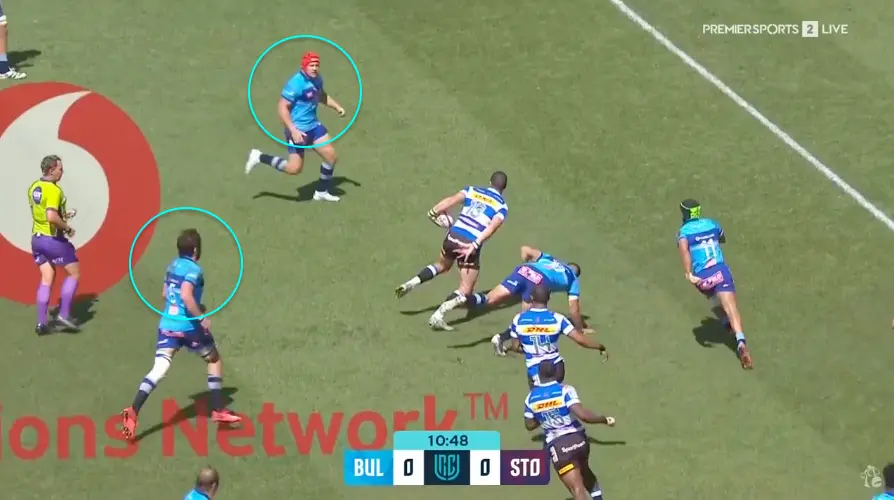
When you look at the play in total — Stormers had a try ruled out for a foot in touch right before scoring — you can see what I mean with that laggy dropback.
Watch them enough this season, and you’ll see that aerial duel issue over and over again. They have Moodie on the right wing for this one, but the pressure point is on the left wing and fullback.
So that’s my starting point. Kick contestables off #9 and #10 at a pretty high volume, contest absolutely everything and then try to swarm the drop before their forwards get back in line, which you can do almost every time, especially if you launch away from the set piece.
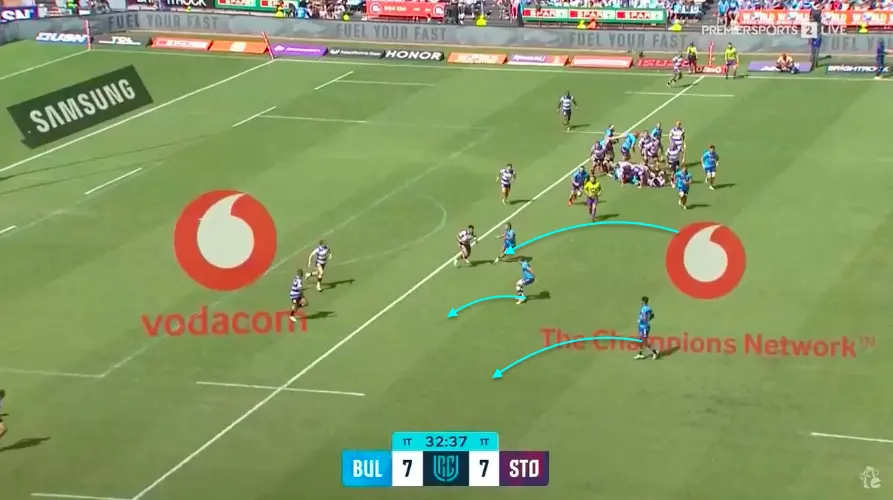
Their defensive system, too, leaves space for a team that attack the way we have. In the last few months, we’ve been under constant blitz pressure, and while the Bulls may adjust for this game, if they produce what they have for most of the season, you’ll see far more lateral space than we’ve been used to.
We can work with space like that. You’ll see the tight spacing around the pods off #9 and #10, where they have the forwards to spare because they can’t afford to leave anyone in their back defending on an island. Their backline covers this with a drift, but that leaves a lot of the kind of room we’ve been crying out for in that 3/4 space.
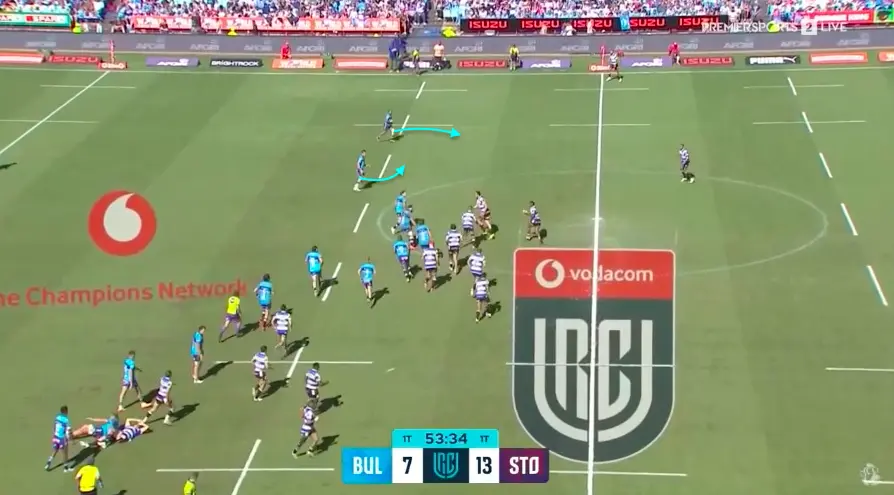
We can use their scrum too. They are going to be gunning for Ala’alatoa and Ryan all game long because they think they’re weak and can easily bomb them off our put-in. They’re right, but that will give us an opportunity too.
If we can draw that massive surge up our tighthead side, and get channel one ball, we expose that drift, and that’s where Jack Crowley can be a unique threat, especially if we establish the threat of Nankivell and Kelly — our most athletic midfield combination — early.
Offensively, they are always looking for offloads out of dominant contact, so we’ll have to stay high in our tackle profile and always look for hard work scraps after a linebreak inside.
It’s not going to be easy.
But kicking contestables early and often is the best way to defang their massive power advantage in the front five. If we can tailor that with a sticky defensive lineout performance, we’ll have a platform that can hopefully negate the scrum pressure that we’re going to face, one way or another.
