

The night ended with Thomas Ramos inevitably kicking the late, late, late penalty that sealed the Championship for France.
I’d spent the last 15 minutes of the game in a squat in front of the couch. I didn’t think France vs England would get me, but it had me. When England took a dramatic late lead, with two minutes left, my heart was breakdancing at the back of my throat despite myself. I told myself I wasn’t going to be invested. I thought about what it would mean for Ireland to win this Championship, hours after beating Scotland (again), off the back of the most dramatic, high-quality Six Nations in years.
In the end, it didn’t matter. Thomas Ramos did what Thomas Ramos inevitably does. When the penalty was awarded, I stood up and stood in front of the TV. The right — no, the responsibility — of every father in his 40s, and watched the ball sail through the posts.
It was just. France were the best team in the tournament — I think — and they deserved to win it. I think.
Ireland would have to settle for the Triple Crown, with all the enthusiasm of finding a fiver in an old coat and realising it doesn’t buy much of anything anymore.
***
A Triple Crown is a decent return from a Six Nations campaign, as is finishing second. The aftermath has focused a lot on Andy Farrell, who has developed the fine habit of being a lucky general, albeit once the pivotal game of the tournament ended in comprehensive defeat.
He’s used 35 players in this year’s tournament, the most players he’s used in a Six Nations campaign in some time. As far as development goes, that will do. Sure, all of that development, such as it was, was done where injured stalwarts had left a hole to be filled. He was hardly going to leave the teamsheet blank, after all, but if that’s what it takes for a 28-year-old Rob Baloucoune, a 30-year-old Nick Timoney and a 33-year-old Stuart McCloskey, in particular, to get a prolonged run for Ireland, finally, so be it.
Farrell also finally got out of his own way on the #10 debate he opened and then left fester for a year or more. It turns out that all you have to do is start the better player, not the guy who does well in meetings. We must be grateful for this tactical masterstroke, however late Farrell stumbled onto it.
In another world, that might have a press corps wondering if Farrell’s dithering cost Ireland a Six Nations title, rather than merely settling for a Triple Crown, but that would also require the press corps to examine their own role in that “debate”, which has disappeared so quickly you’d be forgiven for thinking it was all a dream.
We have always been at war with Eastasia, and Jack Crowley has always been Ireland’s #10.
Where does that leave us? At the end of the Six Nations, and no more. It could have been really bad, verging on existentially disastrous. It certainly looked that way after round 1 and 50/60 minutes of round 2, but the final three rounds have parted the storm clouds and given us the luxury of ending on a high.
Those are the benefits of serving under a lucky general.
***
Ireland always beat Scotland.
That’s been the story of the last decade or so between these two sides, and it was the ultimate story here. Before the game, I wondered if Scotland had what it took to overcome their mental hangup in this fixture. They were more than good enough to do it on paper, but the only question was whether they had the wherewithal to do it when it counted.
They didn’t, as it turned out.
If Farrell is the prototypical lucky general, Gregor Townsend is the opposite. When it comes to it, he always manages to find a way to stand on the only rake in the yard, either through his own intransigence, bad luck with injury, or his players finding a way to lose whenever they see a green jersey.
Scotland didn’t even play badly here, purely from a performance perspective, but they produced the type of game that meant playing well wouldn’t be enough.
Ireland, on the other hand, were brilliant, and looked as good as we did when we put England away — we won that 43-21 — for broadly the same reasons.
The seeds to Scotland’s defeat can be found in two segments; the first one right from the kick-off. Before the game, I wondered how Scotland would manage the kicking battle right from the start of the game. Would they go to a lineout off the first kick receipt, or would they try to engage Ireland in a transition battle?
Transition battle it was. They coughed up a linebreak inside the first few phases, even by aping the defensive strategy that typically works against Ireland from a structural perspective.
Fill the field, stay out of the rucks.
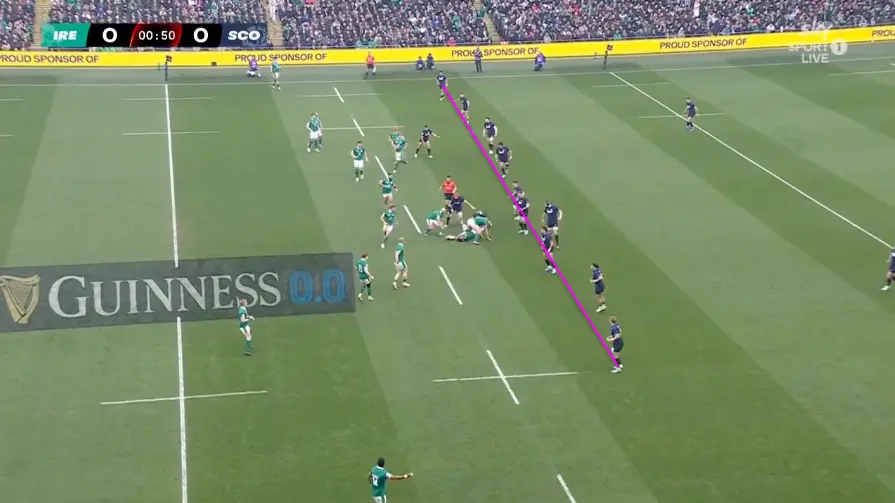
But Jack Crowley produces a different threat. His pace and change of direction coming around the corner on these plays can’t easily be contained — he’s quick, powerful, and when he sees a compression, or a good bump as he saw here from Ringrose on Tuipulotu here, he goes.
Scotland recovered in this instance when O’Brien’s clean out knocked the ball loose, but the next battle proved to be ominous.
A Scottish scrum to relieve pressure, a chance to set the template for the opening ten minutes and… an Irish penalty.
From there, Crowley kicked to the corner, and Ireland do what they do from close-range set pieces more often than not. We convert. 7-0. Mentally, Scotland were huddled under the posts, wondering how the fast start they promised themselves ended the way it almost always does against Ireland.
Gibson Park’s wide passing range and Ireland’s flat line off that produced an unbelievably good pull-back pass from Doris to Crowley. Crowley did the rest to set Osborne under the posts. How did Doris get this around his body and back to Crowley without defensive pressure?
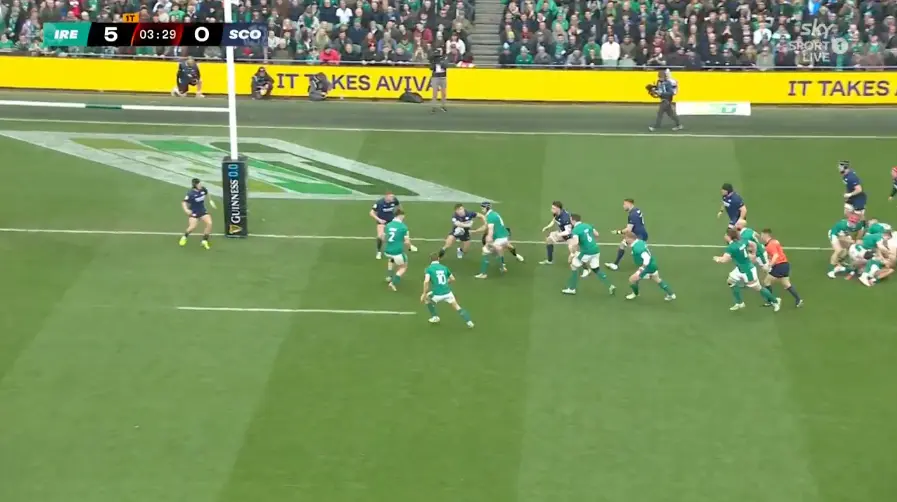
Because the pass went to the widest point on the play, to the softest part of Scotland’s defence in that zone.
Scotland scored off the restart — because they are a good side — but it took them 19 hugely attritional phases to do so. On almost every one of those phases, Ireland contested incredibly hard at the breakdown, which produced a few gaps on our defensive edge progressions that Finn Russell — and probably only Finn Russell — was able to unpick with a series of unbelievable low percentage passes.
This was the crucial one.
7-7.
Off the restart, Scotland went in-field from the exit again, as they had done from kick-off.
I wondered before the game — as I mentioned — about this strategy, figuring it made sense for Scotland to give Ireland lineouts in this scenario as we had one primary jumper in our starting back five in Tadhg Beirne.
But Scotland’s injuries in the second row cost them here more than I assumed. Gilchrist and Williamson had enough on their hands everywhere else to try to counter Ireland in the air, and Scotland seemed to be aware of this. Without Cummings and Brown — two really good contestors — Scotland decided that it would be best not to give Ireland free possession and allow McCloskey to physically dominate Russell and Tuipulotu off the break.
That meant their transition defence had to be perfect, and it was far from that.
They went long to Osborne here again, tried to close the door on him, but gave up two bad collisions in a row before Darcy Graham jumped offside.
Crowley kicked it straight into the corner, Ireland mauled, and Dan Sheehan barged over for another score. That almost autocompleted as I typed it.
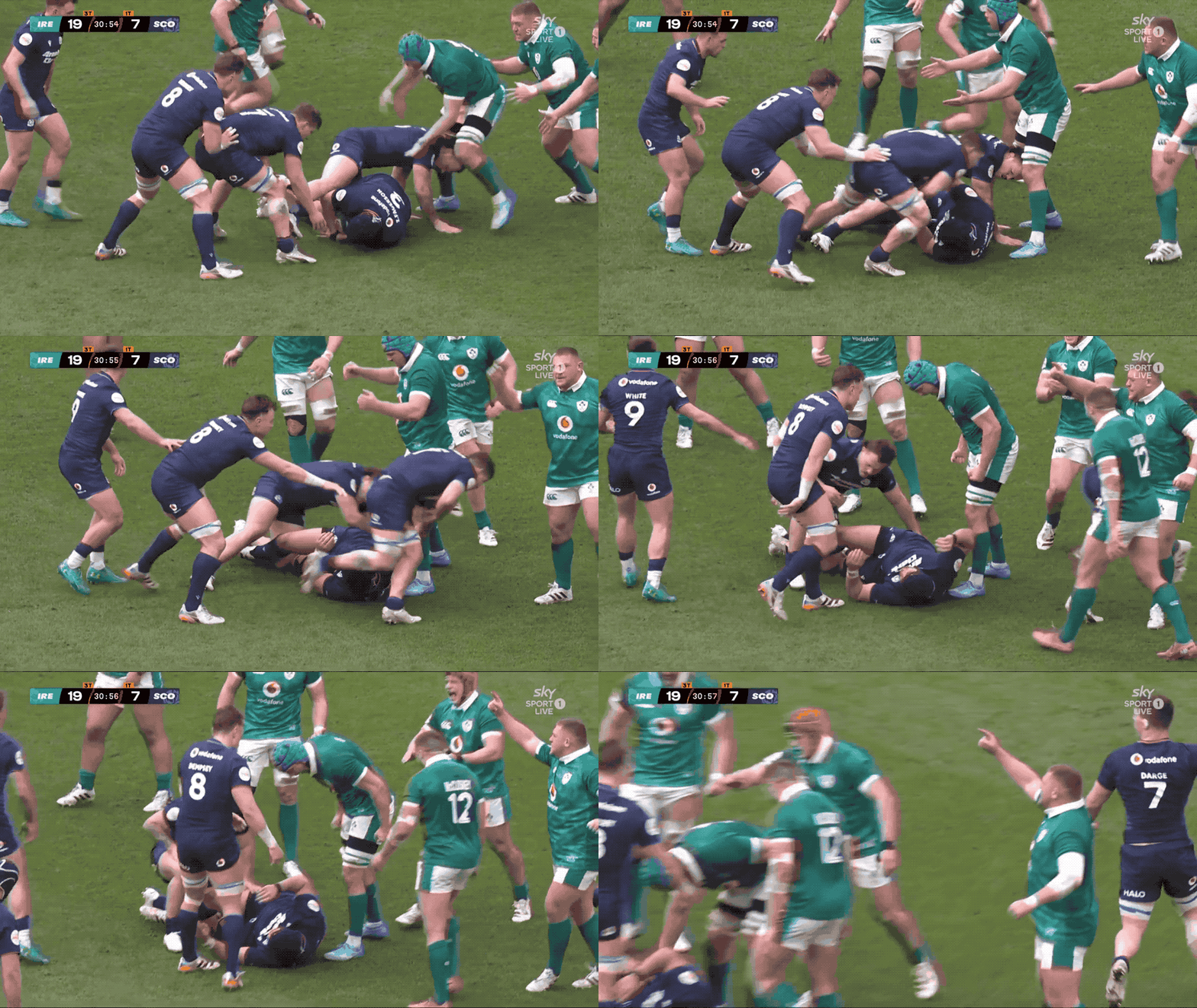
Scotland had a chance to tie the game up again on the next play, off a lineout in Ireland’s half — Doris was unlucky to concede a penalty for kicking the ball out of a Scottish player’s hands. It was a penalty, to be clear, but it came from the pressure Ireland were exerting in every tackle and almost every breakdown.
When even the opposition #10 is feigning for a jackal, you get a good idea of what Ireland’s game plan hinged on here.
Scotland need quick ball to play the game they are best at. They felt that would be enough to win them this game, but it can’t work if every carry is slow to the ground and every ruck has a hand in it.
Sure, that gives you numbers to attack on the edge spaces, but you’ve got to get it there, and Scotland couldn’t really do that consistently.
This was how the 22 entry that followed that penalty ended.
In theory, this is a dangerous position for Ireland, but I would wager that we’re pretty comfortable in this position against any side that isn’t New Zealand, France or South Africa.
Look at the breakdown pressure, even when it might not necessarily be sensible in a traditional sense, and how the outside defensive arm adjusts to Scotland and Russell, in particular.
Pressure, pressure, pressure.
Off the lineout — Crowley exited right to the Scottish 10m line — Scotland went for a daft five-man maul play that Ireland choked up and turned over. The first sign that Scottish heads were melting.
A late +1 switch to throw off Ireland, but the key mistake — a loose connection between Schoeman and Gilchrist on the lift that McCarthy could stroll through to blow up the whole thing.
Ireland won a scrum, then had another after a Scottish player was forced off for a HIA in a tackle.
Off the next scrum, Ireland ran McCloskey into the second layer and that drew a massive compression that asked whether McCloskey could make this pass, or not.
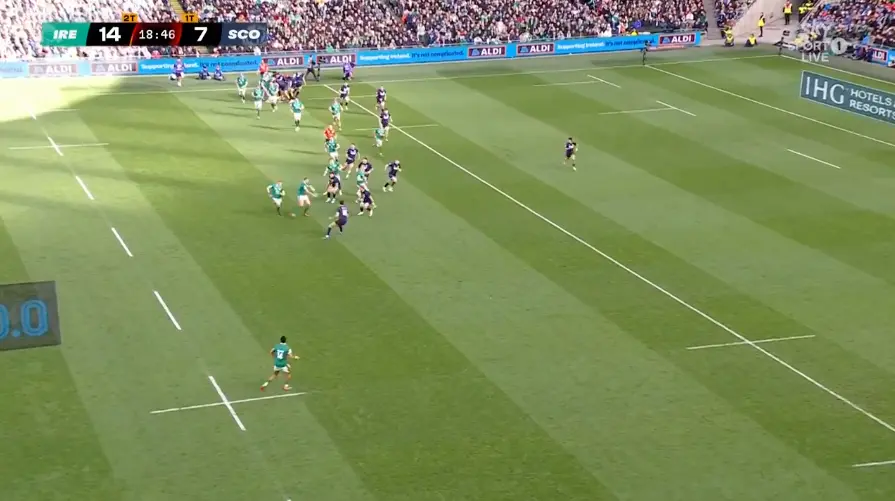
He could, it turned out. And Baloucoune finished in the corner. 19-7 with barely 20 minutes gone.
Scotland had a few more chances in the first half, but they kept running into the same thing. Slow carries, slow rucks, and Tadhg Beirne playing angry.
It was becoming a game where Ireland are the worst possible match-up for Scotland in this championship — arguably their worst matchup in the sport.
Scotland had scored their first try with 18 phases of pressure, unlocked it at key points with low percentage passes, but that will only work the odd time against Ireland. Give us rucks to defend — and they did — and we’ll burn you down to the ground.
Scotland ended the half 12 points down, and it’s a lead you felt they’d never quite overhaul. Well, I certainly felt that, anyway.
The second half saw scores traded back and forth, but Ireland always had breathing room. Scotland took enormous effort to score, only to concede again soon after. Ireland’s five-point buffer in that time was an airlock that Scotland couldn’t pop, because they couldn’t get a stop when it counted.
Then Ireland landed the killer blow. Scotland blew an exit to touch, and Ireland ran back in transition. McCloskey, once again, bulled his way to a big gain that allowed Ireland to stretch out their lines and give Jack Crowley the space to play. In two phases, he’d engineered the score that would decide this game with 12 minutes to play.
This was Crowley bossing phases, using the threat he’d established early — you can’t sit off him. The first pass to Aki sat two defenders down on Crowley, with McCloskey holding the inside defender. That gave Aki a pocket to hit.
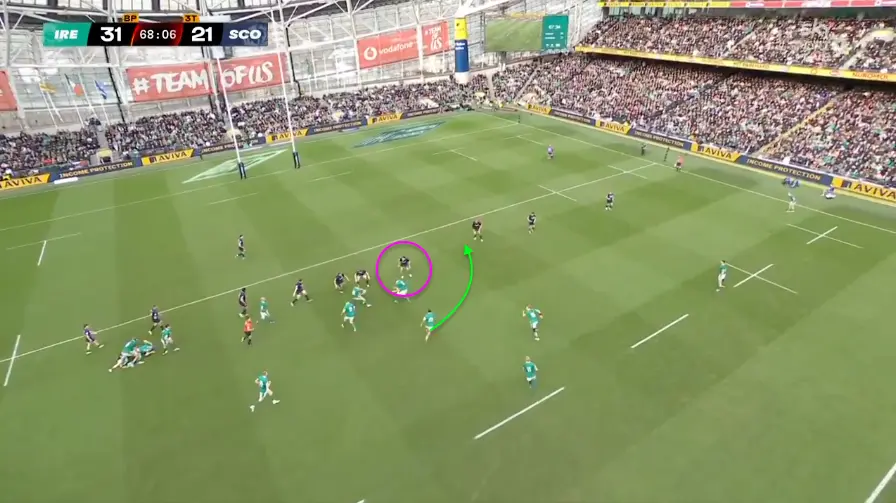
The second pass was based on the threat Crowley poses. You can’t drift on him here, because the inside defender doesn’t have him. Crowley pulls the defenders in, releases to Frawley, and Frawley put away O’Brien in on the loop.
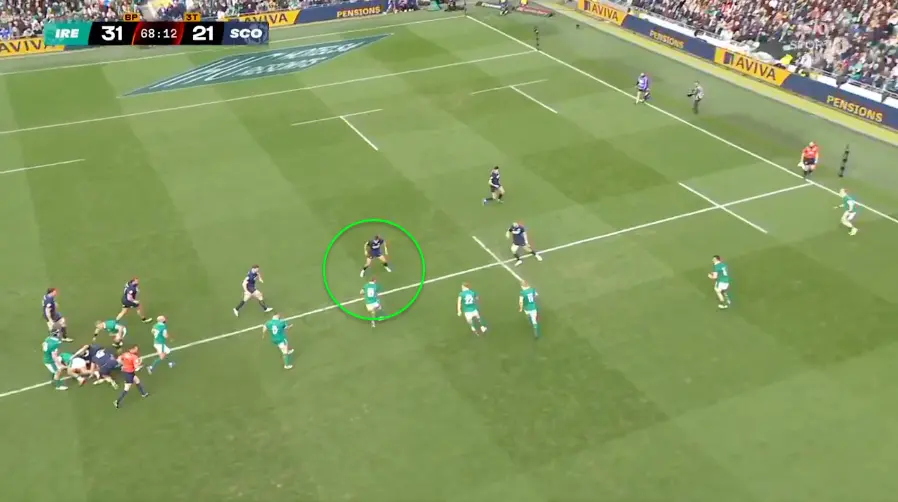
Game over.
For Scotland, it was dreadfully familiar. For Ireland, it was the same old story. Scotland showed up, did well, but it was nowhere close to enough. Ireland did what they always do against Scotland since the early 2010s.
Win.
| Players | Rating |
|---|---|
| 1. Tom O’Toole | ★★★★ |
| 2. Dan Sheehan | ★★★★ |
| 3. Tadhg Furlong | ★★★★ |
| 4. Joe McCarthy | ★★★★ |
| 5. Tadhg Beirne | ★★★★★ |
| 6. Jack Conan | ★★★ |
| 7. Josh Van Der Flier | ★★★★ |
| 8. Caelan Doris | ★★★★★ |
| 9. Jamison Gibson Park | ★★★ |
| 10. Jack Crowley | ★★★★★ |
| 11. Tommy O’Brien | ★★★★ |
| 12. Stuart McCloskey | ★★★★★ |
| 13. Garry Ringrose | ★★★ |
| 14. Robert Baloucoune | ★★★ |
| 15. Jamie Osbourne | ★★★★ |
| 16. Ronan Kelleher | ★★★ |
| 17. Michael Milne | ★★★ |
| 18. Finlay Bealham | ★★★ |
| 19. Daragh Murray | ★★★ |
| 20. Nick Timoney | ★★★ |
| 21. Craig Casey | N/A |
| 22. Ciaran Frawley | ★★★ |
| 23. Bundee Aki | ★★★ |
The best thing about this game was that Ireland played above the general performance of Jamison Gibson Park for the first time in a while. Andy Farrell still believes Ireland can’t do much of anything without him, which is why he stayed on the field even when Ireland were two scores up with less than ten minutes to play.
It’s the kind of scandalously bad management of Craig Casey that Jack Crowley endured last year, and that players who weren’t Johnny Sexton endured for years before that. It bit Farrell eventually, and it’ll bite him here again, lucky general or no.
Jack Crowley had the kind of complete performance that left no equivocation. His goal-kicking against Wales blotted his copybook last week, but there were no such worries this week. He played like a man who knew that meetings didn’t matter all that much anymore, so what happened on the field could do the talking. When that’s the conversation — as it always should be — the “debate” evaporates. A top-class performance.
Stuart McCloskey is hardly a find at this stage of his career — he’ll be 34 in August — but he finally got an extended chance to show what he’s been doing at Ulster for his entire career would translate to test level, as if a 6’4″ bulldozer closer in weight to our second rows than our other midfielders who carries better than all of them put together needed proving. He was outstanding again here, frightened the life out of Scotland all day and is arguably the player of the tournament.
Caelan Doris is an excellent counterpunching combo-flanker. Ask him to play like CJ Stander, and he’ll find doors closing in his face. He is not, and never will be, a guy whom you can hinge an attack. That isn’t his game. What is his game — and it’s where he’s undoubtedly world class — is when you lean into his defensive game first, and his counter-punch game as a natural follow-on. He’s arguably one of the hardest players to play against on a multi-phase set because he’s ridiculously fit and mobile. He’ll make sticky tackles, and then harang each ruck that follows in turn. A hand in here, a swing around the ruck there.
And then, when the opposition have blown themselves out, he’s got the kind of punch in his carry that can overwhelm defenders and find key metres at key times. This game was the perfect example of that.
Tadhg Beirne had a quiet enough Six Nations until teams decided that they could run through Ireland ruck for ruck for ruck. Don’t ask for that Tadhg Beirne to show up. It never ends well.
Against teams who want to kick and contest, who force Ireland to play from deep, Beirne can look a little lightweight.
Against teams who fancy their chances on multiphase, he becomes the best defensive player on the planet. You can’t run through him, because he’s the wrench thrown into your engine. If you give him rucks to attack, you’ll find he’s completely unplayable.
