


Using the transitive power of Rugby Maths has never been harder in this Six Nations.
France walloped Ireland in Paris. England pumped Wales in Twickenham. Ireland then laboured to a narrow win over Italy, who beat Scotland in Rome. France then walloped Wales. Scotland produced their near annual beasting of England. So far, so somewhat normal.
But then Ireland smashed up England in Twickenham. Wales almost beat Scotland. France put Italy away easily. Still sensible.
So does it make any sense that Italy then beat England? And that Scotland put 50 points on France?
No. It doesn’t. I can’t get my bearings in this year’s Six Nations, which is a great thing from an entertainment perspective, but objectively very confusing when I’m trying to assess where everyone is.
If Italy beat England — arguably should have done so by more — and we just about beat Italy, but hammered England, who smashed Wales to pieces, something we never looked like doing, what does that mean? If France hammered us, and Scotland hammered them, how does that explain Scotland losing to Italy in Rome, who France hammered?
I need to sit down.
I suppose the answer is that test rugby has rarely been as unpredictable, or as prone to wild swings game to game, even moment to moment, as it is right now.
As a base level, that’s probably why Ireland again laboured against a team that hasn’t won a Six Nations game since they beat Italy back in March 2023.
The reality is that Wales and Ireland are far closer to each other than many would like to admit, and the prime differential is efficiency. I wrote that before the game, and this game showed it.
Ireland and Wales had the same volume of 22 Entries, but we were efficient with ours; they weren’t with theirs.
This is a great example. Wales had done all the hard work of getting to the Irish 5m line — twice — and has this opportunity to take the lead after surviving an early surge from Ireland.
Held up. Chance gone. That’s been the difference for Wales, as of late, and it was the core separator in this game.
But they were in the game because of the quality and intensity of their defence, and their work on defensive transition. In some ways, it was an inversion of Ireland’s win over Twickenham; Wales were happy to kick and harry, Ireland were under pressure to move through the phases.
That lack of variety in Ireland’s play was called out quite a bit post-game, but it’s a symptom of how muddled our play is at the moment. We’re obviously a very highly skilled team. Post 2023, Farrell decided that Ireland were going to be a team that primarily played through Jamison Gibson Park. In some ways, Gibson Park replaced Sexton in a way that Farrell was comfortable with — far more comfortable than the chopping and changing he’s indulged himself in at #10. Ireland are tied to Gibson Park’s performance levels, as all teams that primarily play off #9 are.
When Gibson Park plays well, Ireland plays well. When he is average, Ireland are average. When he plays badly, or gets structurally removed from the game by the opposition? You get the pattern.
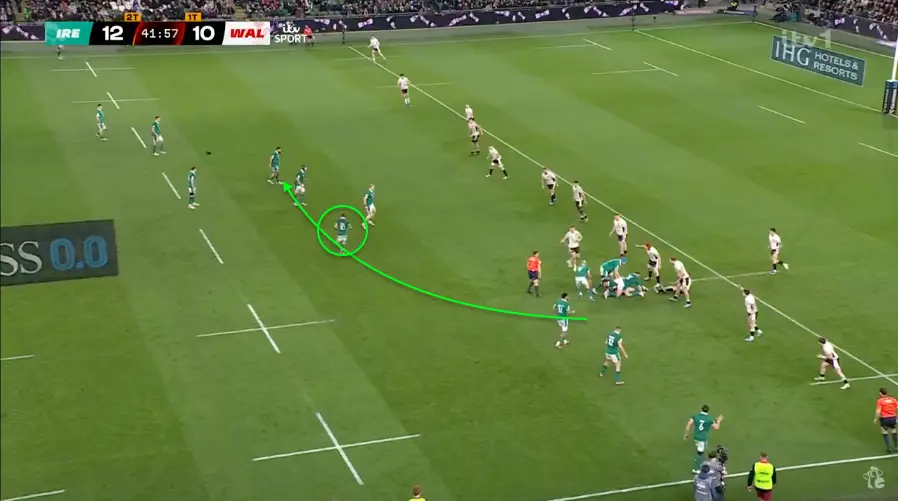
In this post-transition sequence, Gibson Park is driving the play from #9. Everything is arrayed off him.
Crowley is, essentially, either another centre or kicking extension of Gibson Park’s range in this play — which is fine — but it relies on Gibson Park’s passing speed and distance to create the attacking structure.
When you see a kind of wide, flat structure like this, it’s designed to produce options for the #9 to find targets.
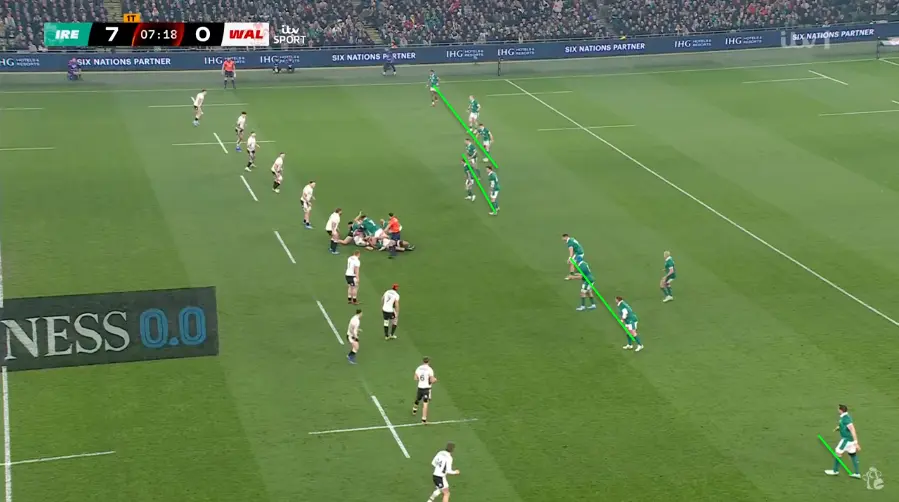
That’s also completely fine in this position inside our own 10m line, but we do it in most positions.
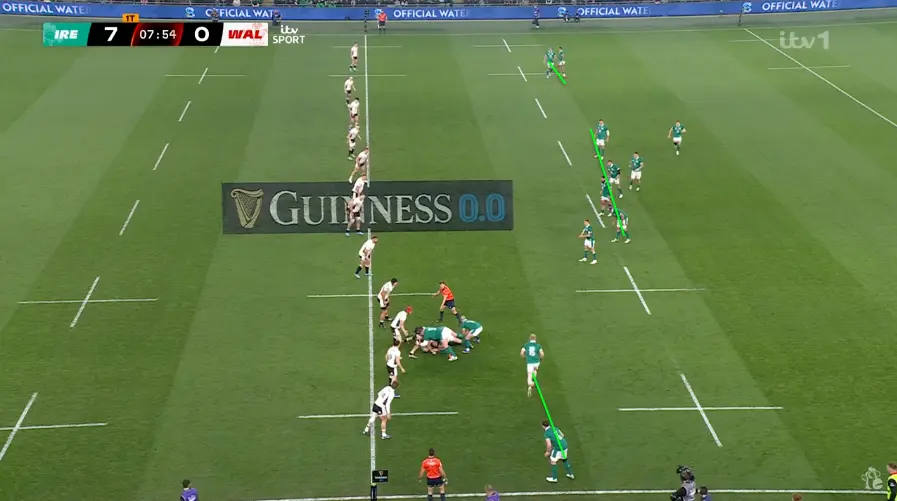
Munster — and all the provinces, to an extent — play with this “setting” on their attacking output. I’ve got an article expanding on this coming this week, but it’s what Mike Prendergast has spoken about when he talks about the provinces mostly playing the same game as Ireland.
It’s also why I feel Sam Prendergast hasn’t ever fully clicked for Ireland, only ever in parts, because it requires the #10 to be a running option for it to work properly. Prendergast has the passing range to extend that flat shape, but not the running threat. It’s the core paradox of Ireland’s last 18 months — who best extends Gibson Park’s game?
We’re very reliant on Gibson Park producing his best, quickest and most accurate passing for it to work as designed. Almost all of our attacking shape is structured to enhance his game — his passing, his breaking threat, his decision making.
If Ireland were arraying off #10 here, the structure would be that much deeper, but we’re not — because the threat we’re trying to enhance is Gibson Park’s ability to hold defenders around the pillar, and then stretch them laterally with his passing range.
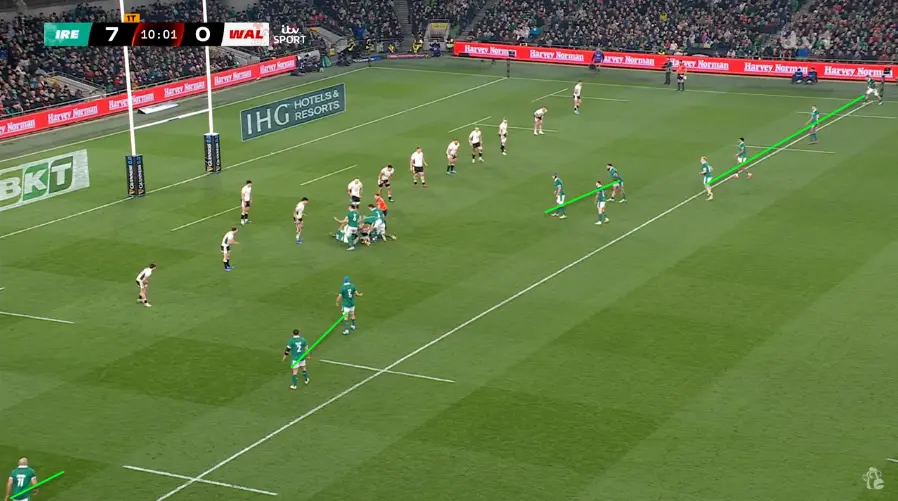
In this instance, the first ruck leads to a naturally flat alignment for the next phase. You can see it run through here, with a poor pass from Crowley putting Osborne under pressure.
But if you visualise it as the pass Gibson Park would have made if he could pass 35m at the same speed he does over 15m, it starts to make sense.
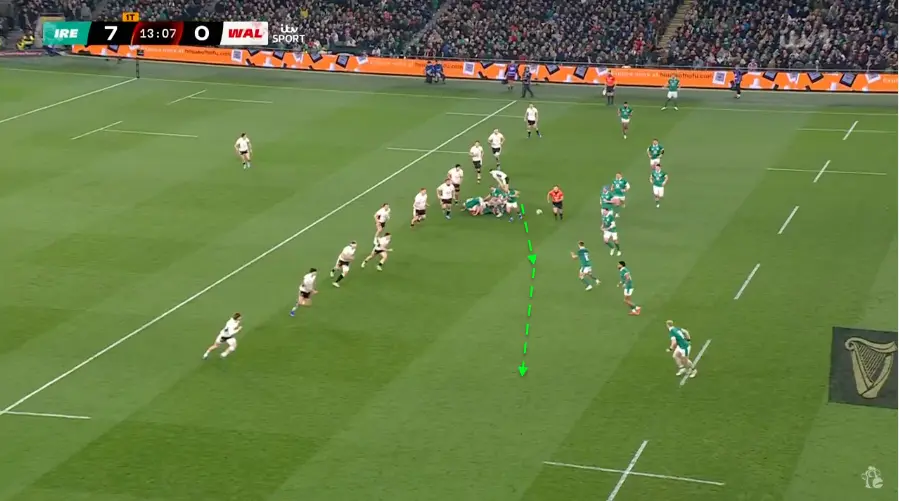
Everything is an extension of Jamison Gibson Park.
When it works, it works really well, but it usually requires lots of persistence to work fully. It’s why we tend to pick lighter, more mobile forwards because of set-ups like the first three phases here, which would, ideally, have a big, heavy runner attached to them. We’re not really about efficiency in this part of the game, more about attrition. Wearing teams down.
Beirne getting smashed on the gainline twice, before we go into our split pod “half-depth” which often leaves the key handler with three sub-par options.
On the first phase, you can see how flat we are off the carry (with Crowley having to loop back around to be the handler on the fourth phase, having been at the first ruck)
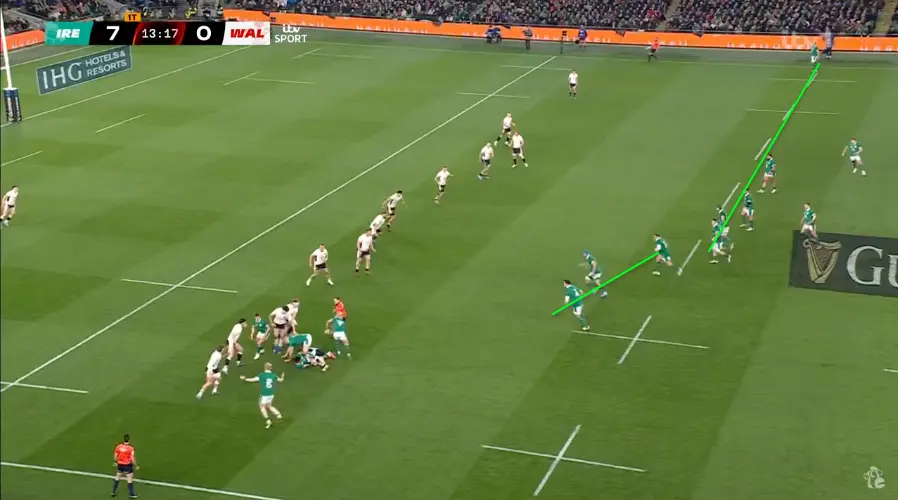
Beirne has a huge run-up here, but he’s not an impact carrier at pace; he can carry twice in three phases, so that’s of more value to the coaching unit than, say, someone who could smash over the gainline once and then maybe be available next time on phase four.
When the ball comes through to McCloskey, he’s left with either a carry or two bad options, and he takes the fourth, worst option by slinging a ball to nobody.
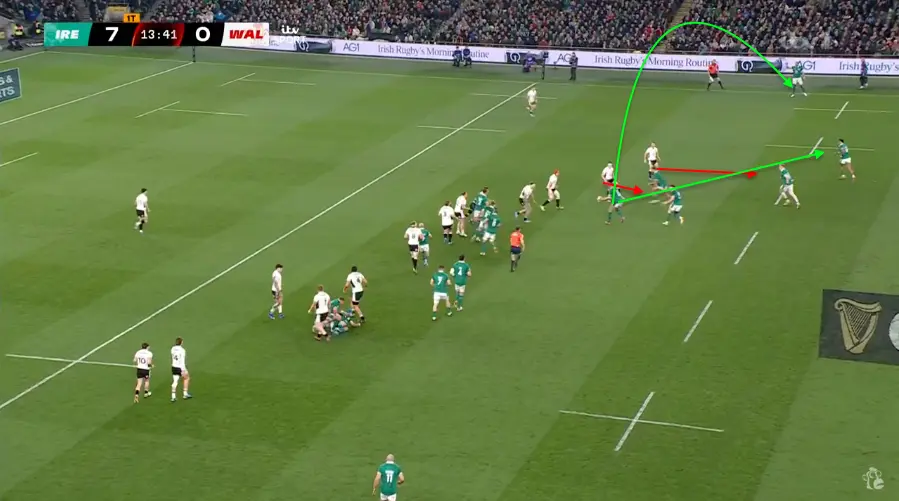
But this is the risk and reward for playing off #9 as much as Ireland does. You get your best player — as far as the coaches are concerned — involved in virtually everything as a main decision maker, with everyone orbiting around his decisions, one way or the other. If that means the space outside is eaten up too easily by even cursory linespeed, that’s the risk we’ll take.
One of the complaints I often hear about Crowley — or Prendergast, or whoever post Sexton — is that they don’t “organise” the backline when Ireland aren’t playing well, but that isn’t needed. The stack organises itself from #9 on out. The system then flows into the gaps. If #10 is involved in a ruck, as they often have to be, at least when it’s Crowley, Osborne, or Ringrose, they will slot into first receiver and run the play, with the #10 looping back around to find the open spot in the structure.
If getting structure off #10 was a key part of the system, the pods would do it regardless of who happens to be standing at first receiver. You don’t need the #10 to do it.
You can see it here, in two post-transition phases. Same flat shape, even when Crowley is buried in a ruck post-carry.
Stockdale gets the cue from Gibson-Park, runs a flat loop line around the blindside pod for a pullback, but we don’t use it — no space — so we carry and kick.
A few phases later, we won back the box kick; you can see the same principle. Flat off #9, tip-to-space if it’s on, and then what depth we have goes through that split pod, before flattening out again.
On that out ball to Crowley in the first phase, it’s almost inevitable that he’s going to be hitting a ruck, but the structure outside on the next phase fills itself in. Osborne, split pod, second handler makes the play.
When you play off #9 as much as this, with the intent being that you want to batter teams into submission with phase play — as we seem to want to do — you burn a lot of energy. For everything to work, there has to be a flat pod of forwards in position, so there’s a lot of up-and-downs and back to back to back repeat efforts. Phase, phase, phase.
I’m not sure it’s a coincidence that we keep getting counter-punched by teams in the aftermath of large sequences of phase possession, either, or why this game looked so much like the Italian game for large stretches.
We’d score, after a huge effort, and then look a little passive and leggy on the next sequence. Look at how comfortably Wales power through contact here — twice in a row — before blowing another 22 entry with a bad pass.
Surely Wales, as the team that had defended for most of the game to that point, should have been too tired to do this?
A few minutes later, they scored under the posts after Ireland’s scrum got in trouble on back-to-back sets. 19-17. Two points up with just over 15 minutes to play.
That wasn’t really in the script.
But Wales started to make mistakes. A dud contestable from Joe Hawkins only travelled 11/12m in the air, and Joe McCarthy — of all people — could hoof the ball downfield into space, like he was a super-sized version of James Lowe.
Wales cleared, but they conceded the killer score soon afterwards, with Jamison Gibson Park showing why Ireland want to play everything through him.
Doris makes a decent hit up, but Gibson Park’s speed and delivery open up a killer flat-line progression that sees Conan put away in space. Sure, it was a forward pass, but he offloads back inside to Gibson Park on the support line. We almost score in the corner, but score soon after anyway through Osborne.
That fizzing pass to Van Der Flier goes right in front of the face of the defence. They are fixed by it. Crowley floats outside, takes the pass, releases Stockdale, and that’s the killer break.
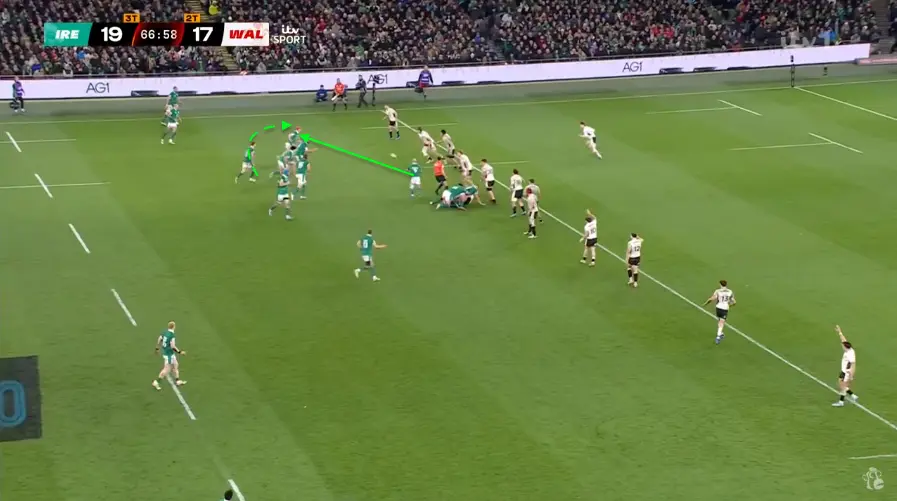
When it works, it’s bordering on undefendable without serious heroics.
Crowley’s missed conversion — his worst miss of the season so far — meant the last ten minutes had far more jeopardy than they needed, even with Wales having Tomos Williams in the bin, but we eventually forced a kickable penalty, and that was that.
I still feel, having watched this game back four times, that we really struggle against teams who are comfortable without the ball. Wales are actually better without it. But because our structure runs so much through #9 at the volume of phases we play, we’re vulnerable to a key system error. That error is “what if Gibson Park has a bad one”, or if the flat system doesn’t work exactly as designed because he’s not there.
You see it with Leinster, the same is true with Ireland. Gibson Park is Ireland’s strategic weapon, but also our biggest systemic weakness. If he’s not kicking, we’re not kicking. If he’s not hitting you, loop around and loop around again. But when he’s firing, he’s borderline undefendable, and everything he touches turns into a hard drive with Bitcoin from 2013 on it.
That can lead to games like this, where it feels like we have the ball for the entire game, but spend most of that same game buried in rucks, getting smashed in collisions and vulnerable to counter-punching.
Yet we still won. The value of that win depends on your read of where Wales are at. For me, they’re an underrated team, undone by their own inefficiencies, so beating them is a positive, but I keep coming back to their record and wonder about how much of our approach to the game empowered them to play better than they have in a year or more. What would happen if we came up against a side with a better defence? With way more attacking efficiency on their entries, fewer gaps in their game and with a better scrum and lineout?
We’ll see next Saturday against Scotland.
| Players | Rating |
|---|---|
| 1. Tom O’Toole | ★★★ |
| 2. Ronan Kelleher | ★★★ |
| 3. Tadhg Furlong | ★★ |
| 4. James Ryan | ★★★★ |
| 5. Tadhg Beirne | ★★★ |
| 6. Jack Conan | ★★★ |
| 7. Nick Timoney | ★★★ |
| 8. Caelan Doris | ★★★ |
| 9. Jamison Gibson Park | ★★ |
| 10. Jack Crowley | ★★ |
| 11. Jacob Stockdale | ★★★ |
| 12. Stuart McCloskey | ★★★ |
| 13. Garry Ringrose | ★★★ |
| 14. Robert Baloucoune | ★★★ |
| 15. Jamie Osbourne | ★★★ |
| 16. Tom Stewart | ★★★ |
| 17. Michael Milne | ★★ |
| 18. Tom Clarkson | ★★★ |
| 19. Joe McCarthy | ★★★★ |
| 20. Josh Van Der Flier | ★★★ |
| 21. Nathan Doak | N/A |
| 22. Tom Farrell | N/A |
| 23. Ciaran Frawley | N/A |
I thought Jamison Gibson Park and Jack Crowley had poor games for different reasons. Jack Crowley did almost everything that was asked of him quite well, but his influence on games like this — where it becomes attritional phase warfare — is limited in a system where he is often reduced to being an Inside Inside Centre, looping around our flat lines, hitting rucks, carrying back on transition and defending, well, like a centre. He took his try incredibly well, but it feels like this system has him doing too much of everything, and it’s affecting his goal kicking, where, not for the first time, he looks like a tired, shaky kicker.
If we aren’t getting separation in our attacking structure, that directly relates to our ball carrying, but, almost more importantly, the performance of Jamison Gibson Park. When he doesn’t play well, Ireland don’t play well. Here, it felt like he never quite got the picture he wanted, so his usual quality with the ball in hand presented as rips to nowhere, or those “edge-finder” passes that almost everyone is looking to intercept these days. His kicking was, again, very good for the most part, but when so much is put through one player, everything fluctuates with his ability to execute, which wasn’t at his usual level.
I thought James Ryan had his best, most physical game in a while, as did Joe McCarthy. Ryan is probably at his best when he has a short ball to work with and short defensive lines. He did that well here, while McCarthy looks best suited to a big 20 minutes off the bench, where he can just bullock around the place without having to worry about pacing himself for the full 80.
