



When you’re trying to assess the modern sport of rugby union — or any professional sport, really — eventually, you’ll end up speaking about the philosophical outlook of the head coach of any given organisation.
At lower-level rugby, or in older iterations of the sport, the philosophical questions were simpler. I remember seeing a quote from Warren Gatland when he was still the head coach of Wales before a game against Ireland. In that interview, he spoke about how, in a meeting with IRFU committee members before a game, he was asked if Ireland would be playing a “rucking game” or a “continuity” one, which he said “sounded like a good question”, but it highlighted how out of touch they were with the game at that point.
That was 25+ years ago, but many of the ideas around what a coach’s philosophy is, or could be, or should be, haven’t really moved on in the mind of the general rugby public. When you talk about what a coach’s “philosophy” might be, you often hear “rugby is a simple game” as a riposte.

But it’s not.
It was, relatively speaking, but in 2026, and for much of the last 15 years at least, it has become incredibly complex to the point that the only way to really impart what is required to a group of players who are expected to think and perform in the equivalent of car-crash chess, is to speak in technical, positional and philosophical terms.
What are we trying to do here? When we do this, it will generally produce this. When we see this picture, we will do this.
Real philosophy — in rugby and in life — is a framework for decision-making under uncertainty, not a predetermined answer.
A rugby philosophy doesn’t tell you what will happen. It tells you how to respond to what happens. When the breakdown is messy, when the weather turns, when your gameplan is torn up by half-time, your philosophy is what’s left. It’s the set of values and principles that guide improvisation. We go wide when space is there. We always contest the breakdown. We never kick possession away cheaply. When we are in our 22, we exit, or we run if the space is there. These aren’t instructions for a specific situation; they’re the lens through which you understand the chaos of a collision sport with multiple, unpredictable variables.
But who decides if the space is there? Who decides if a ruck is there to be contested or left?
Philosophy will eventually decide this.
At Munster this season, we have had clashing philosophies that have only really come to light as the pressure has ratcheted up in the December/January block. Philosophy, just like real life, gets tested when expectations and stakes rise. If you commit to a life of stoicism or, say, Marxist determinism in theory, the real world can and often does throw up challenges to test your application of those philosophies in practice.
For the stoic, prosperity is as hard a test as adversity. Stoicism demands that you don’t become attached to good fortune either. Many of those who think they’re stoic discover they’re only stoic about losing.
If you like to think you’re a Marxist determinist, for example, and you have a friend or a family member who rejects that theory, it can be a fundamental challenge to your worldview. You feel that history moves according to material forces toward an inevitable destination — capitalism contains the seeds of its own destruction, and class struggle drives everything forward. They don’t see it that way. As far as you’re concerned, they might be someone with every material reason to reject the system, but they simply… don’t. The determinist either has to call them deluded or quietly admit that human beings are more complicated than the model you subscribe to allows.
You might say that Marx’s theory of “false consciousness” explains this way. But if every piece of counter-evidence can be explained away as false consciousness, the theory can never be wrong. And a theory that can never be wrong isn’t really a theory at all — it’s a closed system of belief.
The Stoic’s enemy is raw emotion. The Determinist’s enemy is historical surprise. Both philosophies are most useful — and most honest — when their followers admit where they crack.
You think and believe one thing. The reality shows you something different. When it comes to it, how much do you believe?
At Munster this season, that question has had a very specific, very human answer.
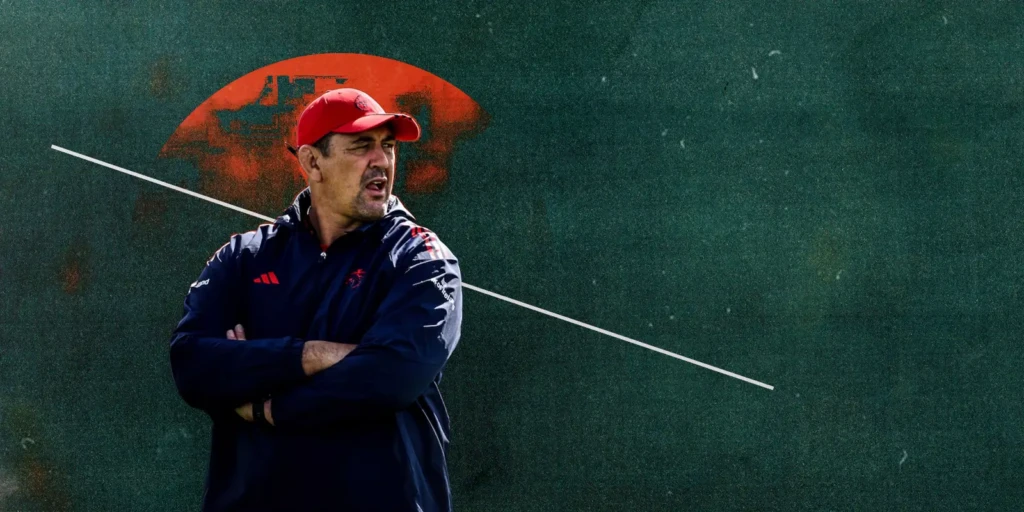
When Clayton McMillan was appointed head coach last summer, Mike Prendergast — who had been shaping Munster’s attack for three years — was promoted to senior coach alongside him. On paper, it looked like continuity and evolution working in tandem. In practice, it placed two different — not wildly so, but enough to matter — philosophies in the same room, with only one of them holding ultimate authority.
McMillan is a pragmatist in the truest sense — not as a pejorative, but as a philosophical position. What works is what’s true. The game dictates the approach. Prendergast’s instincts run in a different direction: expansive, committed to a vision of how rugby should look when it’s played at its best. One philosophy is in service of the result. The other believes the result is the by-product of executing the philosophy with enough conviction.
For a while, that tension was productive. Then the December and January fixtures arrived, the stakes rose, and — as they always do — the philosophies got tested. Prendergast will leave Munster at the end of the season. Outside of any personal ambitions or great opportunities elsewhere, he still chose to leave a club a year early. That doesn’t just happen for opportunity elsewhere.
He didn’t lose the argument. He lost the environment.

When I’ve asked players what the main difference that McMillan was looking to bring earlier in the season, they focused on “not playing too much rugby in our half” as a constant. I’ll look at the actual data on that in a minute, but when McMillan was directly asked about what his philosophy was, he said this.
“To be honest, I’ve never been a coach to sit down and say ‘what’s my coaching philosophy?”
That single line is almost a philosophical statement in itself. A man who has never written down his philosophy, and who explicitly resists the label, is by definition a pragmatist. He’s not reaching toward an ideal form of rugby. He’s responding to what’s in front of him.
McMillan has often spoken about getting Munster to a place where the floor gets raised.
That is not the language of someone chasing an expansive vision. It’s the language of someone managing risk and minimising variance; exactly what pragmatism demands. McMillan has also spoken at length about “culture” and “leaders”.
Prendergast’s philosophy, to me, lives on the pitch, in the shape of the game. McMillan seems to live off it, in behaviours and standards. Both are legitimate. But they pull in different directions when the pressure comes on. The question is how?
In practice, it creates a specific kind of confusion that’s very hard to diagnose from the outside — because it doesn’t really look like a crisis. It looks like an inconsistency. And that’s what we look like.
On the pitch
Prendergast’s expansive philosophy requires players to make decisions based on what they see — space, shape, opportunity. It demands creative autonomy, but inconsistency comes with it, by default. Like when you see a spider, there must be a web somewhere else.
Players who have spent three years being coached to read the game and express themselves don’t easily switch to a more conservative, exit-first, then play mindset. Especially when they haven’t been told, explicitly, not to do that. The instinct to play is trained in. So when McMillan’s directive says get out of your own half, but the player’s rugby brain — conditioned by Prendergast — sees a gap, what does he do? The hesitation in that moment is where you concede penalties, make errors, and lose the collisions you were supposed to avoid.
Earlier, I mentioned Munster’s “exits”.
McMillan has, in my opinion, identified the problem correctly in preseason — we are playing too much rugby in our own half. That’s a pragmatist’s diagnosis, and I have to admit that it syncs up with my own philosophy, so I am biased towards it.
Whatever we’re doing this season, that “exit success” rate hasn’t improved, with an exit success rate of 87.3% and only 71.8% of exits kicked. We sit in the bottom third of European rugby on both metrics. We’re not executing the exits well — we don’t get a territorial gain, or the opposition moves back to the point of the exit with a few phases — and we’re not kicking our way out with the frequency of the teams above us.
It’s more complex than just the exits, of course, but to make it a bit simpler for now, the coach who wants to simplify the game in Munster’s own half is presiding over a team that is neither playing its way out effectively nor kicking its way out effectively. We’re caught between two approaches and executing neither cleanly.
In training and selection
This is where it gets more subtle. McMillan’s framework — behaviours, standards, culture — is fundamentally about who you are day to day. It rewards consistency, discipline, and doing the unglamorous things well. Prendergast’s seems to reward expression — the player who sees something others don’t and acts on it. Those aren’t always the same player. Selection becomes quietly contested ground, even if nobody says so openly.
The deeper practical problem
A squad eventually organises itself around whoever it believes holds the real philosophical authority. Players are shrewd readers of power; make no mistake about that. If they sense a tension between the head coach and the senior coach — even unconsciously — some will gravitate toward one pole and some toward the other. That fracture doesn’t appear in a post-match analysis, because analysis can’t detect it if philosophies are divergent.
Ultimately, the real divergence appears in the moment a player has to decide under pressure with no time to think, and reaches for whatever he actually believes in. We end up talking about moments, rather than something solid and repeatable.
This is where I see Munster’s last few games. Not just exits, but what we want to do phase by phase, decision by decision.
The next hire, the man who will replace Prendergast as either the senior coach with responsibility for attack, or as the attack coach (the terminology isn’t important), will be an exact fit for his read on the squad as it stands. Van Graan, it turns out, did this with Larkham. Larkham wasn’t the coach I thought he was; he was who Van Graan knew he was.
That, ultimately, didn’t work.
But that kind of hire might actually be the more coherent one this time — not someone who will push against McMillan’s instincts too much, but someone whose attack philosophy starts where McMillan’s pragmatism ends.
Build the platform, control field position, and let the attack flow from tactical and positional superiority rather than, necessarily, shape, persiverance or inspiration.
The question for Munster is whether our squad has the forward dominance to make that model work. But the thing is, we’ve really tried to use expansivity and complexity to work around it, and mostly failed to crack the top end of Europe. Ultimately, I think we’ve learned that every system worth relying on relies on it, either on the offensive or the defensive side of the ball.
Whatever comes next, it will fit.
What that fit does, and what success might come from it, we’ll see quite soon.
