



In Ireland, the ruck is the heartbeat of our game, and has been for some time.
I mean, it makes sense if you take it all in the context of the last decade of Irish Rugby.
I will take it that you know what a ruck is. I could squeeze a hundred words out of a laboured definition of what you already know, but I’ll save you the calories it takes for you to move your eyes over the words. Instead, I’ll squeeze out a hundred words on what a ruck means.
Offensively, a ruck is a fixed position on the field that creates an offside line that the defence must stay behind, or they’ll concede a penalty. It also creates a fixed point that the defence has to rally around with their pillar/a/b/c defensive structure, which gives you settled pictures to scheme plays around.
As an added x-factor, it also lets you take some defenders out of the next phase if they contest the ruck with a clearout, which you can use to physically dominate bigger teams in a way you might not be able to do in the carry. If they get their tackle technique wrong or over-commit to the ruck, you can trap them in and sometimes get a cheap penalty.
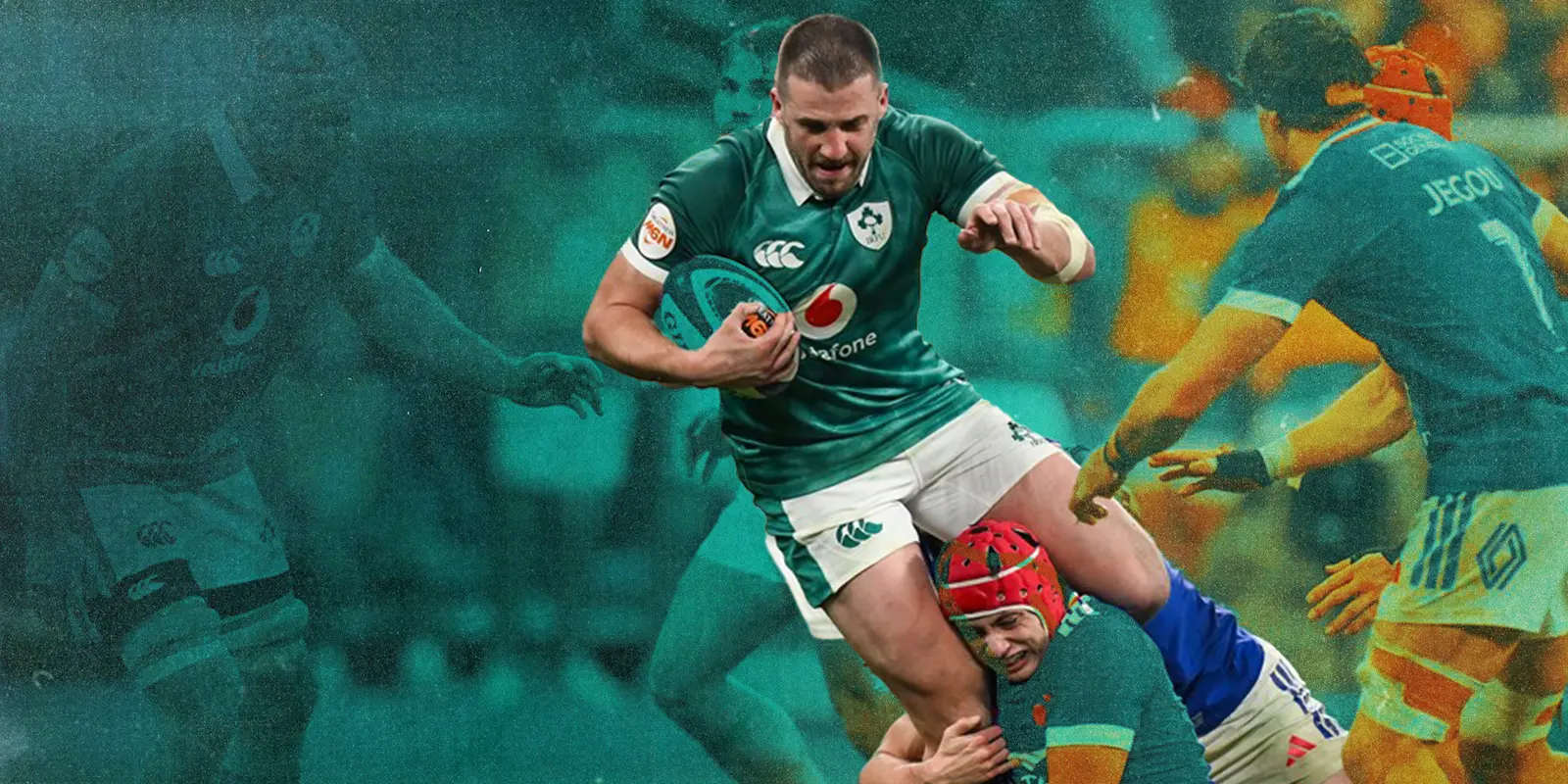
When people talk about the value of sub three-second ruck ball, what they’re actually talking about is how it empowers a rapid series of fixed defensive rally points and a constantly adjusting offside line that most teams will eventually trip over with either a penalty, a misread or a slipped tackle. You can wear down a team phase by phase, with the only risk being your own accuracy, in the carry, the pass and at the ruck itself. I think it’s fair to say that you don’t need to be dominant physically if you are violent and efficient enough at the ruck.
And defensively, it’s the inverse.
Rucks are also a stopping point for the attacking team, where they need to get bodies in place to secure the ball, create the ruck and usually wait for a halfback — or someone acting as the halfback — to move the ball on. If the attacking team are late to the ruck, you can jackal. If they undercommit, you can push through a counter-ruck. If they overcommit, they are down attacking numbers on the next phase, so you can swamp them if they keep playing.
On both sides of the coin, a ruck is predictable. You know where you’ll be offensively, you’ll know where the defence will be, all things being equal, and the same is true for the defensive team.
When Ireland were at their best — 2021/22/23 and arguably 2024 — we were the best team in the world at breaking teams down phase by phase, ruck by ruck.
In the 2023 Six Nations, a Grand Slam-winning Ireland team blew away pretty much every side we played with an average of 107 rucks per game.
In the 2024 Six Nations, we won a Six Nations title with an average of 108 rucks per game, and our only loss was against England, where we had our lowest ruck count of that tournament; we had 68 rucks in that game, 40 below our usual average.
In November 2024, the kick escort law tweak was brought in, along with a general package of laws aimed at cleaning up dangerous entries at the ruck kicked into gear. Why is this relevant?
In the 2025 Six Nations, France won the title with an average of just 83 rucks per game. I think there is a direct correlation between those two facts. The only game France lost was to England, who used just 66 rucks on their way to a narrow, late one-point win.
On the weekend just gone, the winning sides in the opening round of the Six Nations averaged just 77 rucks between them.
In general, Ireland used rucks as stage posts. Predictable points where the opposition could be manipulated into place, and we had — and still have — players who are really accurate and physical at the breakdown. On the defensive side of the ball, too, this Irish side has several really good poachers and counter-ruckers, like Beirne, Doris, McCarthy, Van Der Flier and Porter, along with really well-balanced midfielders and outside backs who help you retain the ball on the floor with clean, accurate breakdown work.
Ringrose, Keenan and Aki are really good players, but if you paid attention to the Offensive Ruck Work articles at Ireland’s peak between 2022/23/24, you’ll see how often they produced ruck involvements closer to a flanker than what you’d traditionally expect of an outside back. Here’s one from the 2022 Six Nations — with a bonus reference to the 1990s before it was cool, as a treat — where Ringrose and Keenan produced ruck output similar to O’Mahony and Doris.
That is the Irish system. We’d move you around, kill you with quick ball, and the fact that we didn’t naturally have a ton of impact ball carriers was something of a non-factor. Part of the reason why South Africa — in particular, but the French and English too — so resented being regularly beaten by Ireland during this period came back to the fact that they would look at our matchday squads, pick out maybe one or two players max that they’d back to win a collision one on one with their side, or a scrum, or that could beat them in a footrace and wonder what the hell was going on.

Sure, we had generational talents like Furlong, Doris, Sheehan and Porter, plus high-quality veterans like Sexton, Murray, O’Mahony and Healy, along with players that were obviously highly skilled and tactically aware, but we were something of an aberration athletically and in the traditional fundamentals of a collision sport.
We weren’t small, or weak, or a “flair” team. That might be understandable.
But no. We were repeatedly beating all these teams with a group of players they didn’t rate physically — at least relative to their own assets — or that they could think of a realistic utility for in their teams in place of someone else. Would a 38-year-old Johnny Sexton, suddenly available for an immediate nationality switch, have started for France? Or South Africa? Or the All Blacks?
Probably not. But he was perfect for the Ireland side, which was itself perfectly balanced to maximise every little detail and every nuance of the game as it was.
But in an environment where every tier one side knows Ireland’s plan, and has a good idea of how to stifle it, in combination with being able to pressure Ireland on the kick in a way that wasn’t possible pre-2024.
This is a good example, in line with Ireland’s attempt to play it back.
France kick long to exit — which they could under the old laws too, and often did — but look at the pace of the chase, combined with Ireland’s lack of evasion in transition.
Look at how slow Ireland are to get back into position on this.
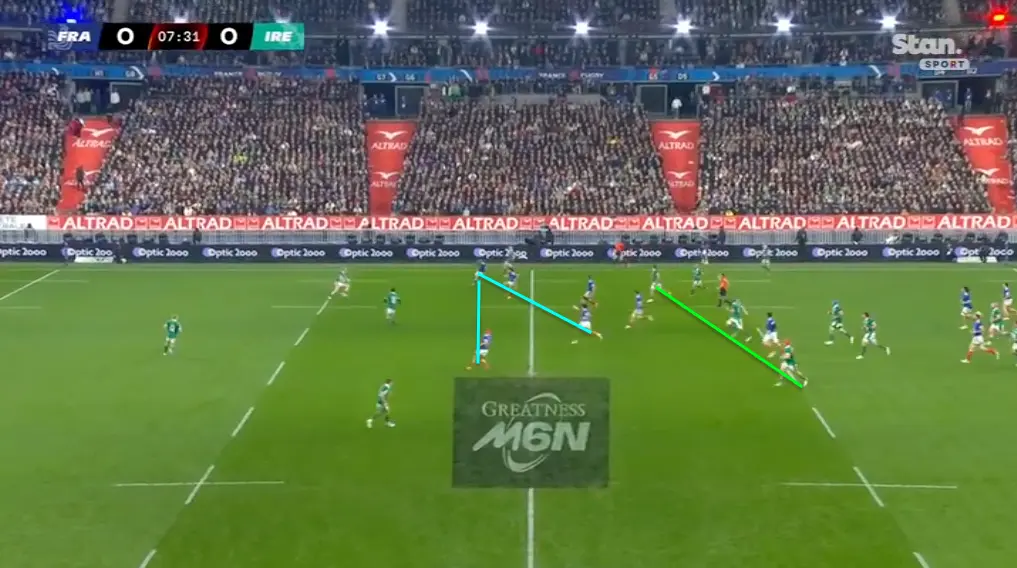
On the receipt, Osbourne has no realistic pass options. O’Brien is too far away to be passed to realistically, and Prendergast has not reset in line with Osbourne until a pass to him makes no sense.
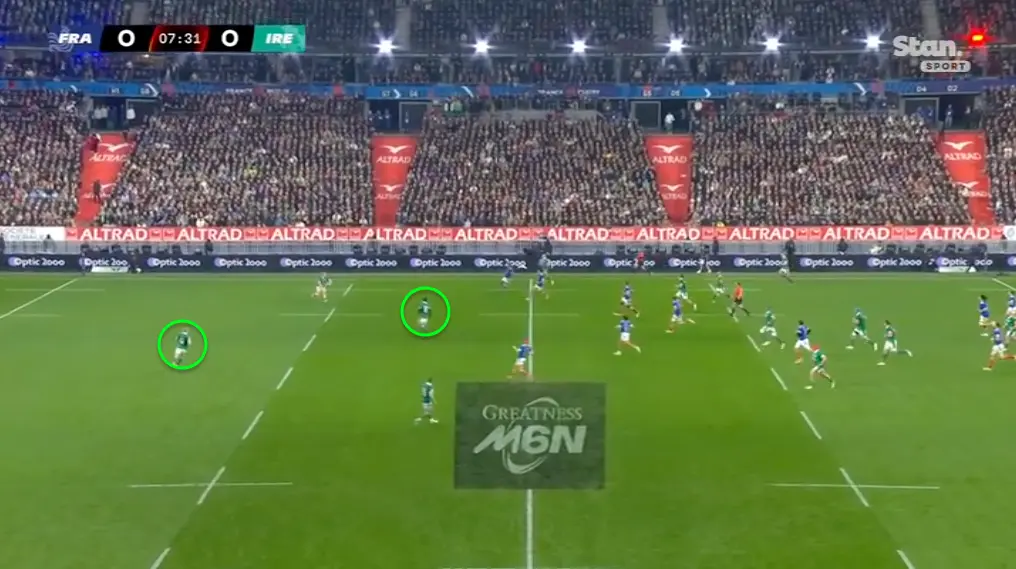
So Osbourne runs into a wall of French chasers, with very little Irish heavy ruck support.
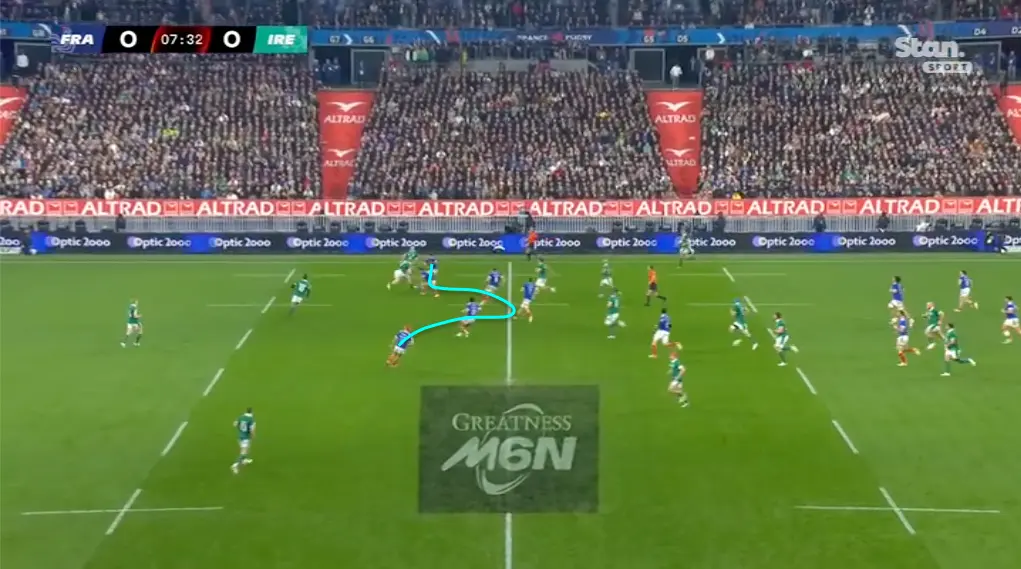
He takes contact and France contest the ruck in this instance, because it’s a free hit to do so with no “numbers risk”. The next phase Ireland try to get a post-transition set going, but it’s shut down immediately with a two-man shot, low and high, that stops Beirne dead. Gibson Park decides to kick to contest, and Ireland lose the aerial duel. But why?
Stockdale has run 40m back from the previous scrum, cleared out the first ruck, and then reset to chase another 25m to contest the drop.
Approximately 65m of running inside 23 seconds of ball-in-play. Stockdale is currently playing at 110kg. A few years ago, he slimmed back to approximately 98kg after a spate of injuries. At Ulster — who kick the least often of all the provinces, and where Stockdale has mostly played at fullback — Stockdale is not expected to produce these kinds of repeat actions because he’s almost always in the position where Osbourne was on this transition set.
When he does chase, he can do so as a first action, not a third.
But we don’t want Stockdale as a fullback, because he doesn’t kick as well as Osbourne does, who himself is filling in for Keenan, who, at his best, gives you kicking coverage and evasion on the drop. Osbourne only does one of these. Even then, if Keenan were fit, would he be the same evasive runner he was before his recent hip injuries? I would wager that he’s not.
So you’d say, “Get James Lowe back in.” Lowe is a better kicker than Stockdale, a more nuggety carrier and offloader, but he’s slower than Stockdale.
Different options, same problems in the aggregate, and every single team we’ll play in the Six Nations will want to defend us on these terms; take away our phase play detail by elongating the post-transition starter plays because they know that’s where we want to play, and they know we’re slower than most teams athletically.
When we kick, as here, we have to chase narrow to fight for “scraps”, but we are not in the best position to win these scraps, or do anything in the aftermath.
Here’s another example; Ireland have a lineout in a decent position, and we run a hit up for Doris, who slips Cros’ tackle, but gets stuffed by Gros.
Our intent here is to always kick off this ruck point, unless Doris wins his collision with France’s two man unit.
Watch O’Brien on this chase.
He is watching the ball the entire way, so he can’t run at full clip, but why? Bielle-Biarrey will show him where the ball is. O’Brien isn’t able to pressure the drop as much as he should, and even loses the aerial duel despite a bigger run-up than Bielle-Biarrey.
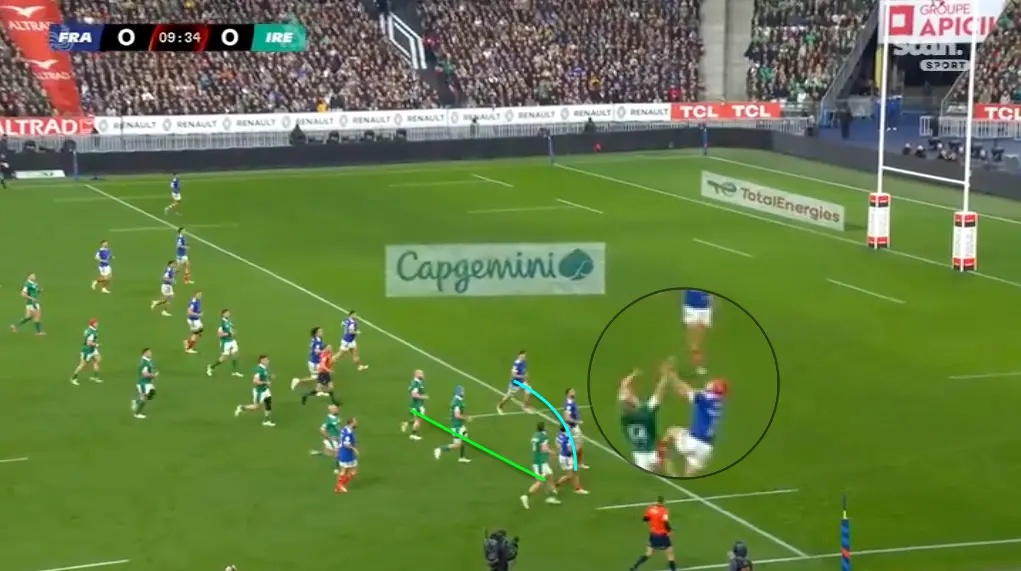
Ireland’s design here was for the lineout forwards to press up and “swamp” the drop zone, but France have a good chance of picking up the ball too because it’s fundamentally a lottery. It doesn’t matter, ultimately, because Bielle-Biarrey dominates a sluggish-looking O’Brien in the air.
What are we looking at here?
This is Ireland trying to adapt to the new game, where we seem to realise that playing through the phases as we did at our best is no longer viable.
But why?
Here’s another lineout play.
The intent here is wide. There’s no natural carrying outlet here, other than McCloskey, but we’re running him in a typical Irish #12 route on this play, where he cuts to the second layer, leaving Ringrose as the point on this carry.
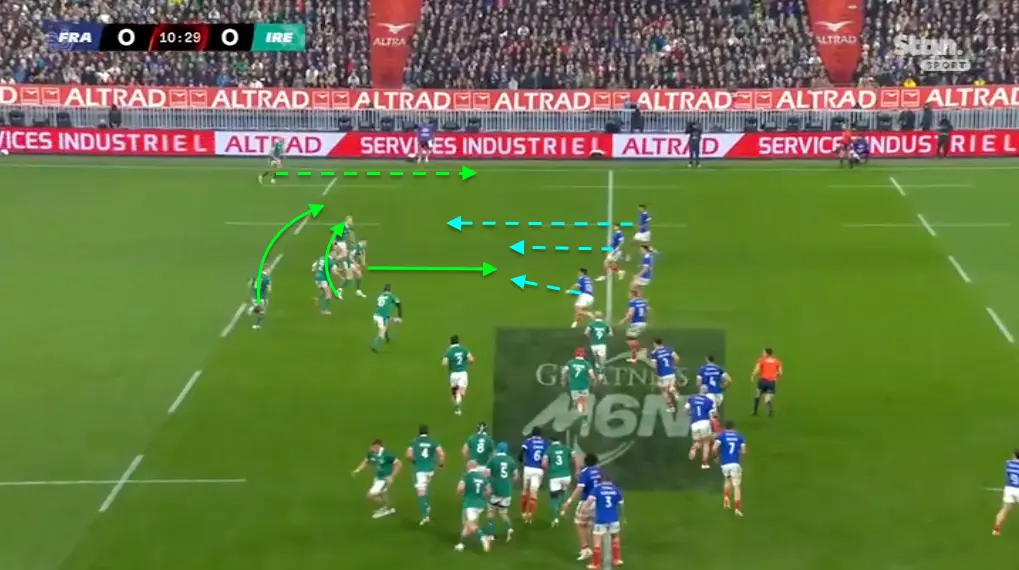
France get a one-man stop on Ringrose, which is always a bankable outcome. Ringrose is good at a lot of things, but he’s not a natural gainline winner. But we swamp the ruck.
In one play, we’ve lost four players, France have lost one, and the rest have filed out in a line behind the ruck.
Gibson Park checks the inside option but decides against it because he’s got no collision winners he can bank on.
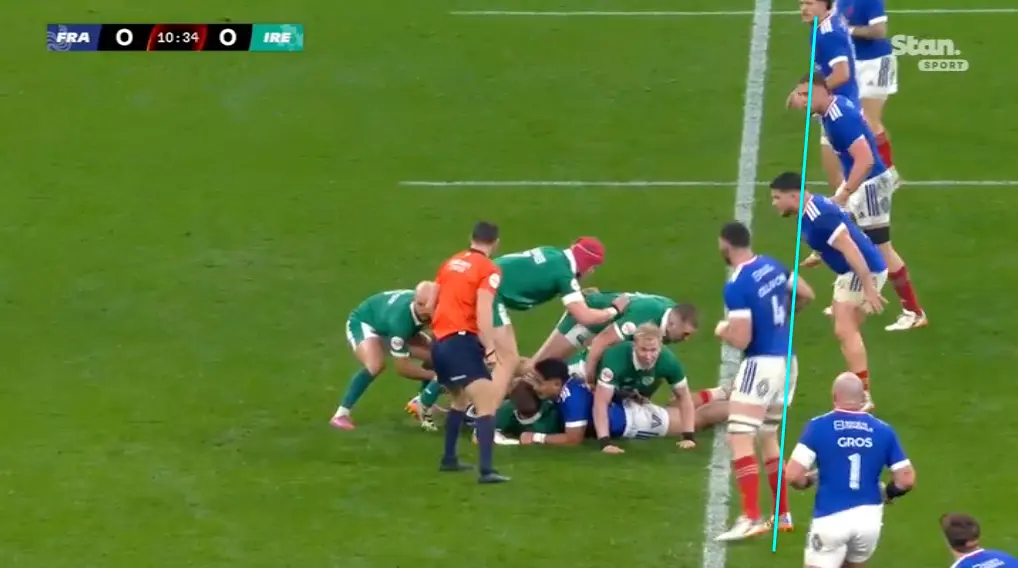
He’s looking at McCarthy as the lead carrier here, with Doris and Clarkson as ruck support. He goes against it and hits Sheehan, who has looped around as a narrow forward option, but he’s isolated. He’s stalled by a chop tackle by Jelonch, and Marchand — who sees the space around the carrier — can jackal and slow because there’s no built-in ruck support.
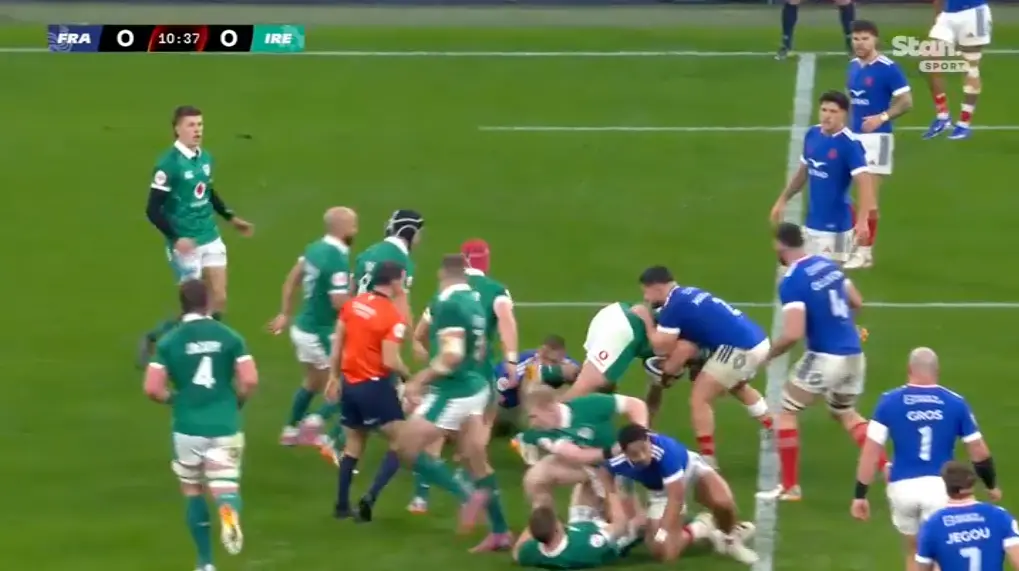
Van Der Flier gets over the ball with Doris. Look at Prendergast — he’s not filing out to the edge, he’s looking at the ruck, because I think, in part, he knows he has no direct utility on any phase that might go there, with only Stockdale and O’Brien outside him.
The key here is lost collisions.
France don’t just play “wide-wide”. That’s a misconception that popped up quite a bit after my Slide article. They back their skills, they play far looser than Ireland and with much more freedom, but it’s based on a principle of compressions.
This comes from a good bat-back, yes, but look at McCarthy; he’s out of position due to a dud-counter-ruck on the previous phase before the kick that was never on, didn’t impact anything and took him out of the central drop-back space in what came after.
It’s simple. Pass to width. A strong positive carry that gets hands through the contact, and then a pretty easy looking offload to Ramos, who just followed the ball.
There’s nothing overly remarkable here. A won collision, eye contact on the runner who’s tracking behind the contact, and the intent to play it.
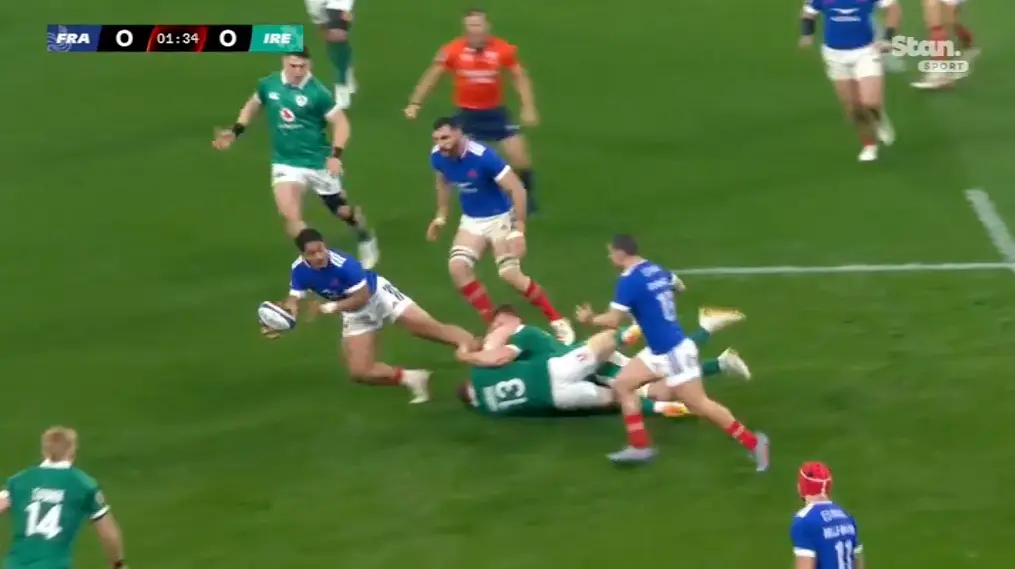
From there, it’s just about cascading support. Far from unplayable, uncoachable stuff. It’s actually really simple when you intend to play the space.
In this example, it’s just simple collision winning and positive carries, coupled up with Ireland losing multiple more players to the breakdown than France did.
On this one, Doris sees that Beirne’s poach attempt has left the inside of the ruck exposed, and France get huge gainline through it with a simple pass from Gros to Ollivon. Does Beirne need to go for a poach here?
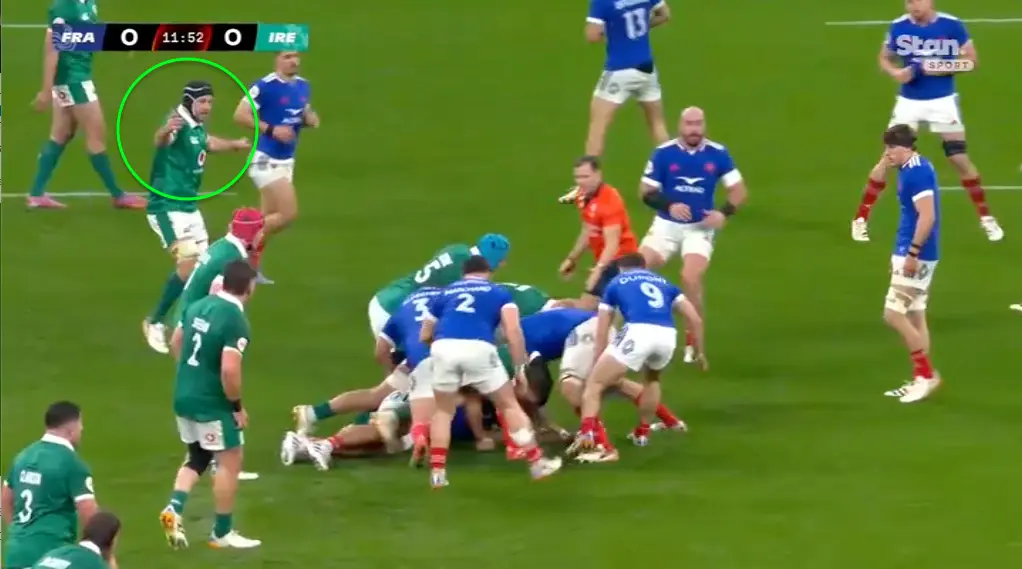
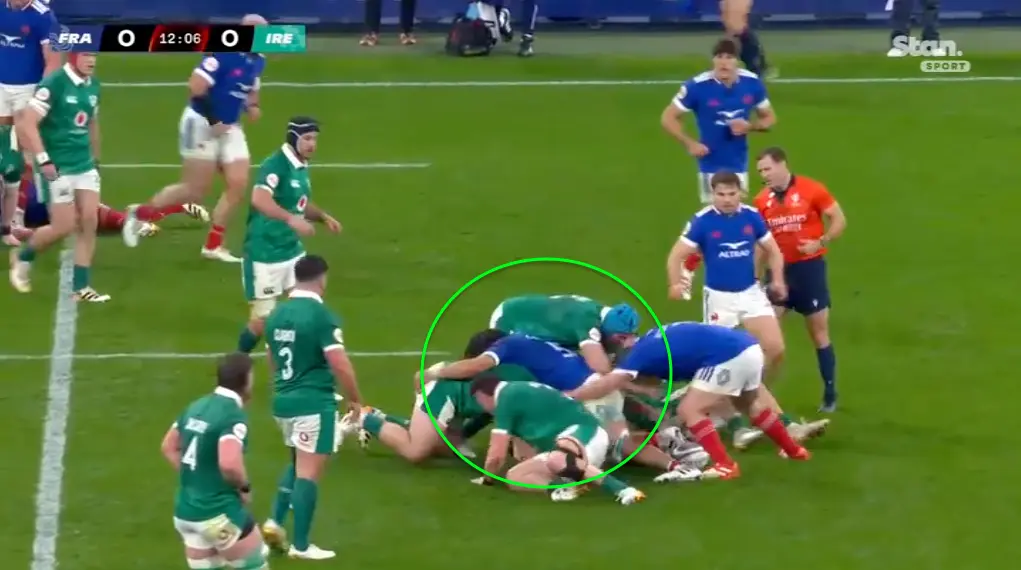
On the collision after that, we lose three players to the tackle — Prendergast joins in to make a 3-1 tackle on Marchand — and Beirne, again, tries a technical poach, reading that France are off their fee,t but that relies on the ref interpreting that, rather than it being the obvious by-product of a dominant action. He’s so late to the contact that the ruck is deemed to be formed effectively, if not fully technically.
We lose four players to the ruck, France lose three. That’s a problem for us, not for them.
All of their forwards are in that tight space, either side of the ruck so they’re not concerned with forward numbers in the breakdown. That’s a problem for us in defence because we’re compressed into the same space, while France’s backline moves around that compression freely, untethered.
When the ball comes back to Jalibert, he has so many options to choose from. He arguably chooses the worst one, only for it to be turned into a try regardless.
McCarthy puts pressure on him, but it’s from too far out. It holds Ringrose in place because he sees the two direct options who might shoot inside it if McCarthy can’t get man and ball, which he can’t.
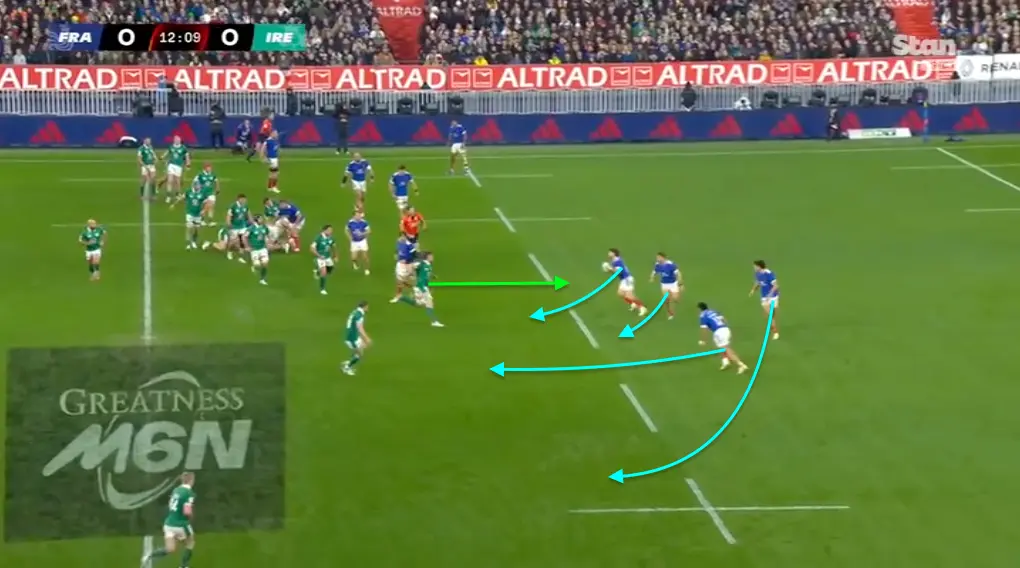
The kick, instead, exposes Prendergast covering the back-pin from a central position because O’Brien has had to — quite rightly — shoot up to cover the obvious threat on this phase.
France aren’t concerned with edge forwards on sets like these because the rucks themselves are just there to be won. They are a byproduct of a collision, nothing more. They can burn two or three forwards because they intend to use their pace and athleticism to attack in the space formed by the collision, not the technical adjustment caused by the ruck. The cleanouts aren’t the most accurate or scripted — you just win the one in front of you — because France don’t expect to drag in wingers, halfbacks or midfielders to zonally hit a ruck point as part of a wider play.
If they lost two collisions in a row here, they’d just kick the ball, but Ireland’s reaction to the collisions — not the ruck — decided for them.
This isn’t joué-joué. It’s a natural by-product of winning collisions tight to allow for creativity in obvious places.
We’re still focused on ruck stage points, even with our new intent to kick and contest. Even before the law tweak on kicks, teams were still finding a lot of joy in stuffing our transitions and overloading our lack of natural collision winners, or evasive, threatening backs.
We don’t select players for that or, if we have, it’s a recent adjustment in the face of retirements — like Paddy McCarthy coming in post-Healy once his own fitness issues cleared up, only to see them pop up again. Our issue is that we don’t have the collision winners to play simply, so the only viable option is to take the lottery of a contestable. France don’t do this. They kick to reset the positioning, but to bring their game into play, which is about crushing physicality on both sides of the ball. Any team with any tactical acumen or physical stoppers on the field is going to do the same. Don’t crowd Ireland’s rucks. Two man stops. Only jackal and counter-ruck when it’s obvious because that’s what Ireland want, and are selected to do. We have excellent ruck players on both sides of the ball, but what happens if the ruck becomes a non-contest, relatively speaking, from a numbers perspective?
It comes back to simpler questions. Can you win collisions repeatedly on both sides of the ball with fewer numbers than the opposition have to use to repel you? Our universally good catch-pass skills become useless, because the outside defence knows well where to go to stop them. If they’re 80% accurate, we go nowhere.
Defensively, France and England — and Italy this weekend — will give it three, four max goes, at generating two positive collisions, and then they’ll just go back to the contestable game where, even if we win the drop, our only threat is a 50/22, long kick up field or a cross-field kick.
This will not be unwound against the elite teams anytime soon, because it’s not a problem we can outwork.
