

That was a nightmare mid-season block by any metric.
Ten games back-to-back-to-back (to back), seven losses, three wins over Gloucester, Ospreys and the Dragons, out of the Champions Cup, and a slew of injuries right at the end when we could least afford them. The Six Nations test window couldn’t have come at a better time. Sometimes after a run like this, the best thing for you is another game to work the kinks out. Not here; this group, this coaching staff, need time away from the grind to rest and reset. It’s been a chastening run of games, where our true current level has become clearly apparent after what we can now clearly label as a new coach bounce to start the season.
And yet, I’ve watched this game back twice now, after suffering through it live, and there’s far more hope than despair. In O’Connell, Sean Edogbo, Quinn, Kelly and Wood, we saw a glimpse of the squad core to come in the next few years, as well as more good performances from stalwarts like O’Donoghue, Barron and Fineen Wycherley. That’s mixed with some of the worst individual defensive and tactical performances you’ll see anywhere at a pro level, which would be doable if it wasn’t also paired with deeply questionable effort levels in a few key defensive moments.
It’s the latter point that will rankle.
Ultimately, you look at a game like this and the halfback meltdown in the first half, there’s no point in examining it in too much detail. Last season, we had to decide whether to sign a backup #9 or #10, and we chose to sign JJ Hanrahan for games just like this one. The feeling was that Tony Butler was too raw, too inconsistent to be relied on for games like this as a core starter, and he has shown that in the last two games. It isn’t a failure on the player’s part. In an ideal world, JJ Hanrahan wouldn’t have done his hamstring kicking goals in the warm-up against the Dragons, and we’d have seen 20 minutes combined of Butler at the tail end of both of these games, where he can play a game as it’s laid out, rather than being the one to set the frame for it. Instead, he’s had to start both, and while he’s shown a few good moments, this game was a disaster, where his head seemed to go early on both sides of the ball, and he couldn’t recover before being hooked after 45 minutes.
The benefit of signing an experienced #10 is that they can help drive in-experienced or inconsistent #9s through difficult games like this. When you have to go with your third-string backup, you are relying on an inconsistent, inexperienced halfback pairing to navigate difficult games where every decision, every pass, every moment matters. That can lead to performances like this, where it feels like we have no reliable way to settle down a performance with back-to-back good decisions and good execution.
Here’s a good example.
We started really well, and almost scored if not for a marginal second movement penalty on the goal line — it looks harsher with each watchback — but what happened next is exactly what has killed us at points in this block. Cascading mistakes.
Glasgow have a lineout and move to the middle of the field. We know from watching Glasgow that they love playing to width here, but we make a key mistake early.
Butler sits down on Yule for a split second on the progression, even though he has Quinn and Barron on the inside, and that, in turn, forces Kelly to jam in on McDowall.
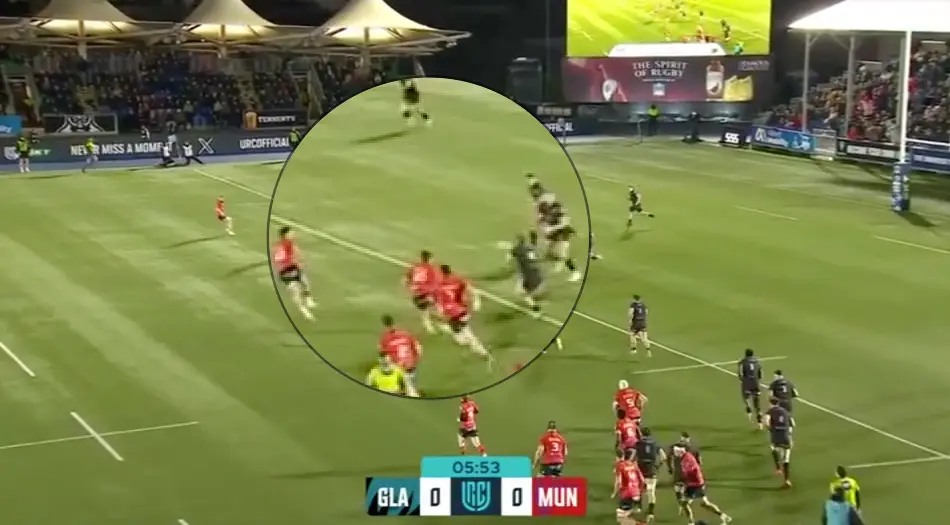
That pulls in Daly, which, in turn, puts Kilgallen on an island and Glasgow are away up the far edge on a play that should really have been stopped on their 22. Abrahams tries to scramble back, but he can’t win the collision going backwards, and Glasgow pick up a 22 entry that they convert on the far edge to go 7-0 up.
It’s a counterpunch we’ve soaked on the jaw a fair bit this season.
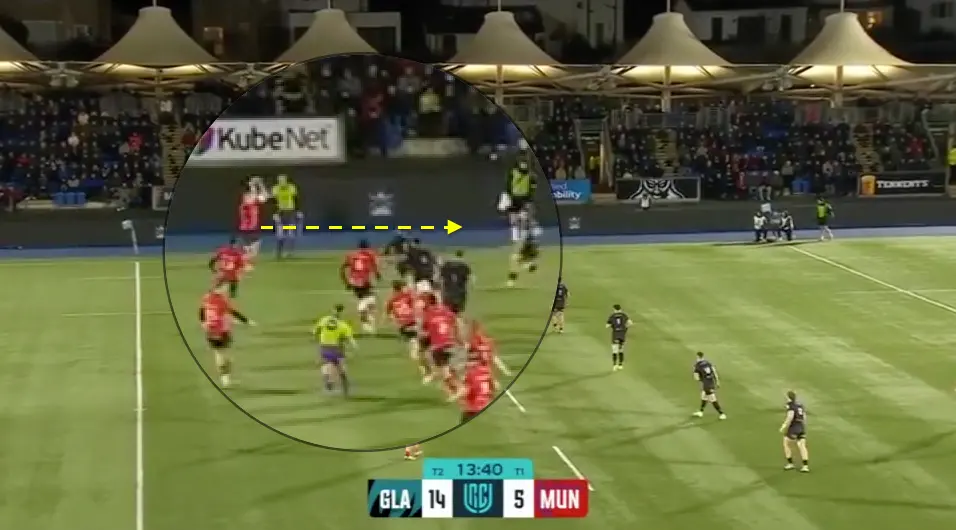
A few minutes later, we managed to get a decent lineout possession on Glasgow’s 10m line. A good throw, a good take, a good delivery and then a floaty pass over Butler’s head, and the #10 sticks to the script despite the change in picture and throws an intercept pass that you could see before the ball left his hands.
He’s off the ground, trying to catch the ball with Lancaster shooting into the passing lane.
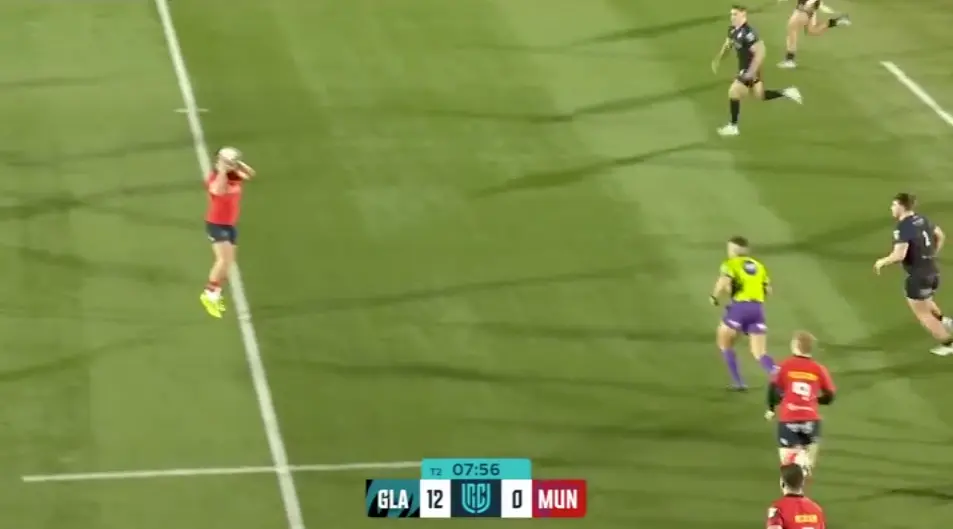
By the time he’s set to pass, this is a genuine 50/50 where the pass has to be perfect to hit Dan Kelly. Instead, it hits Lancaster so perfectly that it was like it was the intent the entire time. It wasn’t. But when you call the play, inexperienced players will go through with it, regardless of context.
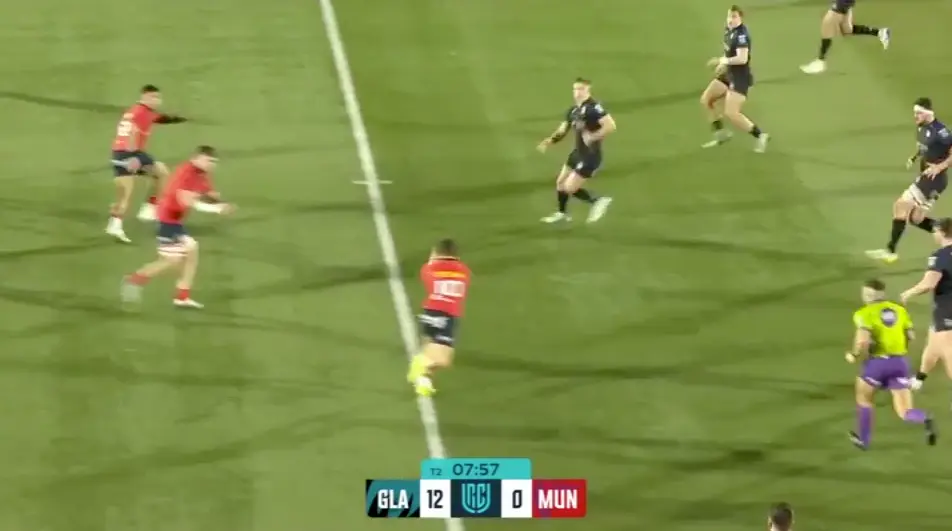
We knew Glasgow would do this.
They play with an aggressive high line on flat alignments like ours, and they almost picked off a similar flat pass a few minutes earlier during our purple patch.
That was a warning sign.
We didn’t heed it.
Our flat attacking system puts a very high premium on the speed and quality of passing at halfback, and when both are inconsistent in their delivery, especially without Casey’s laser bombs and Crowley’s carrying threat, it’s free money to blitz into lanes like this.
Our system empowers moments like this.
Even when we play with depth, we don’t quite have all the pieces to pull teams out of shape.
This is a good example, again from early in the game. We punch a great hole on the edge through a mighty Edogbo carry, but we start too narrow on the next phase to open up space.
Daly gets pressured, chucks a bobbler to Kilgallen, and has to scoot back inside with the chance gone. We can only project a block to the second last forward in the line here, by default.
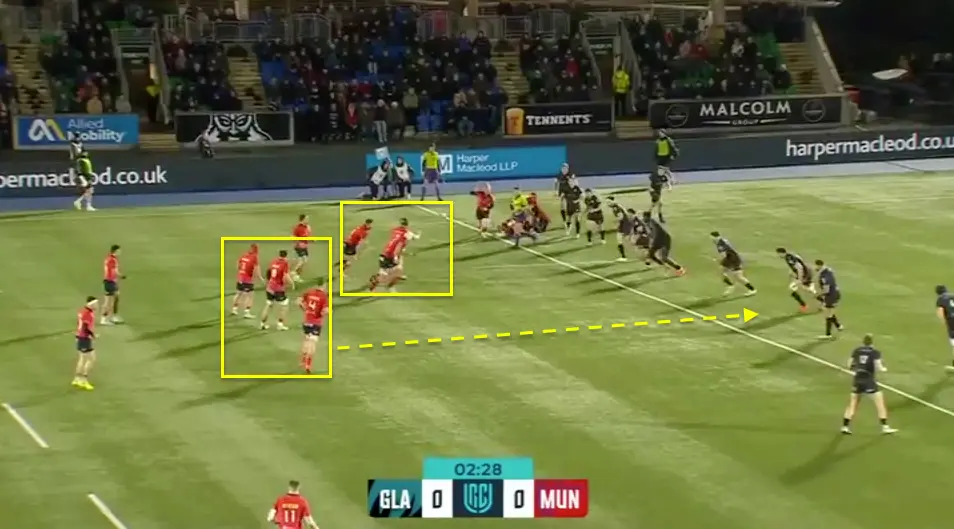
How much more dangerous would it be if everyone were two metres to the right? Now we have space to work with. Now we have momentum. Now Kelly and Daly can play with separation.
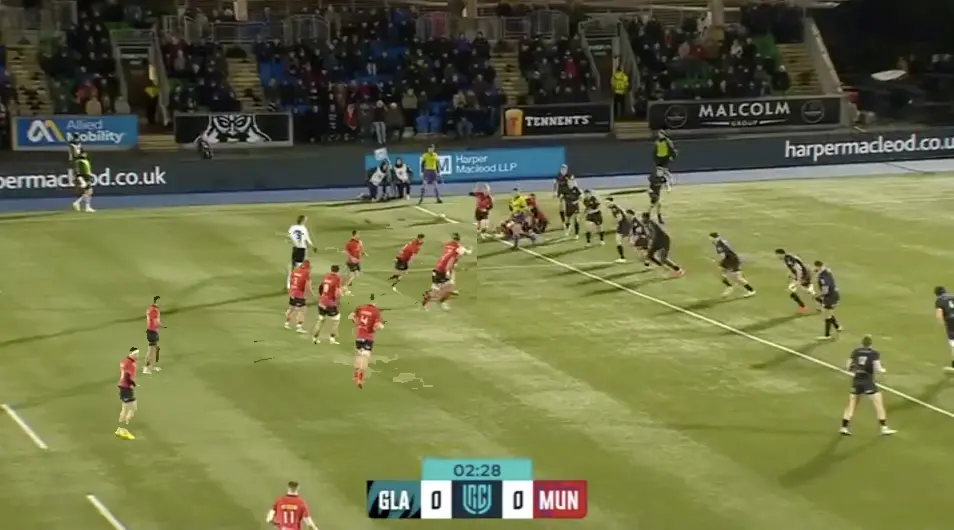
This is where you need an experienced #10 reading the space and planting his screens, or a system that drills that by default, so the #10 doesn’t need to think; it’s just there.
It’s a common thread in this team where we tend to overcomplicate almost everything we do instead of the simple thing; this is a great example, which almost ended in another Glasgow score after picking off an intercept of our own.
This is a good lineout, a good punch-up the middle, but when we come back to the blindside — as we often do — it’s crying out for Kilgallen to hit a straight line into the covering #9 and the winger stepping up from the secondary. Instead, he spills the ball on the floor as he’s trying to deliver it.
Yes, the pass from Butler is a bit of a hospital parking ticket. Kilgallen is 6’4″, and he still has to jump to take this, which stalls his running, but I’d love to see him back himself on a straight line rather than running back into Glasgow’s folding defenders.
If you’re going to cut in, you have to present well, and he got melted on the first contact from Ferrie before spilling the ball before a Munster player could secure the ruck.
Does it need to be that complicated?
***
Even the simple stuff — exiting — we couldn’t do with any reliability for much of the first 45 minutes. Kicks were either too short, too long, or kicked blindly to a side of the field where we had no chasers.
We’re the experts at making things harder for ourselves. If you can’t kick well against an on-ball team like Glasgow, you’ll spend the entire game on the backfoot, and that’s exactly how it looked.
That continued with Patterson at #9 to be fair, including this one, which ran McKay — the most dangerous transition runner on the field — into the middle of the field.
Defensively, we started to leak mistakes up the middle, too. Lee Barron sat down on a line covered by O’Donoghue and left an easy gap for Vailanu to jog through early in the second half.
But we hung in there. Scrambled well. Got another try back off a good kick by Kilgallen that sent a lineout tumbling into Brian Gleeson’s hands that he could finish unopposed.
Then we started stringing good moments together back to back.
All of a sudden, it was a one-point game, and a try bonus point from 28-5 down at the half.
Then we won a penalty on the halfway line with 10 minutes to go.
Wood went for everything off the kick, and the wind pushed it dead. A big moment for a lad making his debut at this level, and it passed him by.
Scrum. We wobbled at it, because Ala’alatoa was doing (another) 60 minutes and John Ryan was covering loosehead off the bench. Freekick. Glasgow won a penalty on the scramble. They kicked it for their first successful penalty of the URC season to take it to a nine-point differential.
From there, we did well to hold Glasgow out from putting gloss on the scoreboard, but the damage had been done in the first half. The frustrating part is that we did more than enough to win this game in almost every metric bar the scoreboard.