


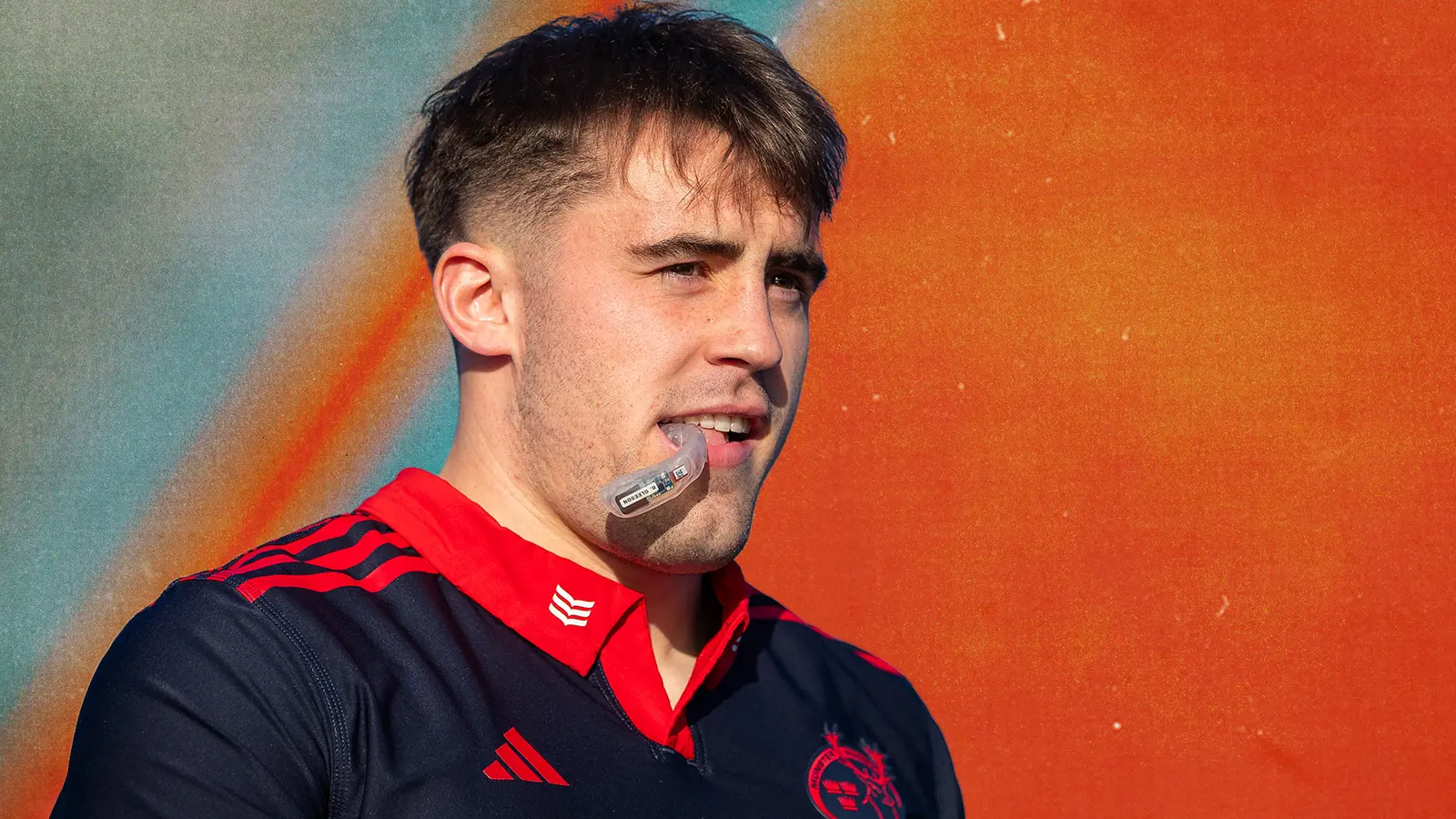
In my time doing Three Red Kings, I have written five Red Eyes about Castres Olympique.
This is my sixth.
I think it’s fair to say that both clubs are sick of the sight of each other. We are both the guy who says “tomorrow night?” when you say “we should meet up for a pint sometime” in an attempt to leave the conversation, for each other. When we go to the other’s house, we steal their PS5 and let the tap run into a plugged sink upstairs.
The adage of familiarity breeding contempt doesn’t cover it. We are like conjoined twins in a blood feud over which shower gel to use.
 I could have genuinely picked 30 photos between these two teams for this one.
Munster vs Castres Olympique; we’re destined to do this forever.
In the last four games, the average margin of victory has been three points, which seems to suit this fixture down to the ground. Tight, high tension, ugly — that’s how it’s tended to go.
This time, however, we need a good bit more than that. We need to win by +8 points and score a bonus point try. That’s what we need if we want to sneak into second place — with a home knockout game — or get as high up in the seedings as we can for a decent away fixture.
That’s the job.
Castres are currently last in this pool on five points, but they haven’t thrown their hat at this game from a selection perspective at least. They’re also 10th in the TOP14 right now, so you’d wonder how much focus their game against Bayonne will take from them in the build-up. A win here would be huge for them — they’ve never won in Thomond Park — they have a decent shot of making the Challenge Cup at least, if not fourth, if results go their way. What’s their interest level in that? We’ll soon find out, but make no mistake, if we want them to check out early, we’ve got to start strong and keep the foot down for the entire game.
Can we make the Thomond Park factor work for us again? We’ll need what we brought in Toulon, plus a little bit more. There’s no room for headloss or daft errors here; do what we do well, and we’ll win well. Bring the scattiness that has bedevilled our season at points so far, and it’ll get messy.
Heads on. Fire on. Blow them away.
Munster: 15. Shane Daly; 14. Thaakir Abrahams, 13. Tom Farrell, 12. Alex Nankivell, 11. Ben O’Connor; 10. Jack Crowley, 9. Craig Casey; 1. Jeremy Loughman, 2. Niall Scannell, 3. Michael Ala’alatoa; 4. Jean Kleyn, 5. Fineen Wycherley; 6. Tadhg Beirne (C), 7. Jack O’Donoghue, 8. Gavin Coombes.
Replacements: 16. Lee Barron, 17. Michael Milne, 18. Oli Jager, 19. Edwin Edogbo, 20. Brian Gleeson, 21. Ethan Coughlan, 22. JJ Hanrahan, 23. Dan Kelly.
Castres Olympique: 15. Theo Chabouni; 14. Christian Ambadiang, 13. Vuate Karawalevu, 12. Jack Goodhue, 11. Geoffrey Palis; 10. Pierre Popelin, 9. Jeremy Fernandez; 1. Atunaisa Sokobale, 2. Loris Zarantonello, 3. Will Collier; 4. Gauthier Maravat, 5. Tom Staniforth; 6. Baptiste Delaporte, 7. Baptiste Cope, 8. Florent Vanverberghe
Replacements: 16. Teddy Durand, 17. Antoine Tichit, 18. Aurelien Azar, 19. Leone Nakarawa, 20. Tyler Ardron, 21. Santiago Arata, 22. Enzo Herve, 23. Atu Manu
Here’s what Castres look like through the lens of these Top 14 team-profile tables — i.e. how they build, where their tries come from, and what they’re not trying to be.
Essentially, Castres are a launch + patience team who’ll grind through phases and punish turnover ball — but they’re not explosive, not an offload/evade side, and they don’t score off kick-return chaos.
How they score tries, and what that tells you
Efficiency In Possession (relative to other TOP14 teams)
- 15.7 possessions per try → 12th/14 (i.e. one of the least “easy-try” attacks in the league).
Try Origins
- Set-piece tries: 57.9% → 5th/14
They’re a set-piece launch side — but not necessarily a maul-drive side (more on that below). - Turnover tries: 21.1% → 3rd/14
They’re dangerous when you hand them transition ball. - Tries from own half: 28.9% → 3rd/14
A lot of their scoring is “field-flip into finish” — not 10m from the line, but from broken/transition moments. - Kick-return tries: 5.3% → 14th/14 (dead last)
This is big: they are not a “run it back and slice you” team off backfield receipts.
What that usually looks like on the pitch
- Win/earn a set piece → take the first strike option if it’s on → if not, settle into phase pressure.
- Or: force/collect an error/turnover → attack the space quickly → and they’re clinical when they do break you (see below).
What their attack actually is (ball-carry and skill profile)
Collision + gainline
- Dominant carries: 33.3% → 14th/14 (lowest in the league)
- Gainline: 58.0% → 11th/14
- Evasion: 18.8% → 13th/14
- Offloads leading to a try/linebreak: 6.5% → 14th/14 (lowest)
So they’re not:
- a smash-and-win-collisions team,
- a wiggle-through-evasion team,
- or an offload-chain team.
I think, defensively, we should stack up really well with them based on their data profile and what I’ve seen of them this season. They have a lot of size in their outside backline — Ambadiang, Karawalevu and Palis are all physically imposing runners — but I think we should be able to handle most of what Castres will try to bring through the forwards in phase play.
At the offensive, they’re missing key offensive ruck players like Gallison, Babillot and Ducat, who are high-volume, high-efficiency cleaners for them. They’ll be vulnerable to pressure here, although we’ll need to use the jackal sparingly after the last few weeks.
But Castres are clinical when they do break through the line
- Breaks-to-try: 45.1% → 4th/14
That combination is classic “Castres” outside of the shithousing and kicking: fewer clean breaks created, but when one appears (often off turnover or a launch), they convert it.
Phase shape, movement, and kicking tendencies
Phases
- 5+ phase rate: 13.7% → 2nd/14
That’s the clearest style flag on the whole sheet: they’re a patient team. They’ll sit in sequences and keep asking you to tackle. For reference, that
Where they play
- <10m movement: 60.2% → 4th/14
Lots of short, close-to-ruck work: tight carries, corner-to-corner inching, not huge “touchline-to-touchline” swings. They’ll do this to milk penalties and swarm offensive breakdowns before kicking to contest in the early to mid-game. - Wider than 1st receiver: 21.6% → 6th/14
They will get beyond the tip-on layer — but usually as part of the structure, not pure width for width’s sake. Goodhue is a key player for this movement.
Kicking
- Possessions ended by kick: 41.0% → mid-pack, and for reference we’re currently sitting at 40.2% on that metric.
- Contested kicks: 12.5% → 5th/14
Translation: they’ll kick, and they’ll compete when they do, but they’re not living in a pure off-ball territory here. The bigger story is still phase patience + hurting you on transition.
Set-piece: stable platform, not a maul-try vending machine
Scrum/lineout stability
- Scrum own win 77.2% (lower half), lineout own win 81.9% (mid-upper).
- They’re fine here — more “platform” than “wrecking ball”.
- A performance like we showed against Toulon will do the job here.
Maul
- Mauls per try: 64.0 → 13th/14 (2nd worst)
This strongly suggests they rarely score maul tries relative to how often they maul. Of course, they’ll be dangerous from the 5m line — who isn’t — but we should be able to limit their momentum here, and legally too.
So when you see 57.9% of tries from set piece, don’t automatically picture them parking it on our line — it’s more likely:
- first/second-phase plays off lineout/scrum, and/or
- structured sequences starting from set piece (where they can get into that 5+ phase identity).
Defence: exit competence, but not dominant or “jackal rich”
- Tackle success: 84.4% → 12th/14
- Dominant tackles: 4.9% → 12th/14
- Misses leading to try/linebreak: 32.4% → bottom half
- Rucks per jackal: 56.9 → 14th/14 (worst)
They do not consistently win breakdown turnovers via jackal.
But
- Exit success: 89.5% → 6th/14
They can and consistently do clear their lines, but they will have a pop from distance here too — they aren’t just kick and chase from that zone.
So, defensively, they profile more as: organise, survive, exit, rather than choke you with dominant collisions and steals. When that system breaks down, it breaks down hard, and they concede linebreaks and tries regularly from range as a result.
What Castres do well
- Stay in the fight through phases (2nd in 5+ phase frequency).
- Launch off the set piece (top-5 set-piece try share), then keep pressure on.
- Punish transition from range (3rd for turnover-try share; 3rd for tries starting in own half).
- Finish chances when they do break you (4th breaks-to-try conversion).
- Exit cleanly (top-6 exit success).
What they don’t (relative to the other TOP 14 sides)
- They’re not a collision-winning carry team (dead last dominant carries; low gainline).
- They’re not evasive (13th evasion).
- They’re not an offload-to-chaos team (dead last for offloads leading to try/linebreak).
- They’re not a kick-return strike team (dead last kick-return try share).
- They don’t generate many jackal turnovers (worst rucks-per-jackal).
- They’re not a maul-try monster (2nd worst mauls-per-try).
What that means for us
Don’t feed their transition game: loose carries, poor kick-chase, soft turnover ball is how you let them access their strike runners from range, or give the likes of Ambadiang or Karawalevu a one-on-one with Abrahams in space.
Win first phase vs set-piece: their set-piece tries look much more like launch → shape → phases than pure maul bullying, so any point of difference we can get here will be incrementally more valuable.
Make them score from kick returns: it’s their weakest try source by a mile. That should empower us to kick to them at a high enough volume with short and mid-range contestables. We want to pressure Palis in the air, and get Ambadiang turning under pressure from Abrahams on the chase. They are not a massively scrum-dominant team either, so that should empower us to kick a little more freely than we would otherwise.
If we can lock down their launch points and apply pressure on ours, we’ll be most of the way there.
Stretch them with speed, not offload chaos: their defensive profile isn’t built around dominant hits + jackals, so the opportunity is pace, reload speed, and decision-making, not trying to beat them at their own patience game. If we can stay patient up the middle of the field, avoid any daft turnovers (this is key), they will break.
We can outlast them, we can break them down, and if we can get scores on the board early, we can knock them out of the tournament half an hour before it’s confirmed officially.
