


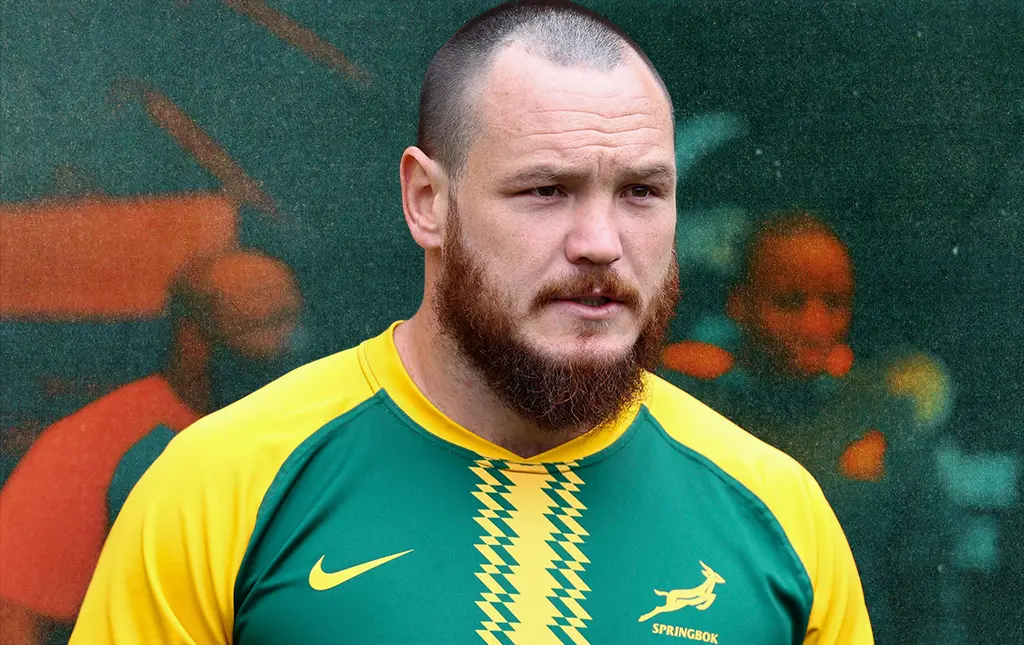
Munster have, arguably, needed a power hooker profile in the squad for the last five years. Arguably longer.
Hell, go back to 2015, and you’ll see Munster trying (and failing) to get dispensation for then Wallaby captain Stephen Moore. David Nucifora (boo! hiss!) did his usual business at the time — stalled making a decision until the player decided to take the offer at the Reds, so he could plausibly state he didn’t block it — and Munster missed out on a proper world class player, right when he was needed.
Since then, Munster have tried to sign an NIQ hooker of a similar profile across the years but have ran into similar issues — no dispensation, right guy not available or, lately, the budget picture changing late in the contract window — but we’ve finally got our man for next season.
Marnus Van Der Merwe

Marnus van der Merwe’s rise has been pretty steep. He moved to Wales in 2024 after establishing himself at the Cheetahs, and he immediately became one of the URC’s best forwards, named Supporters’ Player of the Season and selected in the URC Elite XV for last season. When I tell you that his signing was mostly unheralded, believe that. He was seen as a handy and good value for signing for the Scarlets, but very few people thought there was a potential Springbok there; yet he made that level in the summer of 2025, after Erasmus rewarded him for an outstanding season. When his contract was coming due this season, there was a ton of interest in his services from the Gallagher Prem, the South African URC teams and the TOP14, but Munster won the race for his signature, and he joins the province on a two-year deal from the summer of 2026.
So, why would we want a Power Hooker of Van Der Merwe’s profile, especially in our attacking system?
In modern systems, hooker isn’t just a set-piece specialist; he is repeatedly positioned as:
- the front-door carrier in and around rucks,
- the link into a forward pod,
- the first cleaner after contact,
- and frequently the tip-on/unders line option.
That means if your hooker is a genuine power threat, you’re upgrading:
- the quality of your most frequent forward involvements,
- not just adding one more carrier somewhere.
In a 1-3-3-1 system, those involvements are gold because the shape generates lots of medium-width, medium-traffic carries where winning a half-metre matters more than 2 metres in edge spaces.
Power hooker = ruck speed insurance
A 3-3-1 shape needs tempo — it’s designed to stretch and isolate, but it only does that if you get:
- quick ball after contact, and
- stable rucks without committing three cleaners every time.
A power hooker typically brings two things that protect ruck speed:
- post-contact metres/leg drive (less likely to get folded behind the gainline),
- cleanout dominance and repeatability (he can be a reliable first cleaner).
If you can win collisions with two-man support instead of three, you keep more players in shape, which is the entire point of that flat shape.
It stabilises your red-zone efficiency
The team playing this flat can often struggle in the 22 if the defence can set and compress. A power hooker helps because:
- You can run high-probability entries (short carry + quick recycle),
- And you can keep your shape live without constant pick-and-go sets, which compress your own line as much as it does the opposition.
So what’s the Story with Marnus Van Der Merwe?

Scarlets’ season-to-date numbers do not flatter Marnus van der Merwe. But if we’re evaluating him through a lens of what Munster are signing for next season, what we’re really seeing is a player operating as the primary collision winner in a struggling pack, and a struggling squad.
Make no mistake about it, though, Van Der Merwe is the exact kind of power hooker we’ve been looking for. At 6’1″ and 115kg, he’s immediately bigger and heavier than most of the hookers we’ve used in the last decade.
At a base level, Van Der Merwe is a forward who can (a) force the defence to spend bodies in the middle third, (b) keep our tempo alive at the ruck, and (c) add genuine breakdown disruption without compromising his core hooker duties.
Now — some inside baseball. I heard Van Der Merwe was being signed two months ago, so I ran his numbers back then relative to the elite hookers in the game for 2024/25 but, since then, the OPTA stats for this season have updated twice, so I ran his numbers again relative to a few other hookers who are available and/or playing for some of the best club sides in the game.
There have been some changes season to season, so we’ll look at those.
What changed vs the Oct 8th “elite hooker” benchmark?
Van Der Merwe’s 2024/25
- Dominant carry %: 49.5%
- 2+ tacklers %: 66.7%
- Gainline %: 58.3%
- Evasion %: 22.1%
- Attacking rucks/80: 10.7 at 89.9% effectiveness
- Tackles/80: 17.5 at 86.2% success
Van Der Merwe’s 2025/26 (current season feed, 435 mins)
- Dominant carry %: 30.4%
- 2+ tacklers %: 55.3%
- Gainline %: 46.8%
- Evasion %: 6.5%
- Attacking rucks/80: 15.4 at 90.5% effectiveness
- Tackles/80: 11.2 at 88.4% success
- Jackals/80: 1.5
- Defensive rucks/80: 10.8 (eff. 20.3% per your feed)
- Try involvement/80: 0.4 (tries +/- -10 in his minutes)
The Differential
| Metric | 2024/25 | 2025/26 | Change |
|---|---|---|---|
| Dominant carry % | 49.5 | 30.4 | -19.1pp |
| Gainline % | 58.3 | 46.8 | -11.5pp |
| 2+ tacklers % | 66.7 | 55.3 | -11.4pp |
| Evasion % | 22.1 | 6.5 | -15.6pp |
| Att rucks/80 | 10.7 | 15.4 | +4.7 |
| Att ruck eff % | 89.9 | 90.5 | +0.6pp |
| Tackles/80 | 17.5 | 11.2 | -6.3 |
| Tackle success % | 86.2 | 88.4 | +2.2pp |
Why the “carry regression” is not the red flag it might look like
When the Scarlets lost Vaea Fifita in the summer, they lost the only other forward who bent defences. That creates a very predictable dynamic:
- Opponents could pre-load towards Marnus as the one credible power threat.
- His carries become more front-on, known-role, two-man clamps.
- The space to “win pretty” (evasion, late footwork into soft shoulders) shrinks.
That is exactly why you can see:
- dominant % and gainline % fall, but
- 2+ tacklers remain a defining feature (55.3%)
Defences are still spending two men on him, but Scarlets simply haven’t had enough adjacent threat to punish those extra bodies, so the result looks worse from a data perspective relative to what he showed last season in a Scarlets team playing much better than what we’ve seen this season. He’s also been used off the bench a lot more, in a team that hasn’t been finishing games very strongly, bar some outliers.
This is where the “Munster fit” becomes obvious.
Van Der Merwe isn’t just a powerful carrier; he’s giving us elite-level defensive breakdown disruption. As it stands right now at the time of writing, he’s one the best defensive ruck players in Europe, and forcing turnovers and disruption at an elite rate.
Scarlets’ season has likely suppressed Van Der Merwe’s headline carry outcomes, but it has also stress-tested the precise traits Munster are buying: collision gravity, ruck tempo, and breakdown disruption.
If we put him into a better platform environment with more credible threats around him, the carry outcomes have a reasonable path to rebound, while the elements that already translate cleanly to Munster (ruck efficiency, jackal threat, defensive involvement) are already showing at a very high level.
He immediately improves our front row options — either starting or off the bench — and brings a profile that McMillan used heavily at the Chiefs; Samisoni Taukei’aho. In the absence of contemporary stats for Taukei’aho, I’ve found the next best match for Van Der Merwe in the elite club game: Luke Cowan-Dickie.
If you don’t know much about Van Der Merwe, but you’re familiar with Lions hooker Luke Cowen-Dickie; they’re both in that same “power hooker” build who specialise in tight traffic, but they express it differently.
Cowan-Dickie is still the more obvious front-foot profile — better gainline (55.2% vs 46.8%), higher evasion (14.3% vs 6.5%), and a bit more defensive volume (12.6 tackles/80 vs 11.2). Van der Merwe is the cleaner system lever: similar dominant-carry rate (30.4% vs 30.2), better ruck conversion (90.5% vs 87.7), and the bigger breakdown footprint (1.5 jackals/80 and 10.8 defensive rucks/80 versus 1.2 and 7.6).
They have many similarities, if you want to visualise what Van Der Merwe will bring.
The Video

That’s the data side of it, but what does he look like on grass?
I mentioned earlier in the article about Van Der Merwe’s carrying percentages going down this season, and I want to showcase part of why that is.
Van Der Merwe gets absolutely smoked in a two-man tackle because the latch is nowhere near him as he takes possession.
He still retains the ball, despite being smoked, but that’s part of the Scarlets’ many, many problems this season.
But don’t mistake that for being representative of what Van Der Merwe is all about. He’s a bull in contact.
He immediately up-scales our 5m tap and go game and can regularly get gainline and beyond in tight exchanges. In open space, he’s explosive, heavy and dominates contact with real pace and power.
Defensively, he’s a classic pillar defender who uses his jackal threat to draw defenders, and regularly buzzes defensive rucks — as his stats show. You can see him doing just that in this sequence against Bordeaux. He doesn’t win a jackal turnover here, but he’s a strong pillar that always draws a cleaner.
When he makes his entries, he reminds me a lot of Chris Cloete — very quick, very low and incredibly strong once he gets that contact with the ball.
What about his lineout? It’s generally really good, as long as the system itself is strong. Like most hookers, if you’re constantly asking them to make low percentage throws in contested windows, their numbers will go down. When your lineout works, Van Der Merwe will work, and once he gets that ball down into the boot of the maul, he’s powerful, direct and a constant threat off the back.
In short, what Van Der Merwe does well is exactly what Munster need and have needed for several years. And that’s really something to look forward to.
