



Part of the reason why the first 20 minutes against Bath looked so bizarre is that we conceded so much ground so easily.
It simply has not happened at all this season so far, so when we kept finding ourselves camped inside our own 22, it looked… weird. This is because our defence has been operating at an incredibly high level so far this season, with some of our metrics tracking as best in league and best in Europe.
But the question is “why”?
Last season, Munster’s defence was arguably our Achilles heel. It went from being a core strength in the previous two seasons — look at the run-in during 2022/23 and most of 2023/24 for an example — into being a structural weakness during 2024/25.
It shows up on a fundamental level.
Defensive read-out (points conceded + tries conceded)
| Season (Munster finish) | PA (points conceded) | League rank (PA) | TA (tries conceded) | League rank (TA) |
|---|---|---|---|---|
| 2022/23 (5th) | 357 | 1st (best) | 47 | 1st (best) |
| 2023/24 (1st) | 318 | 1st (best) | 38 | 2nd (behind Glasgow on 35) |
| 2024/25 (6th) | 429 | 8th | 59 | =7th (tied with Sharks) |
If you treat these as standard 18-game regular seasons, that’s roughly:
- 2022/23: 19.8 PA/game, 2.6 TA/game
- 2023/24: 17.7 PA/game, 2.1 TA/game
- 2024/25: 23.8 PA/game, 3.3 TA/game
Assessment:
Two seasons of “title-contender” defence (2022/23, 2023/24)
- 2022/23: We were the best defence in the league on both measures (fewest points conceded and fewest tries conceded).
- 2023/24: We went again — best on points conceded and very close to best on tries conceded (2nd).
This is the profile of a side that can consistently control games: even when the attack fluctuates, the defensive floor stays high.
2023/24 is the peak: a genuine suppression year.
Dropping from 357 → 318 PA (−39) and 47 → 38 TA (−9) is a meaningful step-change. Over a season, that’s the difference between “very good” and “pace-setting”.
2024/25 is a clear regression to mid-table defence.
The swing from 2022/23 to 2024/25 is stark: +111 points conceded, and +21 tries conceded. In practical terms, that’s moving from conceding roughly under 18 points / ~2 tries per match to nearly 24 points / ~3+ tries per match — which typically forces your attack to chase games rather than manage them. If you remember last season, that certainly tracks with the eye test.
Across the last three seasons, Munster’s defence goes elite → elite → mid-pack, and the league finish tracks it. When we keep opponents in the low 300s PA / 40s TA, we’re a top seed profile; when we drift into the 420s PA / ~60 TA, we look like a solid enough playoff team that needs our attack to win shootouts rather than winning with control.
So far this season, we’re trending as a top-two defence in the league.
Where Munster are right now
Munster totals: PA 126, TA 19, DIFF +46, PTS 29 (with TB 4 and LB 1), 6 wins + 1 loss with a losing BP.
Per-game pace:
- Points conceded: 126 / 7 = 18.0 per game
- Tries conceded: 19 / 7 = 2.7 per game
League context
On raw concessions (with the proviso that some teams had a weather-disrupted earlier round, so have one fewer game played):
- Points conceded (PA): Munster are roughly 5th-best (behind Stormers 87, Glasgow 99, Edinburgh 112, Cardiff 122).
- Tries conceded (TA): Munster are joint 5th on 19 (behind Stormers 10, Glasgow 12, Cardiff 16, Edinburgh 18).
So: Munster’s defence is top-5 quality, but not currently the competition’s reference point, albeit with having played Stormers, Cardiff and Edinburgh already, as well as having two interpros in the bank.
Trend vs our last three-season picture
If Munster held this pace across an 18-game league season, it projects to roughly:
- ~324 points conceded
- ~49 tries conceded
That would be much closer to our two strong defensive years than to last season, where we drifted into the 420s PA / ~60 TA range.
The key takeaway
- Positive trend: points conceded rate (~18/game) is in the contender range.
- Watch-out: tries conceded (~2.7/game) is still mid-pack for an outright #1 seed profile. The Stormers and Cardiff games in Thomond Park were the big drag here.
- Benchmark: Stormers are setting an extreme defensive bar (87 PA, 10 TA) — that’s the gap we need to close if “finish top” is the goal, rather than “finish top-4”.
We haven’t seen a massive inflation in try scoring year on year. It’s slightly up on last season, slightly below the season before, so most of what we’re seeing here is scalable, especially with a lot of fixtures against the current top four sides and against dangerous opponents — Connacht, Edinburgh — out of the way already, and soon to be finished with Leinster completely in the regular season.
But what does this mean in practice?
Last season, we seemed to be blitzing a lot more than in the previous two seasons. What does this mean? In general, a blitz profile defence sees a heavy focus on linespeed, with a premium being placed on taking the space first and forcing a reaction out of the opposition.
That leaves more scope for conceding linebreaks, but can produce more dominant stops than a flatter defence. This season, it looks like we’ve tapered our blitz back a little to only really focus on the pod closest to the ruck, with a very mobile underlapping cover behind the ruck.
The data also shows that we are attempting fewer jackals, too — we’re in the bottom twenty teams Europe-wide on that metric this year — but what we lose in turnover attempts (and subsequent penalties when we get it wrong) we’re gaining in defensive solidity. There is a balance to be struck on that. Most top sides have an active turnover threat, but we showed against the Ospreys that we can activate that side of the game too.
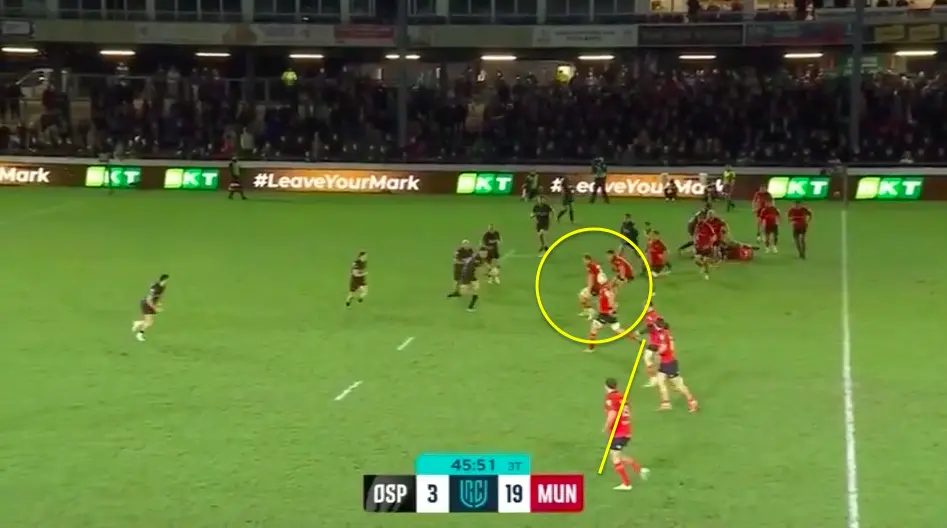
This is a really good defensive sequence against the Ospreys that shows a lot of these qualities.
It ends with a breakdown steal by Paddy Patterson — he saw a window and went for it — but there’s so much defensive control in this sequence that’s worth looking at.
The outside line isn’t looking to blitz up into the opposition layers either; they’re there to cover any wider progression of the ball laterally.
Our lead defender here is Gavin Coombes. Neither he nor Barron is looking to “chop” tackle here, because the intent is to go high on the carrier.
None of our highest volume tacklers so far this season — Coombes, Kleyn, Wycherley and O’Donoghue — have a tackle profile higher than 20% when it comes to tackles that are below the hips and waist. The intent is always to tackle high, but not in the way you might think.
The intent is to target the ball, but not directly shoulder-on. You’ll see this a lot with Munster this season; we’re trying to swing around while the ball is still off the ground to slow the carry, draw cleaners and then use the second defender to directly attack the ball. That sometimes leads to ground being ceded if the latch comes early.
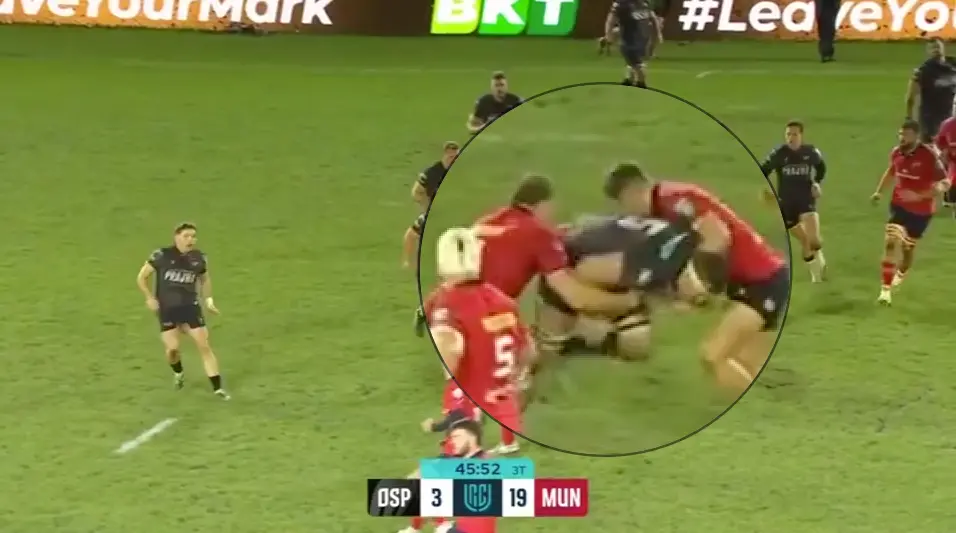
But that buys time for the fold defence to transit from the previous ruck, pack the pillar around the ruck and use the flat line from the previous ruck to create the next half-blitz. The second tackler here is expected to try and rip the ball and generally make themselves a nuisance at the next ruck. Poach if it’s on, but generally make yourself someone who has to be cleared out.
On the next phase, Kendellen shoots up on the inside shoulder of Fineen Wycherley to act as that second man, with the idea that Wycherley will be the first man making contact. The line from the previous ruck transits across to fill the space.
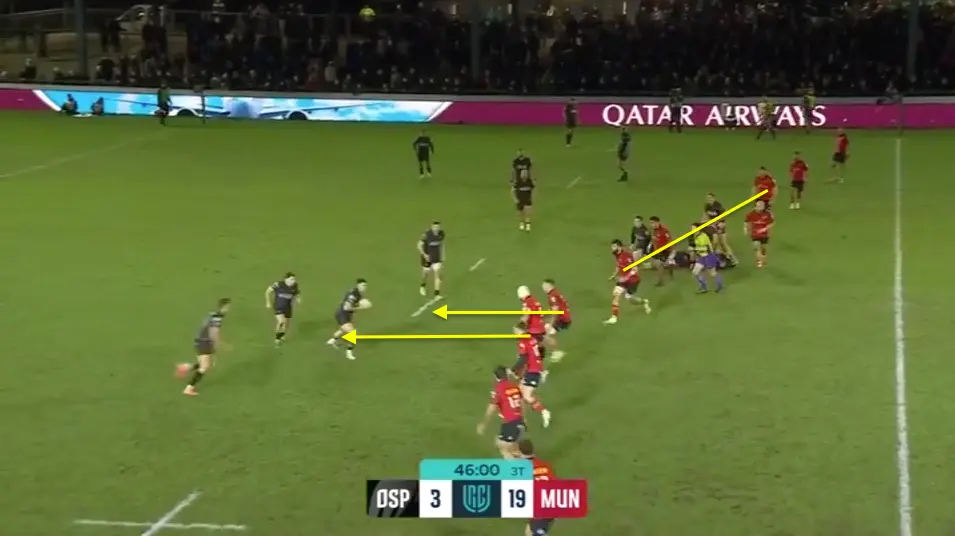
We’re essentially trying to buy time here; slow the recycle of the ball without necessarily poaching — that can lead to quick ball and a gap that the opposition can shoot at.
The angle of the carry involves Crowley as the outside shoulder, so Wycherley gets his body on, while Crowley assists. Kendellen has a sniff at the ruck but knows well he’s got to stay out of it to stay on scheme.
When the ball comes back, our line is packed.
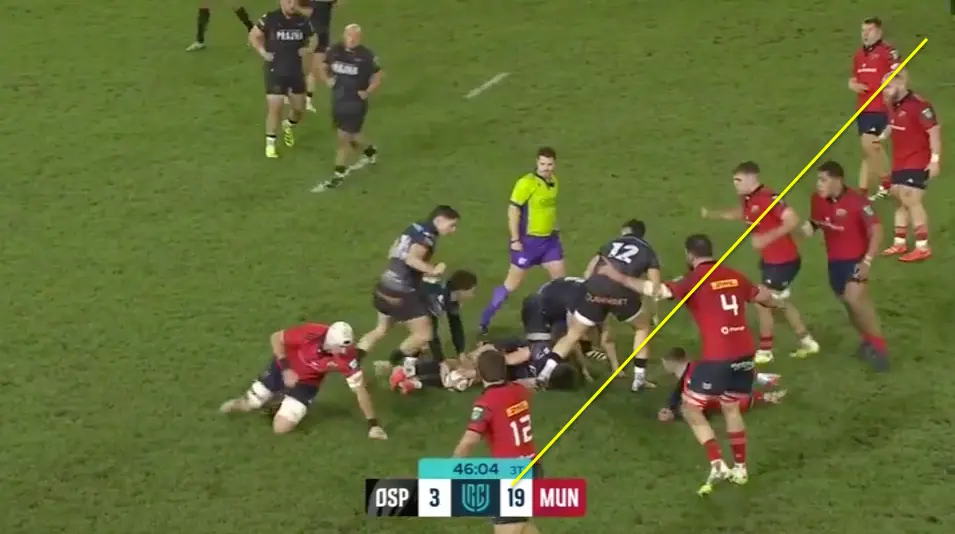
On the next ruck, we repeat the system again. O’Donoghue pressures up on the pod — takes the central target but leaves wiggle room to drift onto the outside pod. There’s no screen option here, so he can be aggressive. Barron joins as ball target, with Loughman holding on the inside ball option. Everyone else pushes to get across the face of the ruck.
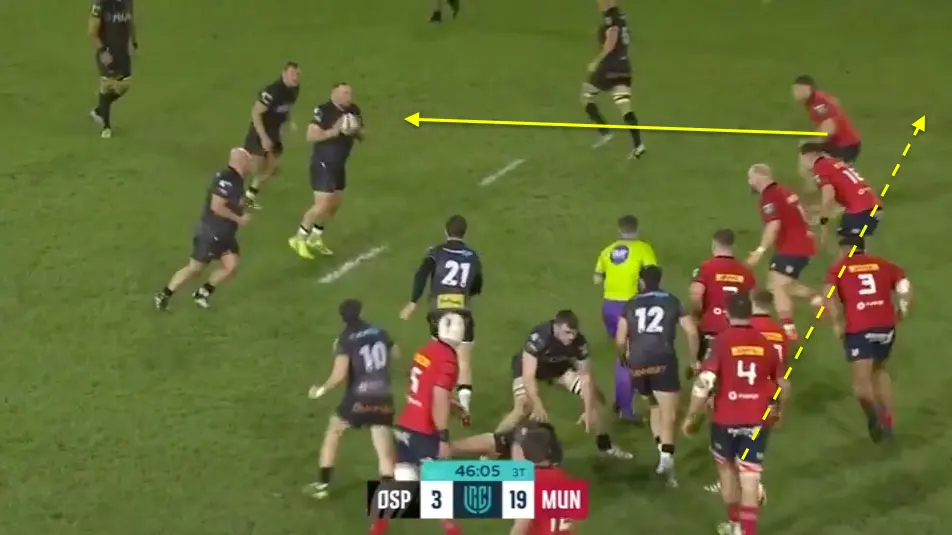
O’Donoghue slips off the tackle, but that’s OK — Coombes and Barron join in high again to slow the carrier, choke him up, draw cleaners and allow the other defenders to transit across, blocking off the space.
Wrap high — waist up — and Barron steps in again as the ball target.
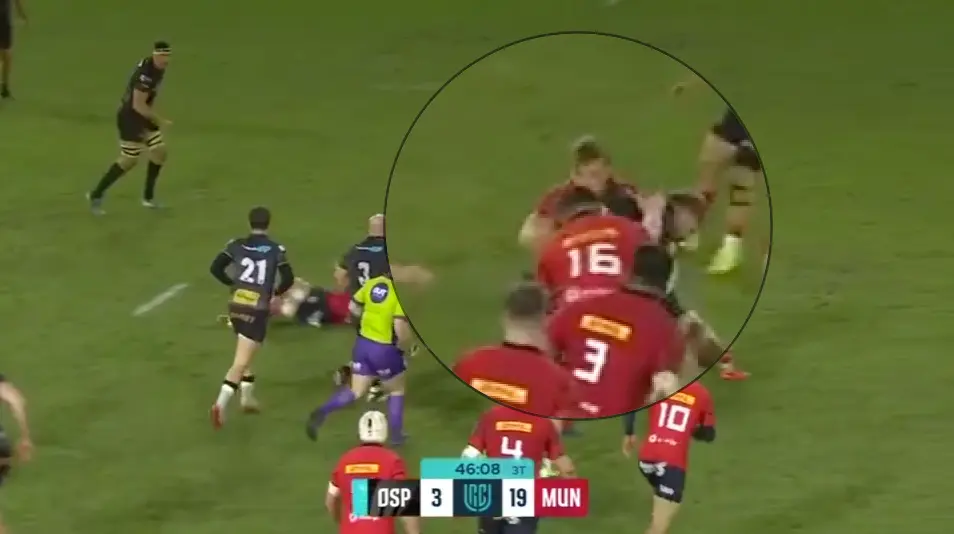
The transiting defenders pack the space around the ruck, and present a red wall to the halfbacks, who now either have to kick or, as it’s in centre field, look for an edge to kick from a tramline.
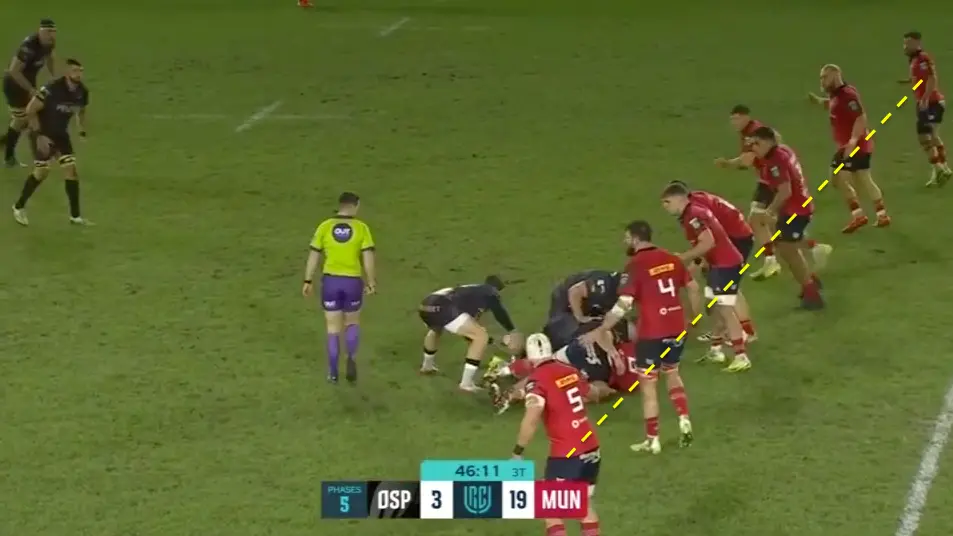
When they move to the edge space, we’re not looking to blitz on everyone — just show a tight defensive line that drifts with the ball and leaves the handler with a low percentage pass to the edge that Nash or the covering fullback will look to shut down as the ball flies, or have a go at a carry with a staggered alignment.
Crowley tackles high again and swings around — that upsets Edwards route as a carrier without being too obvious — and that gives Patterson a clear window to attack the ball on the floor.
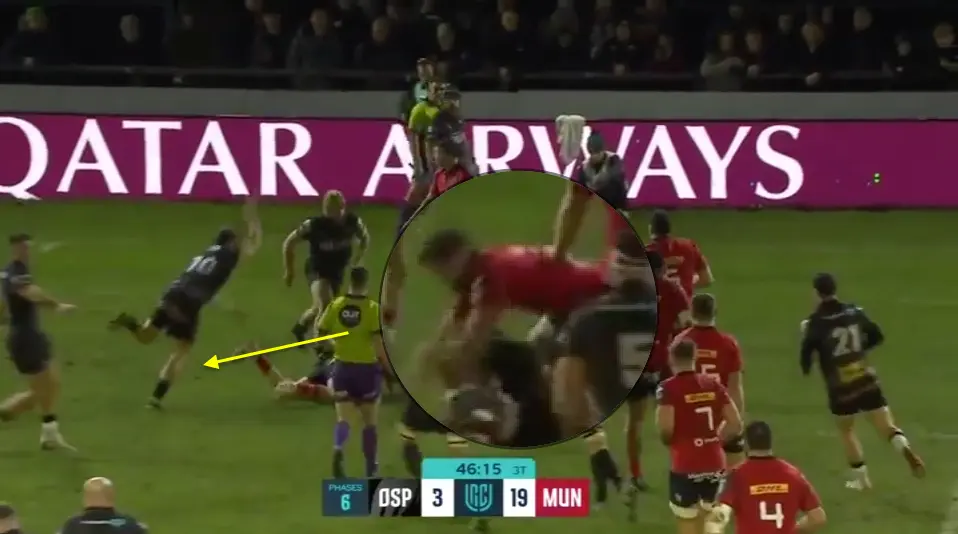
He’s not looking to survive the clean here; he just wants to pressure the referee on a technical release, but he has the time and separation from the defenders to do just that.
You can see that intent in every phase we play outside of the 22.
Two man tackles, target the ball, stay high and look for the choke to draw cleaners.
It’s very effective, and very sticky to play against, especially with our current back five rotation which has numerous choke-tackle threats and enough threat at the breakdown that you can’t just leave that contact zone play out.
It’s on track to be hugely effective, as long as our discipline and fitness holds.
