


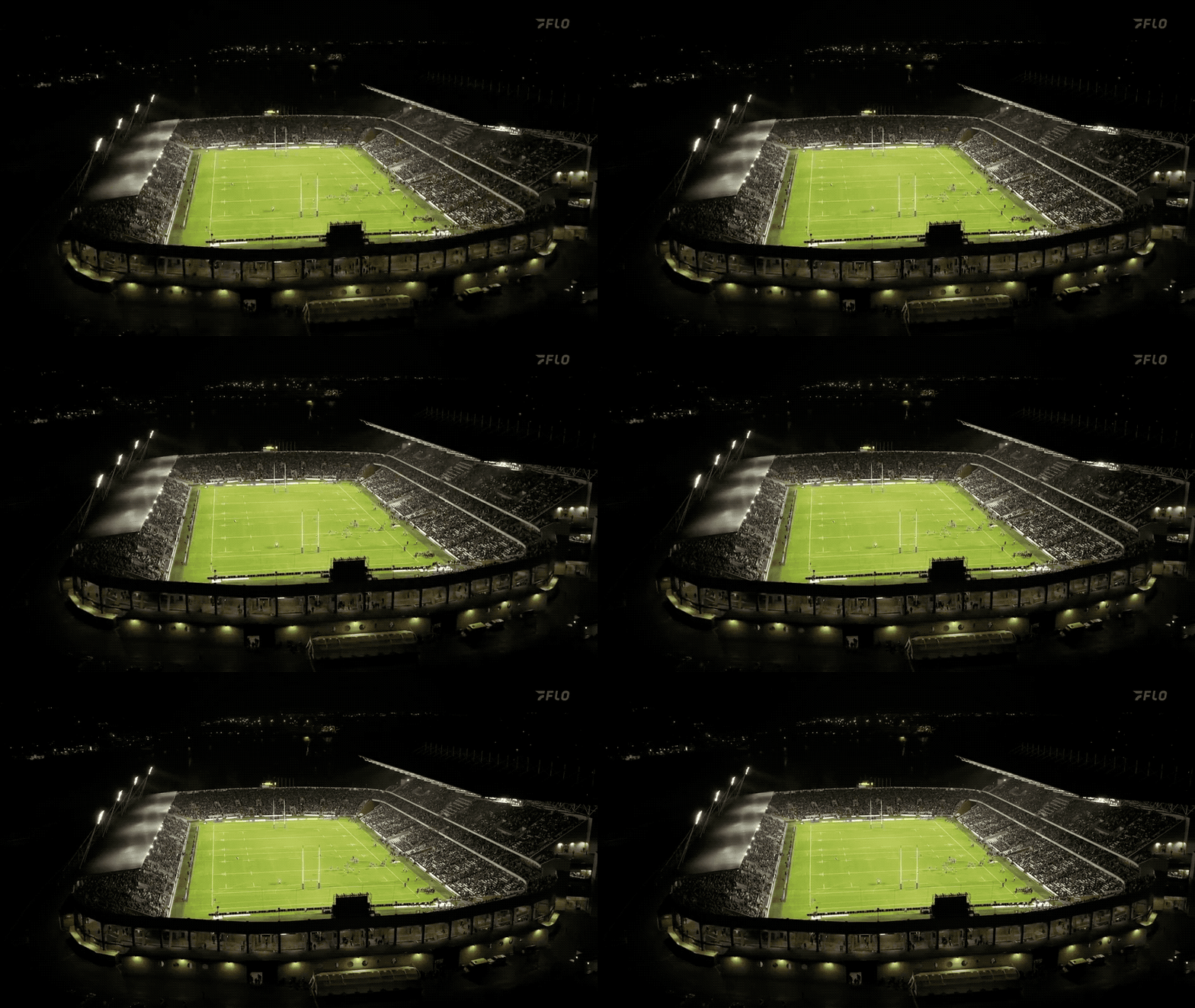

Rugby is a deeply complex sport, but sometimes it can be driven by elementary things.
The wind, for example. If it’s strong enough, and it’s for or against you, it can produce weird outcomes. On Saturday night, Munster were playing into the wind in the first half against a Gloucester side who showed up to kick, defend in depth and spoil for as long as possible — as is their prerogative. It’s a completely legitimate way to approach an away game like this, and they did really well — aided by Munster profligacy — for 50 minutes. We’re going to have to get used to it, because it’s the way most sides will now choose to play the game, especially on the road.
What it did, in the first half, is lengthen the field considerably for Gloucester and shorten it for us.
Why?
Because if we kicked, the wind was going to push the ball backwards in the air, giving forward momentum to Gloucester on the catch and who, if they retained the kick, would be able to push the ball downfield with an extra 10/15m on every kick. Gloucester were set up to kick almost everything — they had a 1:3.6 kick to pass ratio on a night with very little rain — spoil the transition or win a breaking ball, and then look to cause as much disruption as possible at the set piece.
What did this mean in practice? That Munster would try to hold the ball in the first half, kick more sparingly in between gusts or when it was unavoidable, and then reverse that in the second half when we’d have the wind advantage. With the pitch being so long — we deliberately chose a 10m+ in goal area — we knew that any kick anywhere near halfway would and could be end up coming down high around the 5m line.
As a result, Gloucester could push up post-transition. Combined with their two-man stops, it meant we, naturally, played more ball in hand as we tried to navigate to a spot where we could force them to compress or where we could get into a spot where we could kick and be reasonably certain that it wouldn’t hold up in the air and actually cost us all the effort it took to get into the position to kick in the first place.
Gloucester was able to utilise that in the first half to put a lot of line speed on our structures. It made sense. They realised we couldn’t kick freely because of the wind, so, naturally, that meant two-man stops, no breakdown contest and a lot of linespeed.
Our counter to that was layered attacking lines and looking for long passes over the top to the edge. If Gloucester were going to narrow the line and push up, we would try to find the space somewhere.
As a brief aside, check out the wind on Michael Ala’alatoa’s jersey right before Casey attempts that pass to get a good flavour of how strong the wind was.
When Gloucester pushed up, we looked for the space they would have to leave at the edge as they tried to blitz on our middle-line structures.
But some of our passing work and line running was a little… scraggy. A brand new back three combination struggled, at times, to get their spacing right on the loop lines, and the wind put a lot of loft on almost every pass from #9 and tugged at passes back from the screen.
When you combine that with some unfamiliar combinations, you get a deeply scrappy first half where, despite our struggles, we left three tries on the table.
That puts an entirely different complexion on the disappointing first half, but it’s been the story of our season in a lot of ways. Overplaying, guys not on the same page, and just wanting to do something. This was probably the best opportunity to start buffing the scoreboard early. Scannell makes a good break off a great maul, but O’Donoghue and Scannell get their lines garbled on the deck. O’Donoghue wanted to pick and go — the right call, for me — and Scannell was trying to hold onto the ball for a placement to Casey.
It ended in a full penalty to Gloucester.
Pressure lifted.
As has often been the case with this squad, we were able to execute the harder, long-range strikes relatively well. When Gloucester kicked a little bit too long and got their transition defence in a tangle, we were able to pick them off at the first opportunity.
But it seemed like the closer we got to the try line, the more our clarity seemed to desert us.
It was an issue last season; it’s still an issue this season.
Sometimes it’s a lack of tight power, sometimes it’s the drill, sometimes it’s a lack of composure. One more ruck. But you can see it elsewhere too.
This was a great attacking set. Momentum, nicely run layers, but it’s let down at the end by a half-in, half-out offload that either should have immediately, or just been held onto for… one more ruck.
But watching the game back, I felt that most of the frustration was based on how little Gloucester offered, coupled with those three close-range opportunities going to waste at key points. We weren’t playing badly — we’ve certainly played worse at points this season — it was just that we were struggling to break down Gloucester’s “low block”, as they offered very little else. I think, if anything, had Gloucester tried to play a little bit more, it would have opened up our game a little more.
As it was, they defended in depth, packed the backfield and rode out the first half on the backfoot. They tired in the second half pretty clearly, and we were unlucky not to add back-to-back scores from almost identical scrum launches.
The wind played a big role in the second opportunity, but there’s some good stuff there. The score really buffed out in the last 10 minutes, but you’d broadly expect that, too. This was a game dictated by oppositional approach and weather conditions, dragged into the mire by some Munster profligacy in the first half, but ultimately comfortably put to bed without too much hassle.

KPI Scorecard (Targets vs Actual)
A) Deny Gloucester access (primary game-winner vs this profile)
- Entries conceded ≤ 7 (stretch ≤ 6) → 2 ✅
- Gloucester PPE ≤ 2.5 → 0 ✅
Key note: Gloucester still scored 3 (a penalty), which means their only points came without a 22 entry. That is the cleanest possible “deny access” outcome.
B) Linebreak control (stop the Gloucester “spike”)
- Linebreaks conceded ≤ 4 → 2 ✅
- Opposition LBR ≤ 0.0500 (≤ 5.00 per 100 rucks)
Gloucester: LBR = 2/51 = 0.0392 (3.92 per 100) ✅
Key Point: one linebreak every 25.5 rucks.
C) Our attacking punch (create separation, not just phase count)
- Our LBR ≥ 0.0750 (≥ 7.50 per 100 rucks)
Munster: LBR = 11/122 = 0.0902 (9.02 per 100) ✅
Key Point: one linebreak every 11.1 rucks.
D) Finish (where we can still be sharper)
- Attack PPE ≥ 3.2 → (actual total 31/15 = 2.07) ❌
This is the only major “miss”, and it matters because…
…the points flow confirms it: we controlled the match for long stretches without turning it into a scoreboard blowout until the final quarter. That was in part due to the dynamic of playing into and then with the wind, but if we nailed those three opportunities in the first half, we easily hit 50 in this game with that entry volume.
E) Set-piece execution
- Lineout ≥ 88–90% → 83% ❌ (functionally ~10/12)
- Scrum edge (win% and/or leverage) → 80% vs 67% ✅
F) Game-model band (kick/pass)
- K:P band 1:5 to 1:7 → 1:7.6 (just outside) ⚠️
Not a “problem” in that game, but it explains the profile: we chose to own ball and tempo rather than trade aerials given the conditions, both atmospheric and in the context of needing to get a bonus point after the dud first half.
The two metrics that explain the whole match
Rucks-to-entry (how efficiently you turn workload into 22 access)
- Munster: 122 rucks / 15 entries = 8.13 rucks per entry
- Gloucester: 51 rucks / 2 entries = 25.5 rucks per entry
That is complete domination. Sure, Gloucester chose to bring this game to Cork, but still. Gloucester had to play three times the ruck work for every 22 visits (and still only got 2 visits all night).
Field-position possession (they had ball, but no access)
Possession split:
- Munster: 64% total; 23% of possession in Gloucester 22; only 7% in our own 22.
- Gloucester: 36% total; 5% in our 22; 48% of their possession sits in the “our half but not our 22” band.
That is classic “cordon” defence: we let them have some possession, but we prevented it from becoming entries.
Attack: why we won big, and why PPE still flags as a miss
What worked
- Carries: 148–67
- Post-contact metres: 379–173
- Linebreaks: 11–2
- Try output: 5 tries (plus 3 conversions)
This is a pressure-and-punch blend: volume carries + linebreak creation, not just sterile phase count.
Why PPE sits at ~2.07 despite 31 points
Two likely drivers in this dataset context:
- Scoreboard lag despite dominance: points flow shows we were “in control but not separated” for long periods — the classic low PPE symptom.
- Some scoring came without needing a 22-entry build-up. That can depress “points per entry” while the game is still won somewhat clinically.
The correct interpretation isn’t “attack failed” — it’s: we could have put them away earlier if we were more ruthless on a subset of entries (better lineout strike, fewer cheap turnovers, more points-first decisions in the red zone).
Defence: the cleanest Gloucester denial we can ask for
- 0 tries conceded, and only 2 entries conceded is the headline.
- Tackle efficiency: 89% vs their 86% (and they missed 25 tackles).
- Their attacking load was forced into “non-threatening” zones: 51 rucks, only 2 linebreaks, almost no 22 time.
This is exactly the KPI plan I set: make Gloucester live in the middle third and never let them convert pressure into access.
Kicking and control
- Kicks: 30–27 (close)
- Kick-to-pass: 1:7.6 vs 1:3.6
Gloucester kicked relatively more (their season pattern when they can’t generate clean access and were empowered to kick more by their weaker selection in combination with the weather). We stayed pass-heavy, which aligns with the ruck-speed/possession plan: pin them with tempo and ball ownership, then finish late when they crack (last 10 = 12 points).
The two “fix-it” notes
- Lineout accuracy (83%)
Against higher-quality opponents, this is the area most likely to turn “control” into “frustration.” Well, more frustration. If we’re living in their half and not striking at 88–90%+, PPE will stay suppressed. - Turnovers lost (18)
We still won easily because Gloucester couldn’t turn those into entries. Better teams will. Turnovers are how you accidentally donate entries without conceding metres.
We hit every Gloucester-specific denial KPI emphatically (2 entries, 2 linebreaks, 0 points per entry), and we hit the key punch KPI (LBR/100 = 9.02). The only reason it wasn’t a 40+ day is that our finish layer (PPE + lineout precision + turnover trimming) lagged behind our dominance until the final quarter.
| Players | Rating |
|---|---|
| 1. Michael Milne | ★★★ |
| 2. Niall Scannell | ★★★ |
| 3. Michael Ala'alatoa | ★★★ |
| 4. Jean Kleyn | ★★ |
| 5. Tadhg Beirne | ★★ |
| 6. Tom Ahern | ★★★ |
| 7. Jack O'Donoghue | ★★★ |
| 8. Gavin Coombes | ★★★★ |
| 9. Craig Casey | ★★★★ |
| 10. Jack Crowley | ★★★ |
| 11. Ben O'Connor | ★★★ |
| 12. Alex Nankivell | ★★★★ |
| 13. Dan Kelly | ★★★ |
| 14. Shane Daly | ★★★ |
| 15. Mike Haley | ★★★★ |
| 16. Diarmuid Barron | ★★★ |
| 17. Josh Wycherley | ★★★ |
| 18. Conor Bartley | ★★★★ |
| 19. Edwin Edogbo | ★★★ |
| 20. Ruadhan Quinn | ★★★ |
| 21. Paddy Patterson | ★★★ |
| 22. JJ Hanrahan | N/A |
| 23. Tom Farrell | ★★★ |
