



Well, that one stung.
The trend of our best performances coming away from home so far this season continued, despite what was arguably our best 40 minutes on the offensive side of the ball so far.
However, the reality is that we had a 21-6 lead at halftime that we ultimately lost in the last 20 minutes. The Stormers brought weight and power off the bench, and we struggled to live with it — our discipline, momentum, and lead followed. At halftime, this looked like a game where one more score would mentally send the Stormers packing, but it just never materialised.
Watching this game back showed how witheringly close it actually was, in all but one area. And that was the area that hurt.
Scoreboard & flow vs the preview
Preview Stormers profile (first five games)
- Avg scoreline: 31.4–7.8 (+23.6).
- Conceded only 4 tries in 5 games.
- Conceded 0.87 pts per 22 entry (about 1 try every 8.5 entries).
Actual vs Munster
- Stormers 27–21 Munster (+6) – nowhere near their +23.6 norm.
- They conceded 3 tries in this one game, almost doubling their season total.
- Munster led for 67 minutes (81%) but lost 0–7 in the last 10.
We did drag them down – just not far enough on the scoreboard.
22-entry battle
Preview expectations
- Stormers attack:
- 10.2 entries/game, 2.64 pts per entry, ~1 try every 2.6 entries.
- Stormers defence:
- Opponents: 6.8 entries, 0.87 pts per entry, 1 try every 8.5 entries.
- Munster: decent entry volume, but we “leave points behind” and concede nearly 2 pts per entry and a try about once every 3 entries.
As I wrote;
[Munster need to] keep our entry volume up and be more ruthless in the 22, while dragging Stormers’ 22 defence down from the freakish levels they’ve shown this season.
Actual game
- Munster: 7 entries, 21 pts → 3.0 pts/entry, 3 tries (0.43 tries/entry).
- Stormers: 8 entries, 21 pts from tries → 2.6 pts/entry, 3 tries (0.38 tries/entry).
What that means:
We fixed our points-per-entry problem for the night – 3 pts/entry against the best red-zone defence in the league is outstanding.
We absolutely nuked their 22 defence: they go from conceding 0.87 pts/entry and 1 try every 8.5 entries to 3 pts/entry and 1 try every ~2.3 entries against us.
Stormers, though, basically hit their own attacking norm: 2.6 pts/entry, 1 try every 2.6–2.7 entries — exactly their season profile — and then added two penalty goals from outside the 22 to get to 27.
So the 22-entry story from the Red Eye holds up perfectly: entries are roughly even, Stormers’ attack is its usual efficient self, and the game is decided by who adds “cheap” points on top. They did. We didn’t.
Rucks & linebreaks – the LBR picture
Preview Stormers LBR snapshot
- On ball: 10.7 linebreaks per 100 rucks (1 every 9.4 rucks).
- Opposition: 4.9 per 100 (1 every 20.6 rucks).
- TL;DR: “[Stormers] more than double the opposition’s linebreak rate per ruck”.
Actual game
- Munster: 67 rucks, 5 linebreaks → 7.5 per 100.
- Stormers: 41 rucks, 4 linebreaks → 9.8 per 100.
So:
- Stormers still sit around their 10-per-100 sweet spot.
- But we’re well above the 4.9-per-100 average their opponents usually manage — we break them more than their early-season numbers would suggest.
Given that both sides scored 3 tries relative to 5 vs 4 linebreaks, conversion per break was high all round. Again, very “on script”: tight game, both teams dangerous when they did break, but Stormers don’t run away from us in LBR terms the way they have everyone else.
Kicking shape vs what the piece recommended
Preview: Stormers live around 1:3–1:4 kick-to-pass, kick long, and are a classic “kick and jackal” team. Munster are “kick and grind” — similar volume and distance, but far less jackal.
I hoped we’d:
- Keep volume high-ish but not crazy.
- Front-load kicks in our own third as exits.
- Kick less in their half, trust our carry/ruck engine there.
Actual game:
- Munster: 33 kicks, 123 passes → 1:3.7.
- Stormers: 21 kicks, 72 passes → 1:3.4.
That’s pretty much exactly what I described for both sides. We didn’t go into a 1:2 lunacy; we stayed in a “normal” Stormers-style kicking game.
Where it didn’t land is the field position:
- Possession: Munster 56% vs Stormers 44%.
- Territory: Munster 47% vs Stormers 53%.
So, instead of using the boot to move our defensive sets into their half, we end up with more ball but less territory — classic “playing from too deep” profile. The script (kick smart out of our half, attack more in theirs) didn’t show up clearly in the zone splits.
Turnovers & jackal – script flipped
This is the biggest inversion.
Preview turnovers per 100 tackles (season to date)
- Stormers: 6.23 per 100 (1 every 16.1 tackles) – “kick and jackal”.
- Munster: 3.84 per 100 (1 every 26.1) – “kick and system defend”.
Actual game:
- Stormers: 98 tackles, 3 turnovers → 3.1 per 100, 1 every 32.7 tackles.
- Munster: 71 tackles, 5 turnovers → 7.0 per 100, 1 every 14.2 tackles.
On the night:
- Munster have the Stormers-like breakdown game.
- Stormers end up with a turnover rate more like our early-season profile.
So the big pre-match fear (“we kick, they jackal, chaos kills us”) just doesn’t materialise in the stats. We actually won that battle.
Set-piece vs preview
Preview: Stormers’ lineout at 94.4%, never below 88%, opposition averaging 83.2% with a couple of sub-80 collapses – a serious weapon.
Actual game:
- Munster lineout: 83% (12 throws).
- Stormers lineout: 86% (21 throws).
We don’t implode at lineout as Leinster/Zebre did, but:
- They still edge accuracy and, more importantly, volume – 21 lineouts vs 12 tells you a lot about territory and how often they’re launching from touch.
- Scrums were even on paper: 83% vs 86% on 9 vs 8 puts-in. But the reality is that we conceded 5+ penalties at the scrum, and our defensive lineout held that back for a while, but couldn’t prevent the territory and position leak in the second half, especially when they replaced their entire front five around the 45-minute mark.
Game story vs “how do we win this?”
I surmised that if we;
- Stop Stormers’ jackal from running the game,
- Keep our kicking in that normal band rather than going wild,
- Use the ball in their half,
- And crank our own points per 22 entry upwards…
…we give ourselves a real shot.
Looking at the numbers:
- Jackal threat? Neutralised – we win turnovers.
- PPE problem? Fixed – 3 pts per entry vs their 0.87 season concession.
- Stormers’ 22 defence? Dragged down hard — 3 tries conceded.
- Stormers’ attack? Still bang on its 2.6-per-entry baseline.
- Territory + discipline? Edges to them – 53% territory, 10 pens vs our 13, and they slot two penalty goals.
And then the killer stat:
- Last 10 minutes: Munster 54% possession, 0 points; Stormers 46% possession, 7 points.
So, weirdly, a lot of the “keys” to a win did show up in Munster’s favour in the numbers. But Stormers still got:
- better territory out of fewer possessions, and
- more value out of their scoring moments (two penalties + a decisive late try).
The Stormers I described are exactly the Stormers that turned up — but this game is a reminder that even when you successfully drag a team’s numbers back towards the pack, you still have to close out the last 10 minutes and avoid giving them those two or three premium scoring shots.
So if the data is so tight, in line with the scoreboard, so what went wrong?
No Scrum, No Win
At a base level, we hit a ton of our targets.
- We led for 67 minutes and 81% of the game.
- We had 56% possession.
- We scored 3 tries from 7 entries in their 22 – 3 points per entry against the best red-zone defence in the league.
- We broke them five times to their four, and we actually won more turnovers: 5 to 3.
On paper, that’s the exact profile I spoke about in the preview: drag their freakish 22 defence back to normal, punch above the usual opponent linebreak rate, and turn their breakdown into something we could live with.
We did all of that.
And still lost.
The missing piece is where we were forced to play most of that rugby — and that’s where the scrum and the second-half defensive lineout come roaring into the conversation.
The scrum: Penalty Vending Machine
On the stats sheet, the scrum looks fairly even:
- Scrums: 9 (us) v 8 (them)
- Win rate: 83% v 86%
But it hides an uglier stat.
By my count, five or more of our 13 penalties came at the scrum, and most of them were between the 22s. That’s a territorial hosepipe aimed straight at our 22.
Every time we thought we’d survived a phase set, or earned a chance to exit, the scrum would reset the picture:
- Defensive scrum → penalty → Stormers clear to halfway or the edge of our 22.
- Attacking midfield scrum → penalty → we’re suddenly defending a lineout 35 metres further back.
- Late in the game, under fatigue and with the benches on, that pattern hardened. Instead of the scrum being a restart, it became their most reliable way of winning metres and time.
This is how you end up in the weird scenario where we have more of the ball but less of the pitch.
Territory: more ball, in the wrong areas
Look at the global numbers:
- Possession: Munster 56% – Stormers 44%
- Territory: Munster 47% – Stormers 53%
So we had the ball — just barely more than they did — but they had the field.
The possession-map makes that clearer:
- With the ball, we spent 42% of our time in our own half (12% in our 22, 30% in the next band).
- Stormers spent 35% of theirs in their own half, and 51% in the central third.
In other words, our phases were starting from deeper, more often. That is exactly what repeated scrum penalties do:
- They erase exits.
Instead of clearing to touch and defending a lineout around halfway, we’re marched back 30–40 metres and defending again in our own half. - They feed Stormers’ lineout.
They had 21 lineouts to our 12. Every scrum penalty is either a free exit for them or an attacking launch. Even when we defended those mauls, the cumulative effect was a game tilted towards our end. - They change how we attack.
Starting sets from inside our own 40 forces us to be more conservative: more carry-exit, more box-kick, fewer multi-phase sequences in their half where our 22 efficiency could really bite.
So while our numbers in the 22 look good, we simply didn’t spend enough time playing there. Too much of our “good” rugby happened 30/40 metres from their posts.
Defensive lineout: first-half resistance, second-half squeeze
The defensive lineout actually did a lot of heavy lifting in the first half.
We spoiled, slowed or completely killed a few of their early mauls. Even when they won the ball cleanly, we were able to stall their drive and force them back to their phase game. It limited them to zero 22 entries in the first half. That’s a big reason why the scoreboard didn’t run away from us when the scrum started creaking.
But as the game went on, Stormers tightened up:
- Their calling became more direct — less movement, more fast ball to their key jumpers.
- Their maul set-up got tidier, and they started winning those “half-penalties” that keep you pinned in the corner: collapse, entry, side-entry.
Once that happened, the combination of scrum penalties and a more accurate Stormers lineout in the second forty turned the game into a constant siege of our defensive 40. We were either defending mauls, or exiting under pressure, or jogging back to the corner after another whistle.
The tries reflect that: Stormers didn’t need a huge volume of entries; they just needed enough of the right kind — lineout platforms in our third — and the set-piece pressure did the rest.
The last 10 minutes: Inverted Pressure
The final ten minutes tell the story in miniature:
- Possession last 10: Munster 54% – Stormers 46%
- Points last 10: Munster 0 – Stormers 7
We still had more ball. But by then, we were playing uphill into all the accumulated set-piece pressure:
- Tired front-row, wary of another whistle.
- Kicking from deeper in our half, into a Stormers backfield that was happy to play the territory trade.
- Defensive sets starting closer and closer to our line.
Eventually, a combination of sub-optimal field position, a dodgy intercept score and one more decisive moment at the set piece turned into the match-winning score. We spent 81% of the game in the lead, but that underlines how long we managed to ride out that pressure before it finally caught up with us.
So what actually went wrong?
When we strip it back, the answer is simple and unglamorous:
- Our scrum penalties handed the Stormers too much free territory.
- Their lineout, especially after half-time, was too efficient at turning that territory into entries.
- We did enough with the ball and in the 22 to win most games — but not enough to escape a contest where we were constantly starting from the wrong end of the field.
I framed this game as a battle of entries, linebreaks and breakdown efficiency. We hit those notes. But this performance is a reminder that against a side like Stormers, the old truths still apply: if you cough up five or six scrum penalties and feed them over 20 lineouts, you’re asking your attack to win the game from range.
We almost did.
Almost.
But almost doesn’t get you much else except a losing bonus point.
Not against a side like the Stormers. The loss itself doesn’t kill us, but it is a timely box to the jaw ahead of Europe, and Bath in particular.
The scrums we’re facing aren’t getting any lighter or less dangerous.
At its core, the scrum is about control. When paired with a strong kicking game, it allows you to control where the opposition restarts from. If you have the scrum, a strong one can turn a 20m kick into a cumulative 50m gain, but even if you don’t, a solid scrum can hold the opposition in place where you can get them back into phase defence or defend a kick play.
If you can mop up those, you can find a way to play on the front foot.
But if the scrum becomes a liability, the modern game, as in the game we’re playing since the Rugby Championship in the summer, will punish you relentlessly.
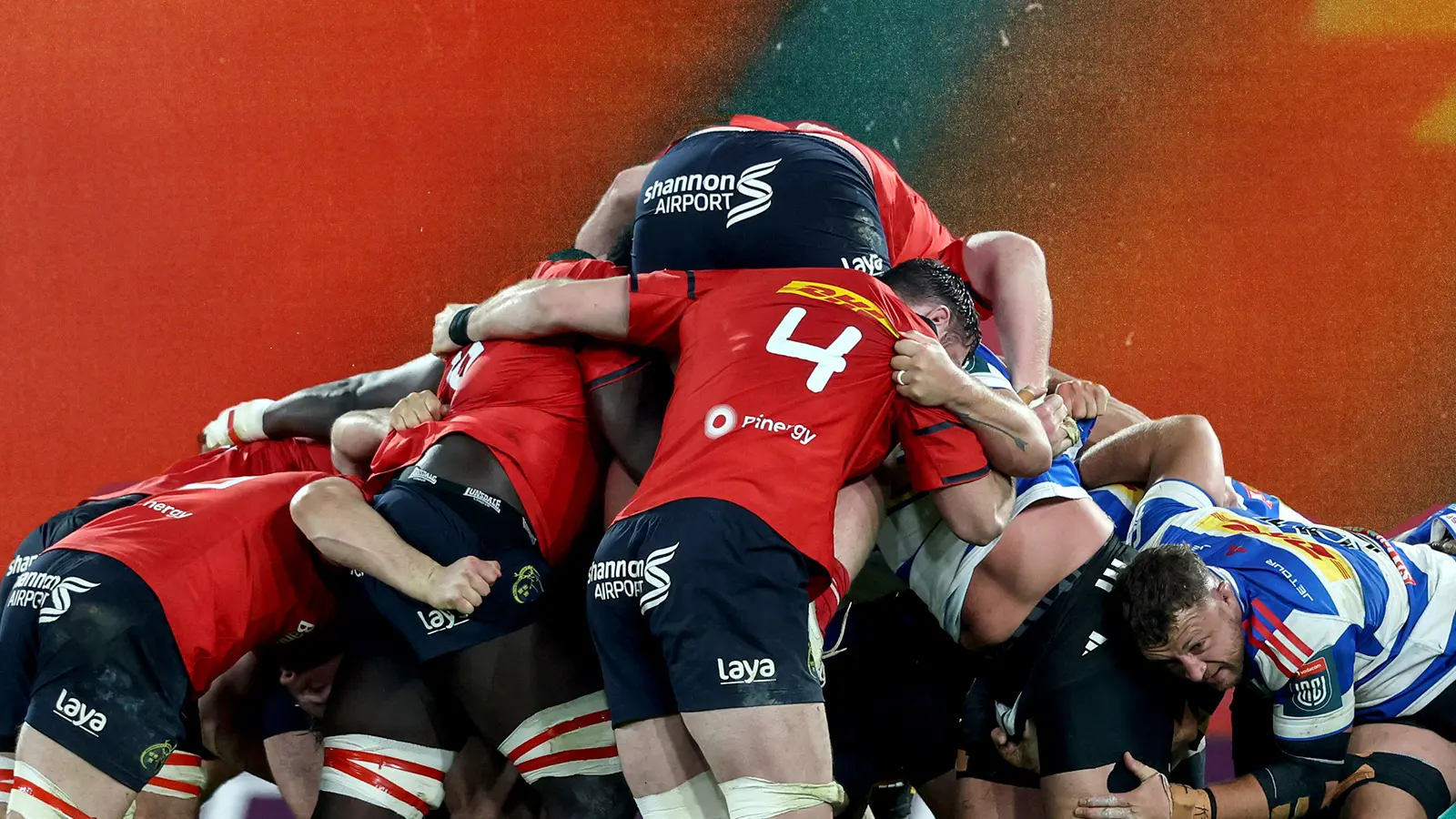
There were 17 scrums in this game. In this season’s URC, there have been 580 scrums total — an average of 12 scrums per game. We have the third-most penalised scrum in the league when it comes to scrum offences committed — free kicks and penalties conceded — just behind the Ospreys and Dragons.
That is not good.
Munster’s raw numbers
In the URC so far;
- Scrums on our own feed: 31 won / 4 lost → 35 total, 89%.
- Scrum penalties won: 7.
- Scrum offences conceded: 21.
- Total penalties conceded: 68.
So:
- We win our own ball most of the time – the set-piece functions.
- But the ref is pinging us at the scrum three times as often as we’re getting rewarded (21 conceded vs 7 won).
Where does that put us in the league?
a) Volume vs offences
League-wide:
- Total scrums: 580.
- Total scrum offences: 240.
Munster:
- Account for 6% of all scrums (35/580),
- But 8.8% of all scrum offences (21/240).
So we’re over-represented in scrum penalties relative to how often we scrum. We’re in the same “over-penalised” cluster as Dragons, Ospreys, Glasgow, and Zebre.
b) Comparison with the elite scrums
Look at the top packs:
- Stormers: 44/1 scrums (45 total, 98%), 28 scrum pens won, 11 offences conceded → +17 margin.
- Sharks: 44/0 scrums (100%), 23 won, 8 offences conceded → +15.
- Bulls: 39/1 scrums (40 total, 98%), 15 won, 10 offences conceded → +5.
Munster:
- 35 scrums, 89%, 7 won, 21 conceded → –14.
So across six rounds, we’ve got, roughly, a 31-offence swing between ourselves and the Stormers pack at scrum time (+17 vs –14). That’s exactly what we felt in Thomond Park on Saturday night: even when the raw win% was “ok”, the balance of the whistle is completely different.
c) Offences as a share of our penalties
- League-wide, about 26% of all offences are scrum offences (240 of 918).
- For Munster, it’s 31% (21 of 68).
Among realistic contenders, that’s high:
- Munster: 31% of our offences are at scrum.
- Stormers: 22% (11 of 50).
- Sharks: 14% (8 of 58).
- Leinster: 28% (17 of 60).
We’re not just conceding more at the scrum than we’re winning — a bigger chunk of our total discipline problem lives there compared to the league as a whole.
How does this change the picture?
At first glance, our scrum looks OK based on;
- scrums on our feed,
- win %,
- penalties we won,
The raw numbers made our scrum look functional, but not a weapon — middle of the league for accuracy, middle for penalties earned.
Once you layer in scrum offences conceded, the picture changes:
- We drop into the bottom third of the league for scrum discipline (21 offences – only Dragons and Ospreys are worse).
- Our net penalty balance at scrum (won minus conceded) is –14, which is one of the poorest differentials in the competition.
So a more accurate summary would be that, on our own put-in, our scrum is steady enough — 89% isn’t killing us directly — but in the eyes of referees, we are a high-risk, low-reward scrum: we give away far more than we get back. That can be directly tied to the games against Edinburgh, Leinster and now the Stormers.
That’s why, in a game like the one at the weekend, it felt like the scrum decided the territory. After that game, the main difference between the Stormers and Munster when it comes to scrummaging is;
- They have a +17 season scrum penalty margin with a reputation to match.
- We’re carrying a –14 margin and 21 offences already on the ledger.
- In a tight, high-profile game, marginal calls are more likely to go in the direction those season-long trends point.
TL; DR
At a basic level;
- Scrum accuracy alone (31/4, 89%) isn’t enough to say our scrum is “fine”.
- The numbers show that almost a third of Munster’s offences are at scrum time, and that we’re conceding three scrum offences for every one we win.
- Compared to the Stormers/Sharks/Bulls tier — who win more penalties than they give away and have a lower share of their total penalties at the scrum — our scrum is not just neutral; it’s a territorial leak.
Our scrum isn’t just failing to give us an edge — it’s one of the main reasons our discipline and territory look the way they do in the scrappier games we’ve played this season. Until that penalty profile changes, games against the big South African packs — or any pack with a big scrum — are almost guaranteed to tilt the pitch against us, even when everything else is broadly working.
That was clearly the case here.
All of the issues here are stemming from the tighthead side of our scrum; that’s where the majority of the movement is coming from, with the loosehead side following as the tighthead and hooker go backwards. This has been true in all of our recent games, where the scrum has been a consistent issue, as seen in Edinburgh, Leinster, and now here.
These have also been the three games where Oli Jager has been injured. The scrum immediately degraded against Edinburgh when he went off with a concussion, and it’s continued in that vein — meaning we’ve had to heavily rely on John Ryan and Ronan Foxe, two props at the opposite end of their careers. Ryan seemed to be taking the initial set quite well, but was getting overpowered comprehensively on the second shove. Foxe was almost the opposite — losing the initial battle, and then struggling to get his weight down, with Oli Kebble popping and lifting him repeatedly.
We didn’t just sit on this either; on our put-in, we did a decent job of getting a quick strike to move the ball away, despite the pressure coming on.
We tried a few free-kick gimmicks on their put-in to try and turn penalties into free kicks, especially as they were hitting early on the engage. We got away with one or two before Piardi caught on and penalised some of our gimmicks as penalties regardless.
This is a really good example of our quick strike, especially as it was 7 vs 8, and we had no flanker behind Foxe. Good feed, good strike, and ball away.
It stacks up to what we’ve seen in the data; decent on our own put-in without being dominant, adapting to pressure, but struggling when the opposition can sink in and dominate us when they control the ball.
This, for me, is a personnel issue — against a scrum like the Stormers, you need a rotation of Jager and Ala’alatoa, especially on defensive scrums.
John Ryan hasn’t forgotten how to scrum technically at 37 years of age; he’s just coming up against bigger, stronger looseheads who can overpower him when the squeeze comes on. Foxe, too, is a good scrummager and has the right dimensions we want physically, but he needs time — a season or two — to deliver on that promise fully.
McMillan’s Chiefs side had an incredibly dominant scrum, so this is a clear area where we need to improve to fully deliver on the system changes we’ve applied. Our strike plays look good, our ball retention has been pretty good for the most part, and we’re a really good kicking team with variety at halfback and very good chasers. Our lineout can be a weapon on both sides of the ball, but the offensive scrum has to start generating forward movement, and our defensive scrum needs to start squeezing the put-in.
Is that possible this season? Against the bigger scrums, it’ll need injury luck with Jager and Ala’alatoa continuing the baseline he’s shown for almost all of his career to this point, but beyond that, it’s an area that needs some recruitment to fully deliver on everything else that’s working.
***
Ultimately, we lost this game because of the intercept try. At 21-20, with just ten minutes to go, we had a chance to bury the ball deep in the Stormers’ 22 and make them kick their way out. We could cheese the clock, make any penalty incredibly expensive to award, and try to see out the game.
Instead, we went for a killshot. Stormers scrum was shooting up on our tighthead side all game, so we called a screen play that would isolate their forwards on one side, to leave a looped isolation for our backline to execute.
We started with Kelly and Farrell stacked on the blindside with Kilgallen, while Daly and Crowley stacked on the openside with Abrahams outside. The play was looking to use the Stormers scrum as a compressor. Their flanker wasn’t getting up off the scrum, so the idea was to use Casey on the loop, with Kelly and Farrell looping around from the blindside to open up a huge gap outside. Kelly and Farrell meant that the Stormer’s #10 — Mathee — would have to stay blind, which meant the real target here was Simelane at #13.
It almost worked — as I’ll show — but Nel read the screen and shot onto the pass, which itself wasn’t accurate enough.
Duvenage tracks Casey’s run stride for stride, which gives Nel enough confidence that Crowley’s inside break is covered. He then shoots up into the screen.
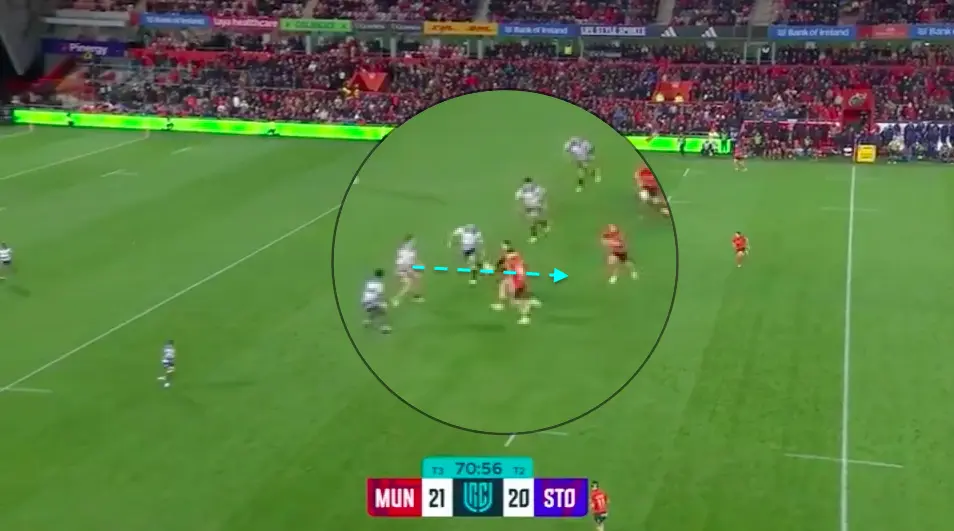
If he sits on the carry, I think we score a try. Casey pops it to Kelly, he pops it to Farrell, Crowley continues the line for support inside, and Abrahams shoots in — try, and most likely under the posts.
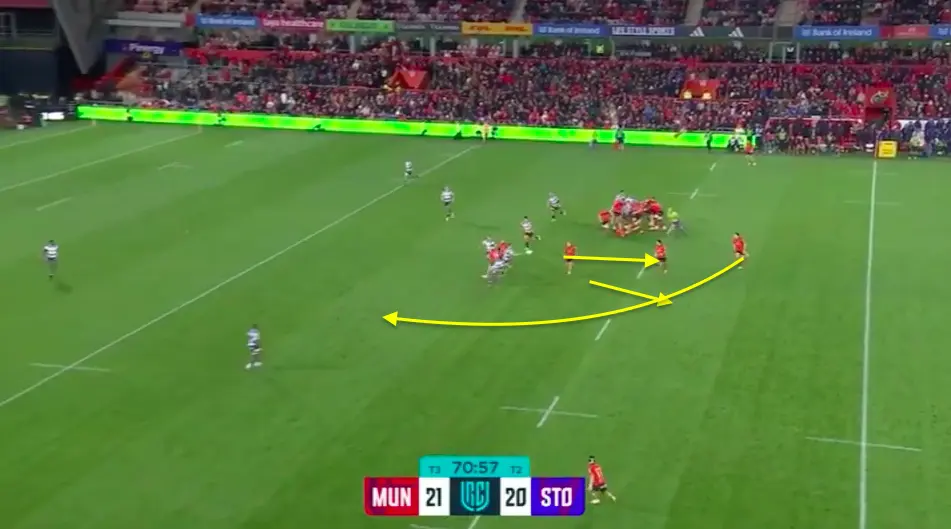
In the aftermath, I felt like a blindside move that ends with maybe a dagger kick into the corner would have been the safer play, but in the moment, the read was a killshot. Instead, it was a seven-pointer up the other end. We have to live and die on that call, unfortunately.
With Bath on the horizon, we have all the direct lessons we could ever want. Let’s hope we learn them.
| Players | Rating |
|---|---|
| 1. Jeremy Loughman | ★★ |
| 2. Diarmuid Barron | ★★★ |
| 3. John Ryan | ★★ |
| 4. Tom Ahern | ★★★★ |
| 5. Fineen Wycherley | ★★★ |
| 6. Tadhg Beirne | ★★ |
| 7. Jack O'Donoghue | N/A |
| 8. Gavin Coombes | ★★ |
| 9. Craig Casey | ★★★ |
| 10. Jack Crowley | ★★★ |
| 11. Thaakir Abrahams | ★★★ |
| 12. Alex Nankivell | ★★★ |
| 13. Tom Farrell | ★★★★ |
| 14. Diarmuid Kilgallen | ★★★ |
| 15. Shane Daly | ★★★ |
| 16. Niall Scannell | ★★ |
| 17. Michael Milne | ★★ |
| 18. Ronan Foxe | ★★ |
| 19. Edwin Edogbo | ★★★ |
| 20. John Hodnett | ★★★ |
| 21. Ethan Coughlan | N/A |
| 22. Tony Butler | N/A |
| 23. Dan Kelly | ★★★ |
