


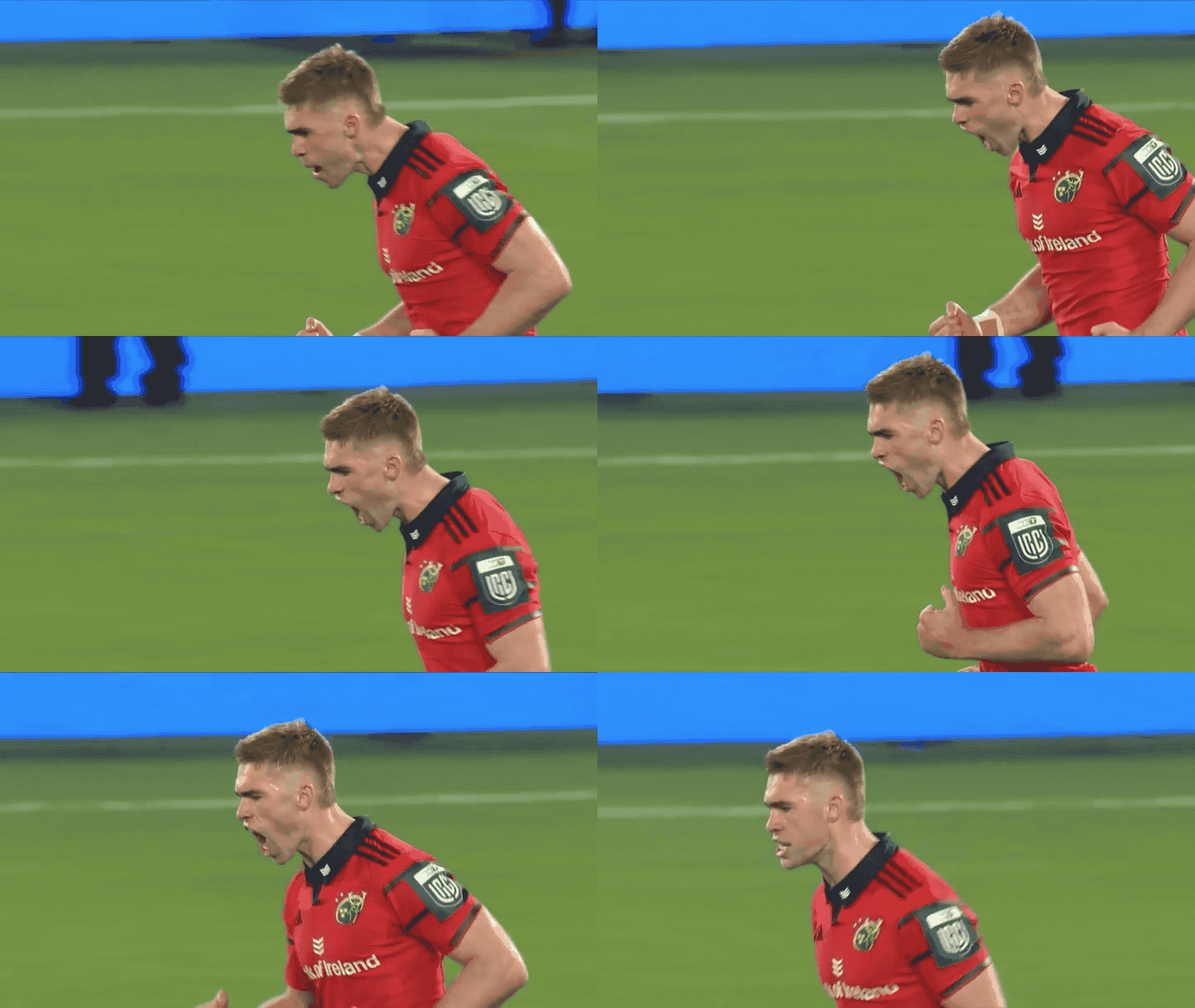

Cardiff are tricky.
More than tricky, they’re tough. I can’t remember the last easy game that we had against this lot.
We lost to them in the Arms Park last season, barely beat them 20-15 in Thomond Park two seasons ago, and lost to them in the Arms Park the season before that. The season before that, it was 27-21 in Cork on 60 minutes before some late scores from Craig Casey put a bit of gloss on the scoreline.
Before then, you need to go back to November 2019, right after the World Cup, over in the Arms Park for anything close to a routine win over the Blue & Black, and I think that reflects just how tough this team are to play against.
I wrote before the game that they were unlucky to miss out on the playoffs last year, and they showed exactly why in this incredibly close game that, honestly, could have gone either way all the way to the 72nd minute when a Jack Crowley drop goal stretched the lead to eight points. Without it, we’d have lost, and that’s a fact.
That somewhat nebulous metric — “we’d have lost that one last season” — is something of a catch-all, but I think it applies here. Last season, Munster were consistently bedevilled by good set-piece teams who kick at volume, win breakdown turnovers and only play off kick transitions or set-piece starter plays. Cardiff were all of that and more here, but we ground out a result without necessarily playing anywhere close to what we hope is our best this season.
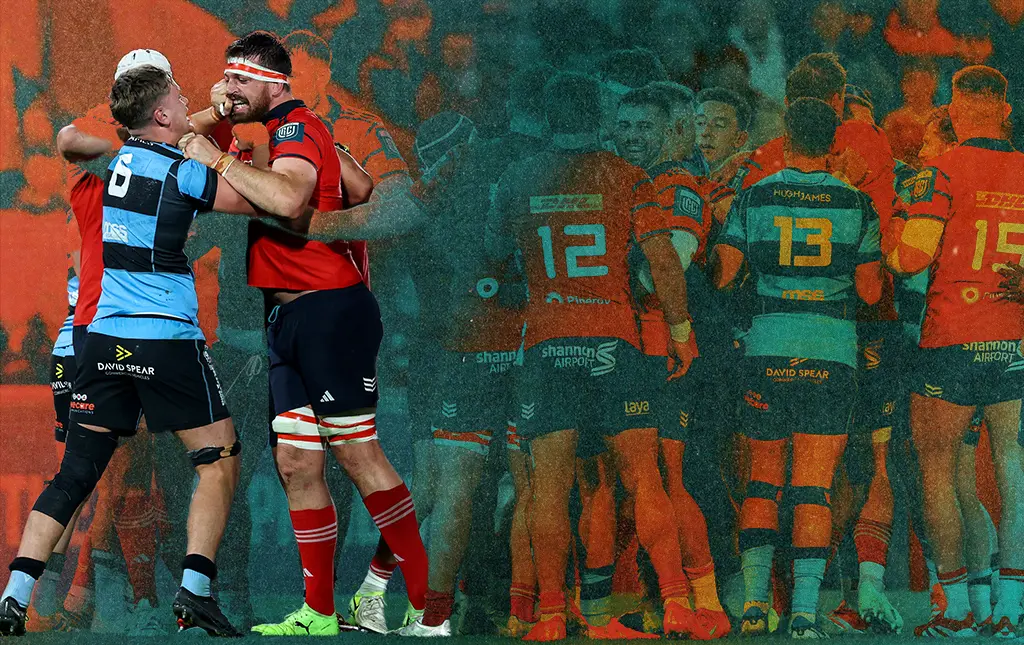
When you look back at the stats for this game, it’s remarkable how closely both sides resembled each other.
An almost identical pass-per-carry, kick-to-pass and ruck count, identical 22 entries, with territory and possession too close to be meaningful. The main difference was Cardiff’s ability to win turnovers — six to Munster’s one — and Munster’s superior lineout.
At a basic level, Cardiff’s defensive breakdown put them in a position to win this game.
Is there a “clear release” here? No, not for me. But that was the picture in the first half — Cardiff pushing their luck at the breakdown with a rookie referee and ARs, getting the reward and putting us back on our heels over and over again.
Does that mean that Sean O’Brien couldn’t have done better over the ball here? Absolutely not — this was a blown clean and he was first on the scene — but Cardiff were excellent at turning any gap between collision points into turnover ball.
I did feel that consistency was an issue on a few of them, though. You can’t tell me that Cardiff’s turnover here is a good steal, while Quinn’s is ruled as “no clear release”.
Whatever way I slice it, though, Cardiff had our number at the breakdown in the first half and probably tied that contest in the second.
In the first half, we were a little too wide in our carrying, and that width translated to isolated runners, lost collisions and scrappy breakdowns with too much time and space between contact and clean.
In the second half, we immediately tidied up our approach and started to run through some tight, penalty generating offence.
That’s 35 seconds long, but it showcases what we want in a situation like this, where there is no easy gainline — keep the ball, pressurise the defence, go back and forth if you need to and trap rolling defenders in for penalty advantage.
We have been shown, over and over again in the last few seasons, that this is winning rugby. It’s nice to see us take advantage.
Munster generated another penalty off the ensuing 5m play, and converted that on the second phase of a tap and go.
It can be that “easy”.
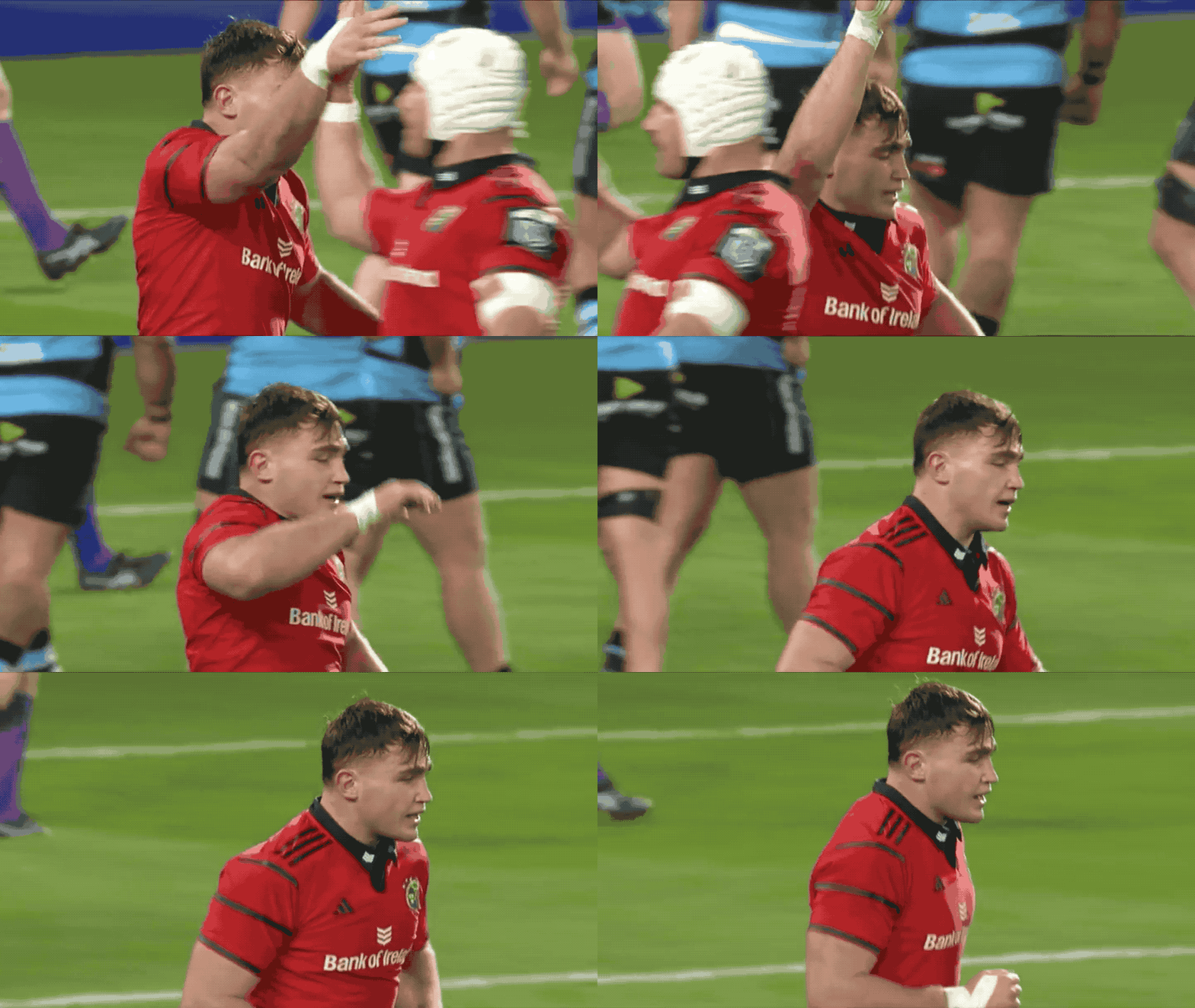
Munster won this game, for me, off the back of a superb lineout on both sides of the ball in difficult conditions. The addition of Alex Codling didn’t feel massively significant, as he was already in the building last season — Milne and Lee Barron had a similar feel — but he’s a critical addition to the coaching staff.
It isn’t as simple as simply increasing Munster’s lineout success rate, because you could arguably throw everything to two all season long, stay at 92%+ completion, but not really be able to do anything with your lineout possession. The key is to tighten the screws on every little detail that we do — on both sides of the throw.
Some of our lineouts were really, really sharp. On a blustery night with a greasy top on the pitch, this was my favourite.
This is the first game this season where we used Tom Ahern as the lineout dominant air raid system that he seems to have been born to play. At 6’9″ with a wingspan longer than a Ford Fiesta, Ahern is built like the perfect lineout forward.
In the Red Eye, I wrote the following;
Ideally, we’d contest the front and middle of the lineout heavily and show tail threats to push them off that 85.3% front/middle tendency — make them throw deep and use Ahern to spook their throwers.
We competed on every single Cardiff throw in the first half, so they were forced to go for the tail on their important ones.
This is a change in approach from last season that directly relates to a weakness in Cardiff’s game. They are weak at the tail of the lineout, so we conditioned them to give us the picture that we wanted.
When Tom Ahern snatched this one back from a Cardiff 5m lineout, it was the difference between winning and losing.
Ahern tortured that Cardiff lineout for the entire game.
But he’s not doing it all on his own either — you can see the extra sharpness in those counter-lifters detail, prep and their speed over the ground.
On the offensive side of the lineout, we ran at 88% on 17 lineouts, which is an excellent return, and while our maul didn’t make a ton of ground, it did soak multiple penalties out of Cardiff, who were a little fortunate not to concede a few more penalties for near constant side entries, as well as the usual craic of throwing jumpers into lifters, playing lads in the air and early engagements on counter-shove.
It was a really good performance on the back foot by Cardiff on the whole. They pushed the envelope with the referee and the poor assistant referees, in particular, and almost got the reward. What was really pleasing from a Munster perspective is that we adjusted at halftime and then consistently throughout the second half.
The ultimate adjustment came well into the last ten minutes when Munster set out on another long series of phases around the 22 against a big-hitting Cardiff defence — they had the second most dominant tackles in the world last season — and with no easy penalty snags to be found, or linebreaks, Jack Crowley dropped back and landed this drop goal to seal the game.
That’s the thing from your #10 in a moment like this; the right thing.
***
This was exactly the type of game that we’d have wanted after last week’s high gear victory over the Scarlets. There, almost everything went right early and often. Here was almost the opposite, and it felt like a game where we learned all the hard lessons of a loss, but with four points in the bag.
I think it underlined how important Shane Daly is to our backfield system. He went off with a concussion after just 9 minutes, and his replacement, Sean O’Brien, was really put under the blowtorch when it came to defending the edge space. Three of Cardiff’s four tries came down his wing, and while it’s absolutely not all on him, it felt like Cardiff were really going after him with Sheedy’s angle kicks into the space around him. Would Daly have done better? I think so, but we’ll never know for sure. I like O’Brien as a player, but I think he’s a 1B/2A midfield option now, and only on the wing in complete nuclear meltdown scenarios.
With two tries coming from some of the freakiest-looking juggle and kick work I’ve ever seen, it’s hard to know what to make of the defensive performance — how much of it was Cardiff getting every bounce possible against a back three with a massive speed imbalance and how much was down to systemic errors?
I think it’s a little bit of both, combined with some individual errors that you would hope are an aberration. That is something to watch, for the time being.
| Players | Rating |
|---|---|
| 1. Jeremy Loughman | ★★ |
| 2. Niall Scannell | ★★★ |
| 3. Oli Jager | ★★★★★ |
| 4. Jean Kleyn | ★★★★ |
| 5. Fineen Wycherley | ★★★★ |
| 6. Tom Ahern | ★★★★★ |
| 7. Ruadhan Quinn | ★★★★ |
| 8. Gavin Coombes | ★★★ |
| 9. Ethan Coughlan | ★★ |
| 10. Jack Crowley | ★★★★ |
| 11. Thaakir Abrahams | ★★★★ |
| 12. Alex Nankivell | ★★★★ |
| 13. Dan Kelly | ★★★★ |
| 14. Shane Daly | N/A |
| 15. Ben O'Connor | ★★★★ |
| 16. Diarmuid Barron | ★★★★ |
| 17. Josh Wycherley | ★★★ |
| 18. Ronan Foxe | ★★★ |
| 19. Jack O'Donoghue | ★★★★ |
| 20. Brian Gleeson | ★★★ |
| 21. Paddy Patterson | ★★ |
| 22. Tony Butler | N/A |
| 23. Sean O'Brien | ★ |
My top performers here were Oli Jager and Tom Ahern, with a number of strong performances from others.
Jager is looking in absolutely superb nick so far this season, and his physicality around the tight carry and in the scrum was really valuable here. His ruck work is incredibly strong, and when you combine that with his set-piece game, I think you have a player who’s right in line to get back into contention at test level with a bit of luck on the injury front.
That applies to Tom Ahern as much if not more.
This was arguably the most game-altering performance I’ve seen from Ahern in his career so far. Sure, he’s had big games and big moments within games before, but this was a complete package performance in the areas where he holds the most value. His work on the edges is certainly unicorn-tier, but when he’s used like he was here as the primary lineout target and disruptor, he can tear teams to pieces, and he did that to Cardiff again and again. They couldn’t get near him on our ball, and couldn’t get away from him fast enough on theirs.
This is the year of the Slim Reaper.
